


Charlie Ngo
•
Last updated: 7 October, 2026
Shopify Product Configurator: 2D vs 3D, Best Apps & Costs (2026)
Shoppers hesitate to buy a $1,200 sofa or a custom ring when they can’t see the exact version they’re...
![[2026] Shopify Instant Checkout: ChatGPT, Shop Pay & Buy Now Button](https://bogos.io/wp-content/uploads/2026/07/Shopify-instant-checkout.jpg)
[2026] Shopify Instant Checkout: ChatGPT, Shop Pay & Buy Now Button

Marketing Manager
Summarize this post with AI
Shopify instant checkout means three different things, and the most important one changed in 2026. It can mean buying through ChatGPT, one-tap checkout with Shop Pay, or a “Buy it now” button that skips the cart. This guide explains all three in plain English, starting with ChatGPT, and shows you what to set up today. I’m Charlie – BOGOS’s Marketing Manager, and I work with Shopify merchants on promotions and checkout every day.
Shopify instant checkout is any feature that lets a shopper buy faster by removing a step. The term covers three separate tools, and people use it to mean any of them.
This guide covers all three. It starts with ChatGPT, because that is the version that changed most in 2026 and the version most merchants are searching for.
Shopping discovery is moving into AI conversations, so where and how fast people can buy is changing. More than 700 million people use ChatGPT each week, and many of them ask it for product recommendations before they ever open a search engine, according to OpenAI.
That shift is why Shopify made every eligible store discoverable across AI channels by default. It is a large bet on AI-driven shopping as a real sales channel, which you can read more about in our guide to agentic commerce.
Checkout length matters once a shopper reaches your store, and a shorter checkout lifts conversion. Nearly one in five United States shoppers abandon a purchase because the checkout is too long or complicated, according to Baymard Institute. Cutting steps reverses that. Shopify reports that its one-tap accelerated checkout, Shop Pay, lifts conversion by an average of 9% across all checkouts and by 18% for returning customers, based on its own data.
Both goals, being found in AI and checking out in fewer steps, feed the same outcome: more completed sales. Our overview of boosting shopify sales puts these levers in one place.
The ChatGPT story has a clear before and after, and the change matters because most articles online still describe the old version. One event splits the timeline: Shopify’s move to agentic storefronts in early 2026. Everything before it worked one way. Everything after it works another.
Instant Checkout in ChatGPT started as a checkout you completed inside the chat. On September 29, 2025, Shopify and OpenAI announced commerce in ChatGPT, as Shopify shared in its newsroom. OpenAI launched Instant Checkout, powered by a new standard called the Agentic Commerce Protocol, built with Stripe.
In this first version, the shopper never left the chat and never filled out a store checkout form. ChatGPT already held their shipping and payment details, so they confirmed the order and tapped to buy. It started with Etsy sellers and single-item purchases, with more than one million Shopify merchants named as coming, including Glossier, SKIMS, Spanx, and Vuori, per OpenAI.
This old model charged merchants a small fee on completed purchases, as OpenAI described. Trade press reported that fee at around 4%. That detail matters only as history now, because the fee applied to the in-chat model that Shopify has since replaced. If you read an article that still lists a 4% ChatGPT fee, it is describing this old version.
By early 2026, OpenAI began scaling back the in-chat checkout. An OpenAI spokesperson said Instant Checkout was moving to Apps and that the focus was shifting to product discovery, reported by Modern Retail. That change led straight to the model you use today. For the wider background on selling in AI chat, see our guide to Shopify ChatGPT.
Today, ChatGPT is a discovery channel, not an in-chat checkout. Shoppers find your products in ChatGPT and complete the purchase on your own store checkout. On mobile, this opens in an in-app browser. On desktop, it opens in a new tab, according to Shopify’s Help Center.
This changes the flow for the shopper. In the old model, they confirmed and bought inside the chat, with no store form to fill. Now they finish on your checkout. A first-time shopper enters their details the normal way. A returning shopper autofills them if they already use Shop Pay or have an account with you.
Shopify introduced this model as Agentic Storefronts in its Winter ’26 Edition in December 2025, announced in its newsroom. It then activated the ChatGPT channel by default for eligible United States stores in March 2026, as Shopify confirmed.
Three facts about the current model matter most for your business:
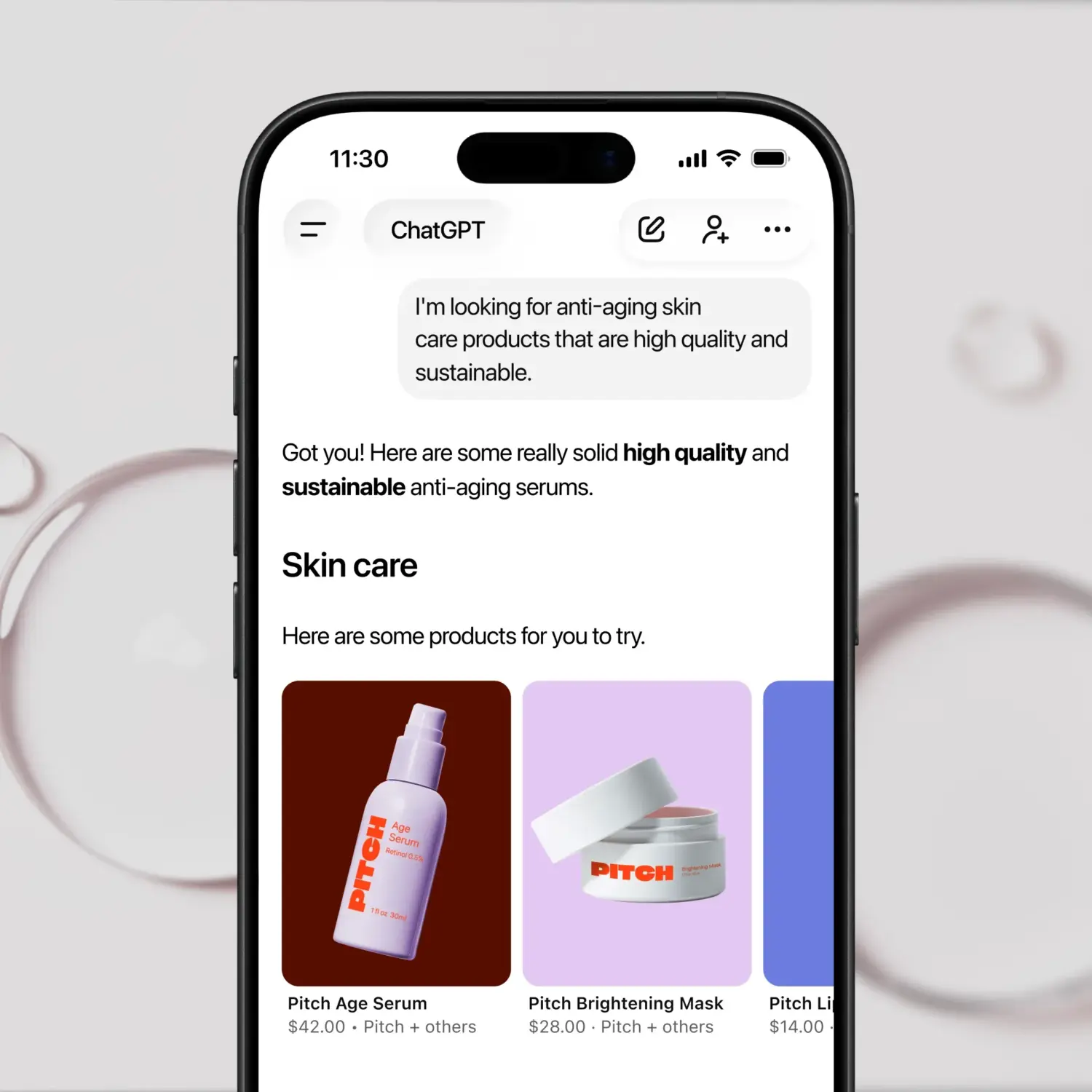
Here is the before and after in one view:
| Feature | Before March 2026 (in-chat Instant Checkout) | After March 2026 (agentic storefronts) |
|---|---|---|
| Where checkout happens | Inside the ChatGPT chat | Your own store checkout |
| Added fees | A small fee on completed purchases (reported near 4%) | None beyond standard processing |
| Merchant of record | Merchant | Merchant |
| Setup | Apply and integrate | On by default for eligible stores |
| Availability | Etsy first, single items | Eligible United States Shopify stores |
The current model has a clear benefit for anyone who cares about order size. Because the sale finishes on your own checkout, the offers you run there still apply. We return to that point in the average order value section below.
For most eligible stores, ChatGPT selling is already on. The agentic storefront is active by default, so your first job is to check your settings, not to build anything, per Shopify’s Help Center. The steps below walk through what to confirm, and our guide to Agentic Commerce covers how AI channels fit your wider strategy.
Your store must meet a short list of requirements to appear in ChatGPT:
Once you meet those, confirm the channel in your admin:
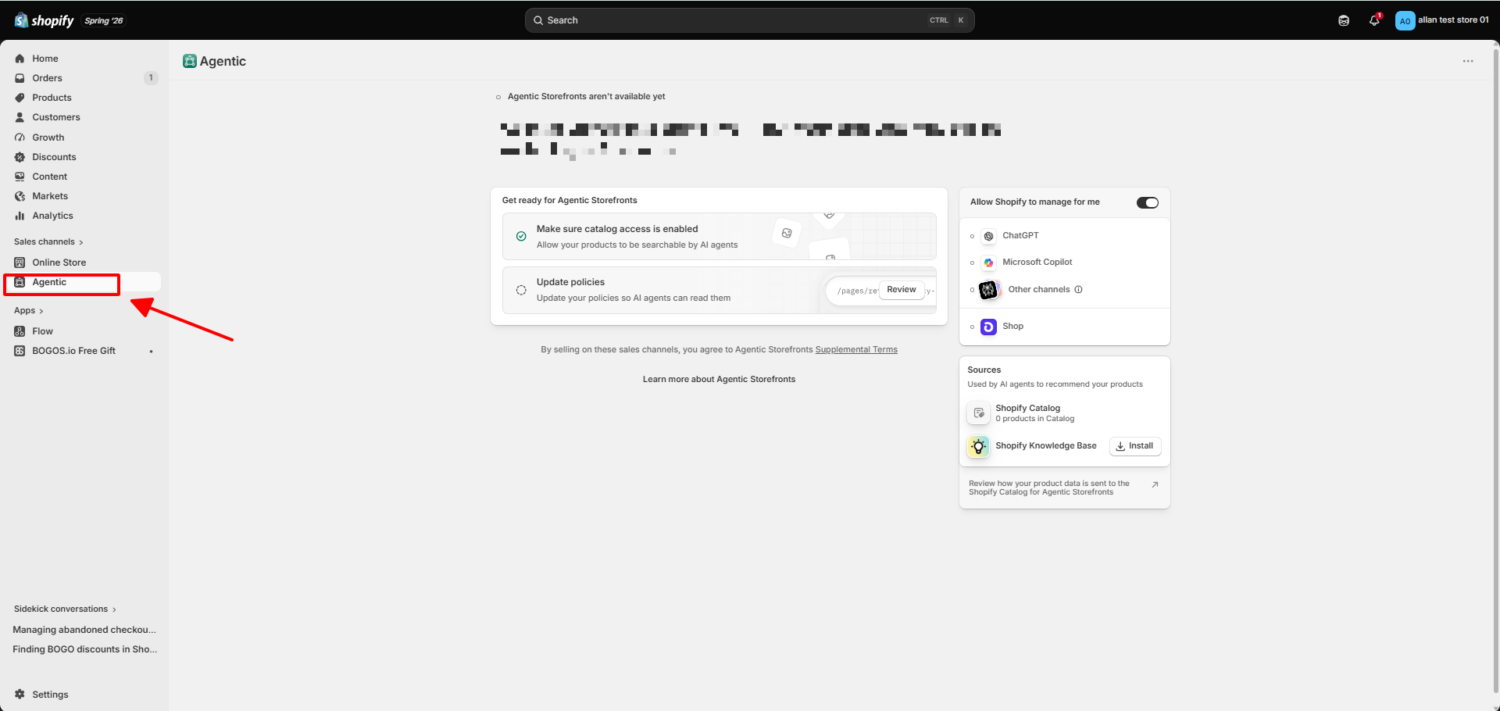
Two extra rules are worth knowing. Put any required legal disclosures in the first 6,000 characters of your product description. Products sold only to businesses are not supported in agentic storefronts, according to Shopify’s Help Center.
Being connected is not the same as being visible. ChatGPT reads your product data to decide what to show, so clean data is what gets you recommended.
Focus on four things:
The pattern is simple: write for a shopper describing a need, not for a keyword. “Waterproof hiking boots for wide feet” beats a vague title every time.
You can remove your products from the ChatGPT channel if you need to. In your admin, go to Sales channels, then Agentic, and turn off Shopify Catalog access for the channel. Shopify notes it can take up to seven days for your product data to stop being shared, per its Help Center.
Think carefully before you do. Opting out removes you from a fast-growing channel while your competitors stay visible. For most stores, staying in and improving product data is the stronger move.
Instant checkout also lives on your own store, and here it means checking out faster once a shopper is already on your site. Two tools do this, and they work in different ways. One removes typing. The other removes a step.
Speed matters here because most carts never convert. The average cart abandonment rate is 70.22%, according to Baymard Institute. A slow or complicated checkout is one of the top reasons shoppers leave, so cutting friction protects real revenue. Our guide to checkout optimization goes deeper on that, and conversion rate optimization covers the full path from visit to sale.
Shop Pay is the fastest instant checkout on your own store. It stores a shopper’s email, shipping address, and payment details across the whole Shopify network. A returning shopper then pays in one tap, because everything fills in for them.
Shopify reports strong results from this. In a study by a large management consulting firm, Shop Pay lifted conversion by up to 50% versus guest checkout, outpaced other accelerated checkouts by at least 10%, and lifted lower-funnel conversion by about 5% just by being present, according to Shopify. Shopify also describes Shop Pay as roughly four times faster than guest checkout, with its buyer network at more than 200 million shoppers, per Shopify.
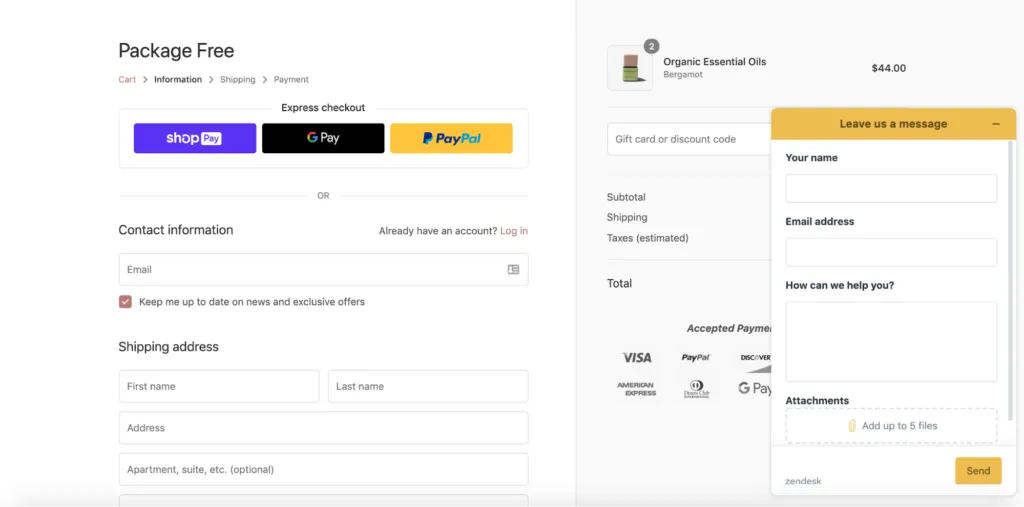
The speed comes from recognizing a known shopper, so the benefit lands most on returning and repeat buyers. Shop Pay is free to enable. You set up Shopify Payments, and you pay your standard processing rate, the same rate a guest checkout order would cost.
A “Buy it now” button skips the cart instead of requiring typing. This is Shopify’s dynamic checkout button. It sits next to “Add to cart” on the product page. When a shopper clicks it, they bypass the cart and go straight to checkout with that one product, as Shopify explains.
There are two kinds:
Which branded buttons appear depends on the payment methods you have turned on, according to Shopify’s Help Center.
This is the clean difference to keep in mind. “Buy it now” removes a page. Shop Pay removes the form. They are not either-or, and many stores run both.
You can add this button two ways:
One caution applies to every skip-the-cart tool. When a shopper jumps past the cart, they also jump past your cart offers. That is the trade-off we cover next.
Instant checkout has one cost worth planning for. Any tool that skips the cart also skips your cart-page offers, such as free-gift thresholds, bundles, and cross-sells. Skip the cart, and you skip those for that sale.
Skipping the cart does not have to cost you order value. Two offer points survive an instant checkout, and you can use either one:
The ChatGPT change helps here too. Agentic storefronts send AI shoppers to your own checkout, so both upsell points, and your other on-store offers, still apply to those orders. You gain new buyers without losing your tools to grow each order.
This is where our app fits, as one honest option among several. BOGOS runs both of those upsell points, so a store using instant checkout can still grow the order after the cart is skipped.
You control how the upsell shows:
The app runs other promotions too, from free gifts with purchase and bundles to frequently bought together offers and volume discounts, so you can keep building order value on the product and cart pages when you keep the cart step in play. Our guide to Shopify AOV covers the full picture.
Shopify instant checkout comes down to three tools and one big shift. The three tools are ChatGPT selling, Shop Pay, and the “Buy it now” button. The shift is that ChatGPT is now a discovery channel that sends buyers to your own checkout, with no added fees, rather than an in-chat purchase.
The practical takeaway is short. Stay discoverable in AI channels by keeping your product data clean. Make your on-store checkout fast with Shop Pay. Protect your average order value while you do both, since speed should not cost you basket size. Handled together, instant checkout brings in more buyers and helps each one buy more, a goal that sits at the center of conversion rate optimization and every strong Shopify store.
Yes, in the ways that matter. Selling through the ChatGPT agentic storefront has no added fees beyond your standard payment processing, per Shopify’s Help Center. Shop Pay is free to enable, and you pay your normal Shopify Payments rate. The old in-chat ChatGPT model did charge a small merchant fee, but that model no longer applies.
No. ChatGPT sends shoppers to your own checkout to finish the purchase, so your checkout, branding, and payment methods stay in place. Shop Pay and the “Buy it now” button are options added on top of your existing checkout, not replacements for it. Your other checkout choices, from guest checkout to a one-page checkout layout, keep working as before.
Yes. Tools like Shop Pay store payment details using tokenization, which replaces card numbers with a stand-in code, and verify shoppers by email or text. Saved details reduce typing without exposing raw card data, which is part of why these checkouts both speed up and protect the purchase.

Shoppers hesitate to buy a $1,200 sofa or a custom ring when they can’t see the exact version they’re...
Selling personalized products on Shopify gets hard the moment a shopper needs to type a name or choose a...
The UK is the largest eCommerce market in Europe and the third-largest in the world. For international Shopify stores,...