


Charlie Ngo
•
Last updated: 20 October, 2026
Shopify Collections: How To Create & Organize Them (2026)
Shopify collections decide how shoppers find your products, yet many guides still describe a setup Shopify is now replacing....
How to Write a Shopify Return Policy (+ Free Template)

Marketing Manager
Summarize this post with AI
Most Shopify merchants write their return policy once, paste in whatever template they find first, and never look at it again. Shoppers treat that same page very differently. They read it before they buy. A clear policy tells them the purchase is safe. A vague or costly one sends them to a competitor.
This guide shows you what to put in your Shopify return policy, a template you can copy today, how to add and automate it in a few clicks, and real examples from Shopify stores worth learning from.
A Shopify return policy is the set of rules for sending items back. It defines your return window, item condition, who pays return shipping, and how refunds work. It also tells Shopify which returns to approve automatically through return rules.
About 48% of US online shoppers returned at least one item in the past 12 months. According to Statista Consumer Insights, the most returned categories depend on size and fit: clothing (25%), shoes (17%), and accessories (12%).
So your return policy is not just a post-purchase document. Shoppers read it before they buy, and it shapes whether they check out at all. Shoppers want fast refunds and clear rules. Vague or strict policies create friction and push shoppers toward abandoned carts.
Cost is the fastest way to lose them. In the NRF and Happy Returns 2025 study, 82% of shoppers said free returns matter when they decide where to buy. Get it wrong, and the damage outlasts the sale. The same study found 57% of shoppers will not buy from a retailer again after being charged for a return, a sharp jump from 40% in 2024.
Your policy works like social proof. It is a promise customers weigh before they trust you with an order. Next, I’ll walk through the seven parts every Shopify return policy needs.
A strong return policy answers every question a shopper has before they buy and after they change their mind. Leave a gap, and customers fill it with doubt.
The best-known policies prove that clarity matters more than length. Apple gives you 14 days and spells out the condition items must be in. Nike gives you 60 days and even lets you return gear you have worn and tested, with a short list of exceptions. One window is tight, and one is generous. Both work because neither leaves the customer guessing.
Cover these 7 parts and your policy will be just as clear.
| Element | What to define | Typical example |
|---|---|---|
| Return window | Days from delivery to request a return | 14, 30, or 60 days |
| Item condition & proof of purchase | Condition items must be in, and proof required | Unworn, tags on, original packaging, order number |
| Non-returnable or final-sale items | Products excluded from returns | Clearance, perishables, intimates, custom items |
| Return shipping responsibility | Who pays return shipping, and exceptions | Free on our error, customer-paid on change of mind |
| Refund method | How refunds are issued, and how long they take | Original payment or store credit |
| Exchange policy | What you offer instead of a cash refund | Another size, color, or only receive store credit |
| Return process | The steps and where to get help | Log in, open order, select Request return, or email support |
The good news is that you do not have to write a policy from scratch. In your admin, go to Settings -> Policies, find the return and refund policy section, and click Insert template.
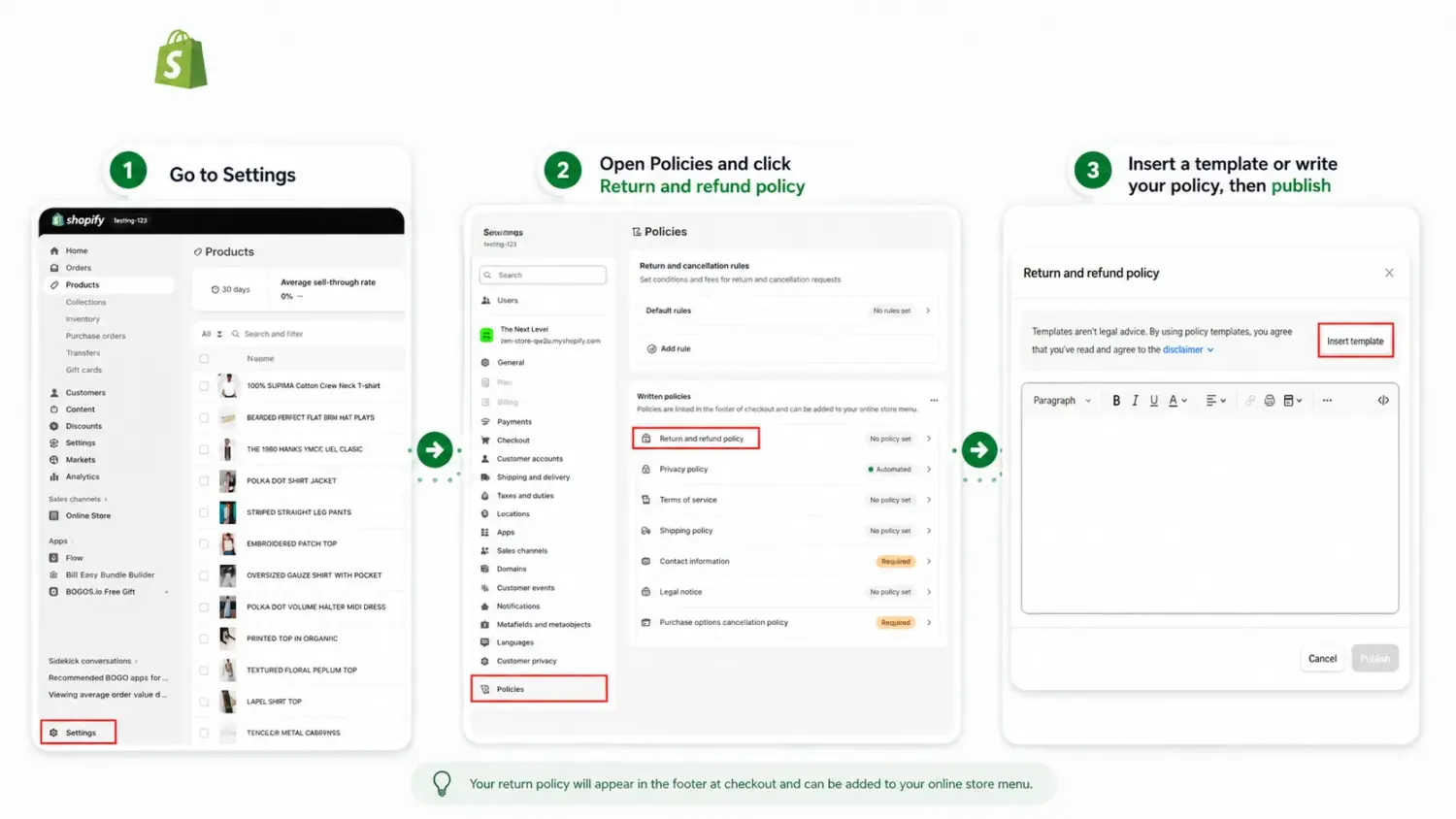
Shopify drops in a standard policy you then edit with your real details. Prefer a form-guided version you can prepare outside your admin? Shopify’s free return policy generator emails you a custom draft based on a few questions.
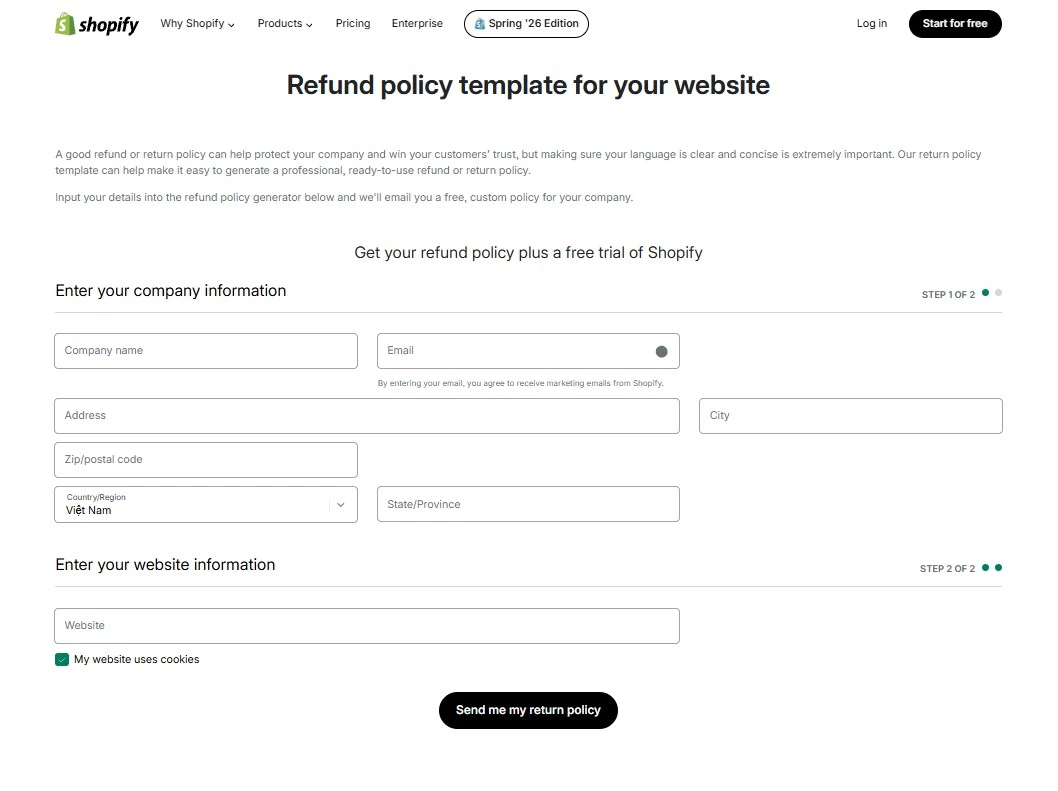
Two limits to know. The generated template is a starting point, so read it carefully before you publish. And it does not pull in the return rules you set up in Shopify, so the words in your policy and the rules in your settings must match by hand.
If you want to start on your own, here is a simple return and refund policy template. Replace the bracketed text with your details.
Writing the policy is only half the job. Shoppers need to find it before they buy, not hunt for it after. Once you save your policy in Settings > Policies, Shopify automatically links it in your checkout footer and on the order status page. The step below puts it everywhere else shoppers look, like your product page:
Step-by-step guide to add return policy to your Shopify home page
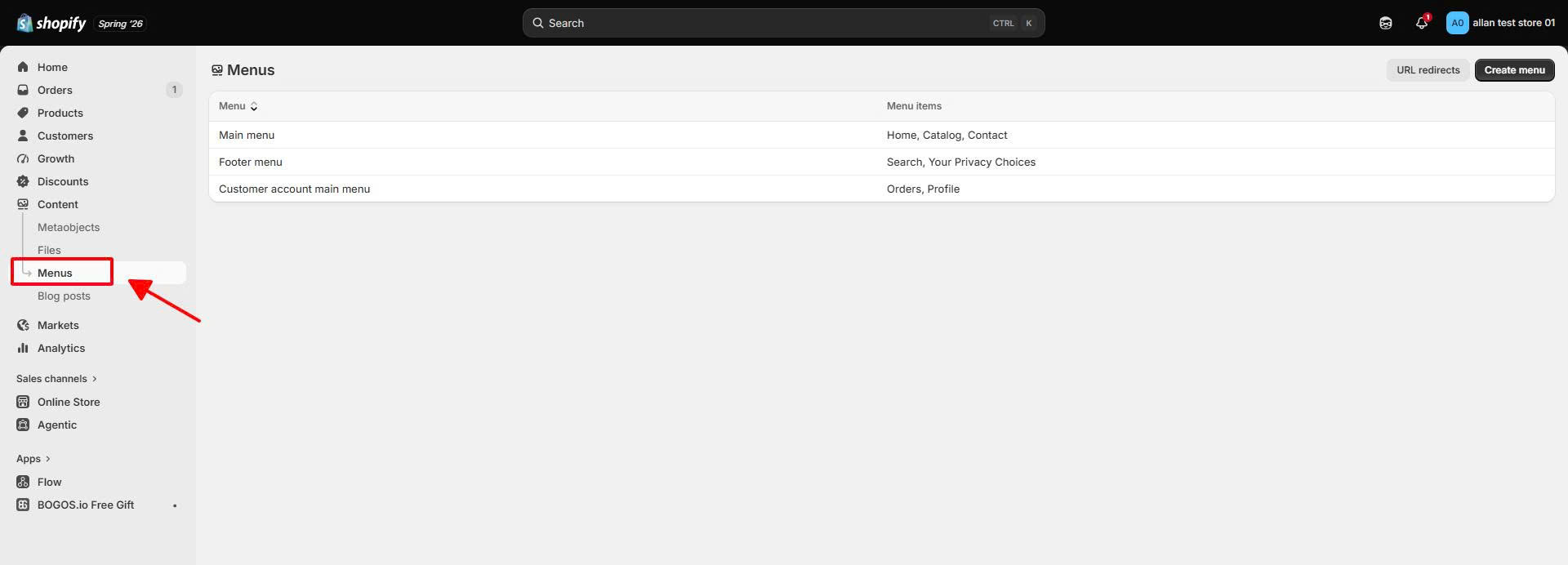
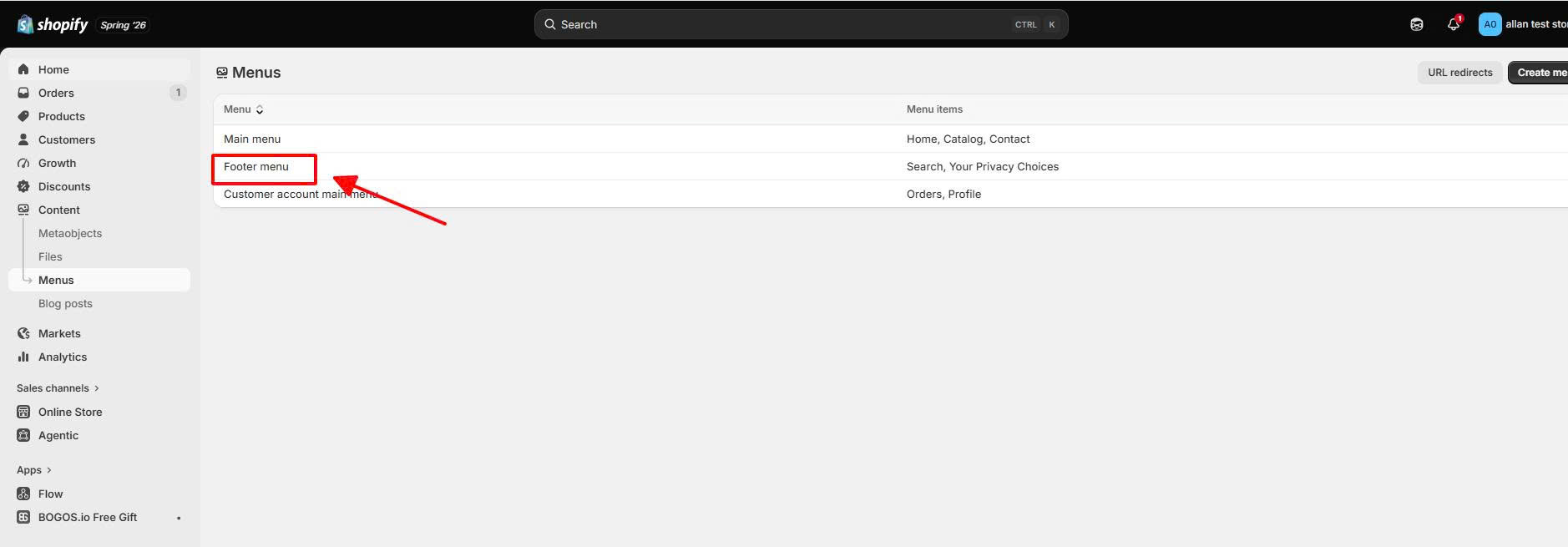
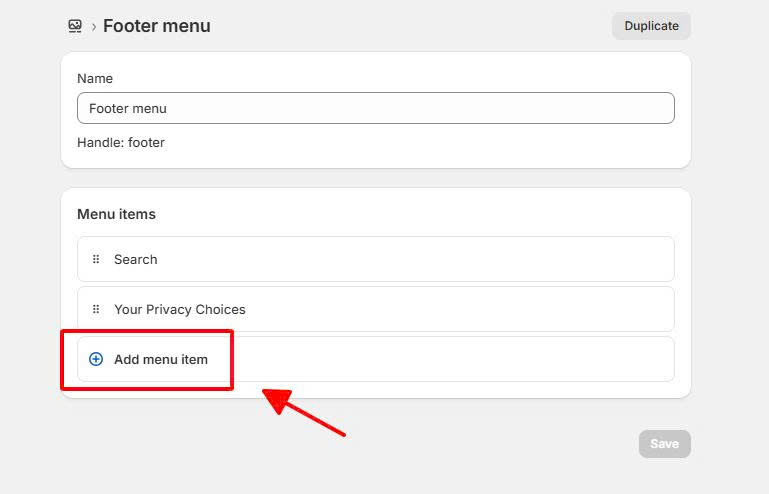
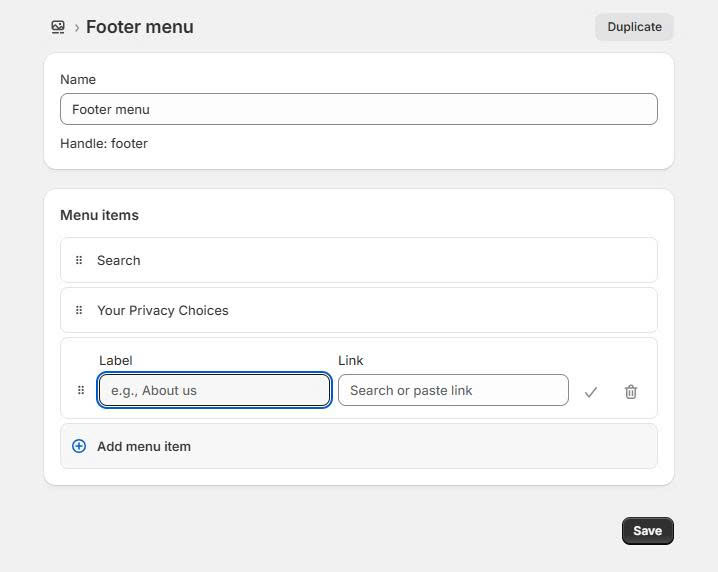
You can also link straight to it. The direct URL is your store domain followed by “/policies/refund-policy“. Use it on product pages, in order confirmation emails, or in your help center.
Adding the link makes your policy visible. These three settings make it run itself. Turn them on, and Shopify handles the requests, enforces your rules, and applies the right terms per market. You stop reviewing returns by hand.
Self-serve returns let customers request a return themselves, without emailing you first. You still approve every request.
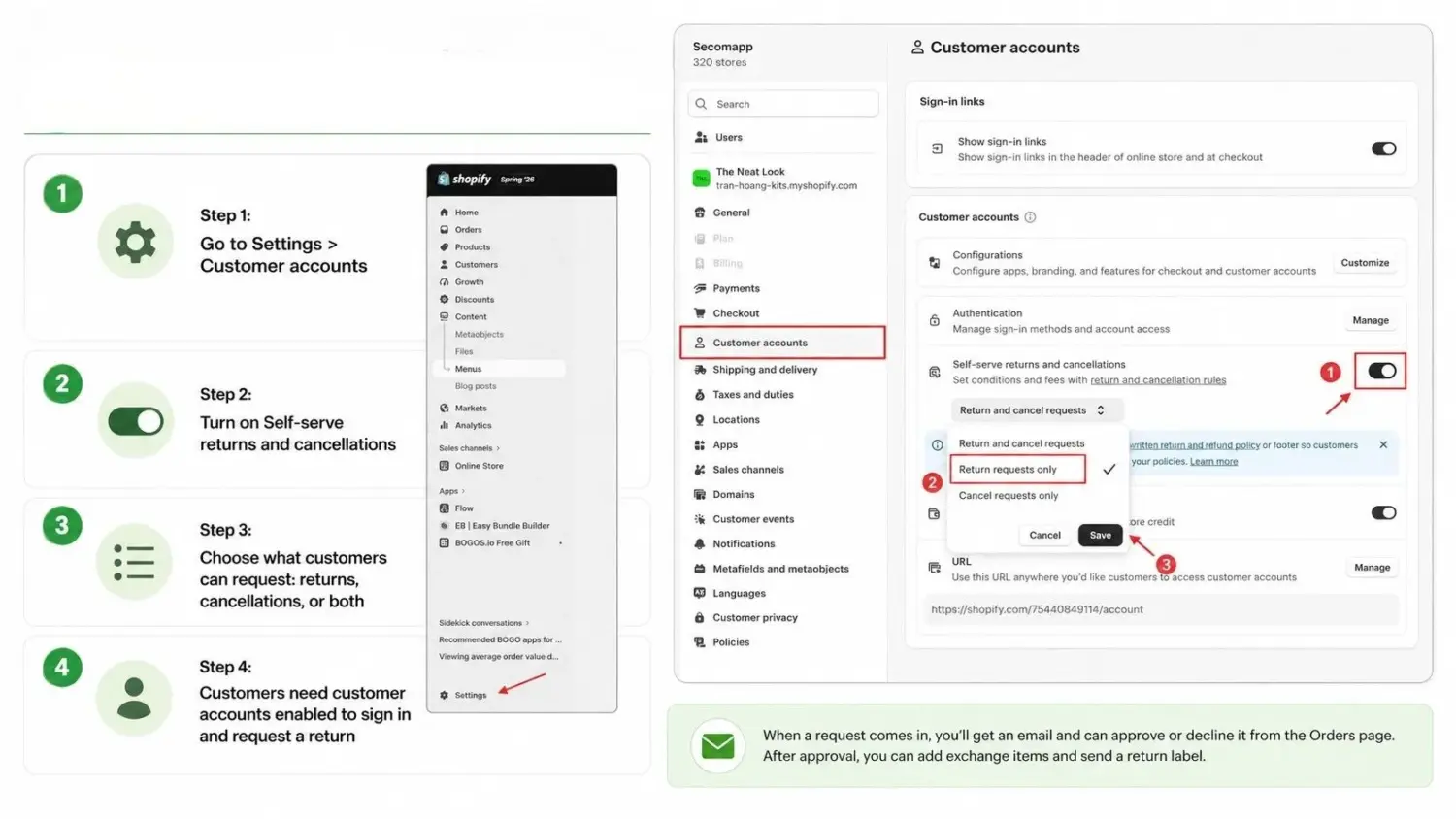
Customers can now request returns from their account. When a request comes in, you get an email, and you approve or decline it from the Orders page. On approval, you can add exchange items and send a return label.
⚠️ One note: customers need access to customer accounts to sign in and request a return, so make sure that is enabled.
This is the setting that automates your policy. Return rules tell Shopify which requests to allow, so customers can only start returns that qualify.
Shopify then shows each customer an estimated refund and blocks requests that fall outside the rules. Return rules also apply when you process returns manually, even if self-serve returns is off.
Keep the settings and your written policy in sync. If they disagree, customers get confused, and you get disputes.
If you sell in more than one country, you can set different return rules per market. This matters because return laws differ by region, which we cover below. Set your default rules first, then add market-specific exceptions where you need them.
A return is not the end of the relationship. Handled well, it is the start of the next sale.
The proof is in the numbers. According to Narvar’s State of Returns survey, 96% of shoppers would buy again from a store that made returns easy. NRF echoes this, describing returns as no longer the end of a transaction, but a chance to build loyalty. The customer already trusted you once. A smooth return keeps that door open.
You can go one step further. Tag customers who make a return, then offer that group an exclusive discount on their next order. A small, well-timed offer now turns a refund into a reason to come back, buy again, and stick around.
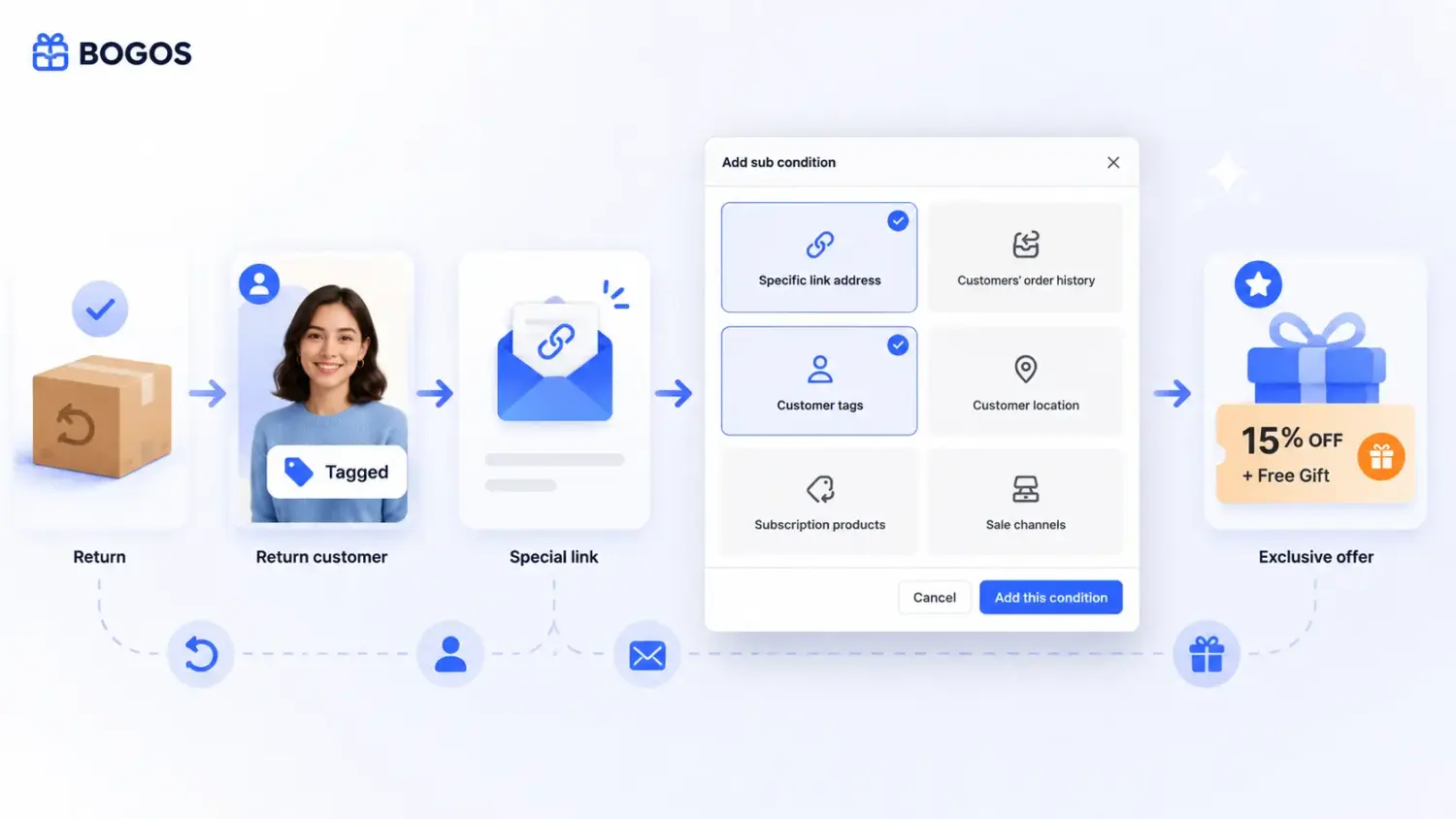
This is where our app, BOGOS, fits. It lets you set up these offers with deep targeting rules, so the right shoppers see the right deal. You can trigger an exclusive discount or a gift with purchase by customer tag, or by a specific link you send in your return follow-up email.
A strong return policy does two things: matches your product’s return risk and explains the rules clearly. When shoppers know what to expect, they buy with more confidence and fewer surprises. Here are three Shopify stores that get it right.
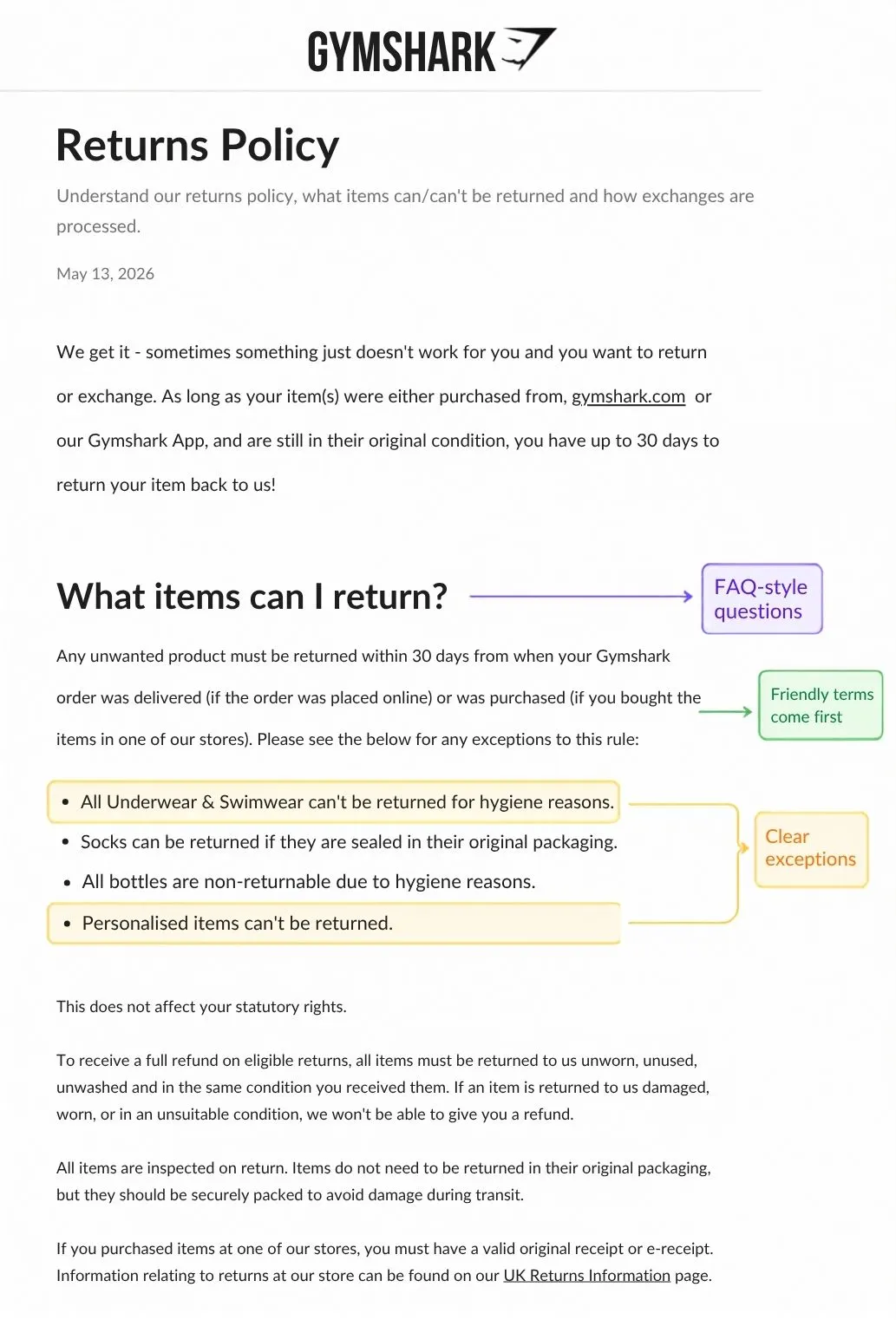
The policy: Gymshark’s return policy gives customers 30 days to return items, whether they buy online or in store. Items must be unworn, unwashed, and still have the care label attached.
Some items are excluded, including underwear, swimwear, and personalized products. In the US and Canada, items discounted by 60% or more are final sale. Refunds go back to the original payment method.
What they got right:
The takeaway
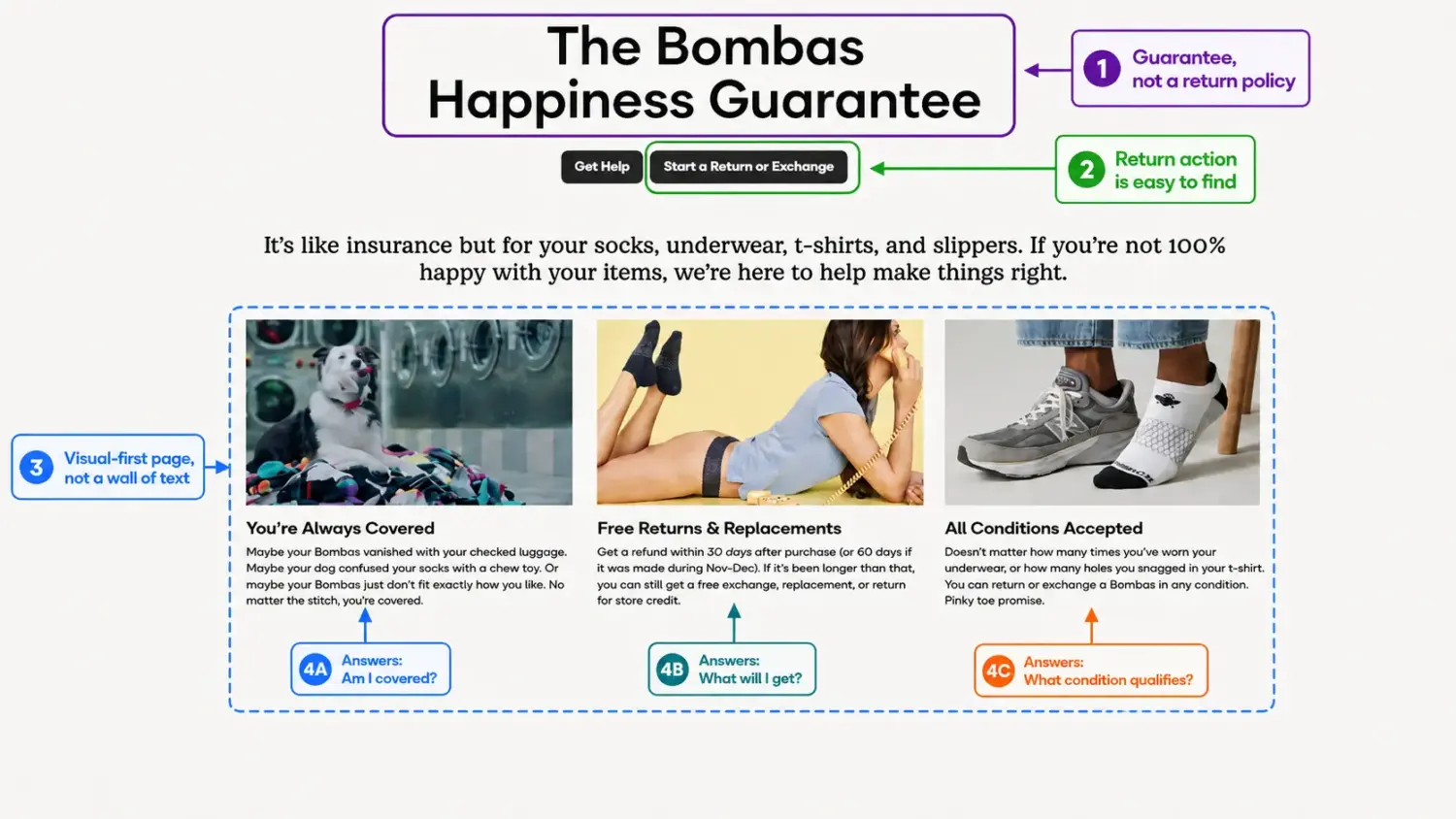
The policy: Bombas does not call it a return policy. They call it the Happiness Guarantee, and customers are covered for any reason.
Within 30 days, customers get free returns or replacements for a full refund. Over the holidays, the window extends to 60 days. After that, Bombas still offers a free exchange, replacement, or store credit. Items come back in any condition, even worn or damaged.
Why it works
The takeaway
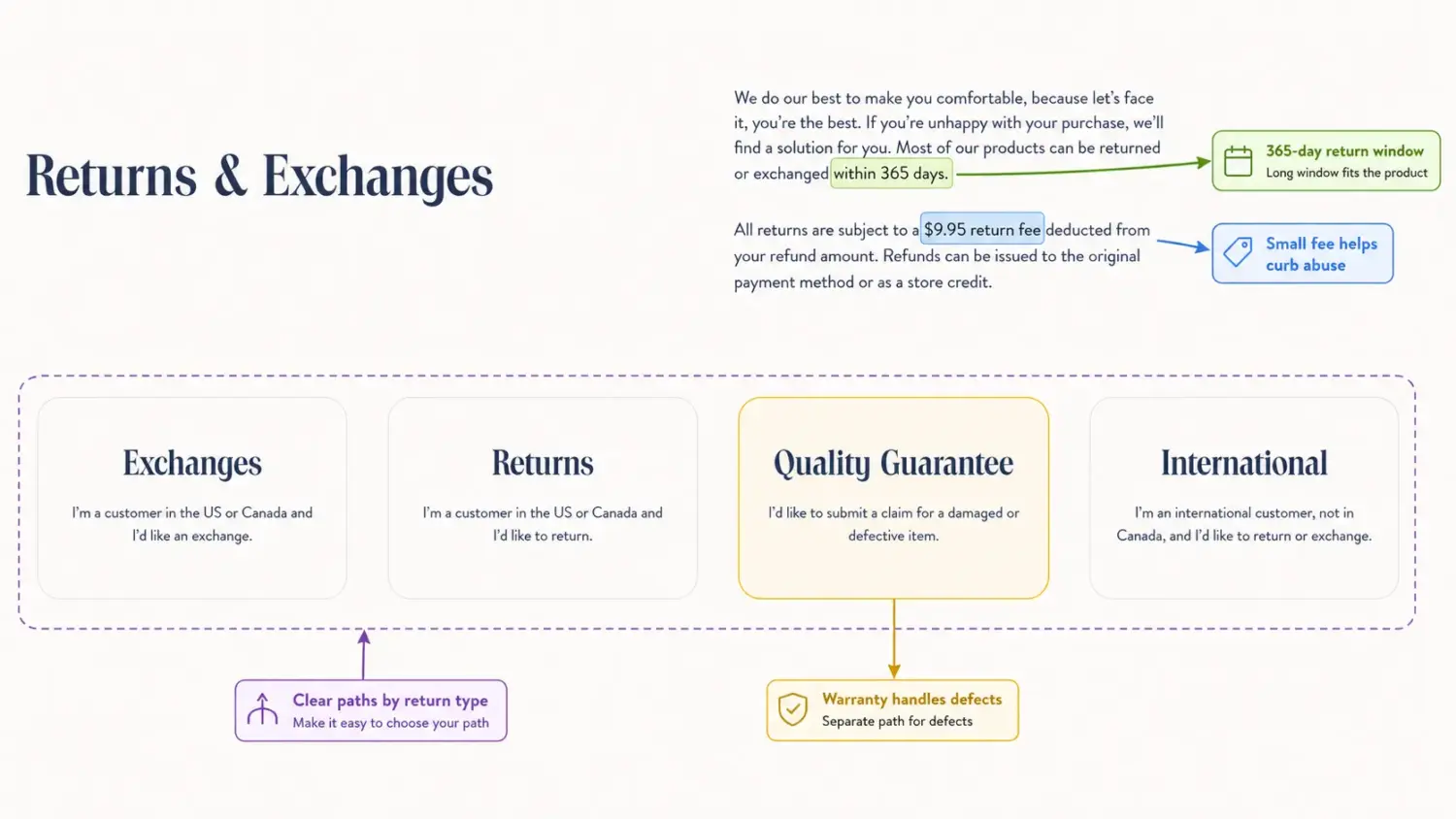
The policy: Brooklinen, a home and bedding brand, accepts most returns for up to 365 days. Refunds go back to the original payment method or store credit, minus a flat $9.95 return fee.
Core products also come with a warranty for defects. Last Call items are final sale.
Why it works
The takeaway
Return laws change by market, and the US and EU sit far apart. This is a general overview, not legal advice. Check the rules for the markets you sell into, or ask a local expert.
The rules below are drawn from official sources: the FTC and FindLaw for the United States, the European Commission for the EU and UK, and the Shopify Help Center for the upcoming EU directive.
| Question | United States | EU and UK |
|---|---|---|
| Do you have to accept returns? | Usually no. Returns are mostly up to the store, except when an item is defective. | Yes for online orders. Customers usually have a 14-day right to cancel for any reason. |
| Do you need to post a return policy? | 12 states require it. If you do not post one, a default return window may apply, often around 30 days. | Yes. You must tell customers about their cancellation rights before they buy. |
| Is there a cooling-off period? | Limited. It usually applies to door-to-door or similar sales, not standard online purchases. | Yes. Customers normally get 14 days, starting from the delivery of the last item. |
| What about defective items? | Defective items are covered no matter what your return policy says. | Defective items are covered too, in addition to the 14-day cancellation right. |
If you sell into the EU, put June 19, 2026 on your calendar. You can meet it in Shopify by turning on self-serve returns and cancellations.
Your return policy is not paperwork. It is one of the first things shoppers check and one of the last reasons they hesitate. Get it right, and it quietly lifts your conversion rate on every product page.
The formula is simple. Cover the seven core parts so nothing is left to guesswork. Match your window and conditions to your product’s real return risk, the way Gymshark, Bombas, and Brooklinen each do. Be generous where it wins the sale, and precise where it protects your margin.
Not federally in the US. Returns are mostly your choice there, except for defective items, though about 12 states require you to post a policy.
If you sell to the EU or UK, customers have a 14-day right to cancel most online orders, so a clear policy is effectively required. See the laws section above for details.
Yes, where it is disclosed clearly, and local law allows it.
Subscriptions are separate from one-time orders. In Shopify, your standard return policy covers physical products, but a subscription also involves a recurring contract the customer can cancel.
For most small and mid-size stores, Shopify’s built-in self-serve returns and return rules are enough.
Consider an app once return volume grows or you want exchange-first flows that retain revenue. Three worth looking at: AfterShip Returns & Exchanges, ReturnGO, and Loop Returns.
It depends on your product, not a universal number. Research shows a longer window can actually lower returns, because urgency fades and impulse returns drop. Match the window to how long your product takes to judge.

Shopify collections decide how shoppers find your products, yet many guides still describe a setup Shopify is now replacing....
A Shopify announcement bar is the thin strip at the top of your store that tells shoppers about shipping,...

Australia is one of the first markets many Shopify stores expand into. It is large, English-speaking, and home to...