


Charlie Ngo
•
Last updated: 2 October, 2026
Shopify Post Purchase Survey: 5 Best Apps & Tips (2026)
A Shopify post purchase survey asks buyers 1–3 questions right after checkout, while the order is still fresh in...
Shopify Shipping To The UK: The Complete 2026 Guide (VAT, Customs & Rates)

Marketing Manager
Summarize this post with AI
The UK is the largest eCommerce market in Europe and the third-largest in the world. For international Shopify stores, the UK can be a valuable market to expand into.
But shipping to the UK involves more than the usual process of adding a new shipping zone. You need to understand UK VAT, especially the £135 rule, which determines when VAT is collected. You also need to use the correct HS code, a product classification number used by customs. A missing or incorrect HS code can delay your shipment.
This guide covers it all. You’ll learn how to set up Shopify shipping to the UK from start to finish, including shipping rates, VAT, customs, and duties. I’m Charlie Ngo, an eCommerce expert at BOGOS with 11 years of experience helping Shopify stores increase sales, AOV, and conversion, including many that sell to UK customers.
To ship to the UK with Shopify, you need to complete a few key steps. First, add the UK as a market or shipping zone and set your shipping rates. Then, handle UK VAT requirements, add customs information to your products, and configure duties and import taxes.
This is the self-managed route. If you do not want to register for UK VAT yourself, Shopify Managed Markets can handle VAT, duties, and customs through Global-e.
Otherwise, follow these seven steps.
For newer Shopify stores, go to Settings → Markets and add a market that includes the United Kingdom. Markets let you manage settings such as currency, language, duties, and shipping.
Older stores may manage the UK through a shipping profile under Settings → Shipping and delivery. Make sure the UK is part of an active market. Otherwise, UK customers may not be able to check out even if you have created a shipping rate
In your UK market or shipping zone, select Add shipping option and choose the rate type that works best for your store. Common options include:
For a detailed breakdown of each rate type, check out our complete guide to Shopify shipping rates.
The £135 threshold determines how VAT is collected when you ship to UK customers:
The £135 threshold applies to the whole consignment, not each product. Once you have a UK VAT number, add it under Settings → Taxes and duties in Shopify.
Note: Today, imports worth £135 or less are generally exempt from customs duty, although VAT still applies. The UK government has confirmed that this customs duty relief will be removed, meaning these low-value imports will also become subject to customs duty under new arrangements. The reform will take effect by March 2029 at the latest. For now, the current rules still apply. (HMRC, July 2026)
Adding an HS code and country of origin to each product helps customs identify your goods, calculate the correct duties, and clear your shipment without unnecessary delays.
You can add this information from the product page under Shipping or update multiple products using a CSV file.
You also need an EORI number (Economic Operators Registration and Identification), a unique ID customs uses to identify businesses that import or export goods.
Collecting duties and import taxes at checkout gives customers a clear final price and avoids unexpected fees upon delivery. This works through DDP (Delivered Duty Paid), which means import duties and taxes are calculated and paid upfront at checkout instead of when the order arrives.
Note: Shopify charges a 0.5% transaction fee on orders where duties and import taxes are calculated at checkout.
#1. Choose your carrier
Choose an international carrier that offers reliable UK shipping. Common options include DHL Express, UPS, FedEx, and international postal services.
#2. Buy a shipping label
Once the order is ready to ship, purchase an eligible shipping label through Shopify. Shopify can then generate the required customs form for the shipment.
If you use DDP, make sure you purchase a DDP label so the duties and taxes collected at checkout are marked as prepaid. US and Canadian merchants can buy DDP labels from DHL Express and DHL eCommerce directly through Shopify admin.
Always test your setup before opening UK shipping to customers.
Place a test order using a UK address. You can use Shopify’s Bogus Gateway or create a low-price test product. Check that:
This simple test can catch issues such as “no shipping rates available” before a real customer sees them.
When shipping an order to the UK, you need to provide accurate customs information so your carrier can clear the parcel through UK customs.
Depending on your carrier and shipping method, you may need a customs declaration and a commercial invoice. Prepare the following information before shipping.
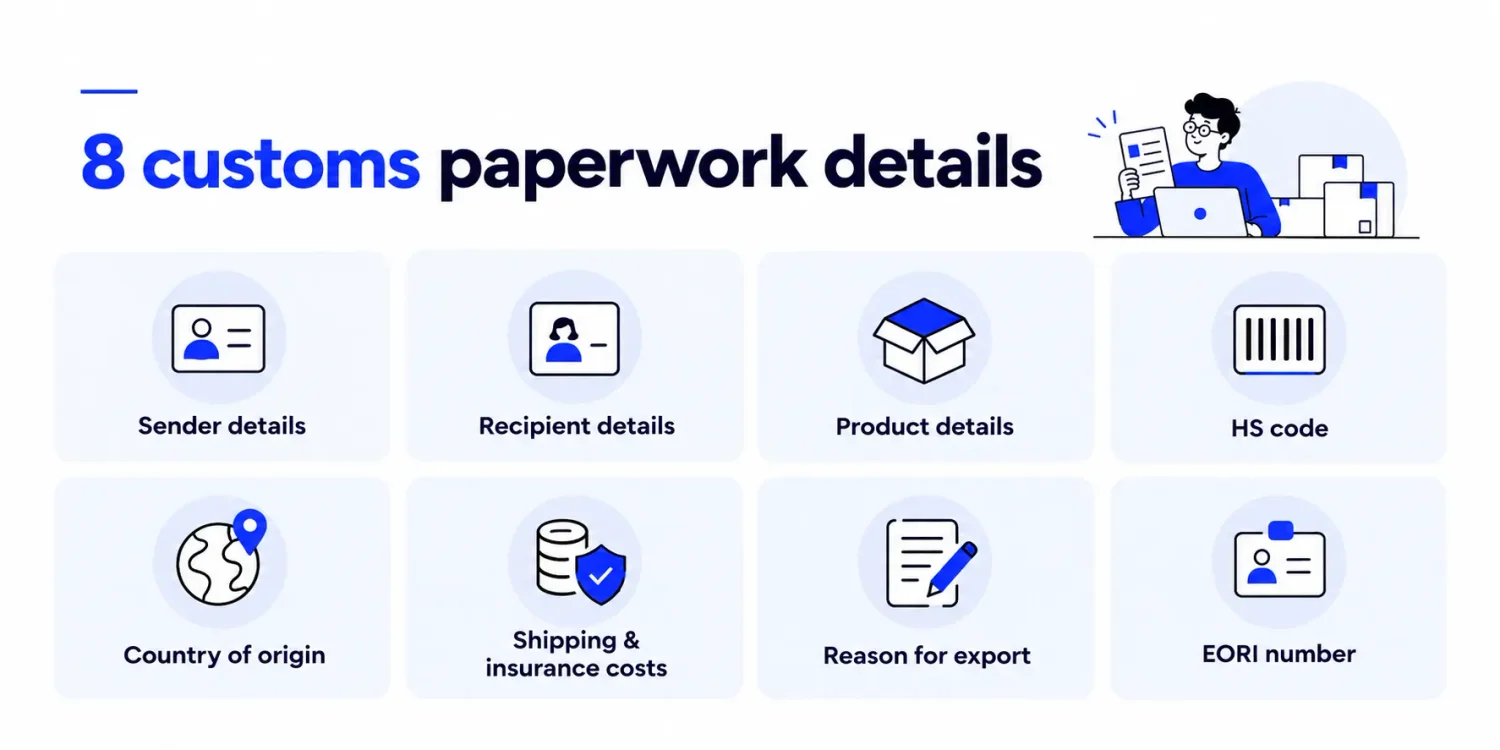
If you buy an eligible international shipping label through Shopify, Shopify can use your product and order information to prepare the customs declaration. Some carriers also submit this information electronically, so you may not need to print a separate customs form.
👉 To learn more about how to set up international shipping on Shopify, read our guide: How To Set Up International Shipping On Shopify
The right carrier depends mainly on your shipping origin, delivery speed, parcel value, and whether you want to use DDP. For most Shopify merchants, the options fall into three groups:
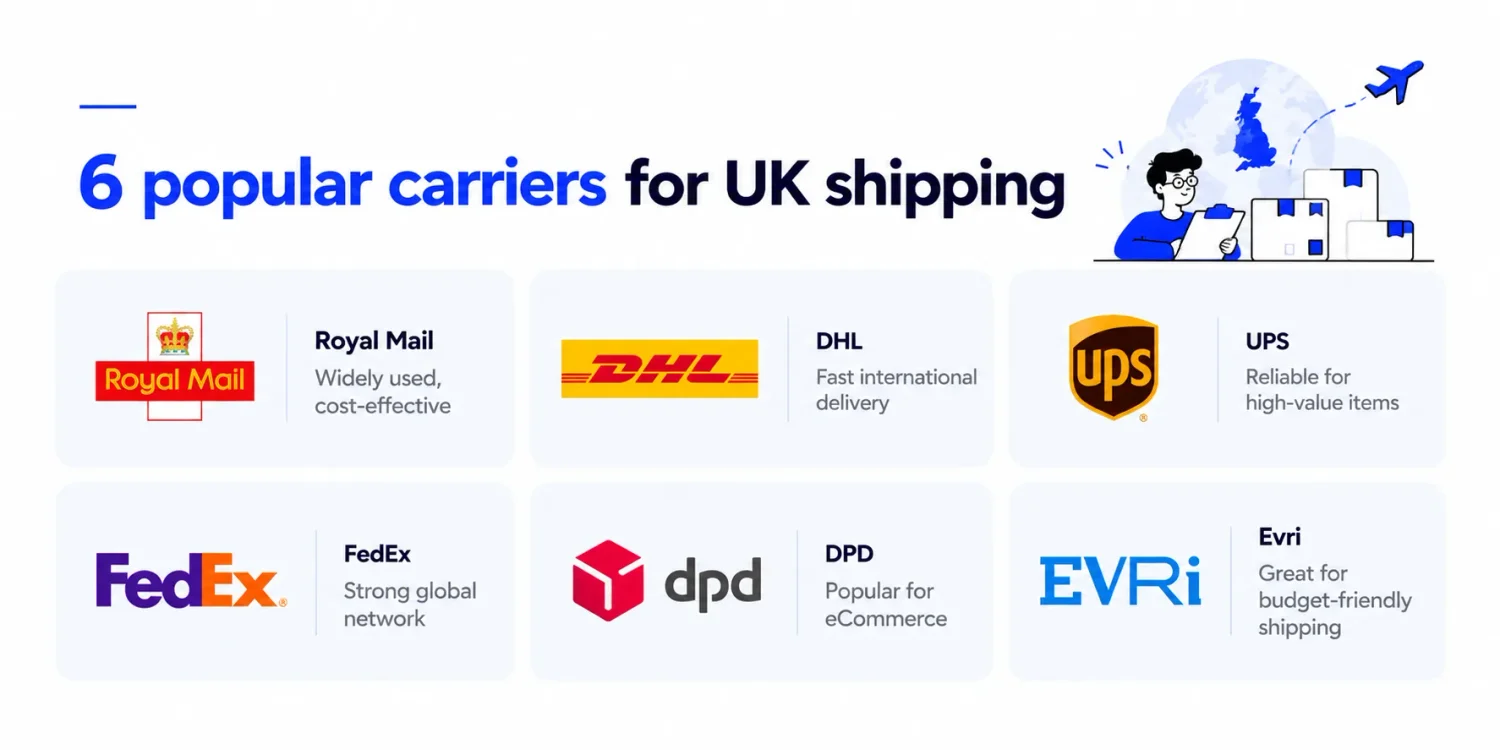
Here is the full comparison:
| Carrier | Typical delivery speed | Relative cost | DDP support | Best for |
|---|---|---|---|---|
| DHL Express | 1–3 business days | High | Yes | Fast, higher-value international orders |
| UPS | 1–5 business days | High | Yes | Express and B2B shipments |
| FedEx | 1–5 business days | High | Yes | Time-sensitive international orders |
| USPS / national post → Royal Mail | About 6–10 business days | Low to mid | Usually DAP | Lightweight, lower-value parcels |
| DPD | Varies by European route | Mid | DDP options available | Shipments from Europe to the UK |
| Economy consolidators | Usually the slowest | Low | Varies by service | Non-urgent, price-sensitive orders |
Delivery times, prices, and DDP availability vary by origin, parcel size, destination, and specific carrier service. Check the carrier’s current service details before choosing.
Also compare the actual rates available to your store rather than choosing based only on the carrier’s standard pricing. Rates can vary significantly by shipping origin, parcel dimensions, weight, and your carrier account.
Free shipping can do more than remove a delivery cost. A well-planned threshold can also encourage customers to spend more. According to the Baymard Institute, 39% of shoppers abandon checkout because extra costs, such as shipping, are too high. Showing a clear free-shipping offer before checkout can help address this concern.
You can create the threshold directly in Shopify. See our guide to free shipping over a set amount for the full setup.
Alternatively, BOGOS: Free Gift Bundle Upsell lets you set up free shipping as a gift-with-purchase reward and promote it through a live progress bar, all within one app. You can trigger the reward by cart value, quantity, specific products, or product packs, then target it by factors such as customer tags, order history, location, market, or subscription status.
This makes free shipping easier to personalize and more visible throughout the shopping journey, giving customers a clear reason to spend more and helping increase average order value.
Shipping to the UK becomes much easier once the right setup is in place. The key is to connect each part of the process: configure the UK correctly in Shopify, follow the £135 VAT rule, provide accurate customs information, choose the right carrier, and decide how duties will be handled before the order ships.
Most importantly, make the total cost and delivery process clear to customers. Using DDP, accurate shipping rates, and clear delivery expectations can reduce surprises at checkout and upon delivery.
Once the essentials are covered, you can turn shipping into a sales opportunity. With tools like BOGOS: Free Gift Bundle Upsell, free UK delivery can become a targeted incentive that encourages shoppers to spend more while keeping the promotion easy to manage.
For example, add a free-shipping threshold and clearly show shoppers how close they are to reaching it. This gives customers another reason to increase their cart value while keeping your shipping offer easy to understand.
Get the shipping setup right first. Then use it to support conversion and AOV.
Yes, if you sell consignments worth £135 or less directly to UK consumers. You need a UK VAT registration and must charge 20% VAT at checkout for qualifying orders.
If you do not want to manage the registration yourself, Shopify Managed Markets can act as the merchant of record and handle VAT requirements for you.
The £135 threshold determines how VAT is handled for imported goods. For consignments worth £135 or less, the seller generally charges UK VAT at checkout. For consignments above £135, import VAT and any applicable customs duty are handled at the border.
The £135 threshold applies to the whole consignment, not each individual product.
For lightweight, lower-value parcels, postal services and economy consolidators are usually the lower-cost options. Express couriers such as DHL Express cost more but generally provide faster delivery and more comprehensive customs handling.

A Shopify post purchase survey asks buyers 1–3 questions right after checkout, while the order is still fresh in...
Shopify has no built-in spin the wheel, so you add one with an app, your email platform, or an...
Most Shopify merchants run promotions, but few know how their setup compares to what’s actually working across hundreds of...