Allan Vu is a Digital Marketing expert and the driving force behind BOGOS’s blog content. With a deep understanding of eCommerce and Shopify promotions, he is passionate about helping merchants unlock the full potential of their stores.
At BOGOS, Allan creates valuable, practical content focused on strategies like Free Gifts, Buy X Get Y, product bundles, and upsell offers to empower Shopify sellers to grow their businesses effectively.
Known for his clear, insightful writing, Allan is dedicated to delivering actionable advice that makes a real difference for BOGOS’s readers.
Disclosure: This article was written by the team behind AI Dynamic Pricing by Intelis, one of the apps below. We’ve kept every other app’s facts to its live App Store listing, and we say where each one fits better than ours.
Black Friday week is when shoppers compare prices hardest, and many competitors change theirs. A dynamic pricing app watches those changes and helps you answer them, without cutting deeper than your margin can carry. We read the live Shopify App Store listing, pricing table, and recent merchant reviews of eight pricing apps on November 9, 2026, so every rating and price below is current. Here is what each one actually does, and which kind of store it fits.
TL;DR
Best for competitor-based repricing with a Google Shopping focus: AI Dynamic Pricing by Intelis. 4.9 stars from 74 reviews. It matches your products to competitor listings with AI and reprices within margin rules you set. Plans start at $49/month.
Best proven option with the most reviews: Prisync AI | Dynamic Pricing. 4.9 stars from 244 reviews and on the App Store since 2015. Plans also start at $49/month, with channel-based tracking as a paid add-on on the higher plans.
Best for hard-to-track competitor sites: PriceMole. 4.9 stars from 34 reviews, with channel tracking (Google Shopping, Amazon and more) on every plan. It starts higher, at $99/month.
Best free way to start: Snoopie (free price-change alerts) or Shopify Smart Pricing (free price tips from your own store data). Neither one reprices against competitors for you.
Best for testing what your own shoppers will pay: Intelligems. It A/B tests prices rather than reacting to competitors.
All ratings, review counts, and prices come from the live Shopify App Store listings, checked November 9, 2026.
1. How we checked these apps, plus 3 quick picks
We built the list from the “Pricing optimization” apps on the Shopify App Store that merchants most often compare for dynamic pricing. For each app we read:
the live App Store listing, including its feature list and “Works with” integrations
the full pricing table, including add-ons and what each plan leaves out
the rating breakdown and the most recent merchant reviews, positive and negative
We didn’t run every app’s paid plans side by side, and we haven’t used reviews as proof of results. Where a listing doesn’t state something (for example, how often prices update), we say so rather than guess.
One thing to know before you read on: “dynamic pricing” covers three different jobs on Shopify.
Competitor-based repricing. The app tracks other sellers’ prices and changes yours within rules you set. (Intelis, Prisync, PriceMole, Pricefy, PriceRest.)
Monitoring and alerts only. The app tells you when a competitor’s price moves, and you decide what to do. (Snoopie.)
Pricing from your own data. The app suggests or tests prices based on your store’s sales, not competitors. (Shopify Smart Pricing, Intelligems.)
Our three quick picks:
Intelis: for stores that compete on Google Shopping and want AI product matching plus margin-aware repricing.
Prisync: for stores that want the longest track record and the most reviews.
Shopify Smart Pricing: for small stores that want free, built-in price tips before paying for competitor tracking.
2. Essential features to look for in a Shopify dynamic pricing app
Check each app against this list before you install:
Product matching: The app has to find the same product at other stores. Manual URL matching works for a few dozen SKUs. Beyond that, you want automatic or AI matching you can review.
Where it tracks: Competitor websites, Google Shopping, Amazon or marketplaces. Track the channels where your shoppers actually compare.
Repricing rules with a margin floor: Rules like “stay 2% below the lowest competitor, but never under cost plus 20%.” A floor is what stops a price war.
Update frequency: Some plans check once a day, others several times. During BFCM this matters more than usual.
Variant tracking: Size and color variants often carry different prices. Some apps include them only on higher plans.
MAP monitoring: If you sell brands with a Minimum Advertised Price, the app should flag sellers advertising below it.
Price history and alerts: You’ll want to see what a competitor did last BFCM, and hear about big moves now.
A clear pricing model: Most apps charge by number of products tracked. Some add fees per channel or per extra competitor site. Count your SKUs before you compare.
3. The 8 best Shopify dynamic pricing apps reviewed
App
Rating (reviews)
Best for
Main con
Pricing
AI Dynamic Pricing by Intelis
4.9 (74)
Competitor repricing with a Google Shopping focus
No free plan; smaller review base than Prisync
From $49/mo, 14-day free trial
Prisync AI | Dynamic Pricing
4.9 (244)
The longest track record
Channel-based tracking costs extra on higher plans
From $49/mo, 14-day free trial
PriceMole
4.9 (34)
Hard-to-crawl competitor sites, channel tracking on every plan
Highest starting price here
From $99/mo, 14-day free trial
Pricefy
4.4 (72)
A free plan to try competitor tracking
14% of ratings are one star; repricing starts on the $99 plan
Free; paid from $49/mo
PriceRest
No reviews yet
MAP-focused stores willing to try a new app
Launched July 2026, no track record
From $49/mo, 14-day free trial
Snoopie
5.0 (31)
Free competitor price alerts
Alerts only, no repricing
Free
Shopify Smart Pricing
4.5 (220)
Free price tips from your own store data
Doesn’t track competitors
Free
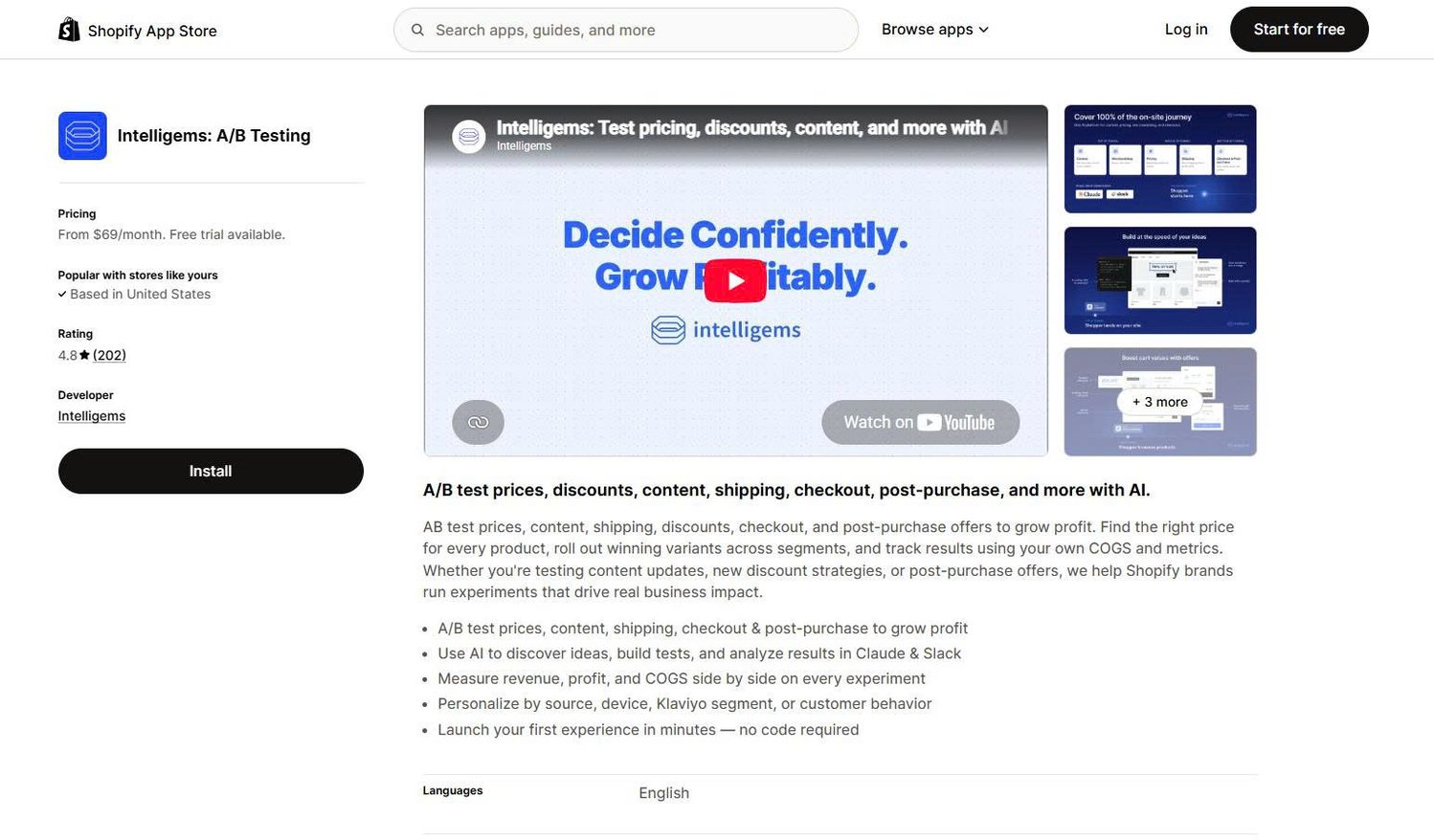
Intelligems
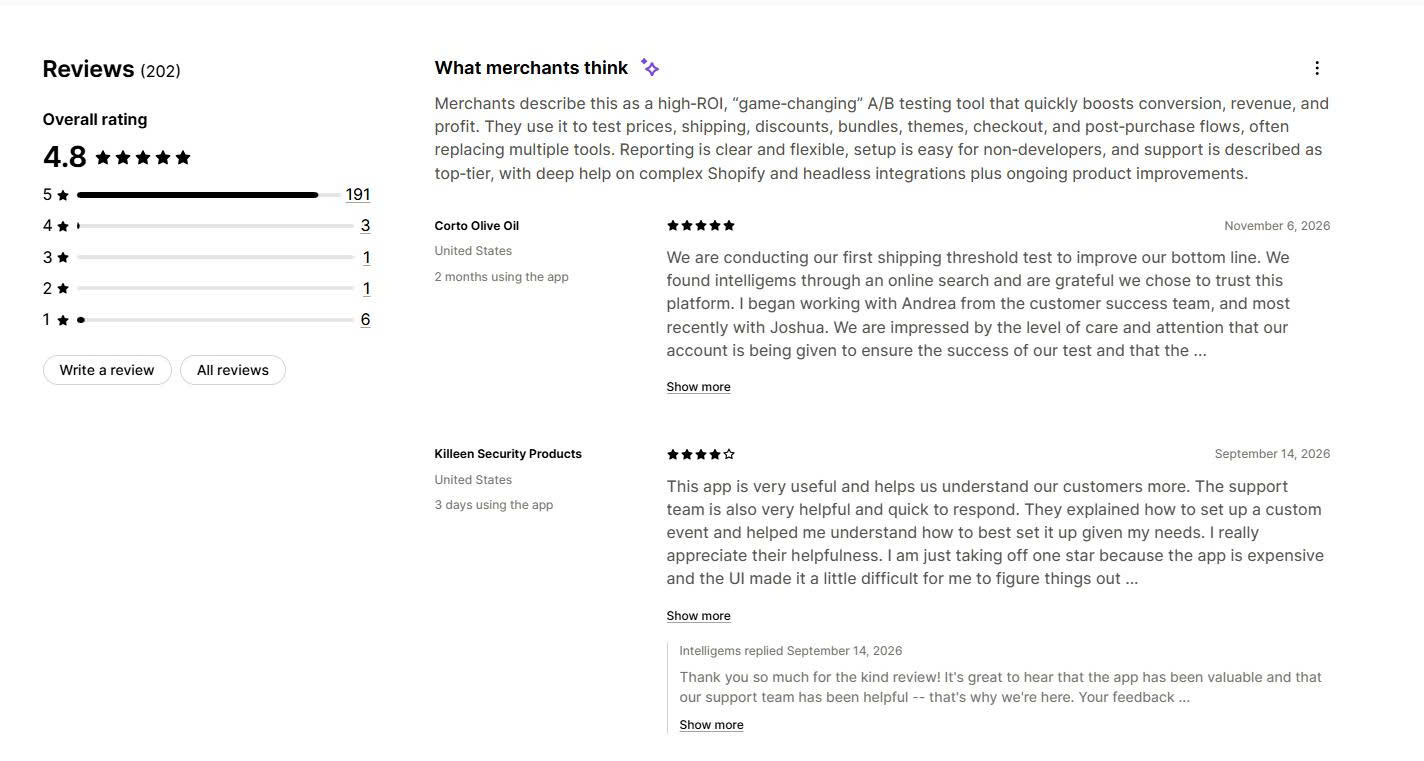
4.8 (202)
A/B testing prices on your own shoppers
Price testing sits on the $349/mo plan
From $69/mo, 14-day free trial
#1 AI Dynamic Pricing by Intelis
🏆 Best for: Shopify stores that sell products other stores also sell, compete for the click on Google Shopping, and want repricing that respects a margin floor.
Pricing:
Basic: $49 a month ($490 a year), up to 100 products/variants, Google Shopping competitor monitoring, AI matching for unlimited competitors, dynamic pricing, reports and price history
Professional: $179 a month, up to 1,000 products/variants, adds variant tracking, sales analysis, pricing strategy monitoring and an AI assistant
Premium: $249 a month, up to 2,000 products/variants, adds Shopify Markets support, Google Analytics integration and API access
Business: $399 a month, up to 5,000 products/variants, adds a MAP monitoring report, a custom labels feed for Google Merchant Center and a customized matching algorithm
14-day free trial. Holiday offer: 25% off all monthly and yearly plans from October 31, 2026 to January 1, 2027. Email [email protected] and mention BOGOS.
Rating and reviews:
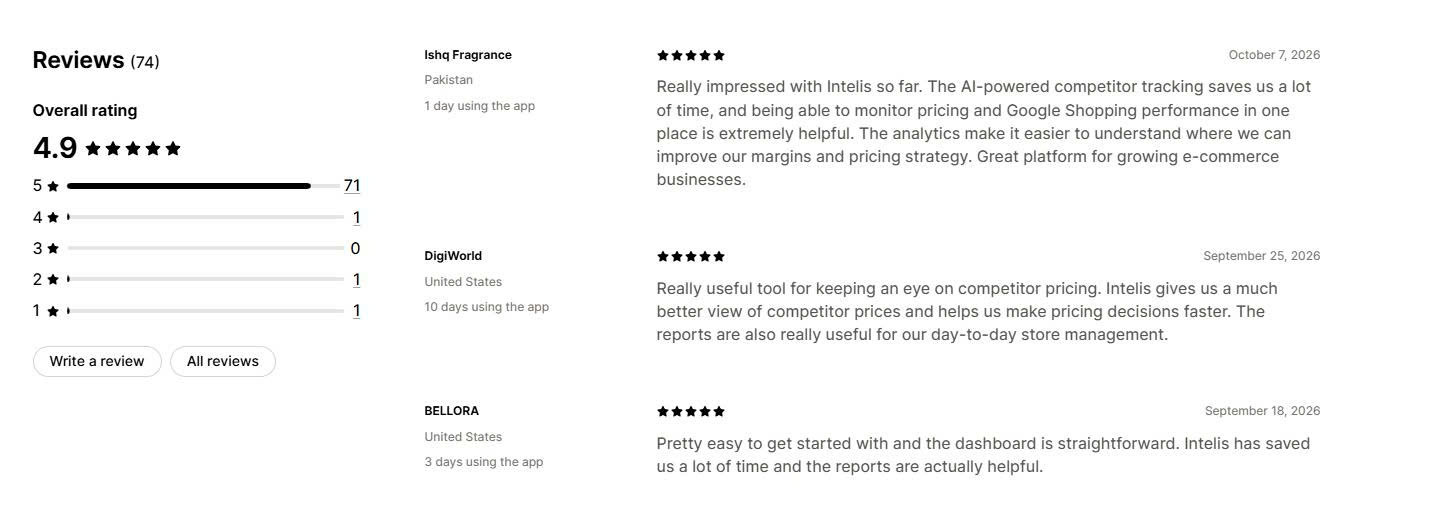
4.9 stars from 74 reviews
96% of ratings are five stars
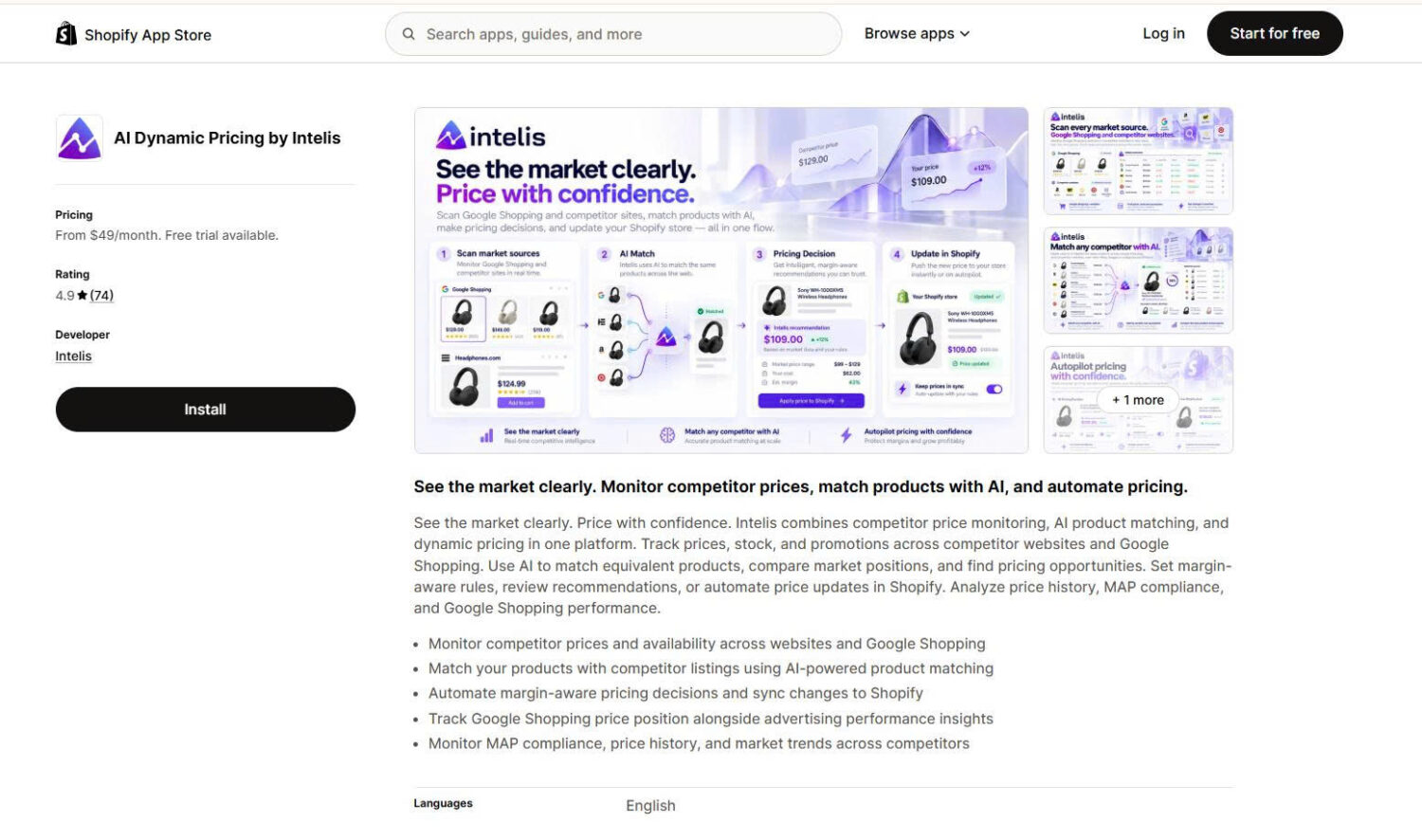
Intelis combines competitor price monitoring, AI product matching and dynamic pricing in one app. You connect your store, and it uses AI to match your products to the same items at competing stores and on Google Shopping. Then it shows where you sit on price, and it can update your Shopify prices automatically within the rules and margin floors you set. You can also review its recommendations before anything changes.
Its focus is Google Shopping, where shoppers see your price next to other sellers’ for the same product. Intelis tracks your Google Shopping price position alongside advertising performance insights. That helps you see when you’re losing clicks because a competitor is a few dollars cheaper, and when you’re discounting more than you need to.
Key features:
AI product matching against competitor listings, for unlimited competitors on every plan
Competitor price and availability monitoring across websites and Google Shopping
Margin-aware repricing rules that sync to Shopify, or recommendations you approve
Google Shopping price position tracked alongside advertising performance insights
Price history and market trend reports, plus a MAP monitoring report (Business plan)
Pros and cons:
Pro: AI matching for unlimited competitors is included from the $49 Basic plan
Pro: Tracks Google Shopping price position alongside advertising performance insights
Pro: You choose between automatic repricing and approving each recommendation
Con: No free plan, only a 14-day trial
Con: A smaller review base (74) than Prisync’s
Con: Plans are priced by product count, so large catalogs land on the higher tiers
What merchants say: Recent reviewers mention time saved on competitor tracking, having pricing and Google Shopping performance in one place, and reports they use day to day. One calls it easy to get started with and the dashboard straightforward.
🏆 Best for: Stores that want the most established competitor pricing app on Shopify, with unlimited competitors and a long review history.
Pricing:
Professional: $49 a month, up to 100 products/variants, unlimited competitors, price and stock updates 3x a day, Excel export
Premium: $199 a month, up to 1,000 products/variants, adds marketplace and variant tracking, category reports and daily price-change notifications. Channel-based competitor tracking is +$100 a month (hybrid tracking +$200)
Platinum: $399 a month, up to 5,000 products/variants, adds price history, instant price-change notifications, advanced reports and Shopify Markets pricing. Channel-based tracking is +$200 a month (hybrid +$400)
14-day free trial. The listing says channel-based and hybrid tracking are free on the Professional plan for Shopify users.
Rating and reviews:
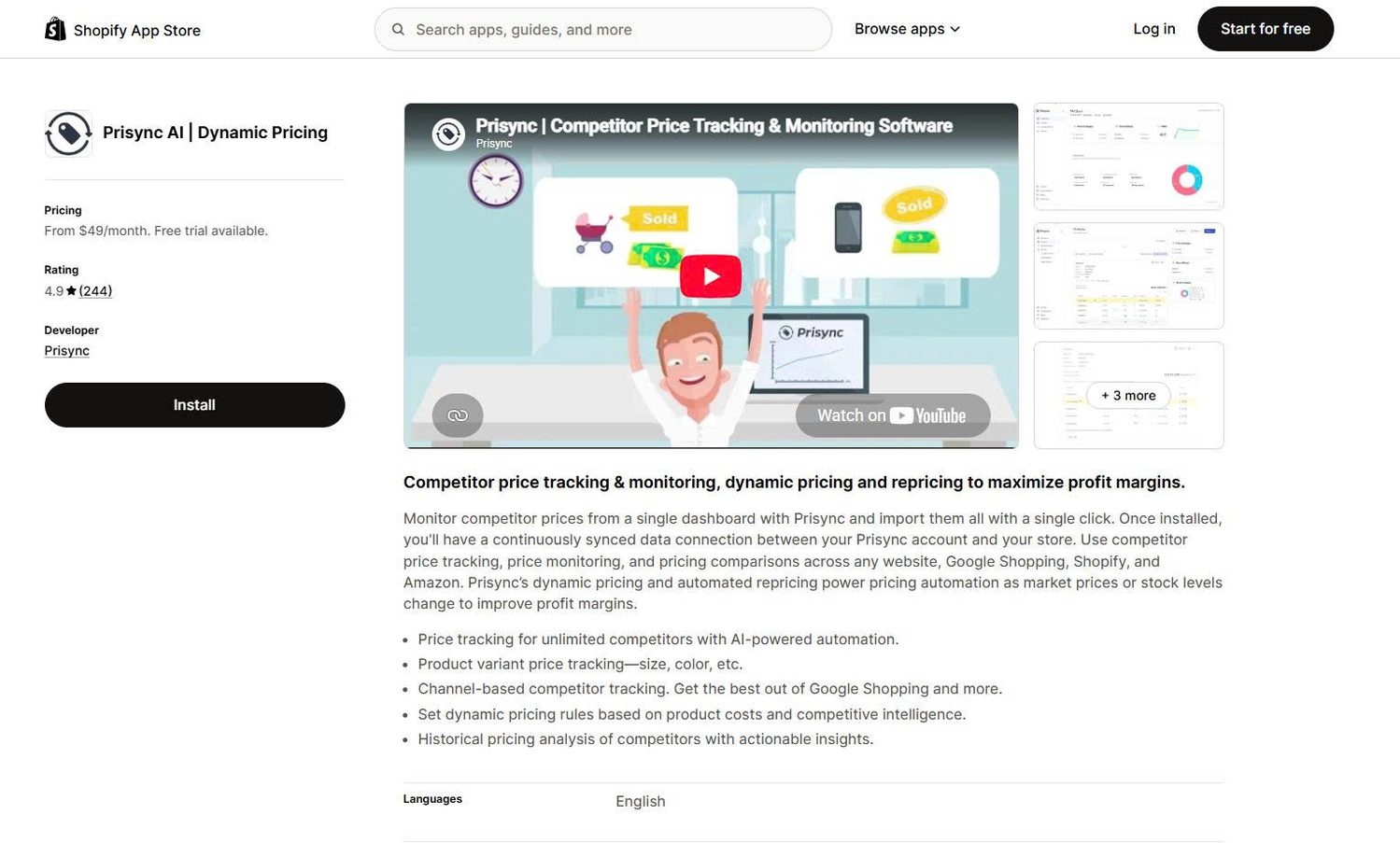
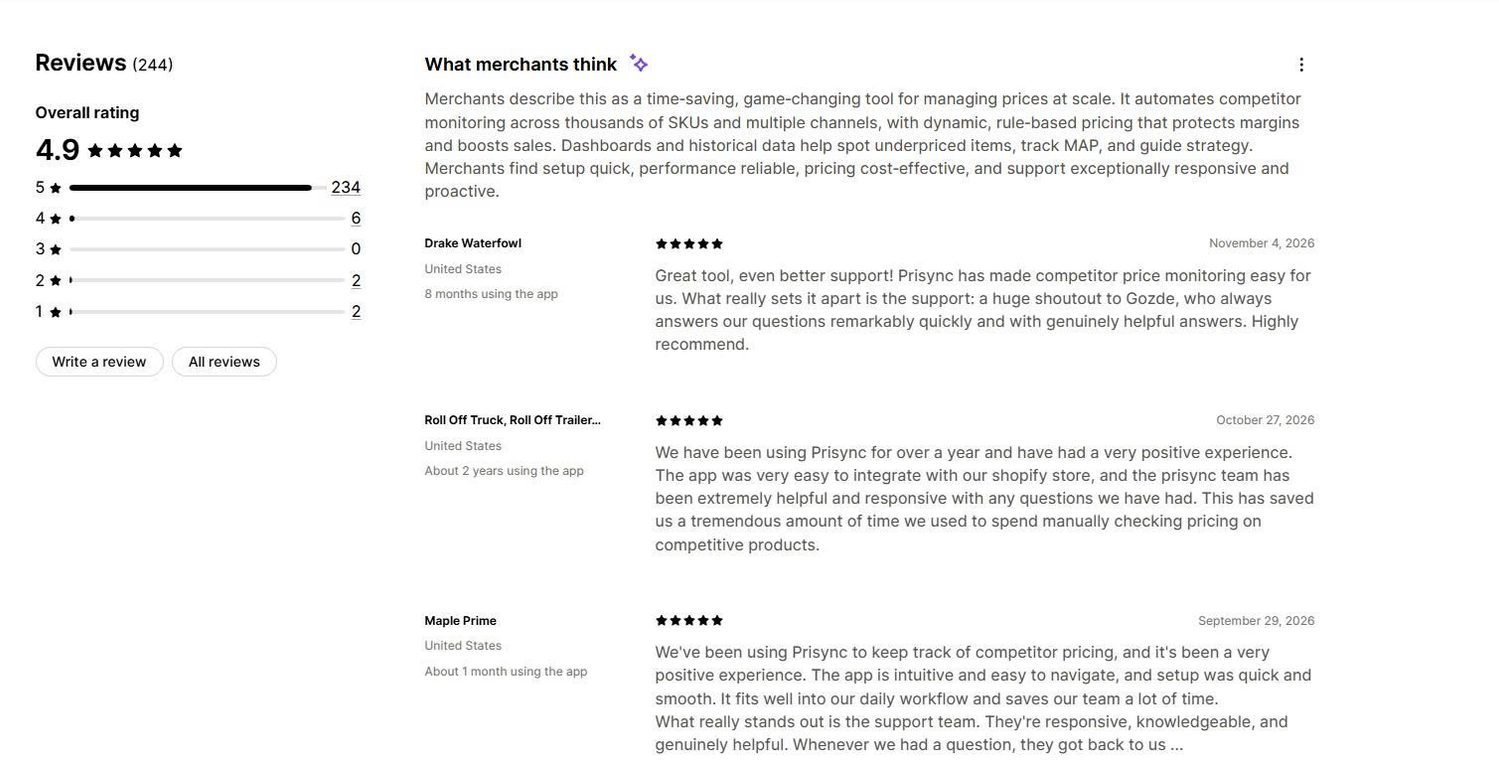
4.9 stars from 244 reviews
96% of ratings are five stars
Prisync has been on the Shopify App Store since 2015, and it shows in the review count. It tracks competitor prices on any website, Google Shopping, Shopify stores and Amazon, imports them into one dashboard, and keeps a continuous sync with your store. Its dynamic pricing rules use your product costs and competitor data to reprice as market prices or stock levels change.
Key features:
Price tracking for unlimited competitors, with AI-assisted automation
Variant-level tracking (size, color and so on)
Channel-based tracking for Google Shopping and more
Dynamic pricing rules based on product cost and competitor data
Historical pricing analysis
Pros and cons:
Pro: The largest review base of the competitor-tracking apps here
Pro: Unlimited competitors on every plan
Pro: Three price and stock updates a day, stated on the entry plan
Con: On Premium and Platinum, channel-based tracking is a paid add-on, so the real monthly cost can be $100–$400 higher than the headline price
Con: Price history and instant notifications are listed only on the Platinum plan
What merchants say: Reviews highlight quick setup, time saved on manual price checks and, most of all, fast and helpful support, often naming individual team members.
🏆Best for: Stores whose competitors are hard to track (sites with anti-bot protection) and that want channel tracking included from the first plan.
Pricing:
Starter: $99 a month, 100 products plus 50 channel connections, prices crawled 4x a day, automated repricing, connect Claude or ChatGPT
Professional: $249 a month, 1,000 products plus 500 channel connections, adds international competitor tracking
Business: $499 a month, 5,000 products plus 2,000 channel connections, adds custom crawling and login support, API access and dedicated engineering support
14-day free trial
Rating and reviews:
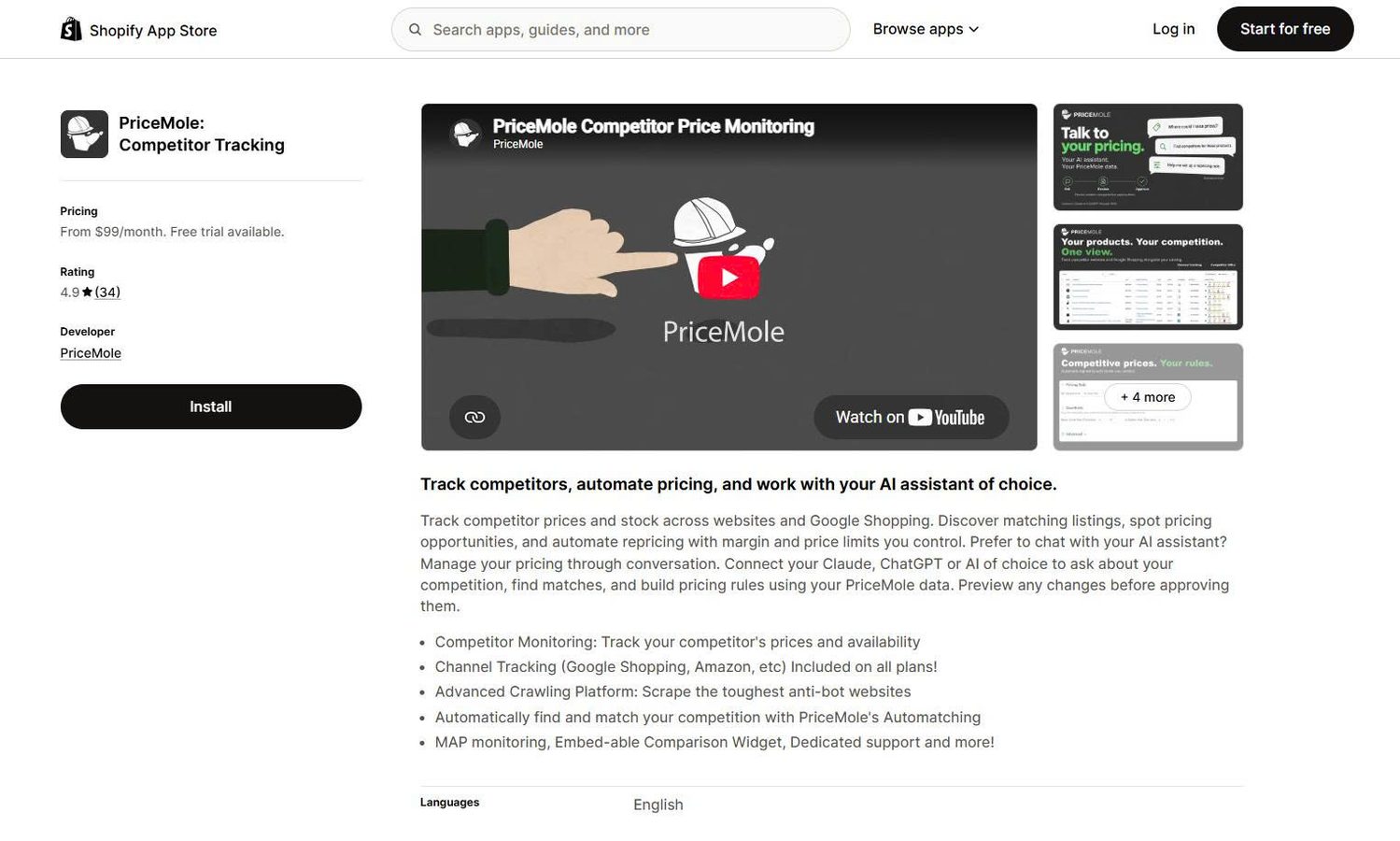
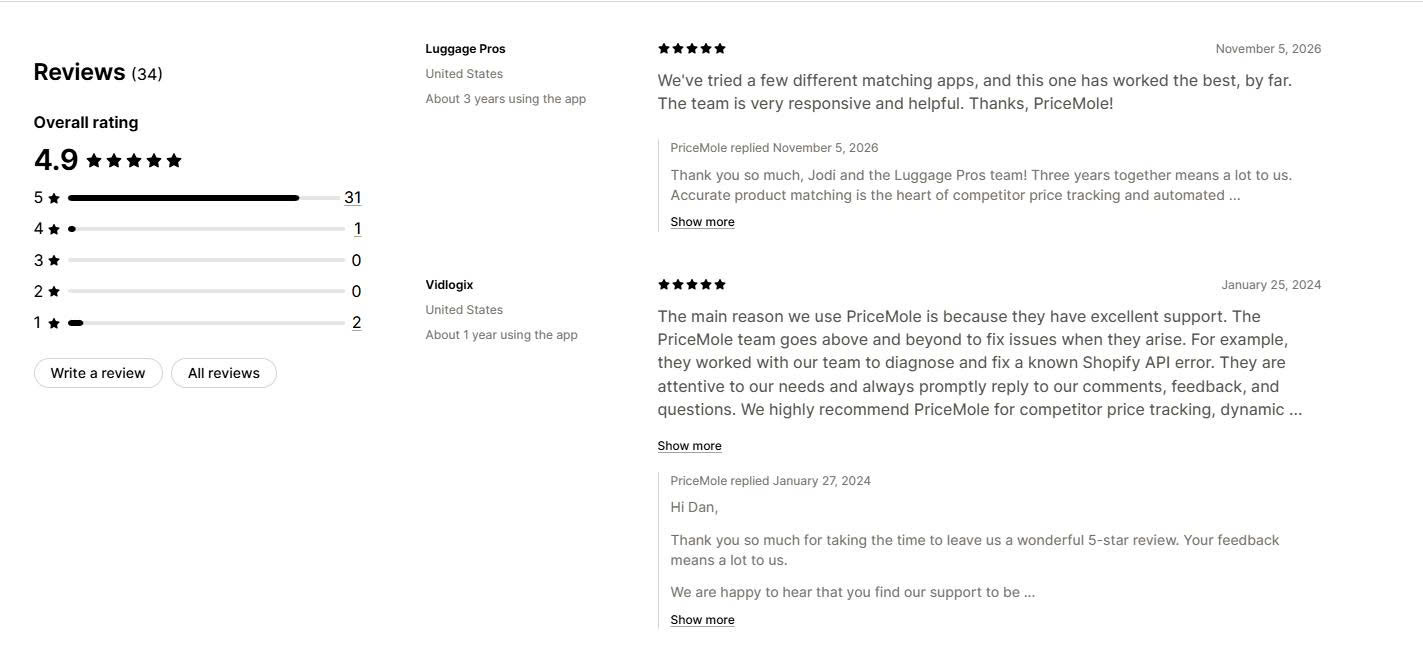
4.9 stars from 34 reviews
91% of ratings are five stars, 6% are one star
PriceMole tracks competitor prices and stock across websites and Google Shopping, finds matching listings automatically, and reprices within margin and price limits you control. Its newer feature lets you connect an AI assistant such as Claude or ChatGPT to ask about your competition and build pricing rules in conversation, with a preview before any change goes live.
Key features:
Competitor price and stock monitoring
Channel tracking (Google Shopping, Amazon, eBay, Walmart) on all plans
A crawling platform built for difficult, anti-bot sites
Automatic product matching
MAP monitoring and an embeddable comparison widget
Pros and cons:
Pro: Channel tracking is included on every plan, not sold as an add-on
Pro: Four price checks a day on every plan
Pro: Long-standing app (launched 2017) with support that reviewers praise
Con: The highest entry price here, at $99 a month for 100 products
Con: Only 34 reviews, so less review history to go on than Prisync
What merchants say: Reviewers single out matching accuracy and very responsive support, including help fixing technical issues. One long-time user says it worked best of the matching apps they tried.
🏆Best for: Stores that want to try competitor tracking on a free plan before committing.
Pricing:
Free: up to 50 SKUs, 3 competitors, 1 price update a day, competitor stock monitoring
Starter: $49 a month ($441 a year), up to 100 SKUs, unlimited competitors, marketplace analysis, 2 updates a day
Pro: $99 a month, up to 2,000 SKUs, adds daily price-change notifications and repricing
Business: $189 a month, up to 15,000 SKUs, adds auto-repricing
Rating and reviews:
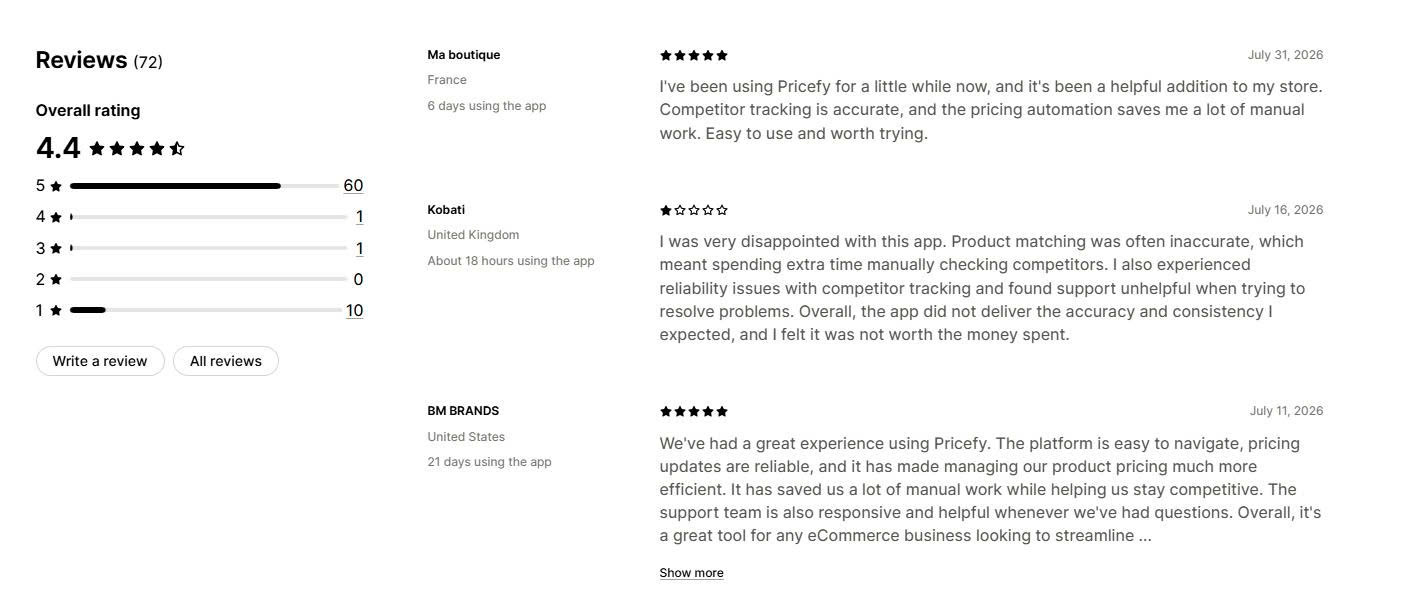
4.4 stars from 72 reviews
83% of ratings are five stars, 14% are one star
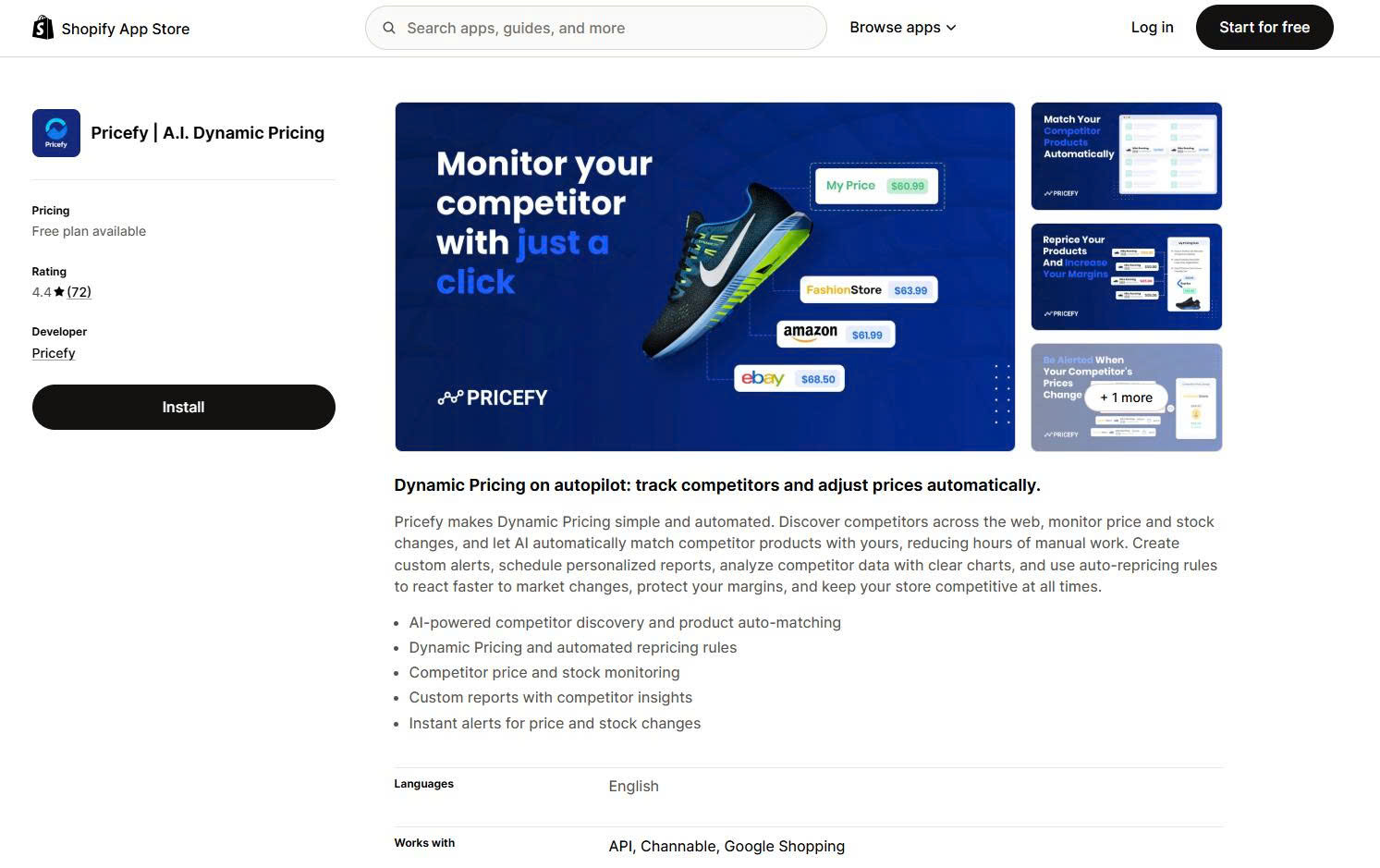
Pricefy discovers competitors across the web, monitors their price and stock changes, and uses AI to match competitor products with yours. Custom alerts, scheduled reports and charts help you read the data. Repricing rules then react to market changes within your margins.
Key features:
AI competitor discovery and product auto-matching
Dynamic pricing and automated repricing rules
Competitor price and stock monitoring
Custom reports and instant alerts
Pros and cons:
Pro: The only app here with both a free plan and paid repricing plans
Pro: The most SKUs per dollar on the top plan (15,000 SKUs for $189)
Con: Repricing isn’t listed on the Free or $49 Starter plans; it starts on Pro
Con: The most mixed reviews of the group, with 14% one-star ratings
What merchants say: Positive reviews mention accurate tracking and less manual work. The negative ones cite inaccurate product matching and slow support, so it’s worth testing matching on your own catalog during the free plan.
🏆Best for: Stores that need MAP monitoring and repricing on a budget, and are comfortable trying a new app.
Pricing:
Basic: $49 a month, up to 100 products, 1 price and stock update a day, 10 competitor sites included, automatic dynamic pricing, MAP monitoring
Professional: $189 a month, up to 1,000 products, 2 updates a day, variant tracking, 20 competitor sites included
Business: $249 a month, up to 2,000 products, API access, 30 competitor sites included
Premium: $389 a month, up to 5,000 products
14-day free trial. The listing notes a setup fee for each competitor site beyond your plan’s included number.
Rating and reviews:
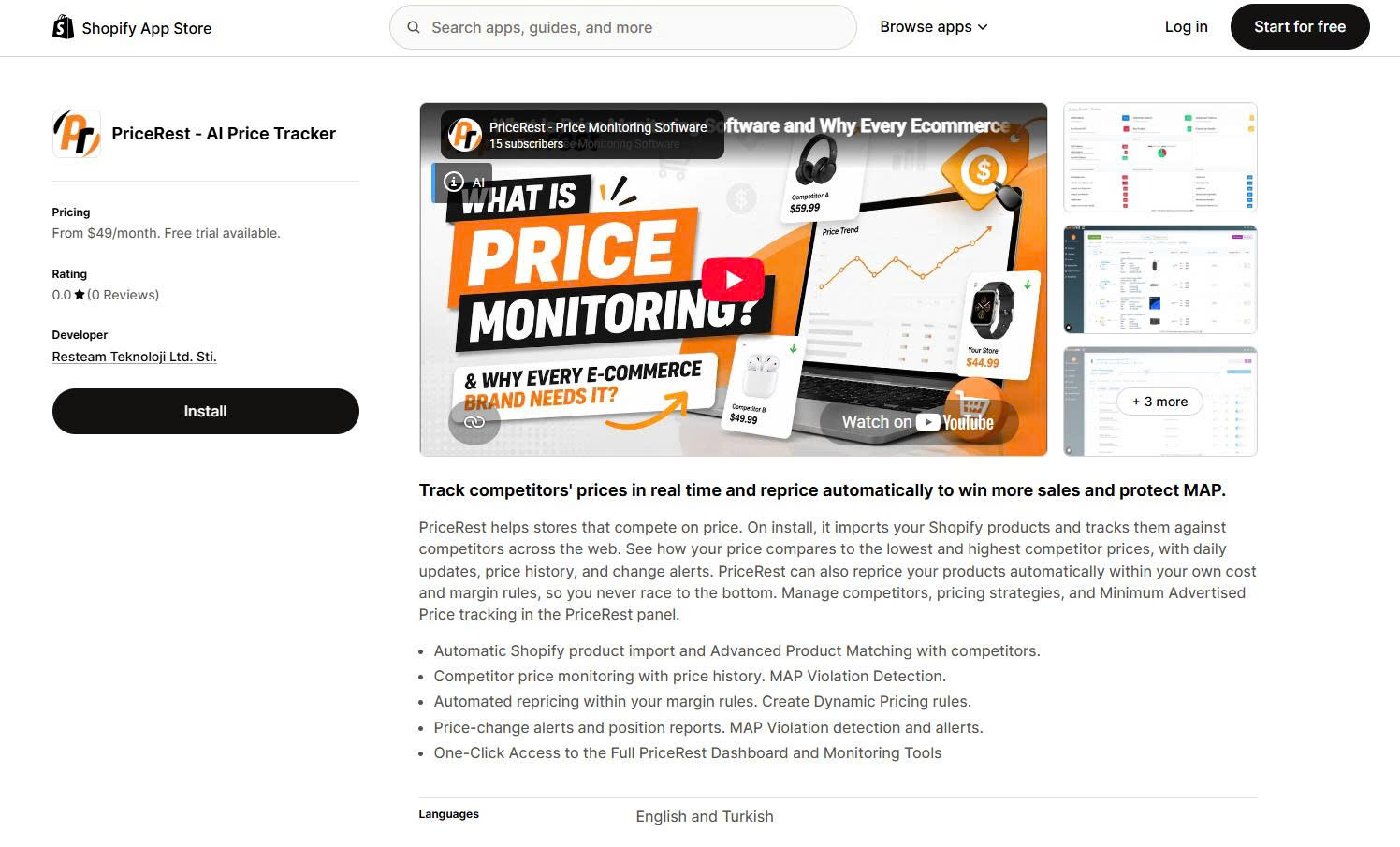
No reviews yet (launched July 1, 2026)
PriceRest imports your Shopify products on install and tracks them against competitors across the web. It shows how your price compares to the lowest and highest competitor price, with daily updates, price history and change alerts. It can reprice automatically within your cost and margin rules, and it flags prices advertised below MAP.
Key features:
Automatic product import and competitor matching
Price monitoring with history and position reports
MAP monitoring, with alerts for prices advertised below MAP
Repricing within margin rules
Pros and cons:
Pro: MAP monitoring is included from the $49 plan
Pro: Competitor suggestions help you find who to track
Con: Brand new, with no reviews to judge reliability by
Con: One update a day on the entry plan, plus setup fees for extra competitor sites
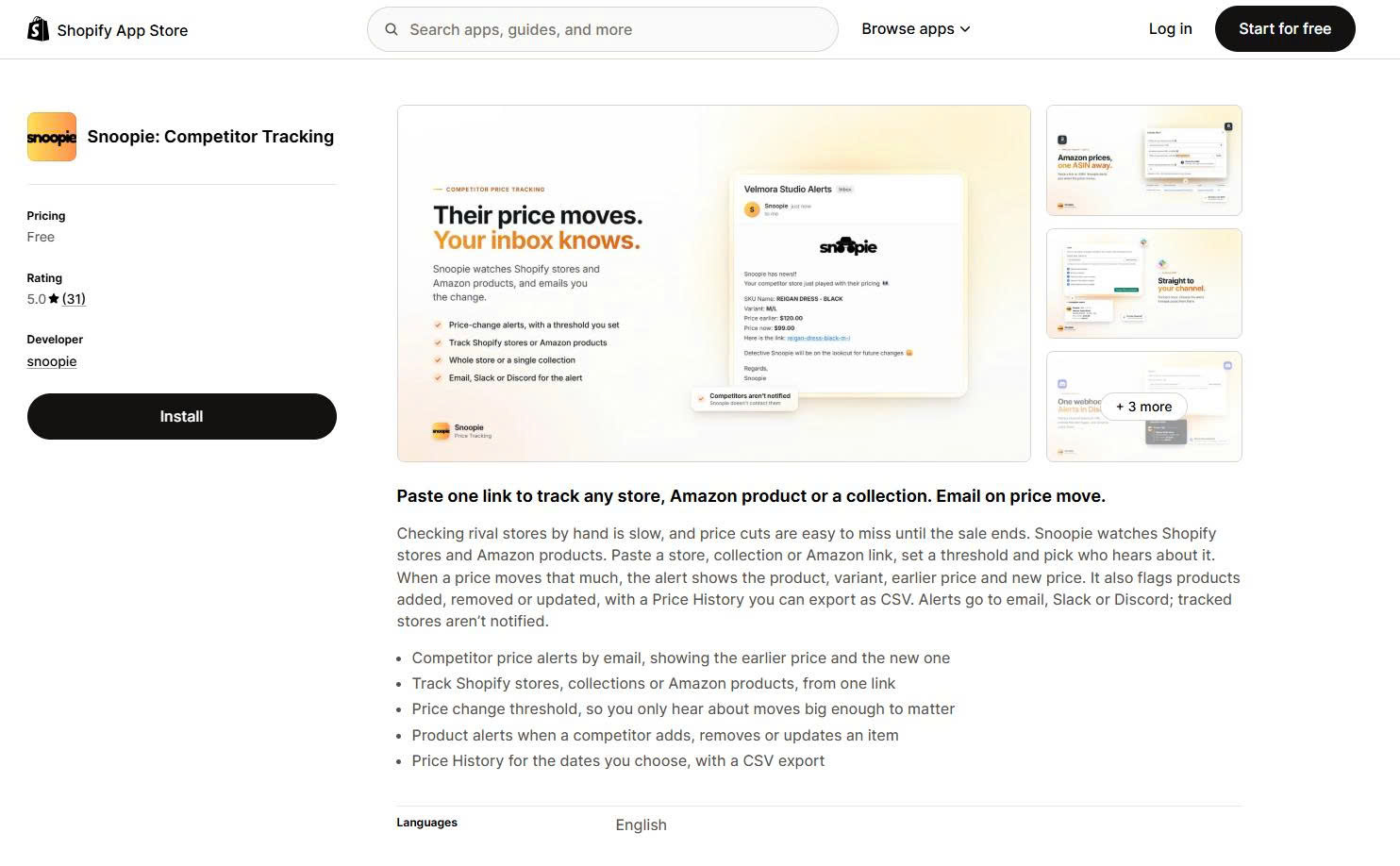
🏆Best for: Small stores that want free alerts when a competitor’s price changes and will reprice by hand.
Pricing:
Free: price-change alerts for Shopify stores and Amazon products, product added/removed alerts, collection-level alerts, delivery by email, Slack or Discord, unlimited alerts (3 email notifications included)
Rating and reviews:
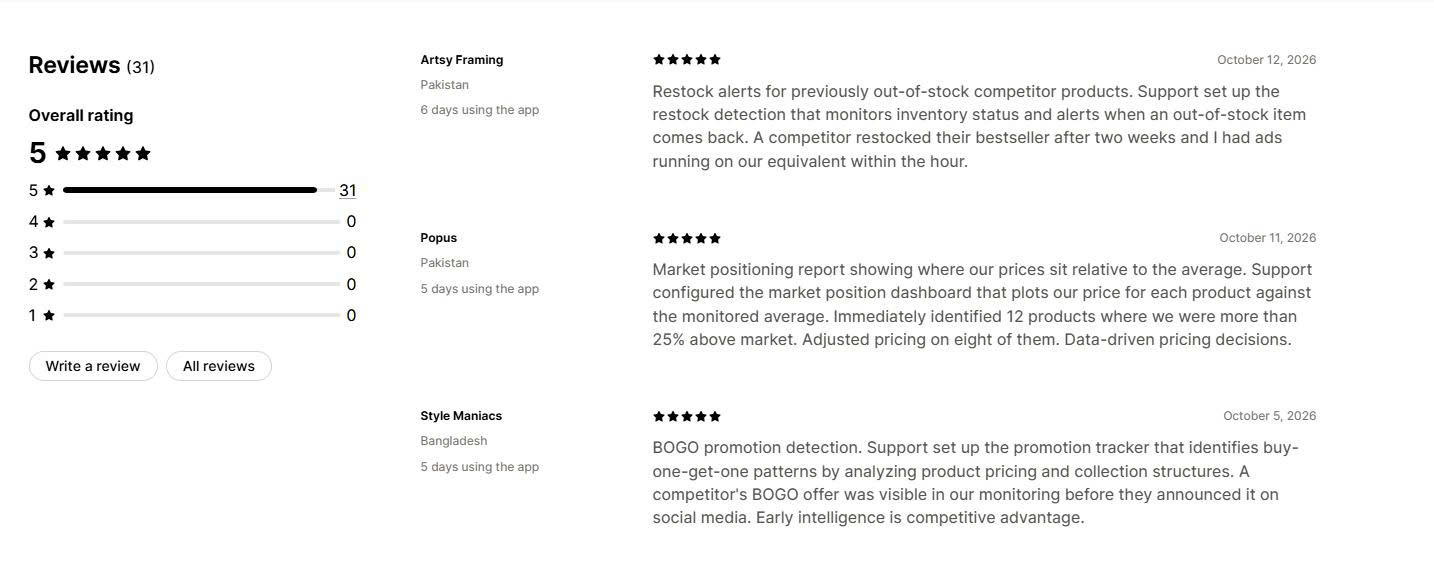
5.0 stars from 31 reviews
Snoopie watches Shopify stores and Amazon products. You paste a store, collection or Amazon link, set a threshold, and get an alert showing the product, variant, old price and new price when it moves that much. It also flags products a competitor adds, removes or updates, and keeps a price history you can export as CSV.
Key features:
Price-change alerts with the earlier and new price
Track a whole Shopify store, a collection or an Amazon product from one link
A change threshold, so you only hear about moves that matter
Price history with CSV export
Pros and cons:
Pro: Free, and simple to set up
Pro: Watches whole stores or collections, not just single products
Con: Monitoring only. It doesn’t change your prices
Con: Tracks Shopify stores and Amazon, not Google Shopping or other platforms
What merchants say: Reviewers describe setups their support team configured for them, such as restock alerts and market-position views.
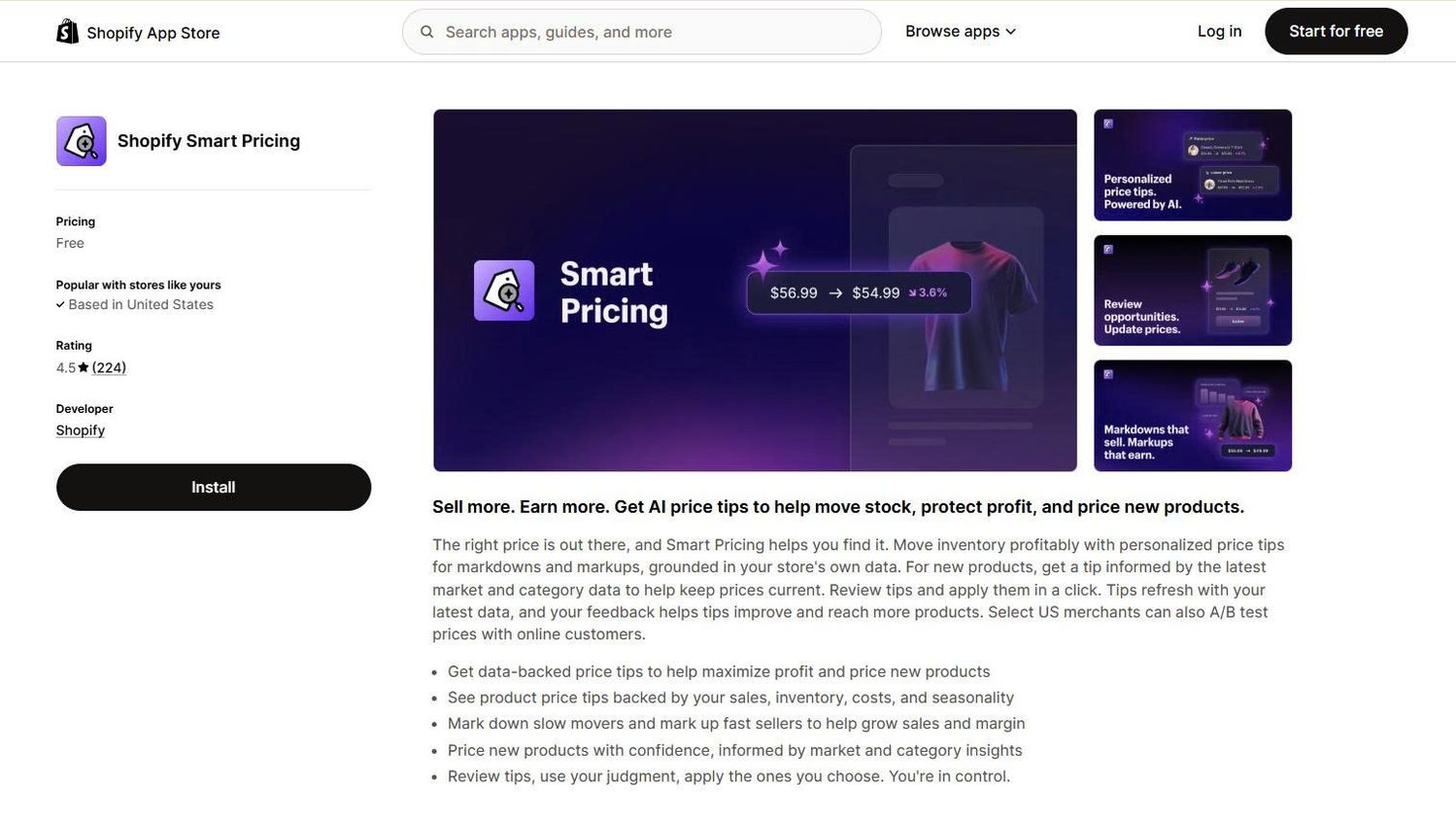
🏆Best for: Stores that want free, built-in price suggestions based on their own sales, inventory and costs.
Pricing:
Free
Rating and reviews:
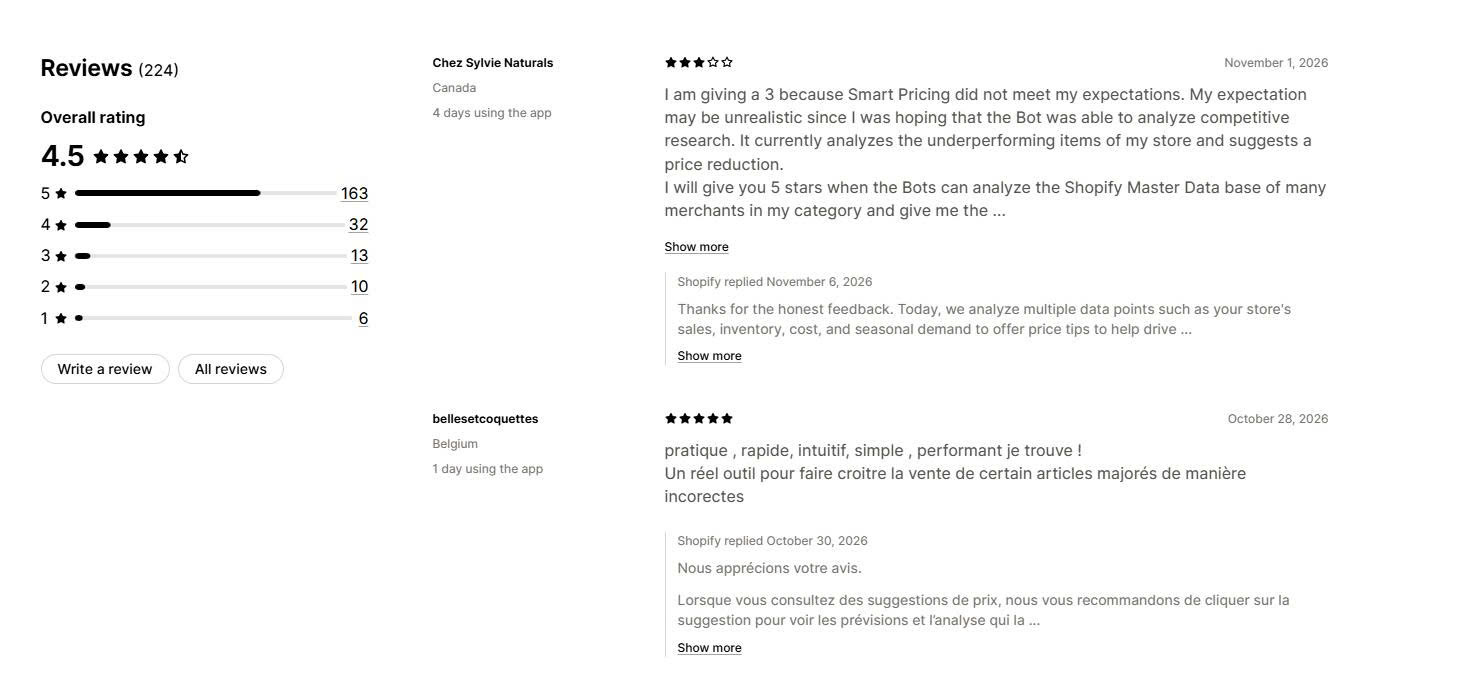
4.5 stars from 220 reviews
72% of ratings are five stars, 3% are one star
Shopify’s own pricing app gives you personalized price tips: markdowns for slow movers, markups for fast sellers, and a suggested price for new products based on market and category data. You review each tip and apply the ones you choose. Select US merchants can also A/B test prices with online customers.
Key features:
Price tips based on your sales, inventory, costs and seasonality
Markdown and markup suggestions
Suggested prices for new products, informed by market and category data
One-click apply, with you in control of every change
Pros and cons:
Pro: Free, and built by Shopify
Pro: Uses data you already have, so there’s nothing to set up
Con: It doesn’t track specific competitors or Google Shopping prices
Con: Price A/B testing is limited to select US merchants
What merchants say: Positive reviews say it saves time on price reviews. A recent 3-star review notes it analyzes your own underperforming items rather than competitors, which is the main limit to know about.
🏆 Best for: Brands with steady traffic that want to find the price their own shoppers will pay, by testing it.
Pricing:
Smart Content: $69 a month, content and theme tests (no price tests)
Smart Merchandise or Smart Shipping: $112.10 a month each, discount and shipping tests
Unlimited: $349 a month, includes price testing (“Smart Pricing”) with every other test type
Prices scale with sitewide order volume. 14-day free trial.
Rating and reviews:
4.8 stars from 202 reviews
95% of ratings are five stars
Intelligems isn’t a repricer. It A/B tests prices, discounts, shipping, checkout and post-purchase offers, then measures revenue, profit and COGS for each variant. If you sell your own brand and don’t have direct competitors on price, testing is often a better route than tracking.
Key features:
A/B tests for prices, discounts, shipping, checkout and post-purchase offers
Profit per visitor, using your own COGS
Personalization by traffic source, device or Klaviyo segment
AI help to plan, build and analyze tests
Pros and cons:
Pro: Shows what your own shoppers will pay, not just what competitors charge
Pro: Highly rated, with strong support
Con: Price testing is on the $349 Unlimited plan, and costs scale with order volume
Con: Tests need enough traffic to reach a result, so it suits established stores
What merchants say: Reviewers call it high-ROI and praise hands-on support during setup. One notes it’s expensive and the interface took time to learn.
4. How to pick the right dynamic pricing app for your store
Start with one question: do shoppers compare your exact products with other stores?
Yes, and they compare on Google Shopping: choose a competitor-based repricer. Intelis, Prisync, PriceMole, Pricefy and PriceRest all list Google Shopping in their integrations. Compare them on product count, how often prices update, and whether channel tracking costs extra.
Yes, but you only need to know when prices move: start with Snoopie’s free alerts and reprice by hand.
No, you sell your own brand: use your own data. Shopify Smart Pricing is free. Intelligems lets you test prices properly once you have the traffic.
Then check three numbers before you install:
Your SKU count, including variants, against each plan’s limit.
How often prices update, since a once-a-day check can miss a competitor’s BFCM flash sale.
Your margin floor. Decide the lowest price you’ll accept for each product before you turn on automatic repricing.
A competitive base price also makes your offers work harder. A free gift or a Buy X Get Y deal from BOGOS feels like a real deal when the product’s price already holds up next to other stores.
Conclusion
There’s no single best dynamic pricing app, because the apps do different jobs. If you compete with other sellers on the same products, a repricer such as Intelis, Prisync or PriceMole is the most direct fit. If you just want to know when competitors move, Snoopie is free. If you sell your own brand, Shopify Smart Pricing and Intelligems help you price from your own data. Whichever you choose, set your margin floor first. That way, a dynamic price wins the sale without giving away your profit.
FAQs
Does Shopify have built-in dynamic pricing?
Shopify’s free Smart Pricing app suggests markdowns and markups based on your own store data. It doesn’t track competitors or reprice against them. For competitor-based repricing, you need a third-party app.
Is dynamic pricing legal for Shopify stores?
Adjusting your prices in response to the market is a normal retail practice. Stay within any Minimum Advertised Price agreements with your brands, and don’t set prices below cost to push out a competitor. Several apps above include MAP monitoring to help with the first.
Will automatic repricing start a price war?
Not if you set a margin floor. Every repricer in this list lets you set rules with limits, so the app stops at the lowest price you’ve agreed to. Many stores also start with recommendations they approve before turning on automatic changes.
How many products should I track?
Start with your best sellers and the products most often compared on Google Shopping. That’s usually a small share of the catalog, and it keeps you on a lower plan while you learn what works.