Charlie Ngo is an eCommerce expert with 7 years of experience in the marketing field, specializing in SaaS and digital growth. A graduate in Marketing Communication, Charlie currently serves as the Marketing Manager of the BOGOS Shopify App, where he leads strategic initiatives to drive user acquisition, engagement, and brand positioning.
Returns are part of running any Shopify business. In 2025, shoppers returned 19.3% of everything they bought online, which means nearly one in five orders comes back.
That makes Shopify returns too costly to ignore. Handle them poorly, and you risk losing both the sale and customer loyalty since 71% of shoppers won’t buy from a store again after a bad return experience.
TL;DR
Shopify handles returns natively. Merchants create and process them from Orders, or let customers file their own with self-serve returns.
Turn on self-serve returns at Settings > Customer accounts. Set return windows, fees, and final-sale rules at Settings > Policies.
Native tools cover the basics. A returns app adds a branded portal, self-serve exchanges, and analytics once volume grows.
76% of shoppers prefer an instant refund or exchange. Lead with exchanges and store credit, not refunds, to keep revenue in your store.
Shopify does not file your sales tax returns unless you use Shopify Tax automated filing.
1. What Is Shopify Returns Management?
Shopify returns management is the end-to-end process of handling an item a customer sends back, from the return request to the refund, exchange, or restock.
How often you face a return depends on what you sell. Fit-driven categories like apparel see the most. Spec-driven and consumable categories see the fewest. Knowing your category’s normal range tells you whether your rate is healthy or worth a closer look.
Category
Typical online return rate
Main reason
Apparel and fashion
20-30%
Fit & sizing
Footwear
~17-20%
Fit
Bags and accessories
~12-19%
Look vs. expectation
Home and furniture
~8-20%
High reverse-logistics cost
Electronics
~8-15%
Defects, compatibility
Beauty and personal care
~4-12%
Hygiene limits returns
Return rates vary widely by source, methodology, and region. Ranges are compiled from multiple 2025-2026 industry datasets. The overall online average sits near 19.3% (NRF, 2025). Benchmark against your own category and history, not a cross-category average.
Most merchants see returns as a cost to contain. That view misses the bigger lever. A return is the last thing a customer remembers about you, so it shapes whether they come back. Handled well, it protects repeat purchases and lifetime value, which makes returns a real part of conversion rate optimization, not just a support task.
This is also where a return becomes an opportunity. A customer who just sent something back is one you can win back. Our app, BOGOS, helps merchants do exactly that: tag a returning customer and offer them a targeted incentive on their next order, turning a refund moment into a reason to shop again. More on the exact setup later.
2. How To Create And Manage Returns On Shopify
A return starts one of two ways. You create it yourself in the admin, or the customer files it through self-serve. Both run on the same foundation: your return policy and the rules that enforce it. Set those first, then the day-to-day process runs smoothly.
#1 Set a clear return policy first
Your return policy is the rulebook every return follows. Shoppers read it before they buy, so it shapes conversion as much as it shapes returns.
A vague policy costs you twice. Your team drowns in “can I return this?” tickets. Shoppers hesitate at checkout and leave, dropping your conversion rate.
A clear policy removes the doubt and gives customers the confidence to buy and answers six questions:
Question
Your options
How long?
Your return window: 14, 30, or 60 days from delivery
What condition?
Unworn, tags on, original packaging
Who pays return shipping?
You, the customer, or free over a threshold
Which items are excluded?
Final sale, perishables, personalized goods
How are refunds issued?
Original payment, exchange, or store credit
How do customers start a return?
Self-serve, or contact you
Writing a policy from scratch takes time, and missing a clause invites disputes later. Skip the guesswork and start from our Shopify return policy template, then adjust the six answers above to fit your store.
With your policy set, returns can begin. You have two ways to handle them: process each one manually or let customers start their own returns with Shopify native self-serve returns.
Method 1: Process a return manually
This method kicks off after a customer emails, calls, or asks in person. Here are the step-by-step instructions for this manual Shopify return process:
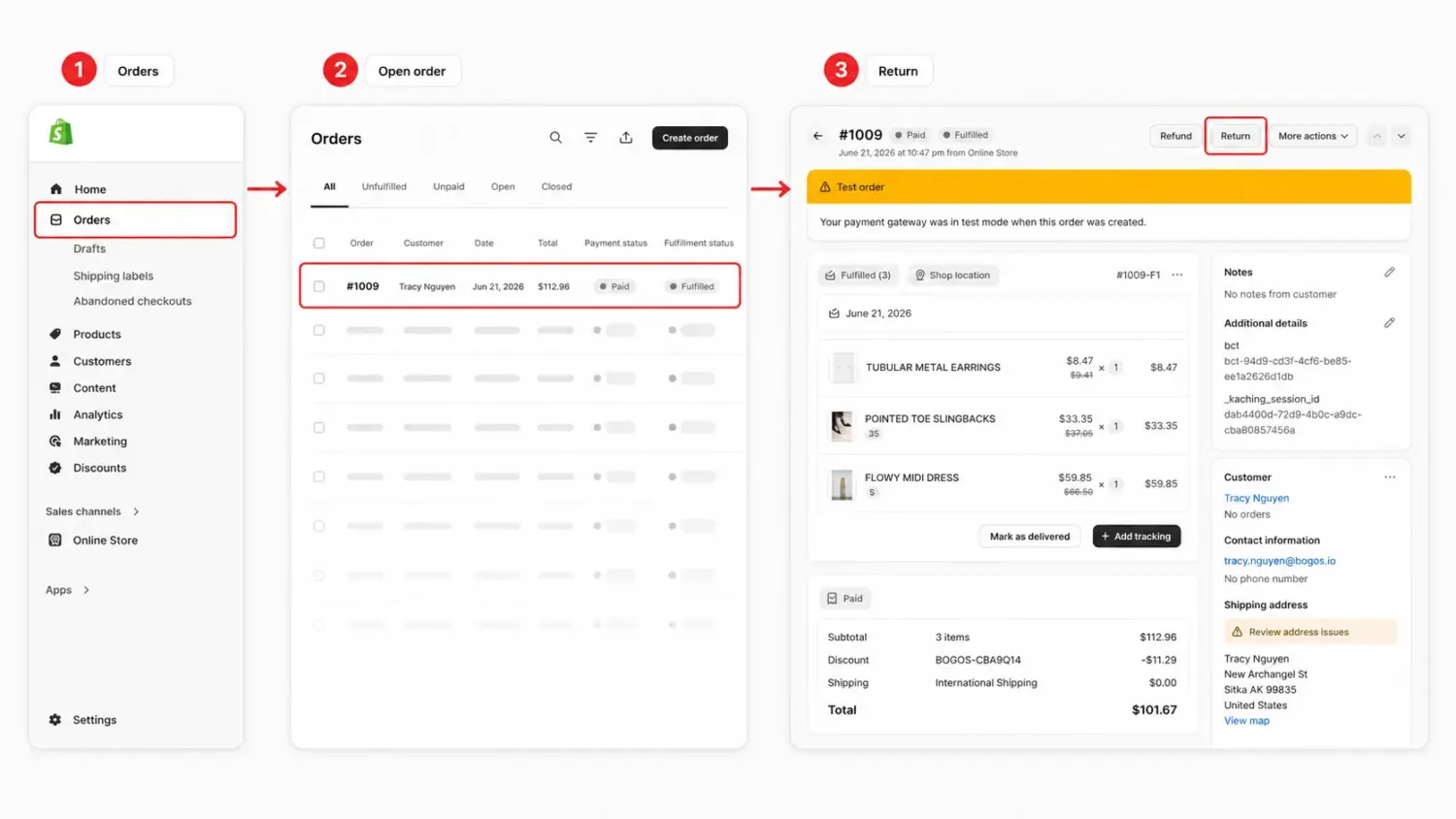
Step 1: Initiate the return
From your Shopify admin, go to Orders.
Click the order the customer wants to return.
Click Return at the top of the order page.
Open the Shopify Orders page, select the customer’s order, and click Return to start the return process.
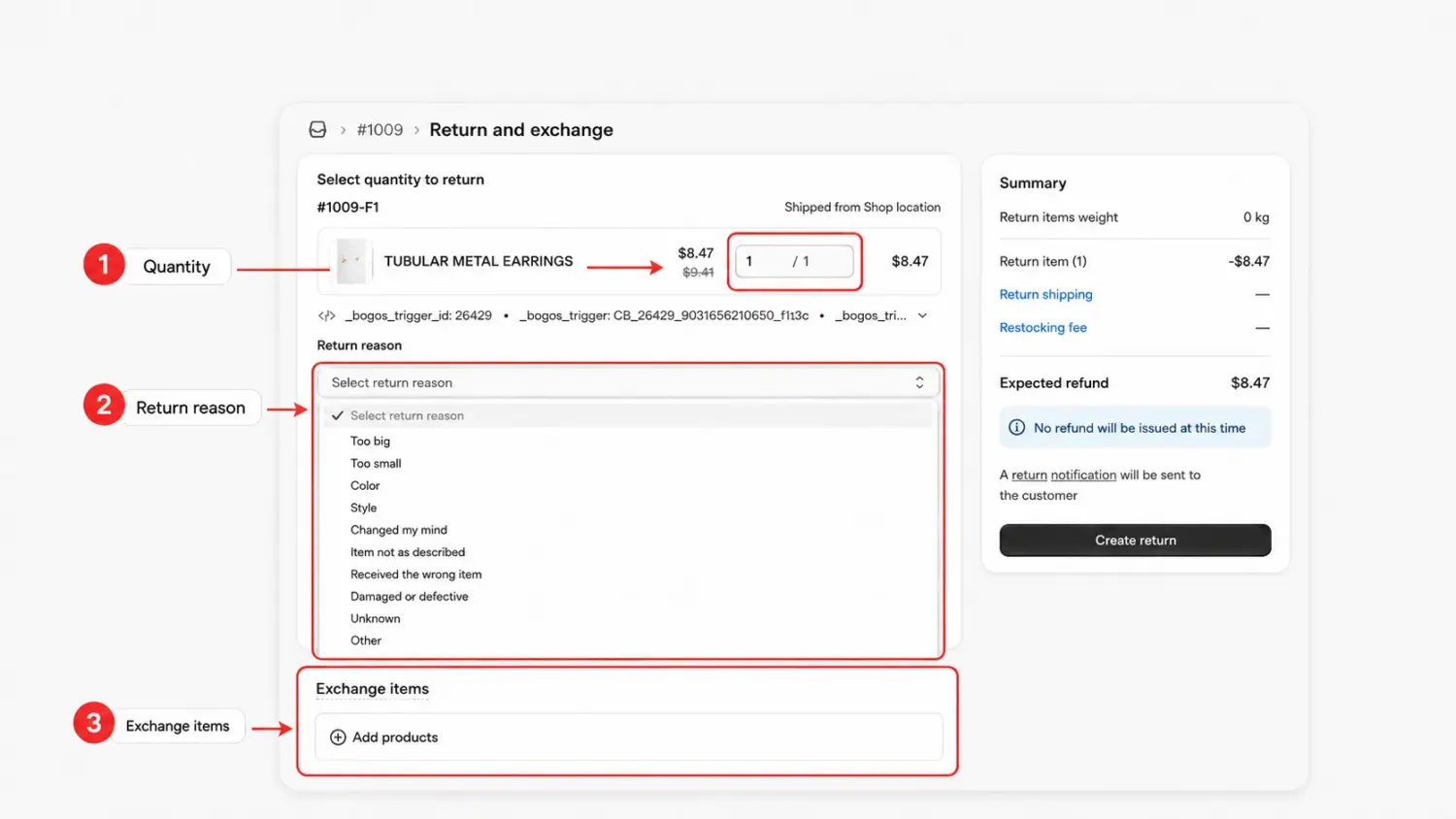
Step 2: Enter return details
Enter the quantity of each item being returned.
Choose a return reason from the drop-down.
To add an exchange, open the Exchange items section and select the swap.
Select the return quantity and reason, then add an exchange product when needed
Step 3: Handle shipping and fees
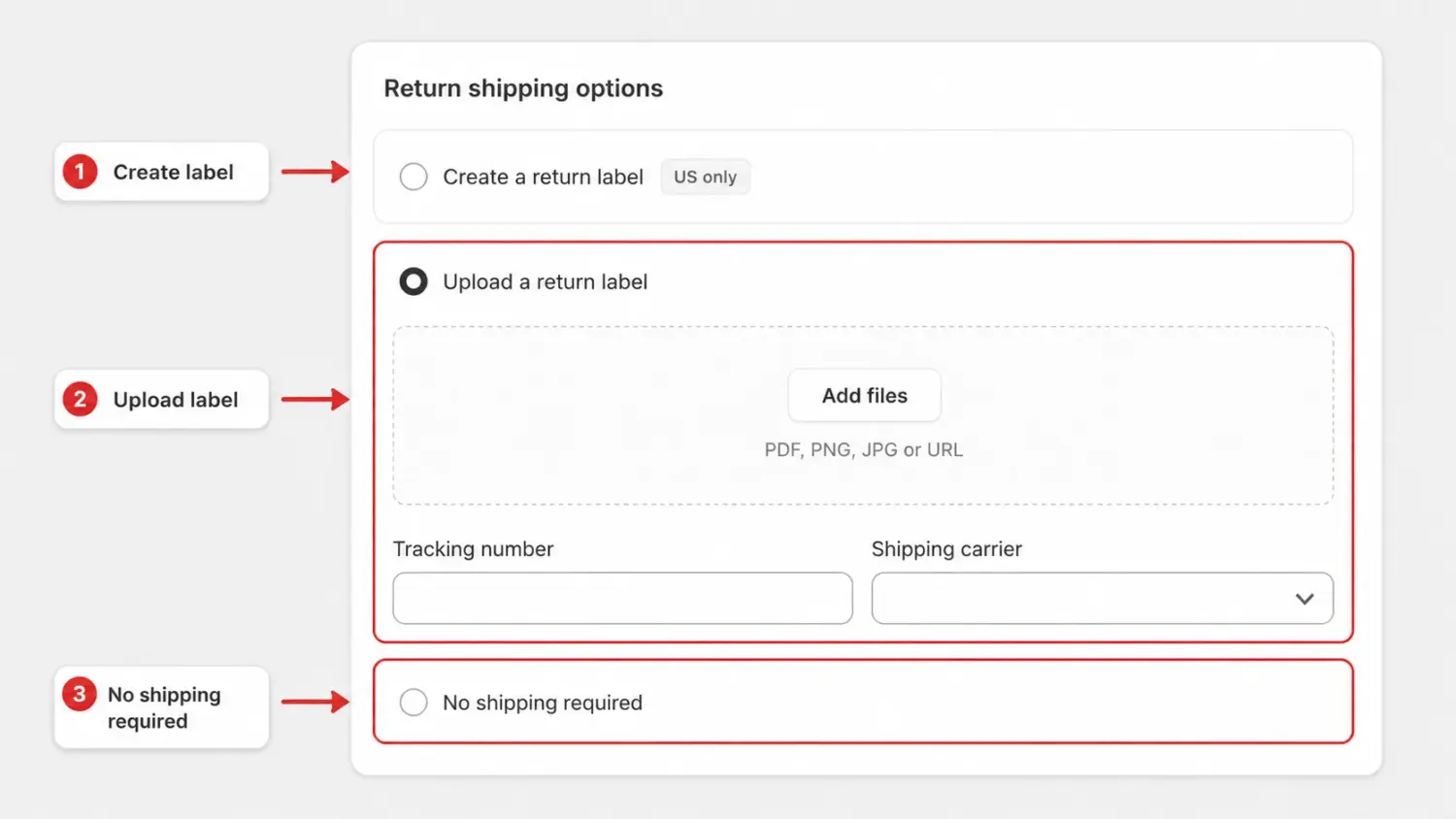
In the Return shipping options section, select one of the following options:
Option 1: Create a return label in Shopify to create a return shipping label for your customer
⚠️ Note: This option is available only if your primary location and customer shipping address are both in the United States.
Option 2: Select Upload a return label to upload an existing return shipping label for your customer.
⚠️ Note: You can upload a PDF, PNG, or JPEG file for your return label or add a return label URL. You can also enter a Tracking number and Shipping carrier.
Option 3: Select No shipping required to create a return without any return shipping information.
Choose whether to create a Shopify return label, upload an existing label, or require no shipping
In the Summary section, fill in the Return shipping or Restocking fee if your return rules contain it.
Double-check all information and click Create return.
Manual returns work at low volume. As orders grow, doing every return by hand eats your team’s time. Self-serve returns fix that by letting customers start the return themselves.
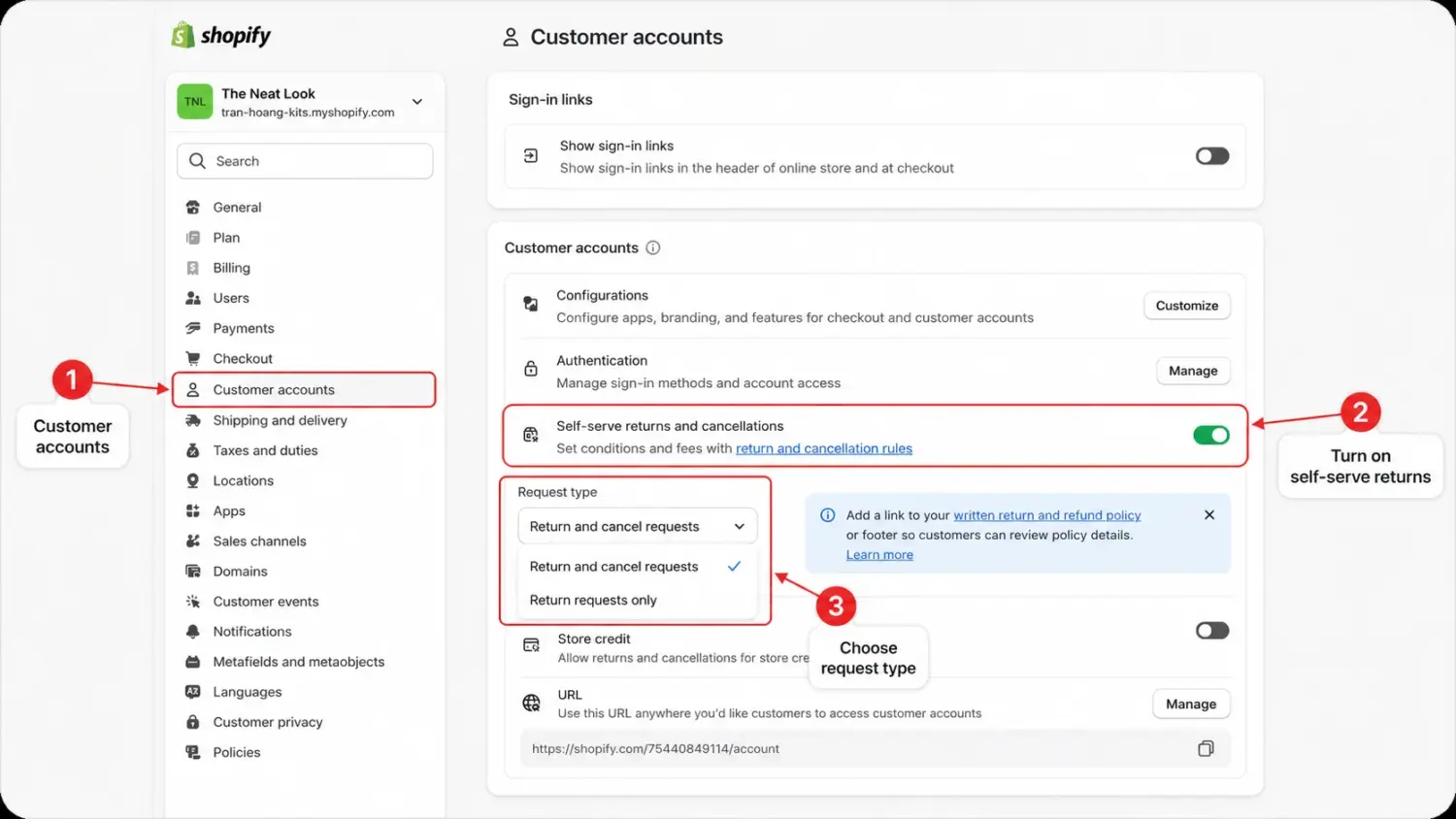
This is Shopify’s native returns portal, and it’s free. Turn it on in three moves:
Go to Settings > Customer accounts.
Turn on Self-serve returns and cancellations.
Choose what customers can request: Returns and cancel request or Return request only.
Once it’s live, customers open a return from their account or order status page. They pick the items, choose a reason, and submit. The request lands in your admin for approval, and your return rules decide what’s eligible before it ever reaches you.
3. Limitations Of Native Shopify Returns
Shopify’s built-in returns work fine when you get a few returns a week. When returns grow, the work grows with them. You do most of it by hand, and the tools start to slow you down.
Here are five signs you have outgrown them.
You handle every return by hand: Self-serve lets a customer ask for a return. After that, you do the rest. You approve it, make the label, receive the item, and send the refund. One by one. At 5 returns a week, that is easy. At 50, it eats hours you could spend selling.
Customers cannot swap sizes on their own: Self-serve returns do not support exchanges. So every size or color swap comes to you first. The easiest way to save a sale, a quick exchange, turns into manual work every time.
Your returns page looks nothing like your store. The native account page cannot match your theme. Your customer moves from your branded store to a generic page. It still works, but it looks less professional, and a consistent look is one small piece of what makes a store feel trustworthy.
You give cash back when you could keep the sale: Native Shopify return tools point straight to a refund. There is no built-in way to push an exchange or store credit first. So money leaves your store that a small nudge could have kept inside it.
You cannot see why people return: Each return reason sits inside its own order. Native reports will not add them up for you. So you never see the big picture, like 40 “too small” returns on one product, and you cannot fix the real cause.
NRF and Happy Returns estimate that retailers will handle $849.9 billion in returns in 2025, and 19.3% of online sales are expected to be returned. A poor return experience also hurts repeat sales: 71% of consumers say they are less likely to shop with a retailer again after a bad return experience.
So the question is not “Is Shopify bad at returns?” The better question is: “Has this process become too manual for the cost of each return?”
4. Streamline Your Returns Process With Shopify Return Apps
Every problem in the previous section- the manual work, the missing exchanges, the plain portal, the lost revenue- is exactly what a returns app fixes.
An app gives customers a branded self-serve portal, automates exchanges and store credit, and shows you why people return. You keep more revenue and hand less work to your team.
Three apps stand out. Here’s how they compare.
App name
Rating & Review
Pricing
Best for
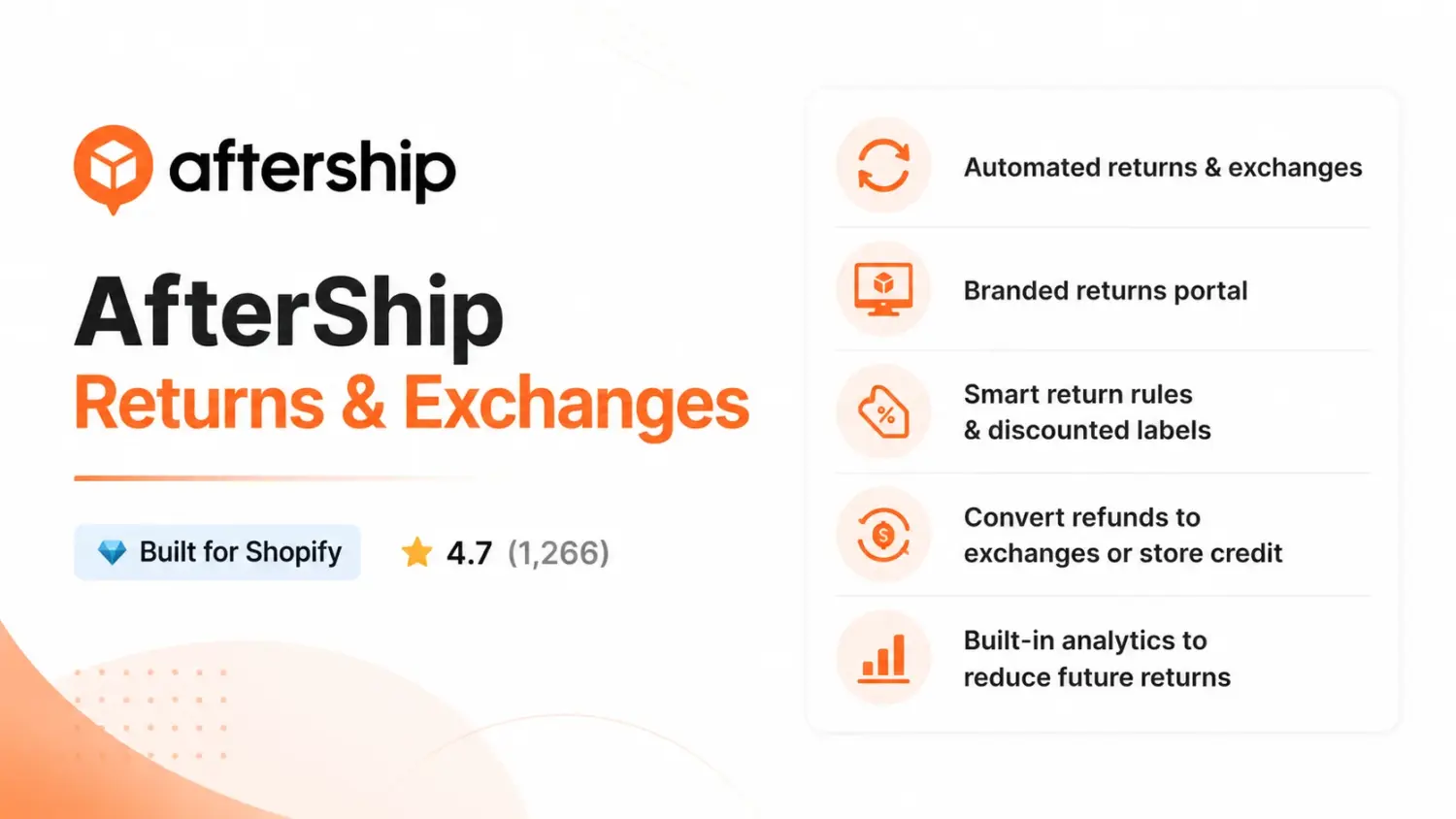
AfterShip Returns & Exchanges
4.7⭐ – 1260+
– Free plan available- Paid plans start from $19/mo
All-in-one omnichannel hub
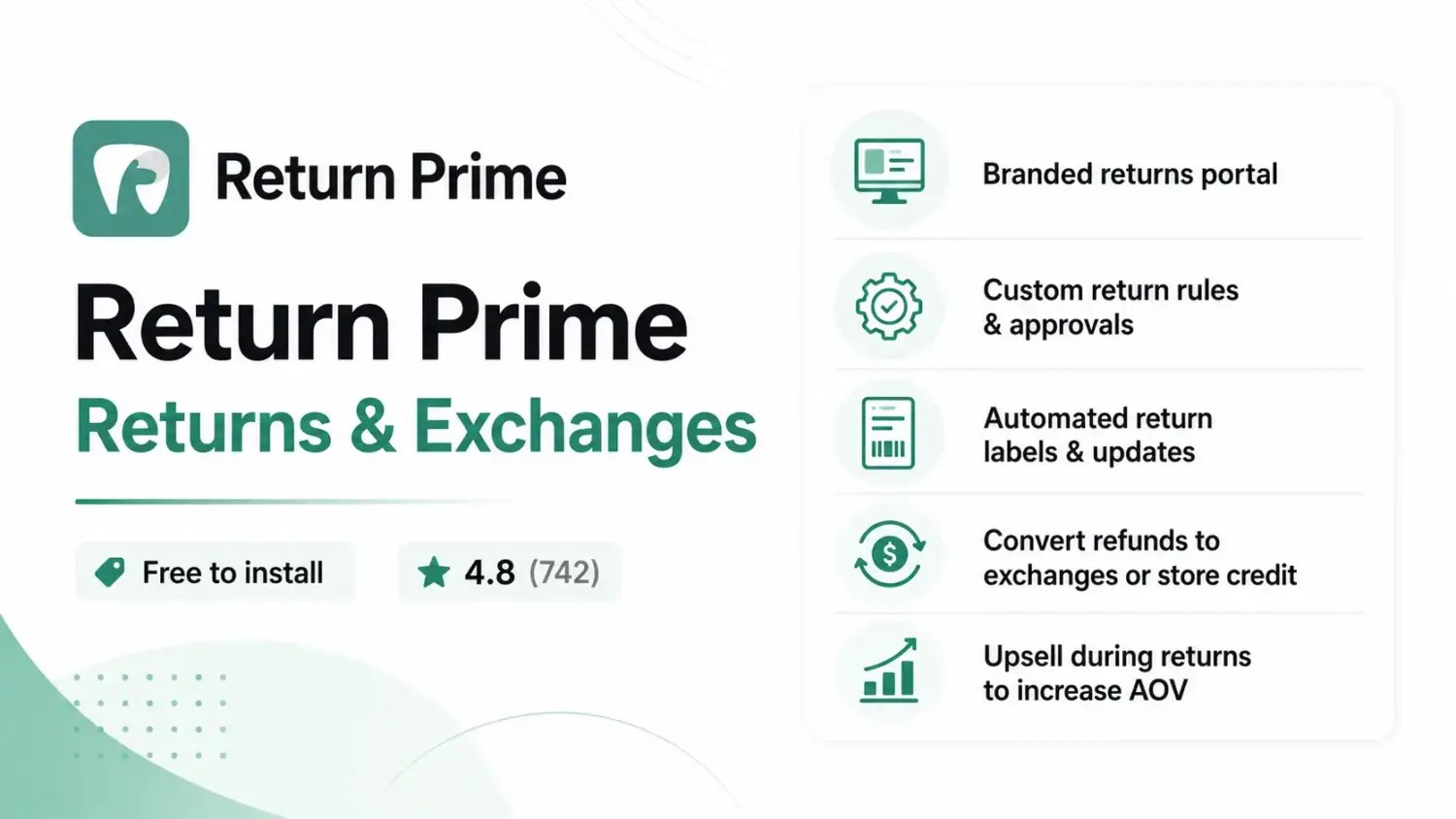
Return Prime: Return & Exchange
4.8⭐ – 740+
– Free plan available- Paid plans start from $19.99/mo
The most budget-friendly app with AI-driven exchange/fraud features
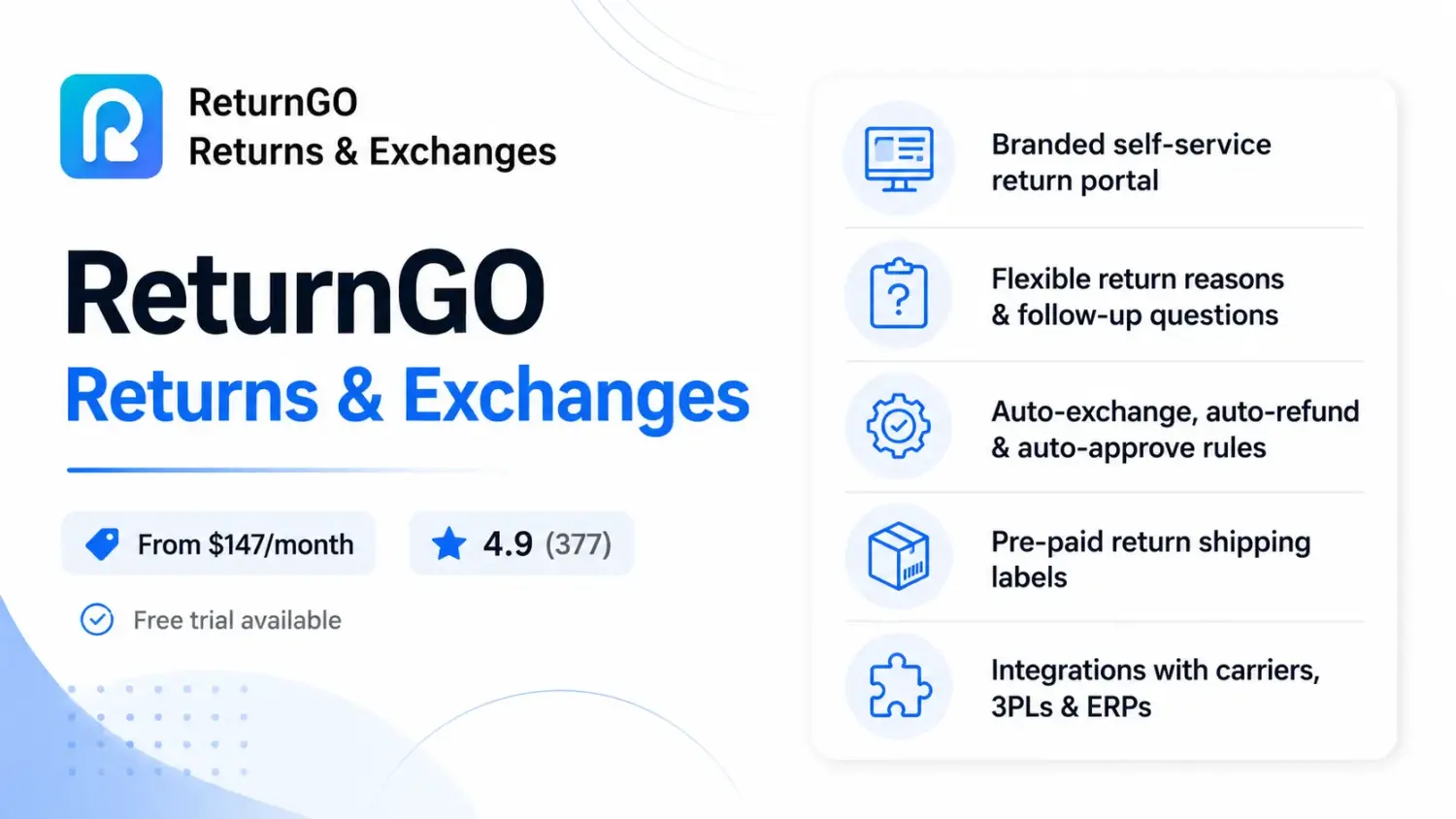
ReturnGO Returns & Exchanges
4.9⭐ – 370+
– No free plan available- Paid plans start from $147/mo
Exchange-first at high volume
App #1: AfterShip Returns & Exchanges
The most established name here, and the most reviewed. AfterShip Returns & Exchanges automates the full flow, plus actionable analytics to spot which products drive returns easily.
Pros:
Offers a wide range of automation conditions and carrier options.
Strong analytics
Easily fits the AfterShip stack
Cons:
Key features sit on higher tiers, and the jump from entry to automation plan is steep.
Some merchants report slow responses and a clunky exchange setup.
Best for: High-volume or multi-region stores that want a proven, all-in-one hub and can use the paid tiers.
App #2: Return Prime: Return & Exchange
The best value for stores stepping up from manual returns. Return Prime: Returns & Exchanges covers the essentials: a branded portal on your domain, exchanges, store credit, and labels, backed by 100+ integrations at a friendlier price.
Pros:
The free plan includes many essential features.
High praise for responsiveness; founder-level help shows up in reviews.
Cons:
Advanced reporting and multi-warehouse setups can need workarounds versus the other two.
A few merchants report stability and support hiccups.
Best for: Small to mid-size stores leaving manual returns behind that want most features without a premium price.
App #3: ReturnGO Returns & Exchanges
ReturnGO Returns & Exchanges is the highest-rated of the three. This app is built to steer customers toward an exchange or store credit before a cash refund, and its automation rules run deep.
Pros:
Prioritizes exchange-first to keep revenue in your store instead of refunding it out.
Deep customization by product, price, or country for precise control.
High-quality support, with many reviews praising fast, helpful responses.
Cons:
No free plan: paid from $147/mo, with per-return overage around $1.25, higher than some rivals.
The deep automation rules take time to set up, which smaller teams can find heavy.
Best for: Higher-volume or enterprise brands needing an “exchange-first” workflow with deep automation at a higher price.
5. 2 Smart Strategies To Turn Returns Into Repeat Sales
Returns are inevitable. Refunds are not. When an item comes back, the sale does not have to leave with it.
The opportunity is real. NRF and Happy Returns found that 76% of consumers are more likely to choose a return option that gives them an instant refund or exchange. In other words, the resolution you offer can shape whether the customer walks away or stays with your brand.
Two strategies below will do most of the work.
#1 Offer exchanges and store credit before a refund
A refund sends money out of your store. An exchange or store credit keeps it in. So make those the first options a customer sees, not the fallback.
Shopify itself notes that exchanges help retain revenue and can grow it through upsells when the new item costs more.
Two practical moves:
Lead with the exchange. When a customer starts a return, show the size or color swap first. Many returns are a fit problem, not a rejection of the product.
Sweeten store credit. Offer a little extra value on store credit versus a cash refund. The customer feels rewarded, and the money stays with you. This helps to protect your average order value instead of draining it.
#2 Win back returning customers with a surprise gift
Here’s a play most stores miss. A return is the moment doubt is highest, so it’s the perfect moment to earn the customer back. A small, unexpected gift on their next order can turn a return process into a reason to come back for a future purchase.
On that customer’s next order, BOGOS automatically adds the surprise gift to their cart.
The customer may expect a plain refund. But instead of ending the interaction there, you give them a small reason to come back. A surprise gift feels more generous. It creates a warmer moment right when the customer is deciding whether your store is worth another try.
You can also pair the gift with a comeback discount for extra pull. Done well, your returns process stops being a point where revenue leaks out and becomes a chance to bring customers back and increase repeat purchases
6. How to Lower Your Shopify Return Rate
You cannot stop every return, but you can reduce the avoidable ones. Most returns come from a few fixable causes: unclear product information, poor fit, damaged delivery, late arrival, or mismatched expectations.
To make that happen, focus on the parts of the buying journey:
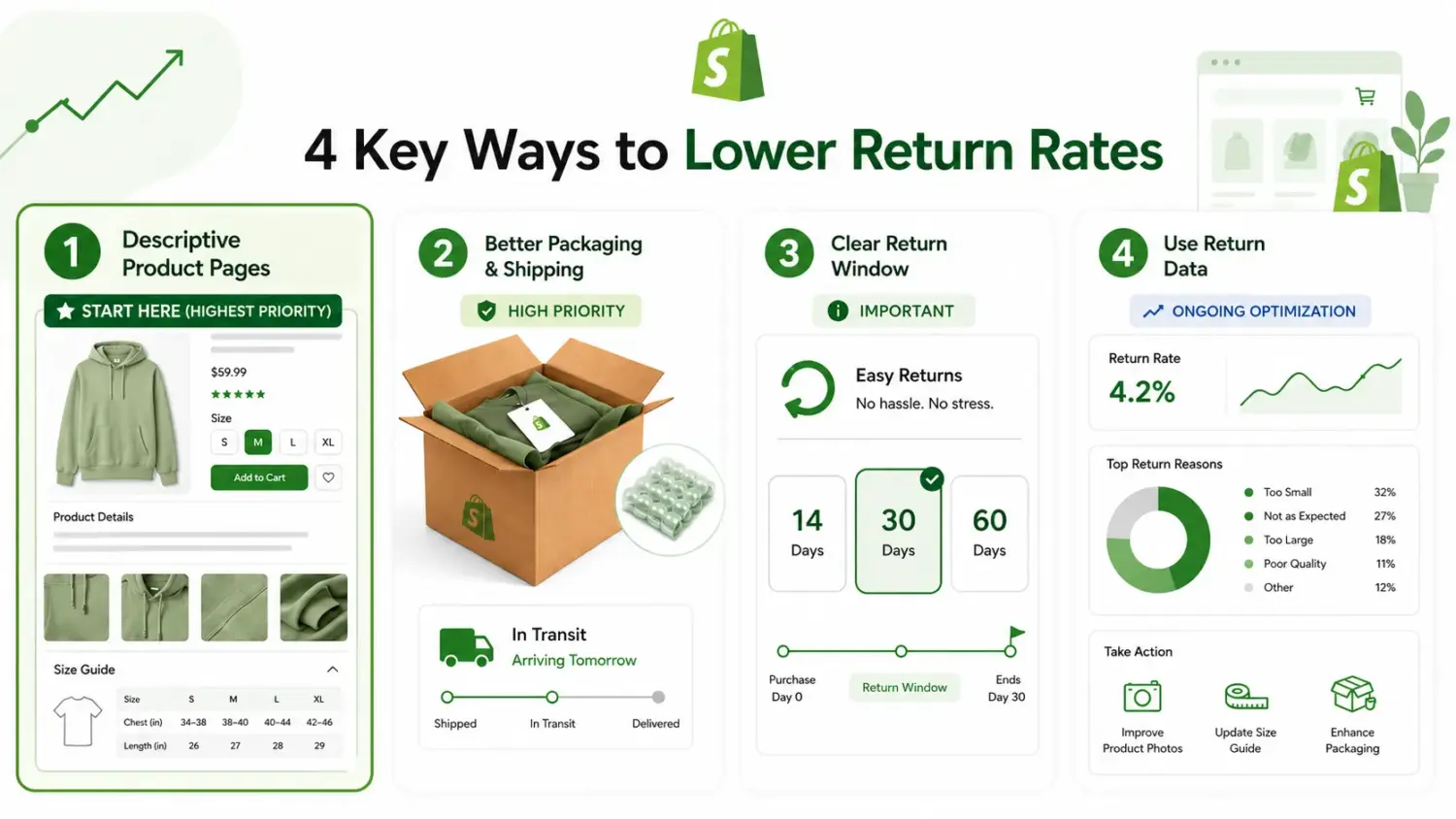
Reduce avoidable returns with clearer product pages, better shipping, a defined return window, and return data
Make product pages descriptive: Use clear descriptions, detailed images, and Shopify product videos to help shoppers understand what they are buying before they check out. If you sell apparel, add a real Shopify size chart, because fit is one of the biggest reasons customers return products.
Improve packaging and shipping: Right-sized, protective packaging helps reduce damage in transit. Clear delivery estimates and shipping updates also prevent “arrived too late” returns.
Set a clear return window: Choose a sensible timeframe, such as 14, 30, or 60 days, and state it clearly in your return policy. Mark final-sale items upfront so customers know exactly what can and cannot be returned.
Use return data, not guesses: Sort return reasons by volume and fix the top two. “Not as described” points to the product page, “wrong size” to sizing, “damaged” to packaging. For faster patterns, export your return data and let an AI tool group the reasons and flag your worst-returning products, so you know exactly what to fix first.
Conclusion
A return isn’t the end of a sale. It’s your last chance to keep the customer.
Shopify gives you the tools to do it: process returns from Orders, turn on self-serve, and add an app when you outgrow the basics. But the tools only matter if you use them right. Lead with exchanges and store credit instead of refunds, and the revenue stays in your store.
Handle the return well, and a cost becomes a second chance at boosting your Shopify sales. Turn on self-serve returns today, and make your next return the start of a repeat customer.
FAQs
#1 Does Shopify handle returns?
so customers file their own, set return rules, and email US return labels. Shopify also handles exchanges and store credit. A branded portal, customer self-serve exchanges, and deep analytics are where you’ll need a returns app.
#2 Does Shopify file sales tax returns?
No. Shopify helps you calculate and collect sales tax, but it doesn’t file or remit it, unless you use Shopify Tax automated filing, available for eligible US states.
#3 Can customers request returns themselves?
Yes. Turn on self-serve returns at Settings > Customer accounts, and customers can request from their account or order status page.
#4 What is a good return rate on Shopify
It depends on what you sell. Apparel runs highest at 20-30% because of fit and sizing, while beauty and electronics sit lower. The overall online average is near 19.3%. Benchmark against your own category, not a flat cross-category number.
#5 How do I reduce returns without hurting sales?
Fix the causes, not the symptoms. Make product pages descriptive, add size guides for apparel, improve packaging to cut damage, and use your return-reason data to fix the top offenders. Then lead with exchanges and store credit so an unavoidable return still keeps revenue in your store.