


Charlie Ngo
•
Last updated: 14 October, 2026
How To Add a Shopify Announcement Bar (Free Themes & Apps)
A Shopify announcement bar is the thin strip at the top of your store that tells shoppers about shipping,...
2026 Shopify promotion data: what 31,770 offers across 882 stores reveal

Marketing Manager
Summarize this post with AI
Most Shopify merchants run promotions, but few know how their setup compares to what’s actually working across hundreds of stores:
“Which offer types dominate? What spending thresholds do the highest-revenue stores set? Which combinations separate growing stores from stagnant ones?“
We analyzed 31,770 live offers across 882 Shopify stores using exclusive data from our app, BOGOS: Free Gift Bundle Upsell. The dataset covers four core offer categories, including free gifts, discounts, bundles, and upsells. All will be broken down by revenue tier so you can see exactly where high-revenue stores invest compared to mid-revenue and low-revenue stores.
This report analyzes data from 882 Shopify stores using the BOGOS: Free Gift Bundle Upsell app to run promotions. Together, these stores created 31,770 offers across 4 categories, including free gifts, discounts, bundles, and upsells.
We grouped stores into three revenue tiers, high, medium, and low, based on the revenue generated through BOGOS offers. Each finding is broken down by tier to show how promotion strategies differ across store performance levels.
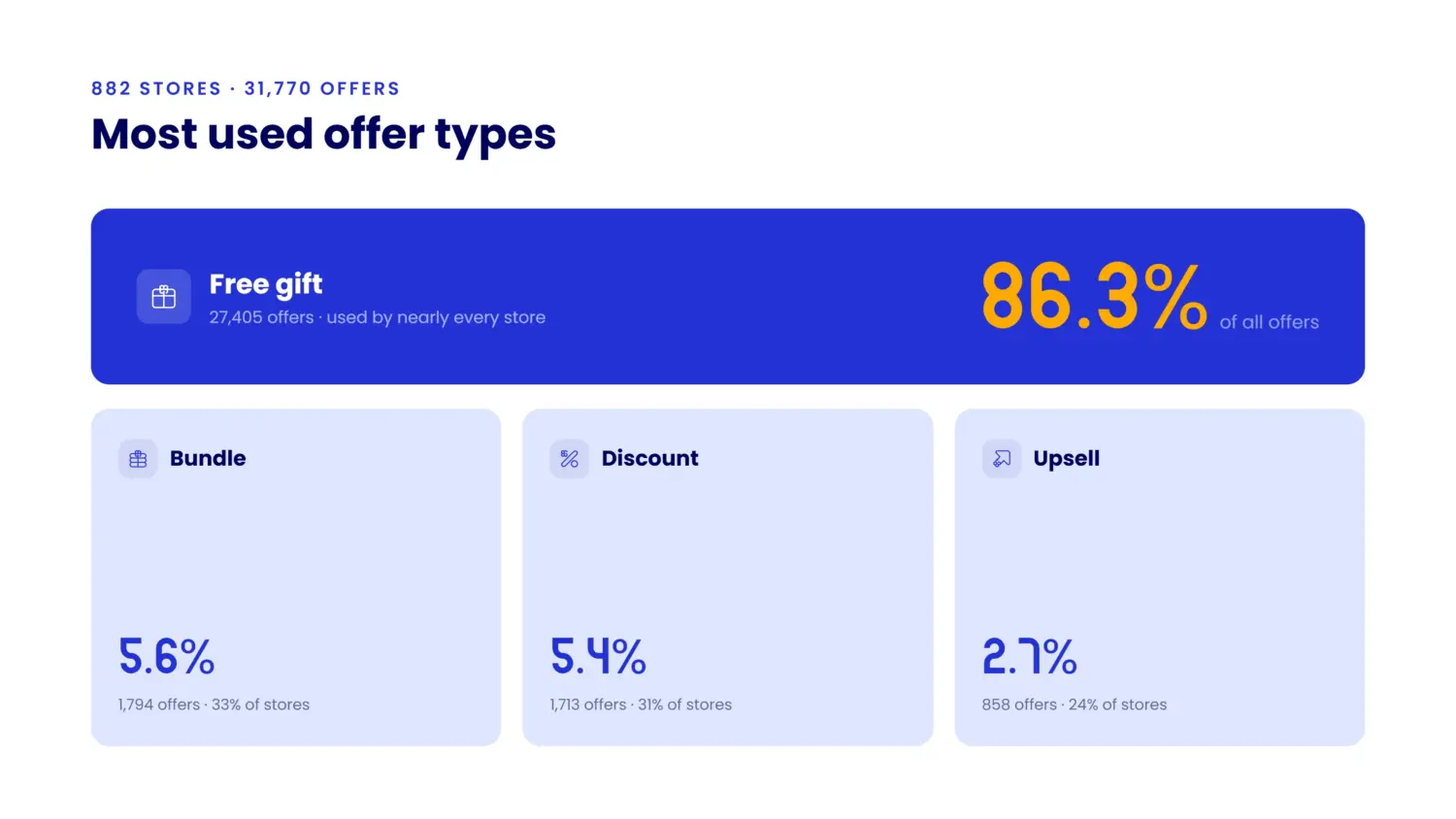
Across all 882 stores, 97.8% run at least one free gift offer. Among high-revenue stores, adoption reaches 100%.
The gap between free gifts and every other offer type is significant:
The three most adopted free gift mechanics are:
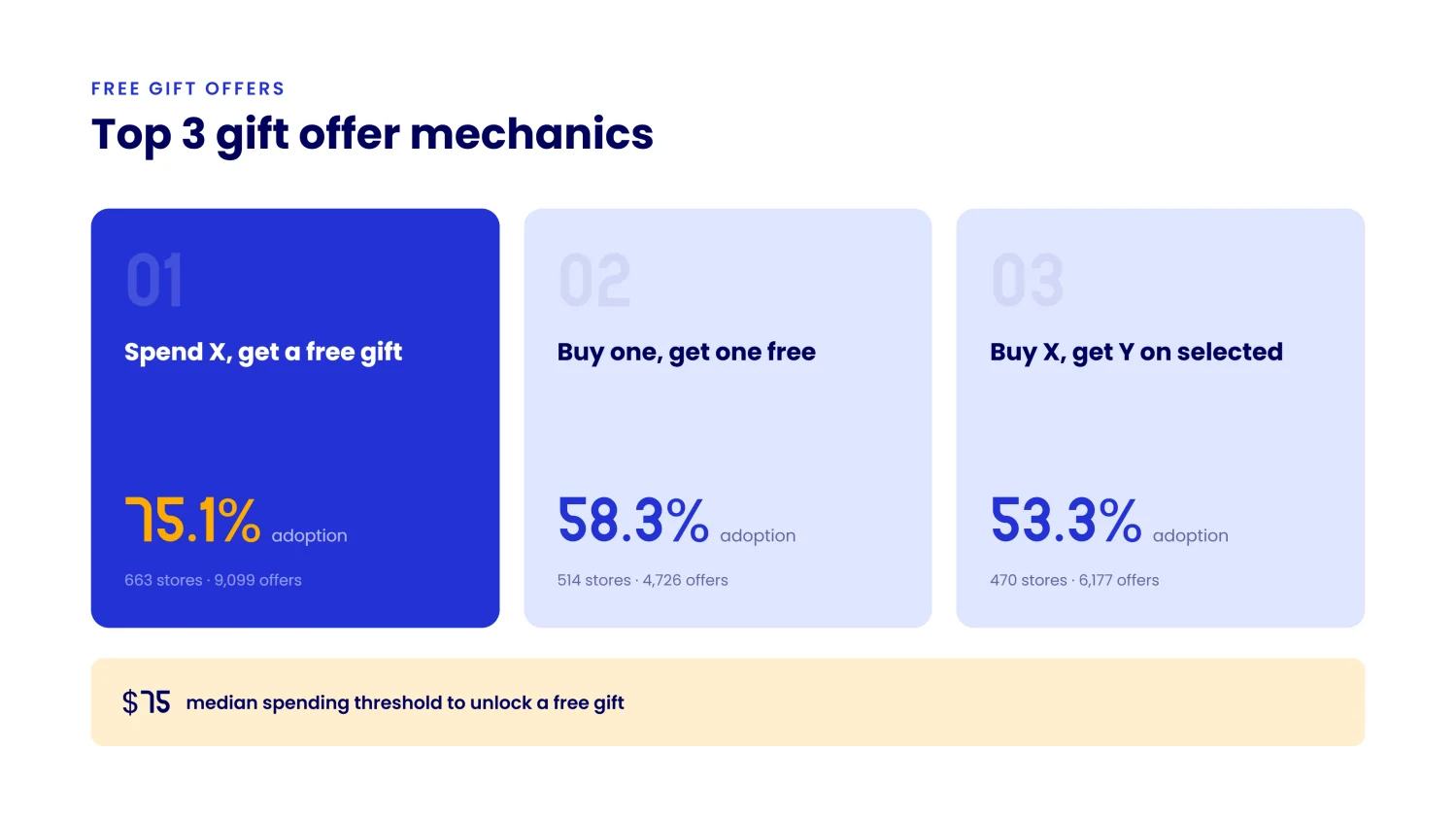
The median spend required to unlock a free gift is $75 across all stores, but thresholds vary by revenue tier:
The pattern is clear: higher-revenue stores tend to set higher spending thresholds, while low-revenue stores make gifts easier to unlock.
Quantity requirements show a similar difference. Among high-revenue stores, 78.2% of gift offers require just 1 item to qualify. For low-revenue stores, that falls to 65.8%, while 18.5% require 2 items.
This suggests low-revenue stores rely more on quantity-based triggers to encourage shoppers to add more products before unlocking a gift.
Most stores keep gift claiming simple: shoppers choose one gift, and the reward is then added to the cart automatically.
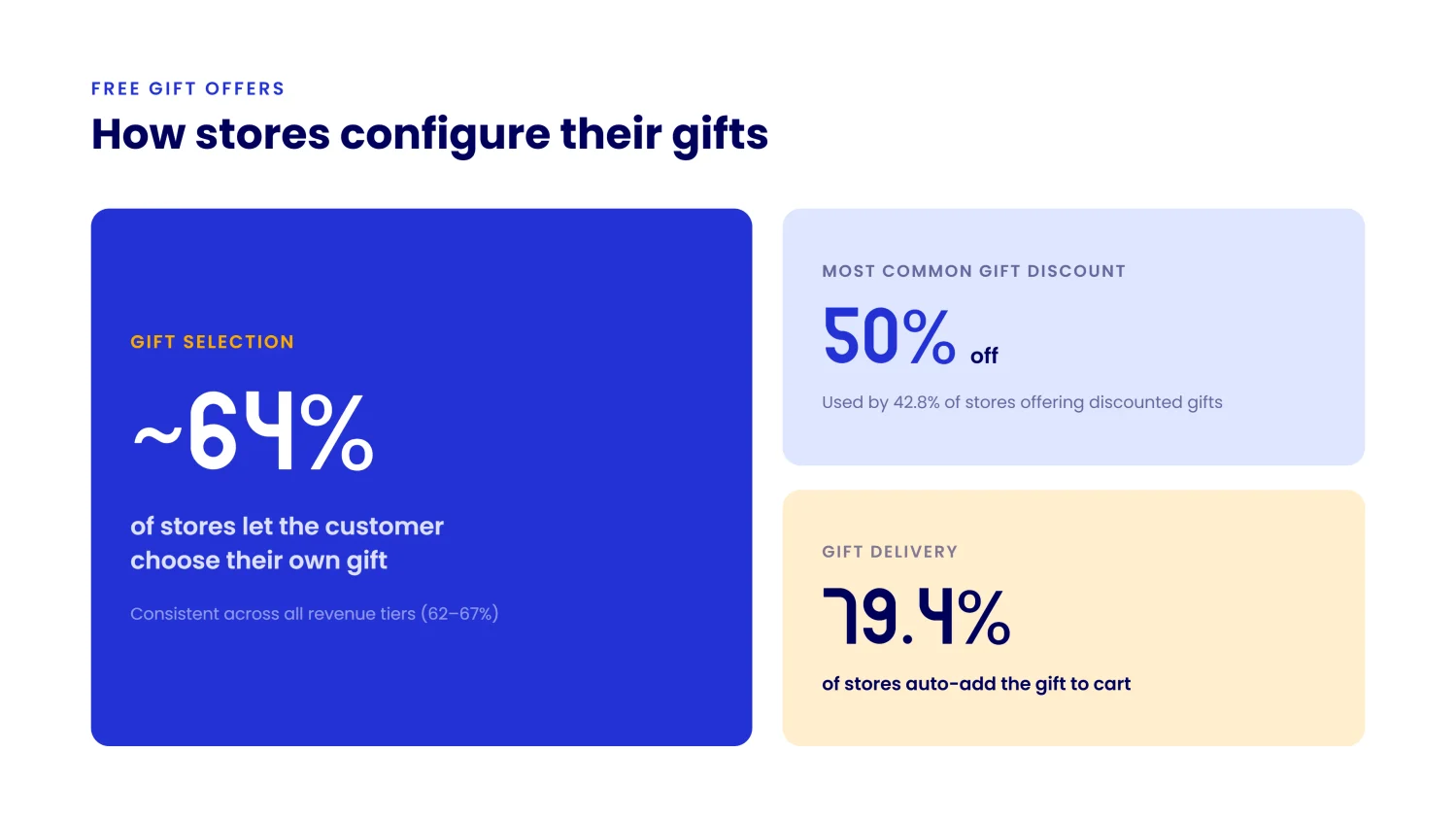
Choose 1 Gift is the most adopted selection method at 63.8% overall, leading across every revenue tier:
Other selection methods are less common:
Selection and delivery are different steps. While Choose 1 Gift leads as the selection method, 79.4% of stores use auto-add as their primary reward delivery method. This means shoppers can choose the gift they want, then have it added to the cart automatically.
For discounted gifts, 50% off is the clear favorite, accounting for 42.8% of discounted gift offers across 76 stores.
Other common discounts include:
Gift values typically fall between $14 and $22, showing the range stores most often use for these rewards.
Among stores that pair free gifts with another promotion, volume discounts are the most common choice, used by 30.5% of stores.
Volume discounts reward shoppers for buying more units. This works well for repeat-use products like shampoo or moisturizer, where buying two or three at once can feel natural.
Among volume discount offers, percentage discounts dominate, accounting for 58.5% of offers across 218 stores.
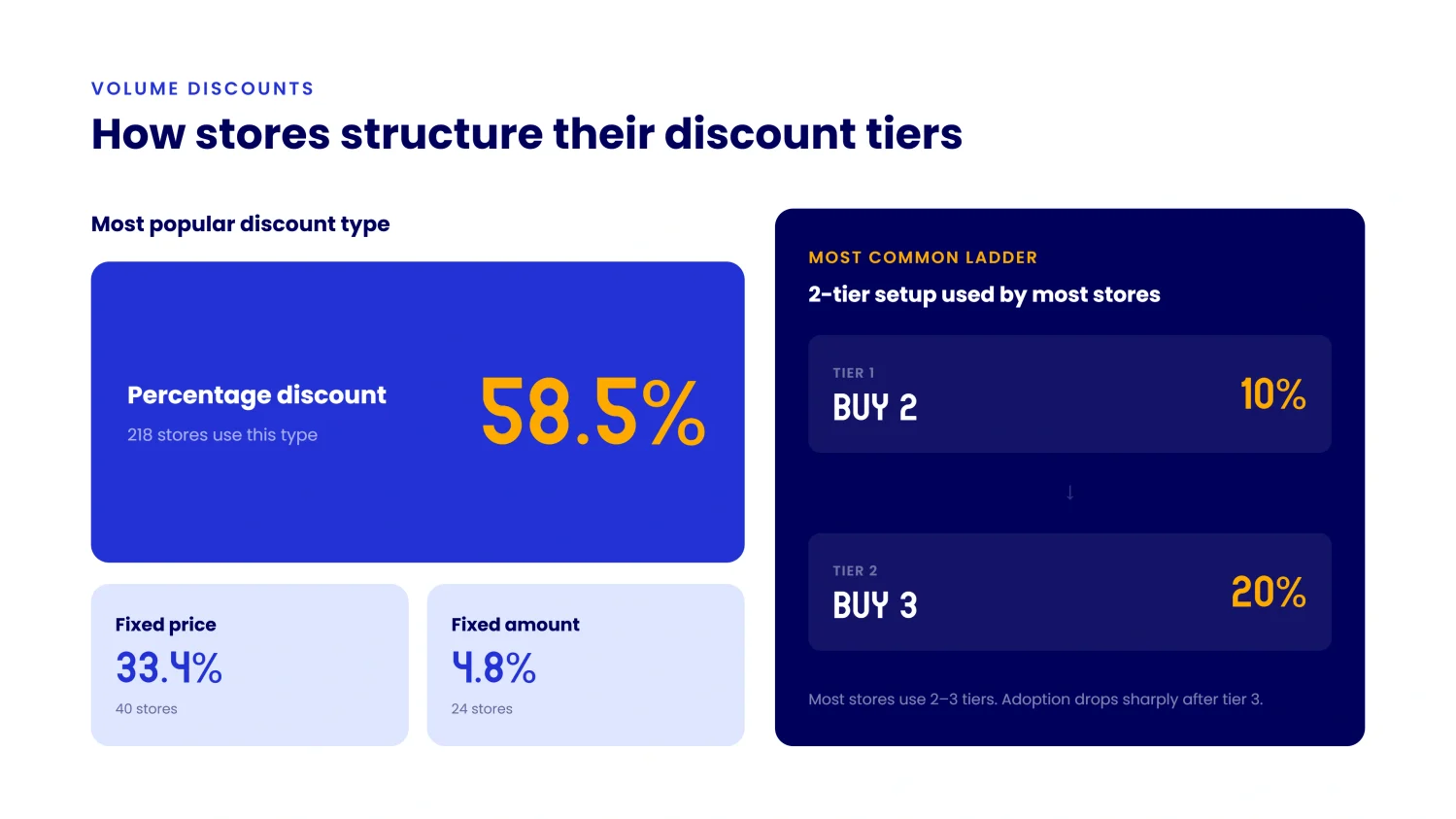
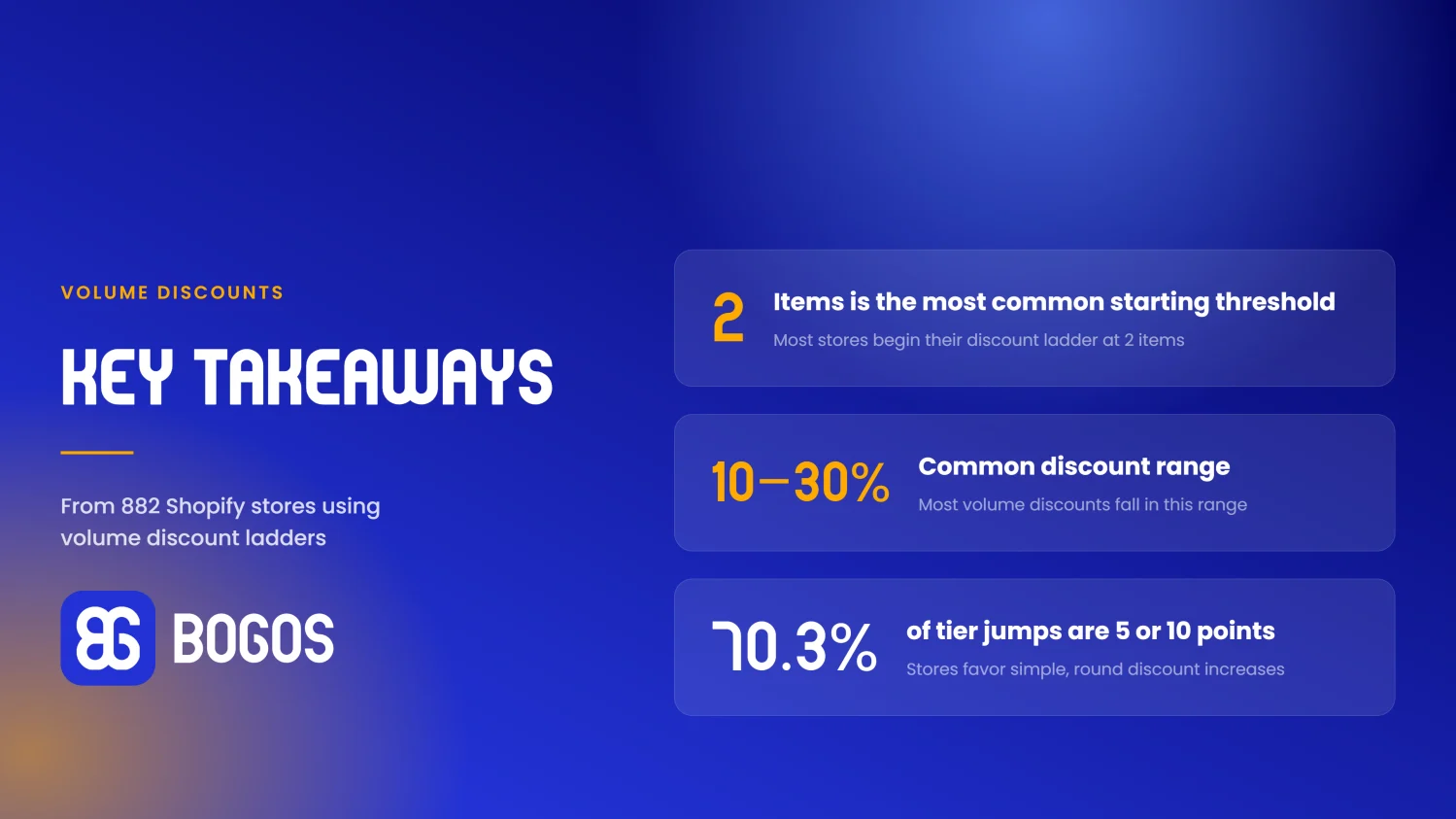
Most stores keep volume discount ladders short: 2 to 3 tiers, usually starting at 2 items and increasing discounts in simple 5- or 10-point steps.
Across the dataset, 70.3% of tier increases are either 5 or 10 percentage points, showing that stores favor simple, easy-to-understand jumps.
Typical discounts by quantity are:
One of the most common ladders is:
Buy 2 → 20% off
Buy 3 → 30% off
Most setups stop at 2 or 3 tiers:
Adoption drops sharply after Tier 3. The data suggests stores do not need long discount ladders. A simple 2- to 3-tier structure is far more common.
Beyond gifts and volume discounts, stores use bundles and upsells to grow cart value at different stages of the buying journey.
Bundles are the second most adopted offer type after free gifts, used by 35.6% of stores. Mid-revenue stores lead adoption at 37.1%.
Adoption by revenue tier:
This suggests bundles play a bigger role for mid- and low-revenue stores, while high-revenue stores rely less on them.
By bundle type:
Adoption is close across all three formats, but fixed bundles generate far more offers, making them the most widely used bundle format in practice.
Upsells are the least adopted main offer category at 24.7%, but checkout upsells show one of the clearest gaps between revenue tiers.
The biggest signal is at checkout: high-revenue stores are much more likely to use upsells at the highest-intent point of the purchase journey.
Part of that gap may come from access, since checkout upsells depend on Shopify plan and setup. But the data still shows a clear pattern: as revenue rises, checkout becomes a more important upsell placement.
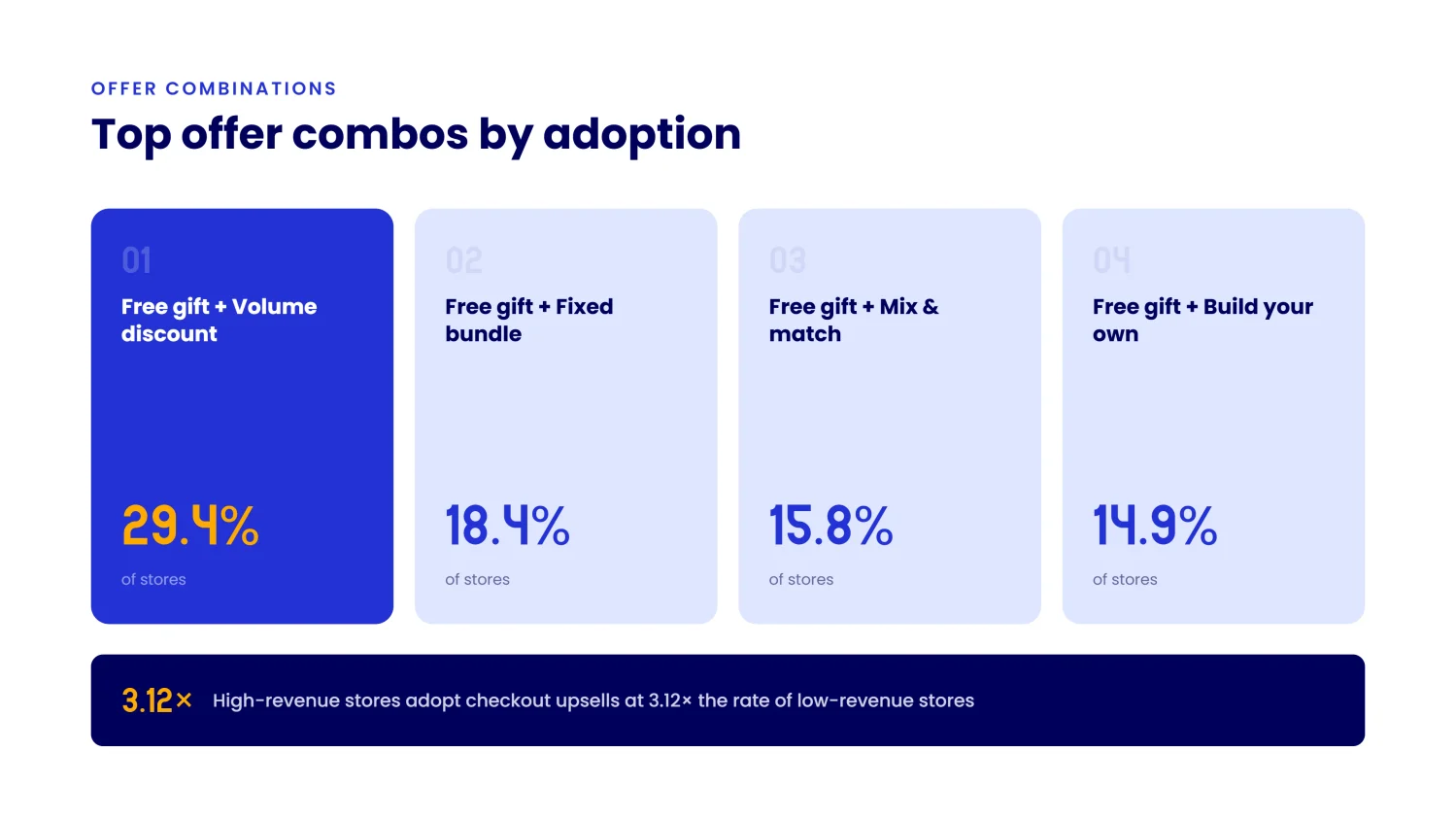
Free Gift + Volume Discount is the most adopted combo, while Free Gift + Checkout Upsell shows the strongest gap between high- and low-revenue stores.
Top offer combinations by adoption:
The pattern is clear: volume discounts are the most common way stores extend a free gift strategy, while checkout upsells become much more prominent among high-revenue stores.
The clearest pattern across 882 stores is simple: start with free gifts, then layer in volume discounts and upsells as the promotion stack expands.
Free gifts dominate across every revenue tier. Volume discounts are their most common companion, while checkout upsells show the strongest adoption gap between high- and low-revenue stores.
The data also gives stores a practical benchmark to start from:
These are not rules for every store, but they show how hundreds of stores structure their promotions today. Use them as a starting point, then adjust based on your products, margins, and customer behavior.

A Shopify announcement bar is the thin strip at the top of your store that tells shoppers about shipping,...
Australia is one of the first markets many Shopify stores expand into. It is large, English-speaking, and home to...
Canada is a promising international market for Shopify merchants, especially those shipping from the US. But reaching Canadian shoppers...