

Charlie Ngo
•
Last updated: 20 October, 2026
Shopify Collections: How To Create & Organize Them (2026)
Shopify collections decide how shoppers find your products, yet many guides still describe a setup Shopify is now replacing....
Shopify BOGO: How to Set Up Buy One Get One (+ Best Apps)

Digital Marketing Specialist
Summarize this post with AI
BOGO (Buy One Get One) is one of the most recognized promotion formats in ecommerce. Customers understand the deal instantly: buy a product, get a second one free or at a discount. That simplicity is why BOGO consistently outperforms percentage-off discounts for clearing inventory and driving multi-unit purchases.
On Shopify, BOGO falls under the “Buy X Get Y” discount type. You can set one up for free using Shopify’s native discount engine, but there are real limitations. The biggest: the free item doesn’t auto-add to cart, and “same product” matching requires manual setup for every product in your catalog. This guide covers both the native method and app-based solutions so you can pick the setup that fits your store.
What you’ll find here: BOGO types, when to use them, step-by-step native setup, the best BOGO apps, customer eligibility targeting, and common mistakes to avoid.
TL;DR
A BOGO (Buy One Get One) promotion gives customers a second product, free or at a discount, when they purchase a qualifying item. It’s one of the most direct ways to increase units per transaction, because the offer is immediately clear: buy this, get that.
On Shopify, BOGO is categorized under the Buy X Get Y discount type. You’ll find it in your Shopify admin under Discounts → Create discount → Buy X Get Y. The “X” is what the customer must buy (the trigger), and the “Y” is what they receive at a discount (the reward). Both can be specific products, variants, or entire collections.
One important distinction: “same product” BOGO vs “different product” BOGO. A same-product BOGO means the customer buys one unit and gets another unit of the same item (e.g., buy one t-shirt, get a second t-shirt free). A different-product BOGO pairs two distinct items (e.g., buy a shampoo, get a conditioner free). Both are valid setups, but they behave differently in Shopify’s discount engine, and the same-product version is significantly harder to set up natively at scale.
You’ll also see BOGO referred to as BXGY (Buy X Get Y), Buy One Get One Free, or Buy One Get One Half Off. These are all variations of the same mechanic. The difference is the discount amount on the second item, not the structure of the offer.
For a complete breakdown of all Buy X Get Y promotion types on Shopify, including “Buy 2 Get 1 Free,” collection-based BXGY, and tiered BXGY, see our “Shopify Buy X Get Y“ guide.
Not all BOGO offers work the same way. The discount structure you choose affects your margins, your messaging, and how customers perceive the deal. Here are the six most common BOGO formats on Shopify.
💡 How to choose: If your goal is maximum perceived value and you can absorb the cost, Buy One Get One Free is the strongest offer. If margin matters, 50% off the second item is the most common middle ground. If you sell consumables and want larger orders, Buy 2 Get 1 Free pushes customers past the single-unit habit. If you want to encourage bulk purchasing with no cap, Multiplied BOGO lets customers scale the deal on their own. Start with one format, test for 2-4 weeks, and measure the impact on units per order and margin per order before expanding.
BOGO is a strong promotion format, but it’s not the right fit for every product or every goal. Understanding when BOGO works and when another strategy makes more sense helps you avoid wasting margin on a deal that doesn’t move the needle.
BOGO works well when:
When another promotion type is a better fit:
💡 If your goal is to move more units of the same product or a closely related product, BOGO is the right mechanic. If your goal is lifting total cart value across your catalog, consider a “gift with purchase” or “product bundle” strategy instead.
Shopify’s built-in discount engine supports BOGO through the “Buy X Get Y” discount type. You can set this up as an automatic discount (applies at checkout without a code) or a discount code (customer enters a code to activate). The setup is free and takes about five minutes.
Tip: After saving, test the full flow on your storefront. Add the trigger product to cart, then add the reward product, and verify the discount appears at checkout. If you’re using an automatic discount, the discount line should appear automatically once both items are in the cart.
Shopify’s native Buy X Get Y works for basic BOGO setups. But there are two major limitations that become deal-breakers as your catalog or promotion strategy grows.
Other limitations to be aware of:
If your store has more than a handful of products, or you want the free item added to cart automatically, a dedicated app solves both problems.
A dedicated BOGO app fixes the two biggest native limitations (auto-add to cart and automatic product matching) while adding storefront widgets, advanced targeting, and analytics. But not all BOGO apps are built the same. Here’s what to look for and how we evaluated the top options.
When choosing a BOGO app, these are the criteria that matter most:
1. Same-product and different-product BOGO support (including bulk setup). This is the most important capability. The app should handle both “buy product A, get product B” and “buy any product, get the same product free” without requiring manual pairing for every SKU. If your store has a large catalog, you need an app that lets you set one rule for same-product BOGO across all products or an entire collection, not one rule per product.
2. Customer eligibility and targeting rules. Shopify’s native discounts only support “all customers” and basic customer segments. A strong BOGO app adds customer tag targeting, geo-location rules, order history conditions (first-time vs returning, X+ previous orders), sales channel filtering (online, POS, mobile), and URL-based triggers (magic links). The more targeting options, the more precisely you can run exclusive deals without discounting for everyone.
3. Booster features for storefront promotion. A BOGO offer that nobody sees is a wasted discount. Look for apps that include promotion tools: a progress bar showing how close the customer is to qualifying, product page badges or banners, a global “today’s offers” block, cart drawer notifications, and dedicated offer pages. These features solve the visibility problem that native Shopify discounts can’t address.
4. Auto-add to cart. The gift or discounted item should appear in the customer’s cart automatically the moment they qualify. No manual searching, no extra steps. This is table stakes for any BOGO app.
5. Analytics and reporting. You should be able to see how many times the BOGO was triggered, how it affected AOV, and which products are most commonly paired. Without this, you’re guessing whether the promotion is actually working.
6. Pricing and value. Does the app offer a functional free plan for testing? Are paid tiers reasonable for the feature set? Is the pricing predictable as your store grows?
| BOGOS | BOGO+ | AOV.ai | |
|---|---|---|---|
| Best for | All-in-one promotions (BOGO + GWP + bundles + upsells) | Budget-friendly BOGO | AI-powered product recommendations |
| Rating | 5.0 ⭐ (3,370+ reviews) | 4.9 ⭐ (1,300+ reviews) | 5.0 ⭐ (340+ reviews) |
| Pricing | Free plan available; up to $109.99/month | Free plan available; from $12.49/month | Free to install; from $19/month |
| BOGO types | Same product, different product, collection-based, tiered BXGY, multiplied | Same product, different product, collection-based | Same product, different product, AI-suggested pairs |
| Bulk same-product setup | ✅ One rule for entire catalog/collection | ✅ | ✅ (AI-matched) |
| Auto-add gift to cart | ✅ | ✅ | ✅ |
| Progress bar | ✅ | ✅ | ✅ |
| Storefront widgets | Global offer block, gift icon, offer page, product page badge | Product page badge | Product page widget |
| Advanced targeting | Geo-location, customer tags, order history, sales channel, magic links | Limited (product/collection rules) | Cart value, product-based |
| Other promotion types | GWP, bundles, upsells, volume discounts | BOGO only | Upsells, cross-sells, volume discounts |
| POS support | ✅ | ❌ | ❌ |
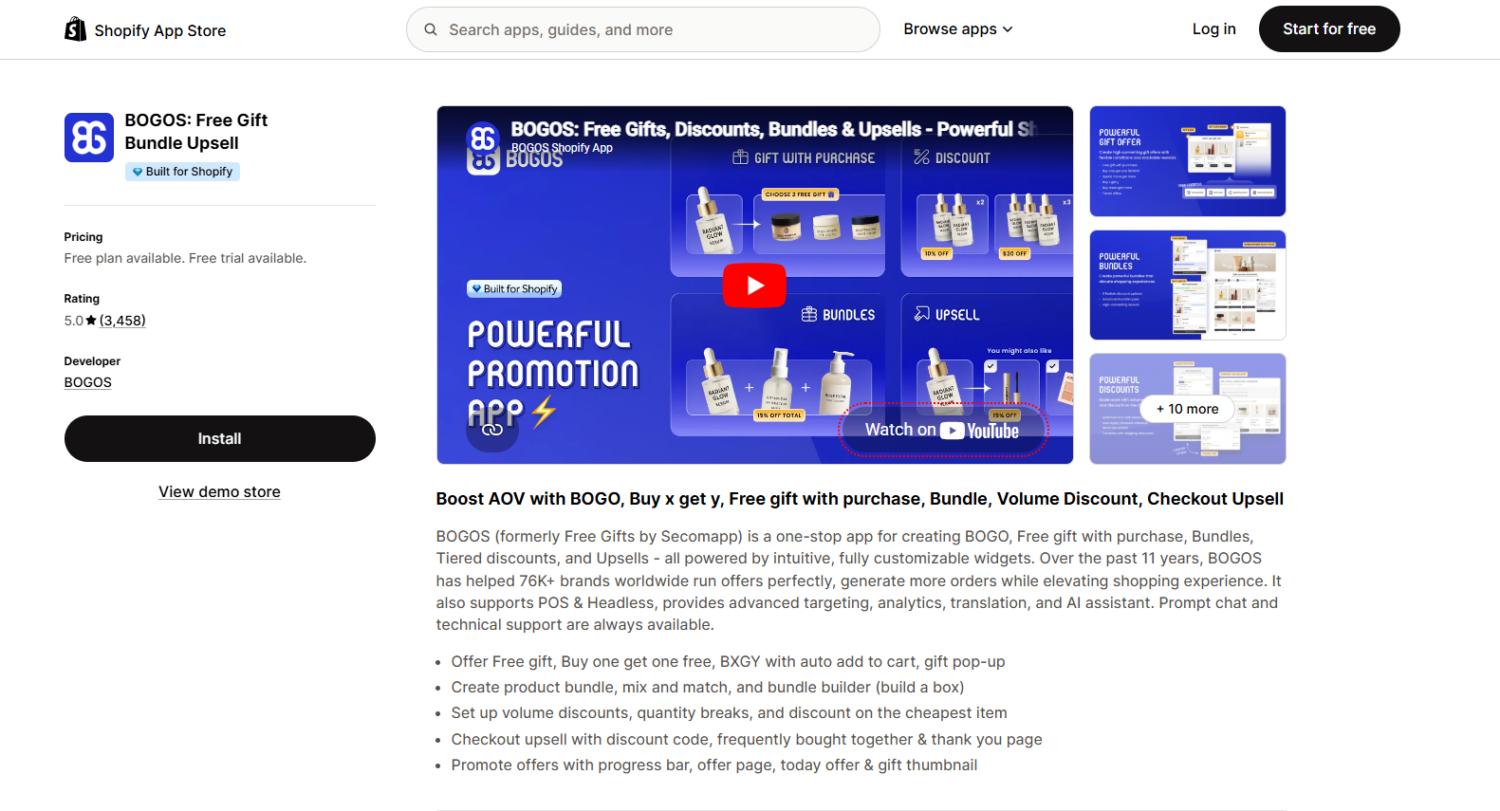
BOGOS stands out as the top choice for running BOGO promotions on Shopify. It offers the widest range of options to customize your BOGO offers based on your specific promotion goal and strategy: same-product, different-product, collection-based, tiered, and multiplied BOGO.
What makes BOGOS the top pick:
The biggest trade-off is price: BOGOS is the most expensive option on this list, with paid plans up to $109.99/month. But for growing stores that need scalable, full-featured promotion management, it’s worth serious consideration.
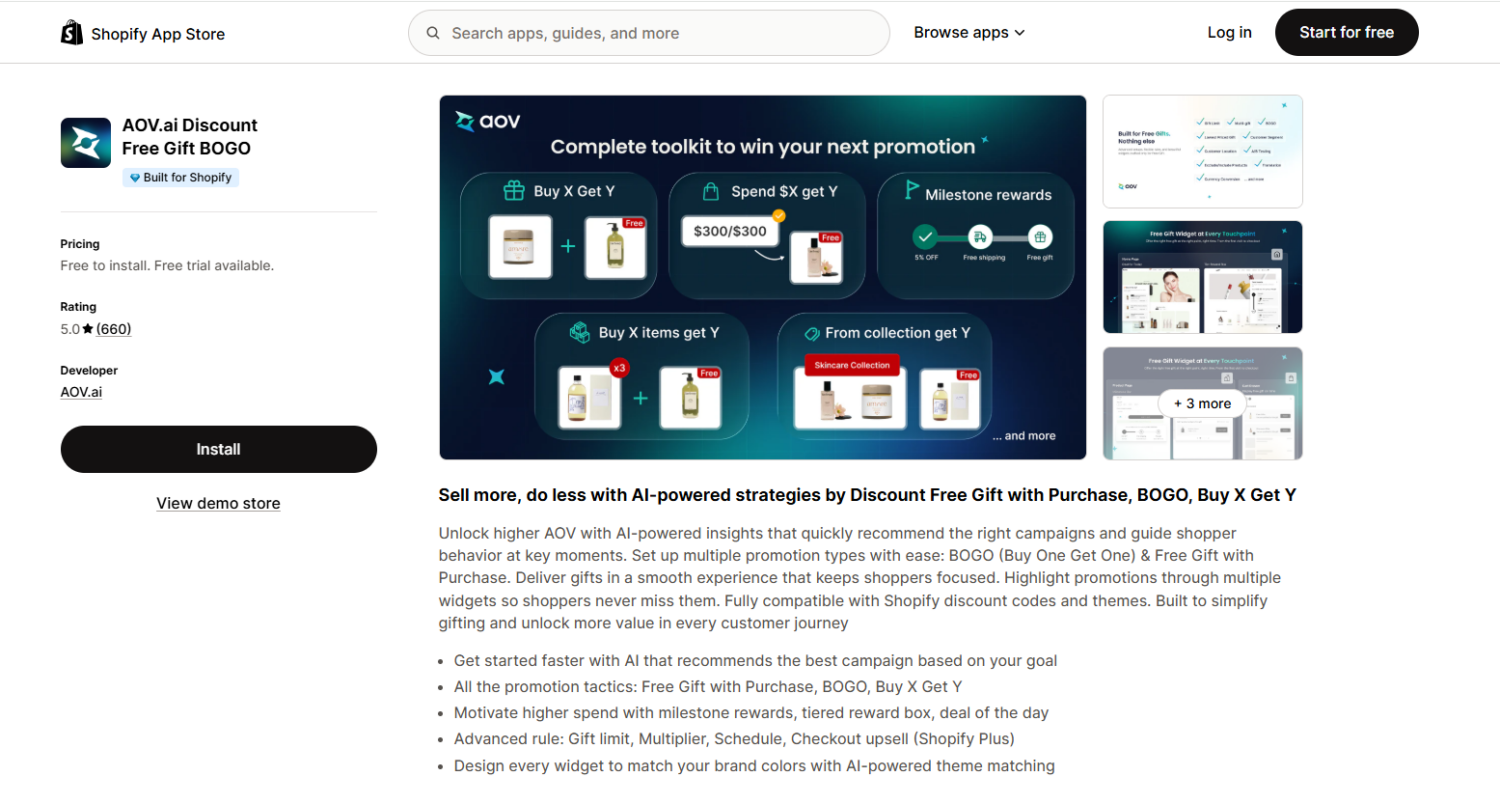
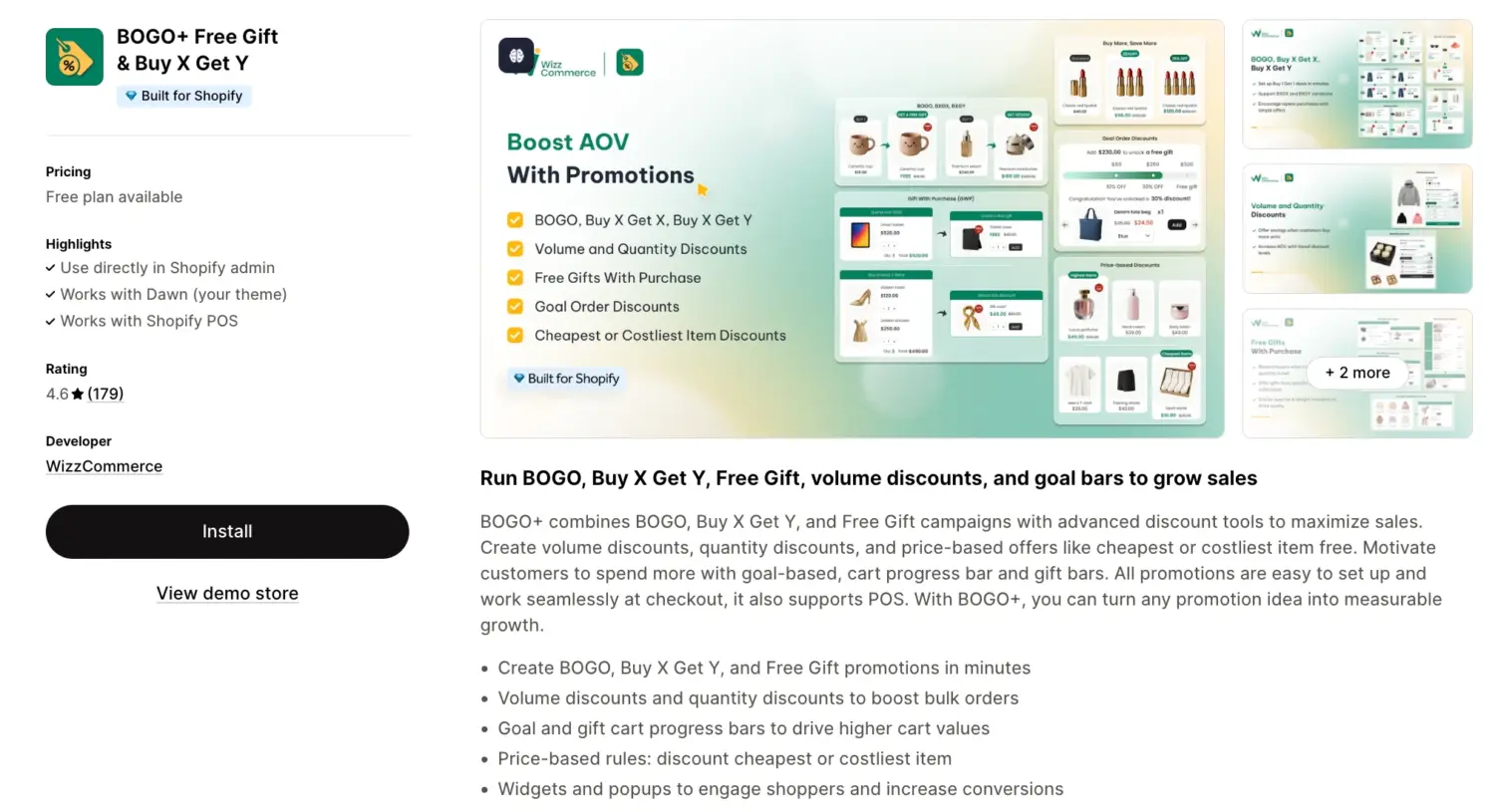
Both BOGO+ and AOV.ai offer wider BOGO customization than most other apps on the market, and they’re priced competitively with each other. Both provide a free plan that covers up to $500 in revenue generated by the app, making them low-risk options to test before committing.
The biggest difference comes down to two areas:
Which one fits better depends on your sales strategy. If on-site promotion and visibility matter most, AOV.ai has the edge. If controlling exactly who qualifies for the deal is your priority, BOGO+ gives you more flexibility.
👉 For more reviews of Shopify BOGO apps, check out this blog: “Best Shopify BOGO Apps“
Not every BOGO should be available to every customer. Targeting lets you run exclusive deals for loyal customers, test offers on specific audiences, or restrict promotions to certain markets without discounting your entire catalog to everyone.
Shopify’s native discount engine supports basic eligibility: all customers or specific customer segments (created in Customers → Segments). That covers simple rules like “customers who have purchased before” or “customers in the United States,” as long as you’ve built those segments in Shopify.
For anything more granular, you need an app. Here’s what each approach supports:
| Eligibility Type | Shopify Native Discounts | Apps (e.g., BOGOS) |
|---|---|---|
| All customers | ✅ | ✅ |
| Specific customer segments | ✅ | ✅ |
| Customers with specific tags | ❌ | ✅ |
| First-time vs returning customers | Partial (via segments) | ✅ |
| Customers with X+ previous orders | ❌ | ✅ |
| Customers from specific geo-location | ❌ | ✅ |
| Customers from specific sales channel (online, POS, mobile) | ❌ | ✅ |
| Customers arriving via specific URL / magic link | ❌ | ✅ |
| Logged-in vs guest customers | ❌ | ✅ |
A few examples of where targeted BOGO makes a difference:
If you only need “all customers” or basic segment targeting, native discounts work. If you want to target by tag, location, purchase history, or channel, you need an app with advanced eligibility rules.
BOGO promotions are simple in concept, but the setup details determine whether the offer actually works. Here are the most common mistakes merchants make, and how to avoid them.
BOGO is a type of Buy X Get Y promotion. On Shopify, all BOGO deals are set up using the “Buy X Get Y” discount type. The “X” is the trigger product and the “Y” is the reward product. Buy X Get Y is the broader category that includes BOGO (1:1), “Buy 2 Get 1 Free” (2:1), collection-based deals, and tiered BXGY offers. BOGO is the most common BXGY format.
Not with Shopify’s native discount engine. When a customer adds the trigger product to cart, Shopify does not add the reward product automatically. The customer must find it and add it manually. To auto-add the BOGO item, you need a third-party app like BOGOS, BOGO+, or AOV.ai.
Yes, but with caveats. You can create a BOGO as either an automatic discount or a discount code. If you use a discount code, the customer must enter it at checkout to activate the deal, which reduces redemption rates. More importantly, Shopify only applies one product discount per line item (the largest). If a customer enters a discount code and qualifies for an automatic BOGO discount on the same item, only the larger discount applies. Test how your active discounts interact before going live.
Yes. Shopify allows up to 25 automatic discounts running simultaneously. However, only one product discount can apply per line item. If two BOGO discounts both target the same product, Shopify applies the larger one. So you can run multiple BOGO promotions as long as they target different products or collections. If you need overlapping promotions on the same products, a third-party app gives you more control over priority and stacking logic.
It depends on your setup. Automatic discounts created in Shopify admin apply at POS checkout, so a native BOGO works in-store. For BOGO apps, POS support varies. BOGOS supports POS; most other BOGO apps (BOGO+, AOV.ai) are limited to the online store. If you sell both online and in person, check your app’s POS compatibility before relying on it for in-store promotions.
Partially with native tools. Shopify lets you set a “maximum number of uses per order” (limiting how many times the BOGO applies within one transaction), but it doesn’t limit uses across multiple orders from the same customer. To restrict BOGO to once per customer across all their orders, you need an app that supports per-customer usage limits. BOGOS and some other apps offer this.

Shopify collections decide how shoppers find your products, yet many guides still describe a setup Shopify is now replacing....
A Shopify announcement bar is the thin strip at the top of your store that tells shoppers about shipping,...
Australia is one of the first markets many Shopify stores expand into. It is large, English-speaking, and home to...