

Charlie Ngo
•
Last updated: 9 October, 2026
Shopify Shipping To Australia: The Complete 2026 Guide
Australia is one of the first markets many Shopify stores expand into. It is large, English-speaking, and home to...
15 Volume Pricing Examples: How Merchants Use Volume Discounts to Boost Sales

Digital Marketing Specialist
Summarize this post with AI
It is common for merchants to rely on simple discount codes since they require almost zero strategy to set up. What many fail to realize is that the underlying structure of a promotion easily outperforms a massive price cut.
Tiered pricing structures gently guide your customers toward spending more without ever making them feel pressured.
To help you master this tactic, we created a curated collection of 15 real store examples featuring brilliant volume pricing. You will discover exactly how to arrange your own pricing tiers to maximize your average order value and effortlessly scale your profits. Let’s check them out!
👉 If you are new to Shopify and looking for a way to do Volume Discounts or Quantity Discounts on Shopify, read our detailed guide here: How to Create Shopify Quantity Discounts in 2026?
Volume pricing is a pricing strategy in which the cost per unit decreases as quantity increases. A supplement store might price one bottle at $15, three bottles at $13 each, and five bottles at $11 each. The structure rewards larger purchases with progressively better deals, rather than treating every transaction the same.
It helps to understand how this differs from traditional promotional tools.
| Feature | Volume pricing | Flat discount code | BOGO |
|---|---|---|---|
| Trigger | Quantity or spend threshold | Any purchase | Buy exactly 1 unit |
| Scales with order size | Yes | No | No |
| Encourages buying more | Strongly | Rarely | Partially |
| Discount depth | Increases progressively | Fixed | Fixed |
As you see, both flat codes and BOGO promotions give away margin without actually shaping how much a customer buys. Volume pricing, on the other hand, builds a continuous ladder of incentives that pushes shoppers to reach the next savings level on their own.
Merchants generally activate these progressive discounts in two distinct ways:
Both formats serve the same goal of increasing average order value, but they suit different product types. Quantity-based tiers work especially well for consumables and apparel, while spend-based tiers tend to perform better in stores where customers mix and match items.
Here are the five most common structures merchants use today.
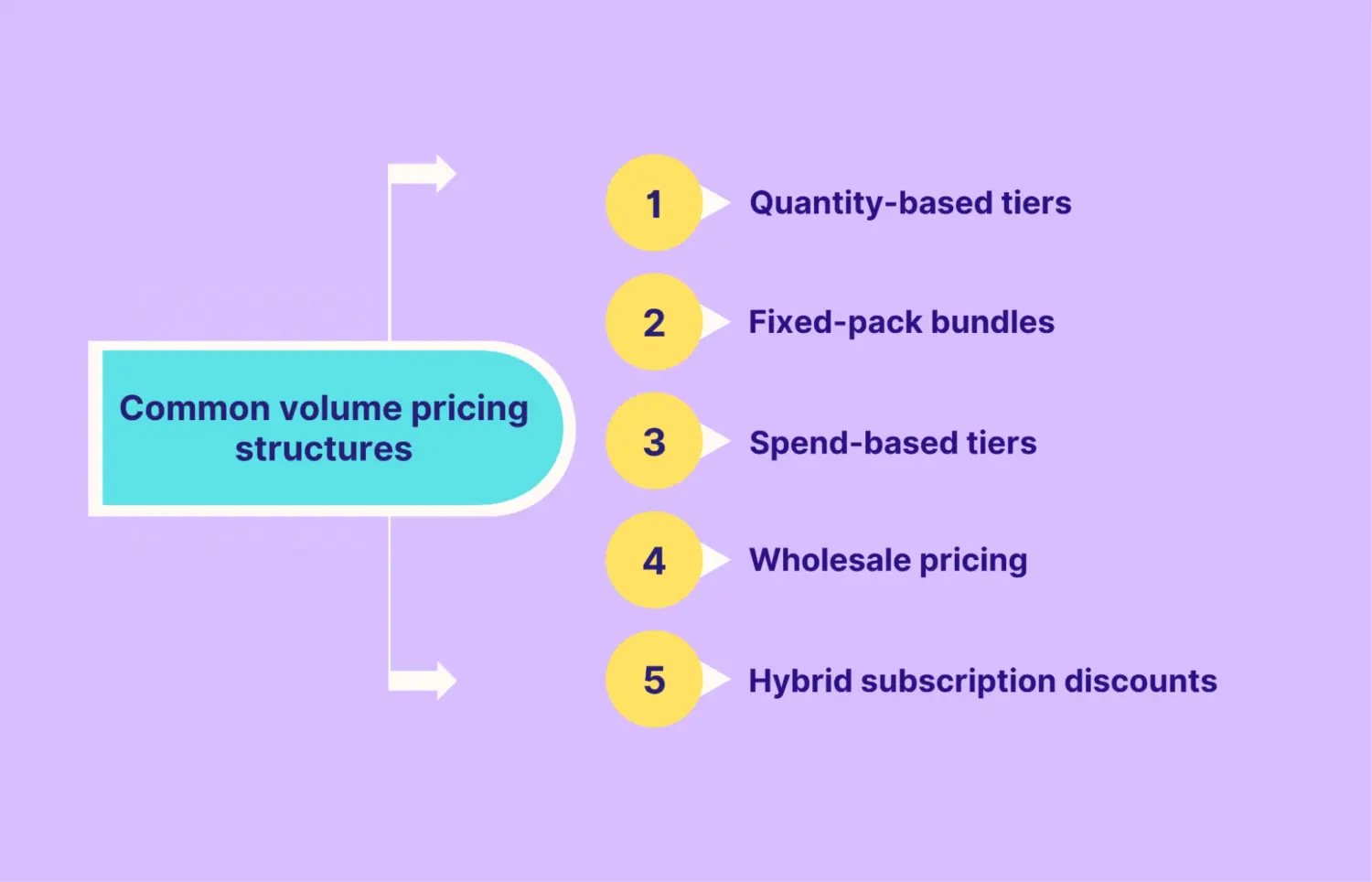
This is the most widely used structure. The per-unit price drops as the customer adds more of the same item to their cart. A typical setup looks like:
When a threshold is crossed, the lower rate applies to all units in the order. This works incredibly well for consumable goods like supplements, coffee, or skincare, where customers naturally need to replenish their stock. Giving them a 10-15% margin jump between tiers creates a strong incentive to stock up now rather than wait months for a second order.
Instead of a sliding scale, this approach offers pre-configured quantities at set prices. A merchant might present a 1-pack, a 3-pack, and a 6-pack. It removes the mental math from the buying decision because the total price for each option is already calculated.
When presented with three choices, a large share of shoppers instinctively select the middle option, thereby boosting your average order value. This works best when products have a natural consumption pattern, such as a 3-month supply of vitamins or a 6-pack of soap.
This structure rewards the total dollar value of the cart rather than the quantity of a specific item. A common breakdown might be:
Because customers can reach the next tier by adding anything from your catalog, this is a highly effective cross-selling tool. It triggers the “top-up effect” where a shopper adds a $15 item just to hit a $50 discount threshold. This is ideal for stores with a wide variety of product categories.
Wholesale pricing targets B2B buyers who place large orders. Rather than displaying volume discounts to all visitors, wholesale prices are hidden behind an account login. Approved buyers might see prices drop significantly when ordering 50, 100, or 500 units. The margins are intentionally tight here because the sheer volume of the transaction offsets the lower per-unit profit.
This structure layers a recurring commitment on top of a volume tier. A customer might get 10% off for subscribing, but 25% off if they subscribe to a 100-count box. It scales the discount based on both quantity and recurring frequency.
For merchants, this model reliably lifts transaction AOV and secures predictable future revenue. Customers love it because it locks in the lowest possible price for an item they intend to repurchase regularly.
Netsys Direct sells networking hardware, and the NV-320DP Ethernet Extender product page shows a textbook quantity ladder. At $325 per unit, a Bundle & Save panel lists Buy 2 at $315.25, Buy 3–4 at $308.75, and Buy 5+ at $299, with each tier showing the new per-unit price alongside the original struck through.
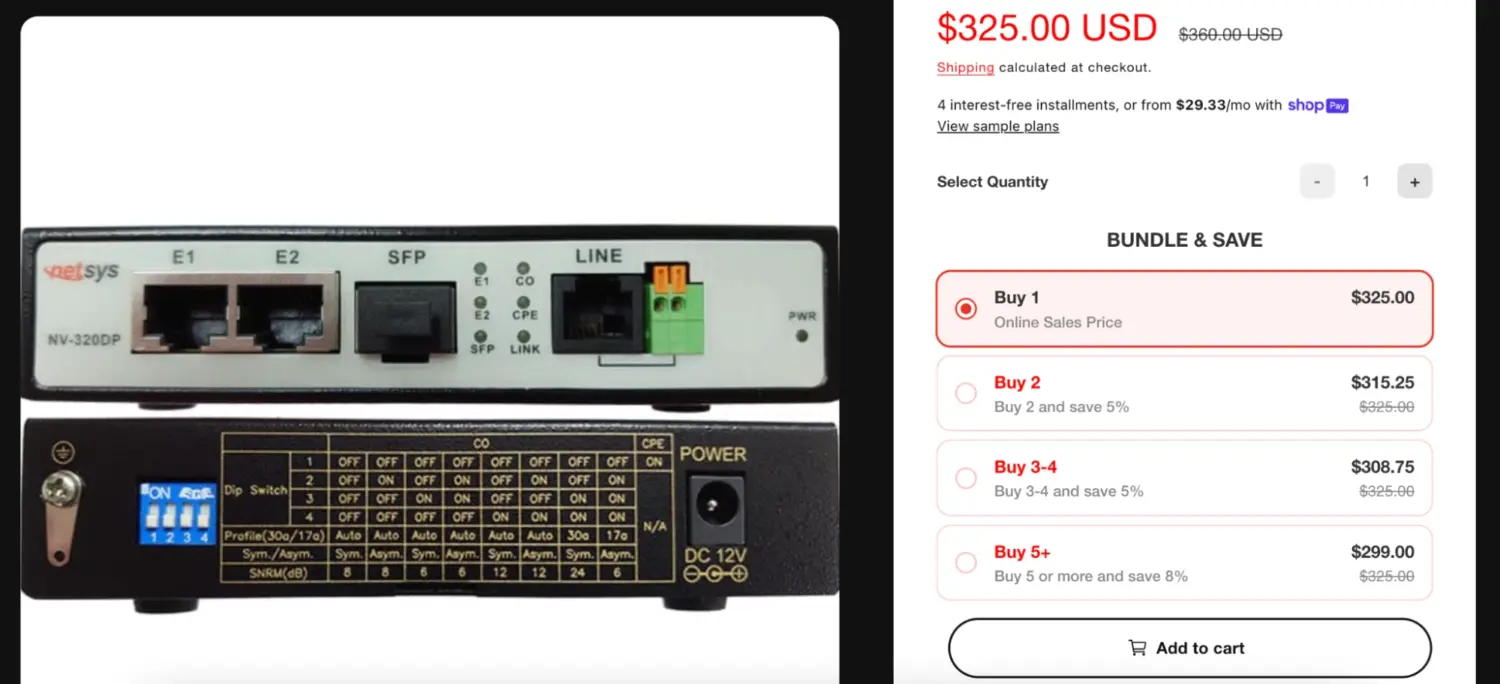
An IT integrator landing on this page is usually pricing out a job, not browsing. The tier panel essentially functions as a self-service quote tool that lets them calculate in seconds whether scaling the order is worth it, without contacting sales.
For technical or trade products where buyers arrive with a specific quantity already in mind, transparent per-unit pricing at every tier shortens the path to checkout more than any discount banner.
House of Enki is a UK retailer of bathroom and kitchen fixtures. The Turin Rose Gold Mixer Tap product page shows two layered volume offers that target different audiences without cluttering the main pricing area.
Near the price, a small banner reads “Multi-buy: Get 5% off when your order is over £200.” Further down the page, under a Contacts or Trade section, sits a proper quantity ladder: Buy 3–4 get 3% off, Buy 5–9 get 5% off, Buy 10+ get 10% off.
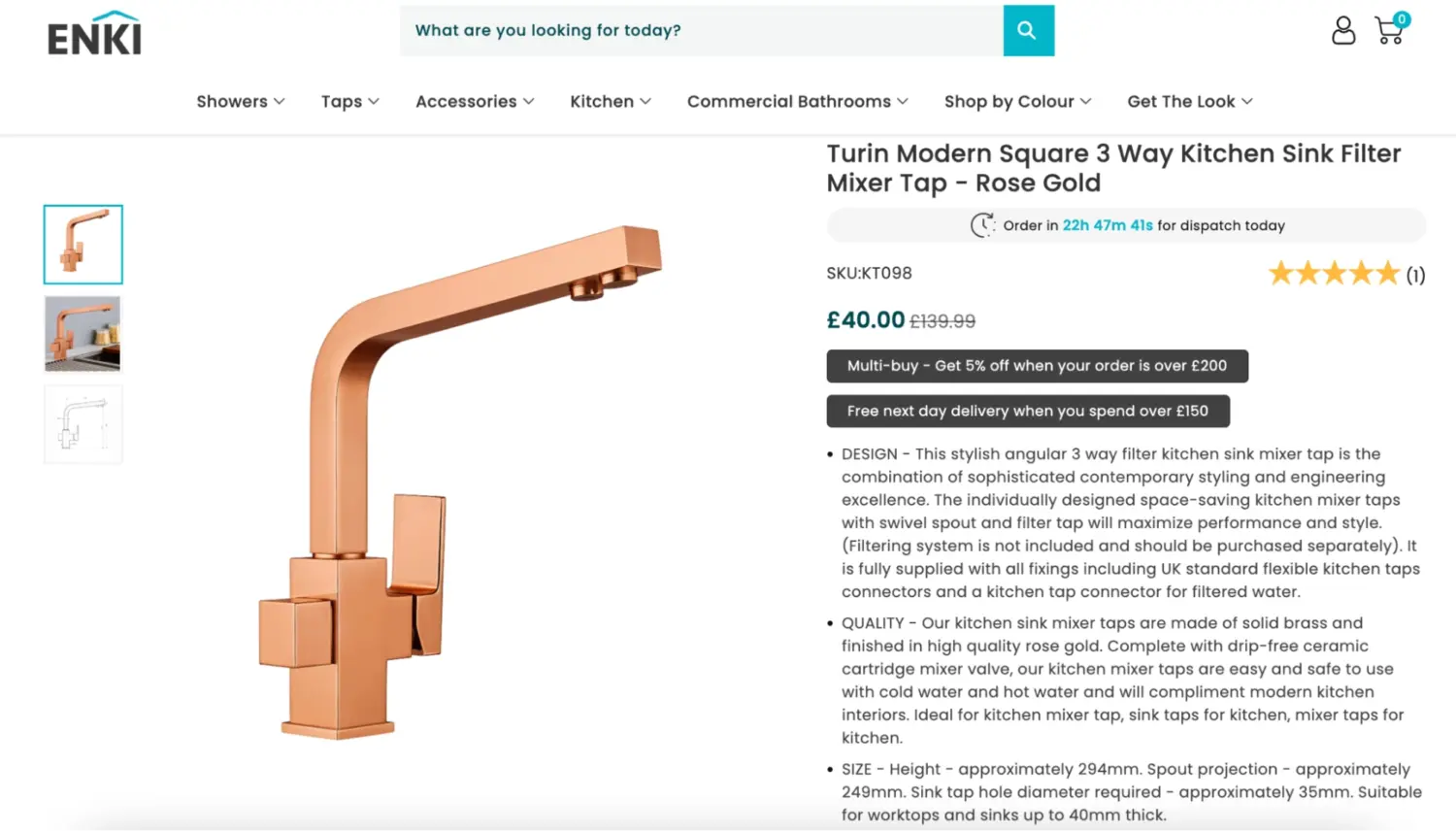
The split is the part worth studying. A homeowner undertaking a single kitchen renovation will respond to the £200 spend nudge, since they’re likely to buy a tap and accessories anyway. A plumber or contractor outfitting multiple sites will scroll to find the trade ladder, which speaks their language about profit margins.
Both buyers see the right offer in the right place, and the page doesn’t try to be everything at once. If you serve both retail and trade segments, this is a cleaner solution than running two separate stores.
SaltWrap sells therapeutic sports nutrition products, including magnesium recovery formulas, joint support, collagen, and a book on rebuilding the body after injury. Their “Buy More, Save More” page runs a simple two-tier offer: 10% off any 3 products with code SW10, or 20% off any 6 products with code SW20.
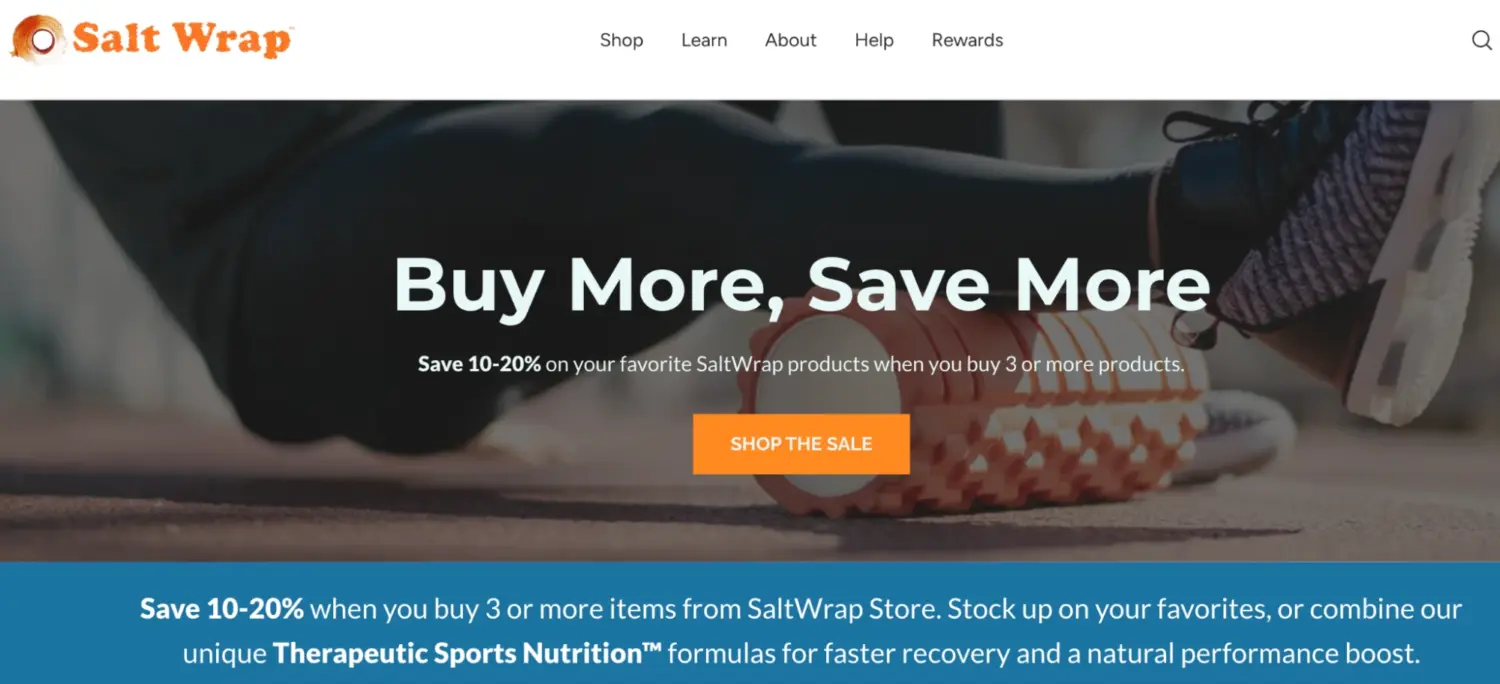
What stands out is the use of named coupon codes instead of automatic cart discounts. On the surface, this adds friction, but it also makes the promotion portable. The codes can be dropped into emails, podcast reads, affiliate content, and pinned posts without needing engineering work or a new landing page.
The structure also fits the catalog well, since SaltWrap’s products are designed to stack: someone buying joint support is a strong candidate for magnesium and collagen too. Counting products rather than dollars keeps the math simple for a customer mixing across categories, and the coded discount gives the brand a clean way to track which channels are driving stockup orders.
Tufting Stuff sells 100% wool tufting yarn in cones at €16.49 each, marketed primarily to rug makers and textile artists. Their bulk discount structure is displayed right at the top of the collection page rather than buried in individual product pages: 5+ cones get 10% off, 10+ cones get 20% off, and 30+ cones get 30% off, with the discount applied automatically at checkout.
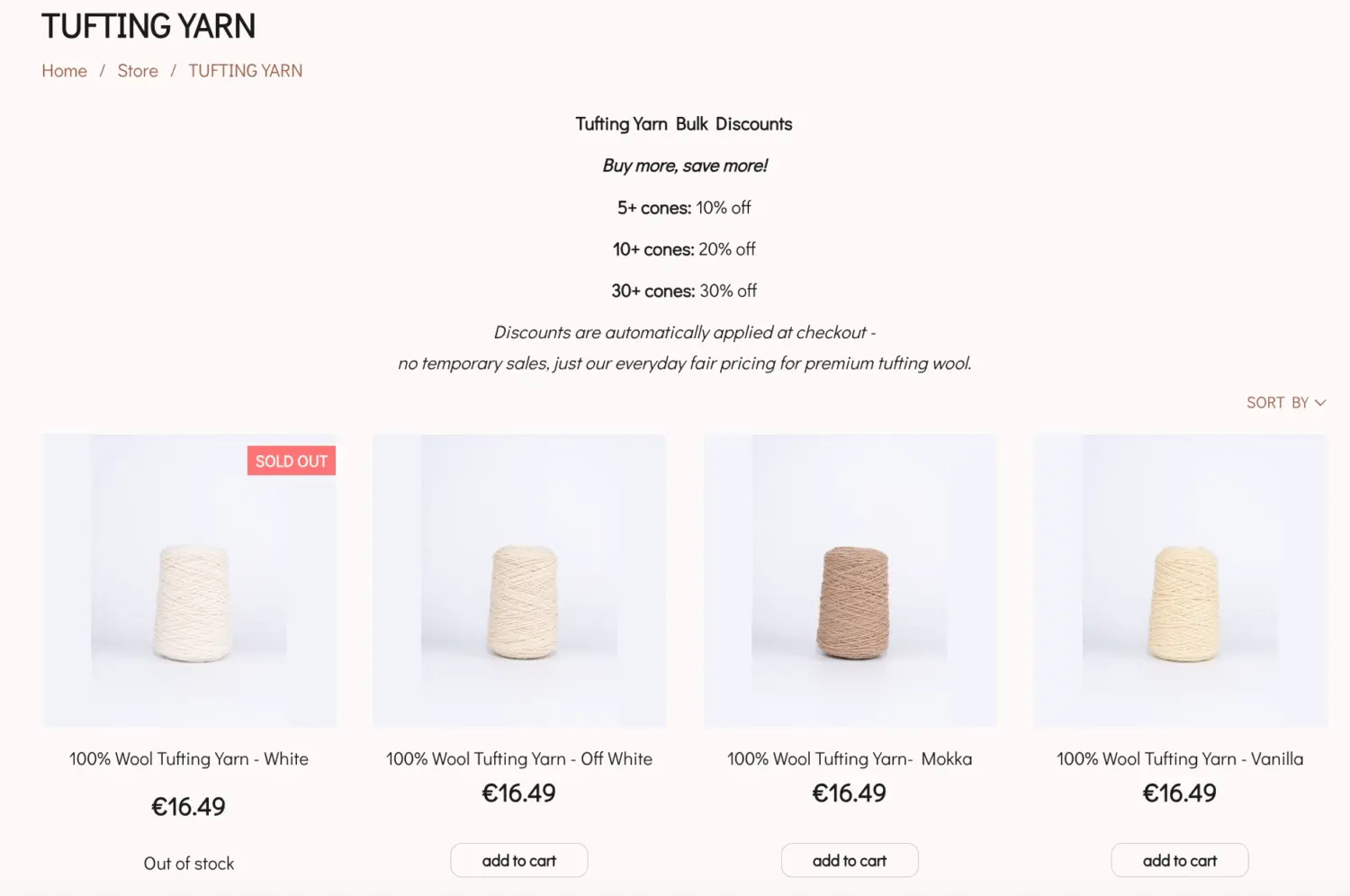
What makes this work is the placement. Tufting is a craft that often requires a mix of colors, so customers naturally land on the collection page before any single product.
By placing the tier ladder there rather than inside each yarn listing, the brand sets expectations upfront and encourages buyers to browse the full color range with a target quantity in mind. A small line of copy also frames the discounts as “everyday fair pricing” rather than a temporary sale, which positions the brand as honest rather than promotional.
Goli Nutrition sells wellness gummies covering apple cider vinegar, sleep, immunity, ashwagandha, supergreens, and superfruits. Instead of letting shoppers pick individual bottles, the brand pushes a Complete 6-Pack at $83.94 that includes one of each formula. There’s no quantity selector, no “build your bundle” interface. The pack is the product.
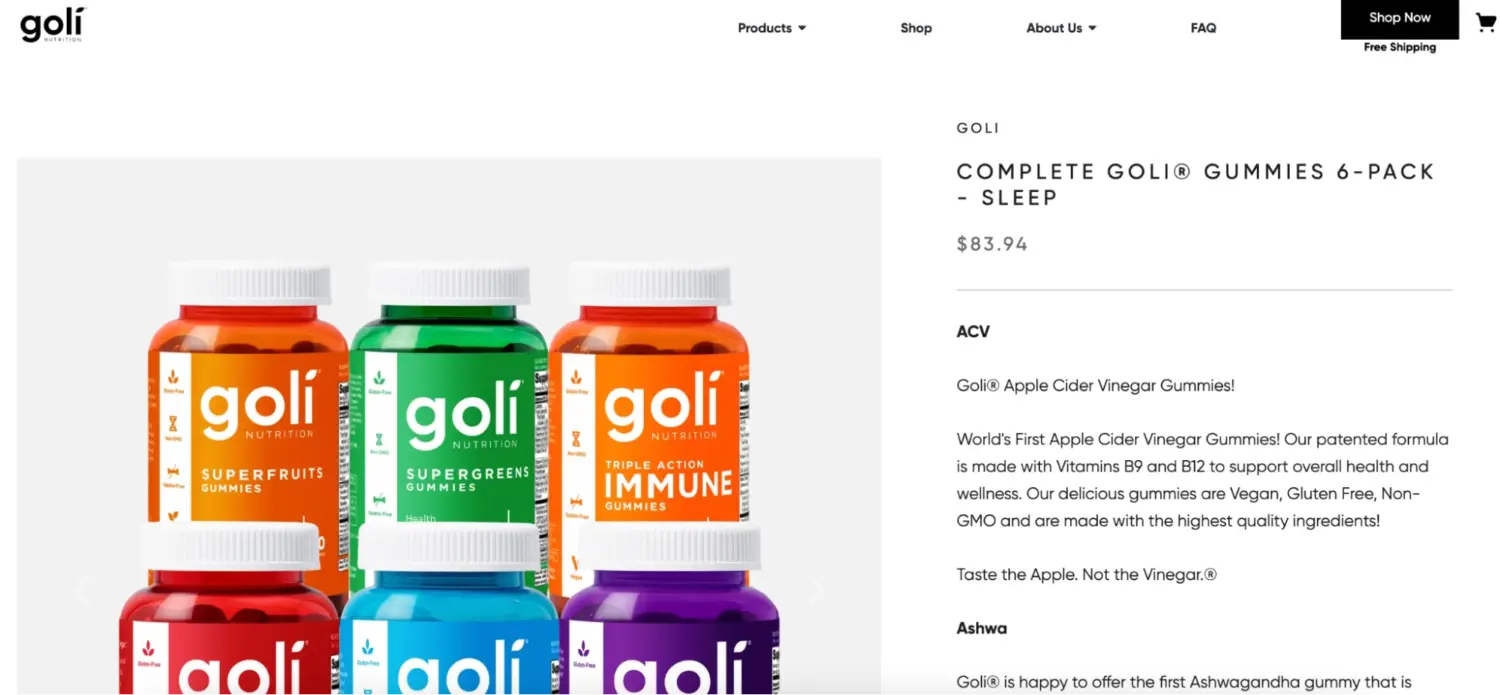
What’s interesting is that Goli isn’t really discounting volume so much as removing decisions. A new customer doesn’t have to research which gummy they need first or worry about picking the wrong one.
The 6-pack frames the entire lineup as a complete daily routine, which is a far easier sell than convincing someone to commit to a single SKU. If your products are complementary and are frequently bought together, a curated fixed pack can boost average order value more than any tier ladder.
Double Wood Supplements sells single-ingredient supplements, and the Magnesium L-Threonate product page is a clean study in how to handle a consumable. The base price is $30.95 for one bottle, with a “Buy More Save More” row offering One Bottle, Double Pack, and Triple Pack options. A separate Subscribe and Save option sits below at $29.40.
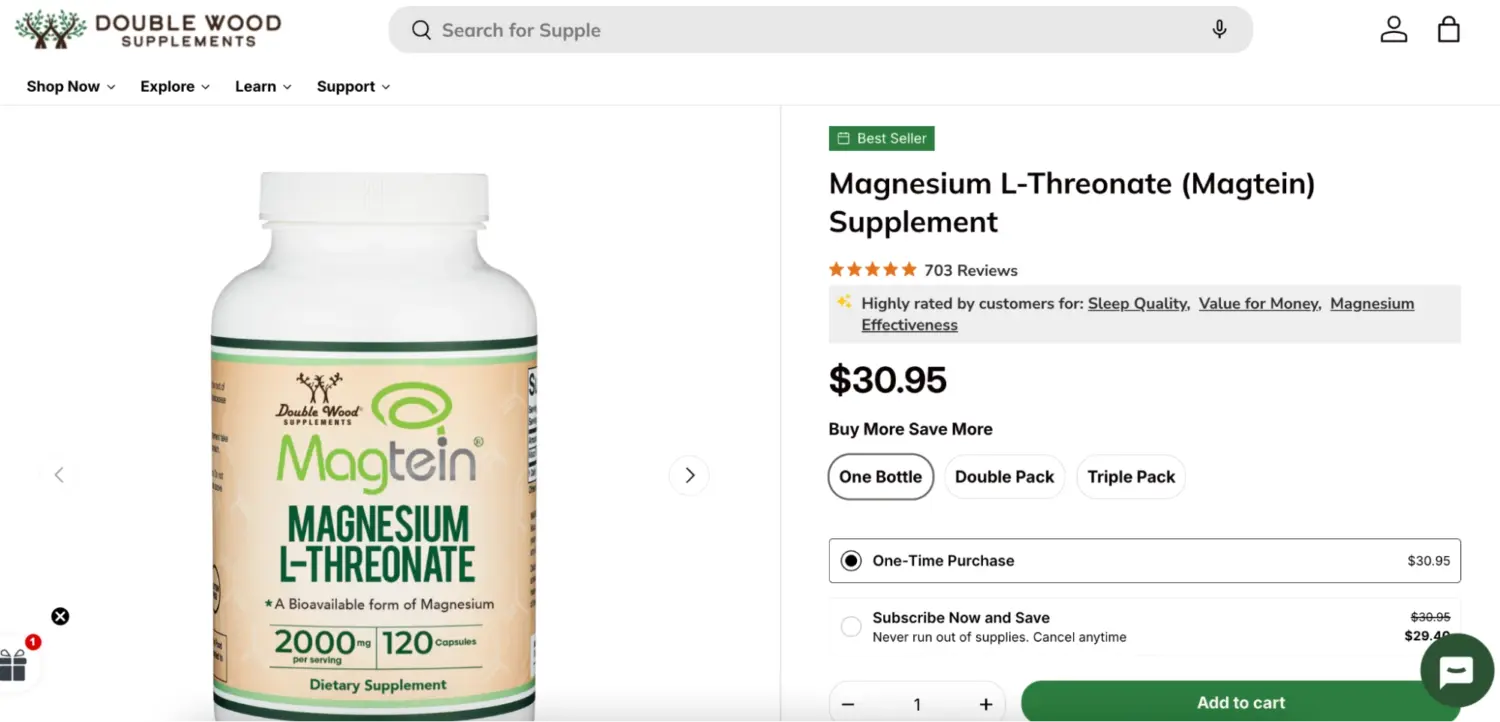
What’s worth noting is how the page treats stock-up buying and recurring buying as distinct behaviors rather than combining them into a single offer.
Pack tiers serve customers who want to load up now. The subscription serves customers who want to set it and forget it. Both lead to higher lifetime value than a single-bottle purchase, and the page doesn’t force one over the other.
KnitPatch sells mending threads aimed at people repairing clothing rather than crafting from scratch. The product page is unusually simple: one set of 50 cotton thread pieces for $19.95, or two sets for $37.91. There are no individual color choices, no quantity sliders, just a binary pick between buying once or doubling up.
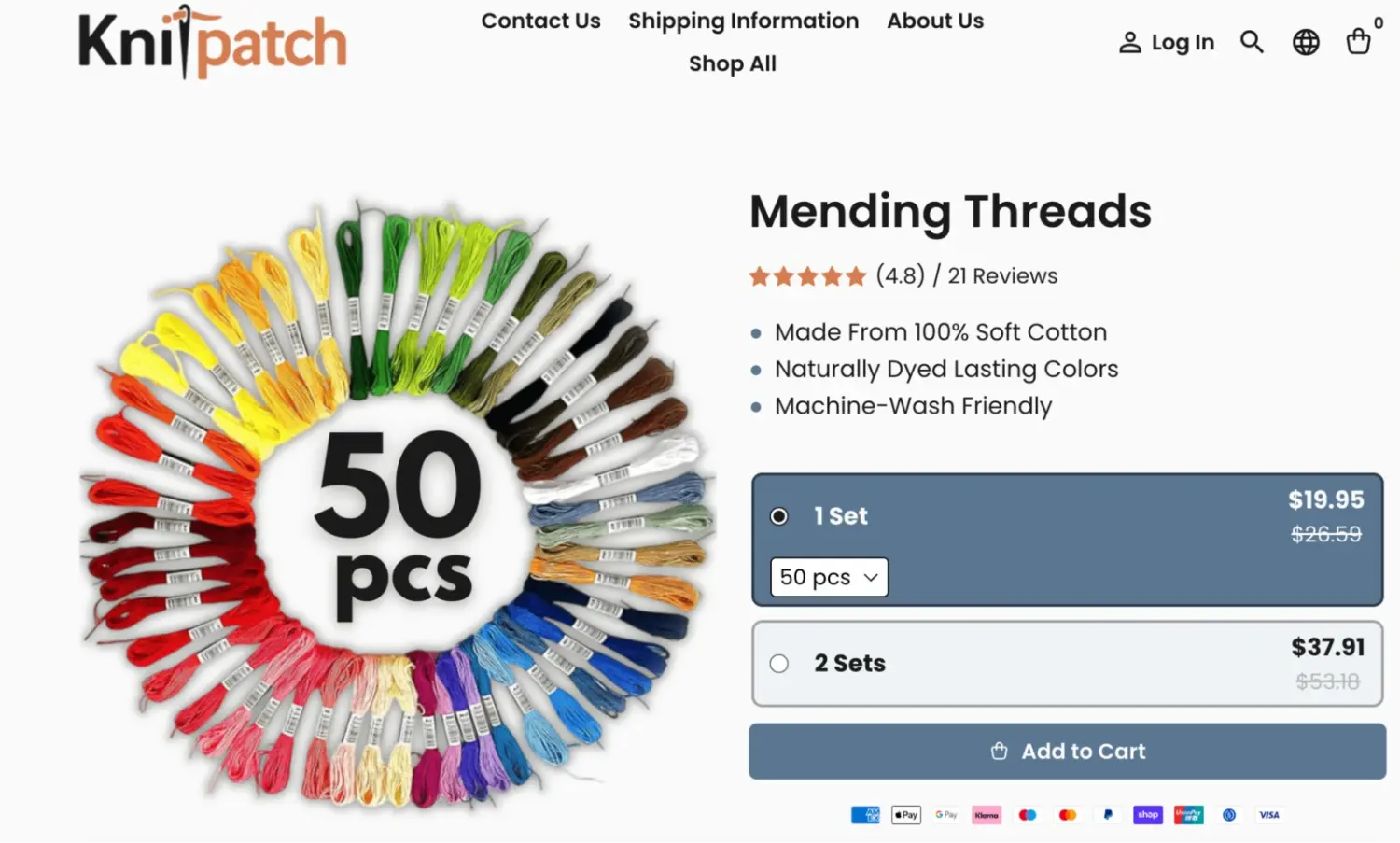
The product itself is the lesson here. Mending threads are bought in assortments because no one knows in advance which color they’ll need for the next torn shirt. KnitPatch leans into that uncertainty by selling only the bundle, which removes any temptation to add items one at a time.
The two-set option then gives heavy menders or households a small price break without complicating the page. When your product is inherently an assortment, fixed packs are the natural unit of sale.
MeUndies sells underwear in colors and patterns, with an UltraModal Trunk 6-Pack listed at $78, marked down from $156. Their pack structure spans three tiers: 3-Pack at $17.94 per pair, 6-Pack at $13 per pair, and 10-Pack at $13 per pair. Each option shows the per-unit cost rather than just the total, making the savings between tiers easy to compare at a glance.
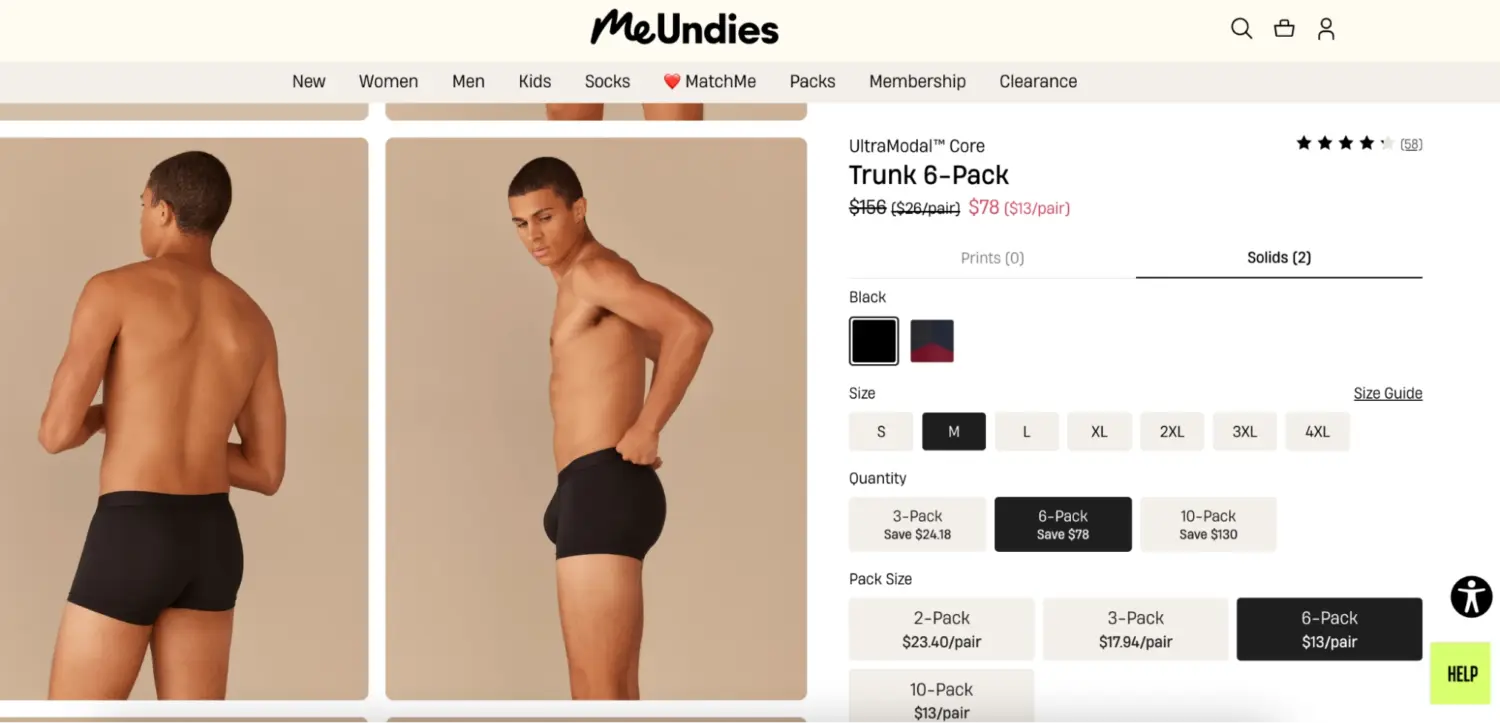
The interesting part is what happens between the 6-Pack and 10-Pack. Both land at $13 per pair, meaning the marginal discount disappears at the top tier. That’s almost certainly deliberate: the brand still gets a larger cart from the 10-Pack buyer, but the 6-Pack becomes the obvious value pick for everyone else.
It’s a pricing technique sometimes called decoy positioning, where one tier exists mainly to make another look like the smart choice. When you have a clear hero SKU you want most customers to land on, flattening the discount curve at the top is a quiet way to push them there.
Dr. Squatch sells men’s natural bar soaps in distinctive scents like Pine Tar, Bay Rum, and Wood Barrel Bourbon. Their Bar Soap 6-Pack page lets customers build a custom bundle of six bars for $36, down from $42, a 14% discount over buying the bars individually.
Unlike Goli’s fixed mix, Dr. Squatch lets shoppers choose each scent themselves through a series of dropdowns.
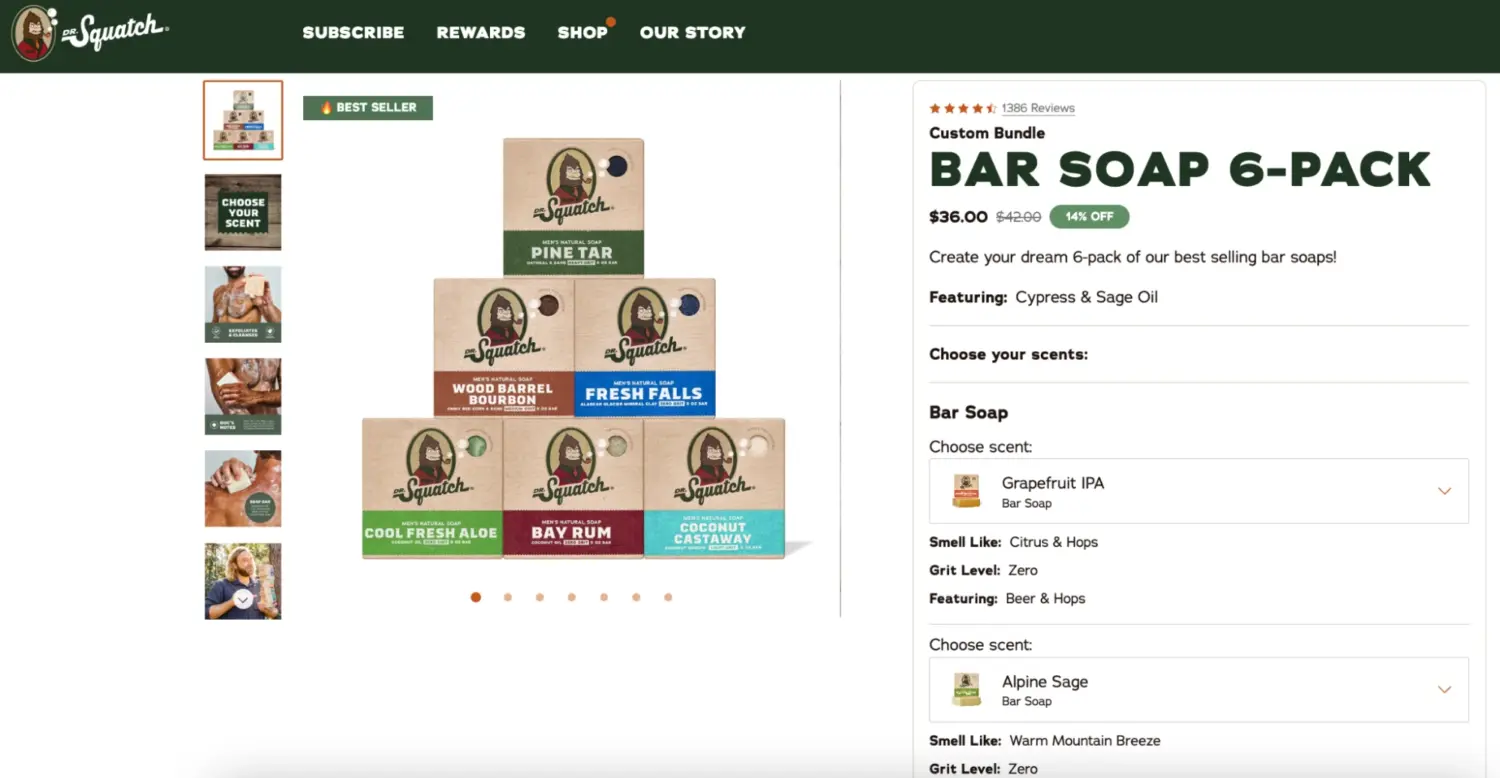
This is fixed-pack pricing with a twist that solves a common bundling problem. A standard six-pack risks giving customers scents they don’t want, which is enough friction to kill the upsell.
By keeping the pack size fixed but the contents flexible, Dr. Squatch gets the AOV benefit of a bundle while letting buyers feel like they’re shopping, not settling. The format also works as discovery, since customers tend to try one or two new scents alongside familiar favorites.
EcoPro Products supplies treatment table cushions, bolsters, and accessories for chiropractors and massage therapists. Their volume discount page is unusually clean: spend $100 save 10%, $250 save 15%, $500 save 20%, up to $4,000 for 35% off. No product-level tricks, no pack sizes, just one ladder applied across the entire catalog.
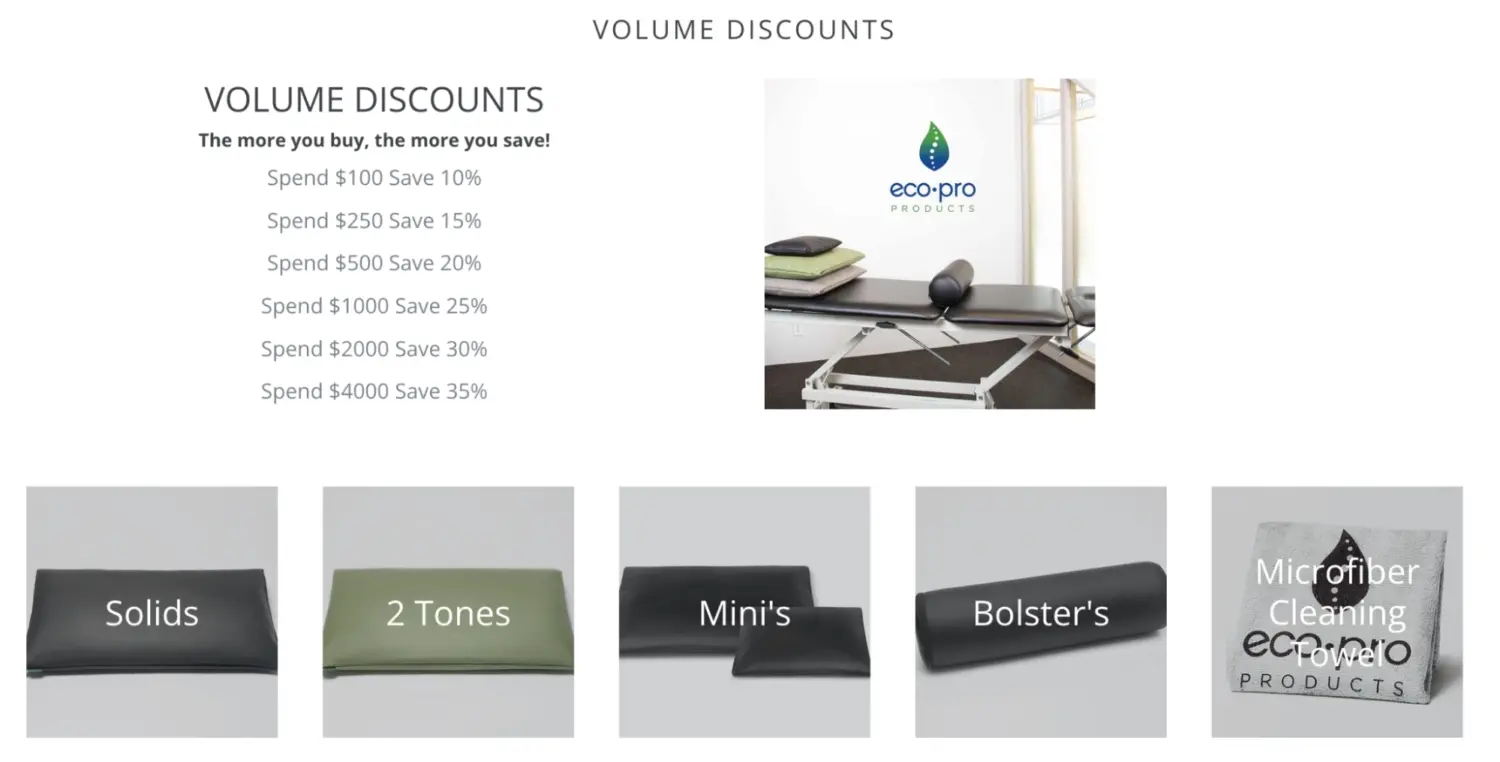
Practitioners rarely buy one of anything. A clinic stocking up needs cushions in multiple colors, bolsters, replacement covers, and cleaning supplies.
Locking discounts to specific product quantities would force customers to hit thresholds category by category, which is frustrating for mixed-cart buyers. A spend-based ladder lets them freely mix across categories and still climb the bracket, which is much closer to how they actually shop.
BagsInBulk sells industrial supplies in case quantities, including standard-duty 8×10 blue poly tarps, 25 per case. The pricing table is built for buyers thinking in cases rather than units.
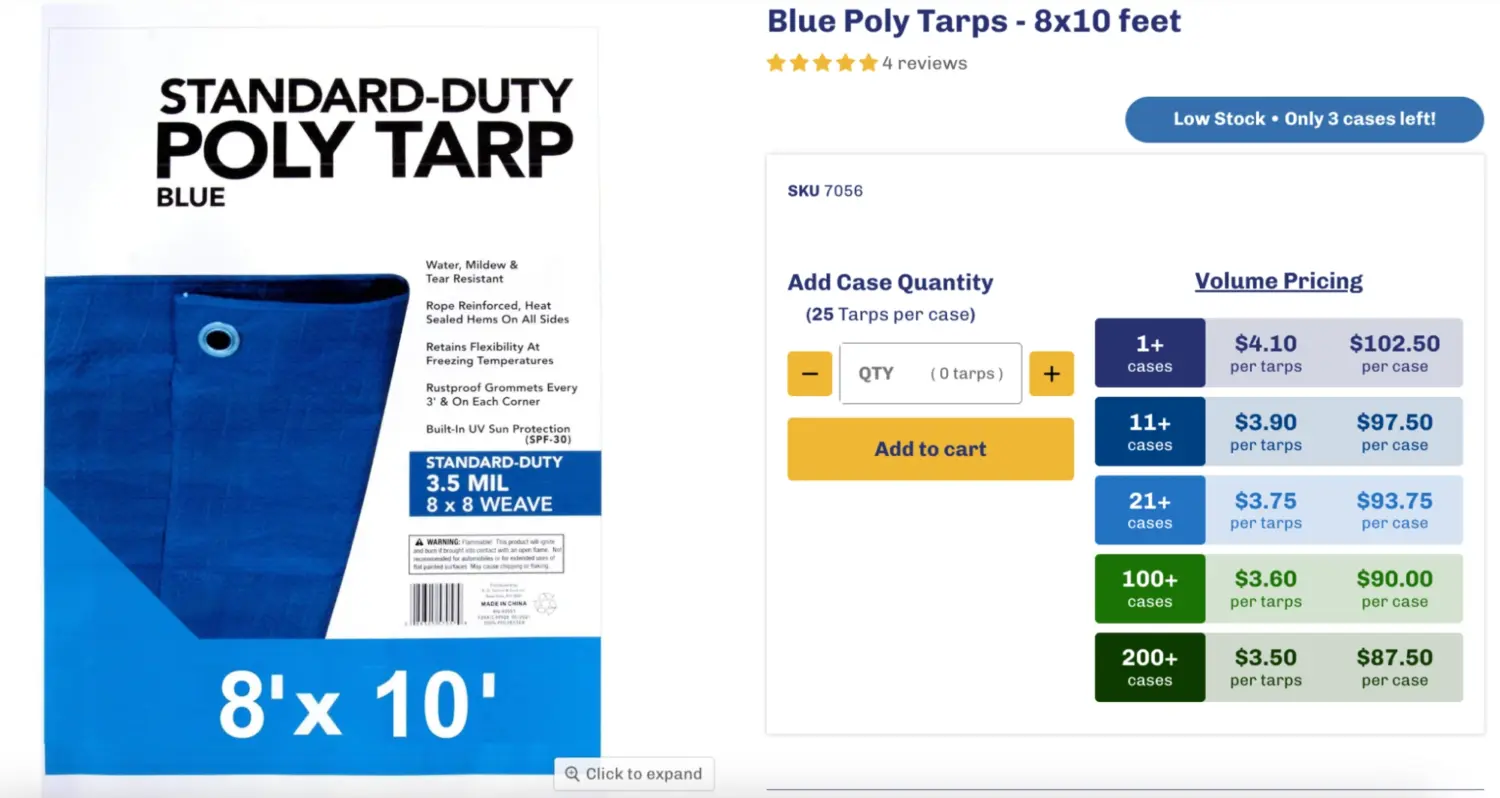
This is wholesale pricing done right for a customer who already knows their volume requirements. Each tier shows both the per-unit and per-case prices, allowing contractors, event planners, and resellers to calculate landed cost without external tools.
The 200+ tier extends far beyond a typical retail ladder, signaling that the store genuinely serves large buyers rather than just adding a token bulk tier. When your audience is professional purchasers, transparent volume math at every level builds trust and shortens the quoting process.
Stickerine sells custom-printed die-cut stickers with pricing that flexes based on shape, size, material, and quantity. For a 3″x3″ die-cut sticker, the price per unit drops dramatically as quantity increases.
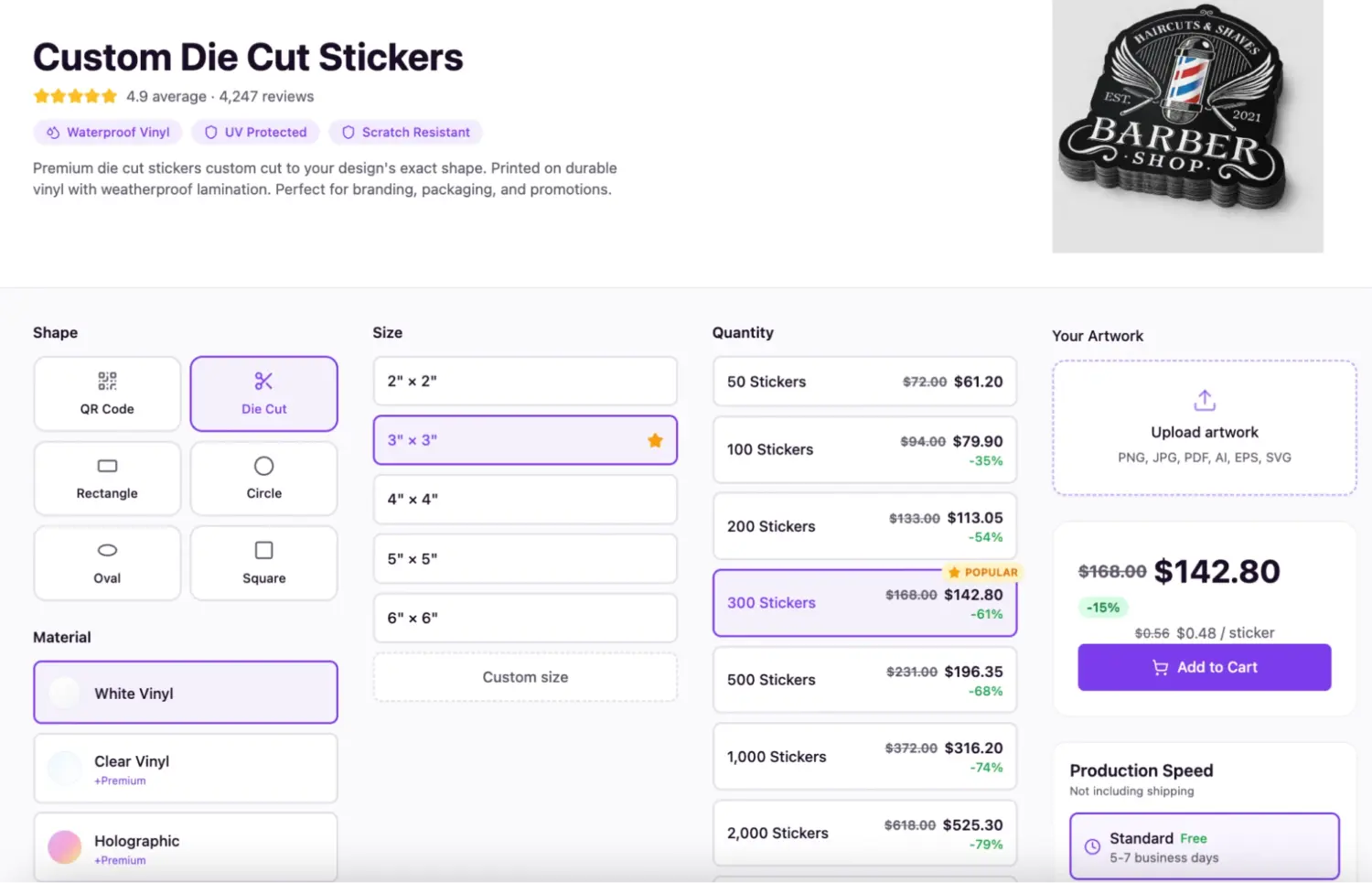
The unique angle here is how Stickerine uses the savings percentage itself as a selling tool. Each tier shows the discount in green next to the price, turning a dry spec sheet into an active comparison. They also tag the 300-unit option as Popular, which gives undecided buyers a default to anchor on.
For custom-manufactured products where unit costs genuinely fall with scale, surfacing the percentage discount makes the underlying production economics visible to the customer and reframes a larger order as the rational choice rather than an upsell.
FabricWholesaleDirect sells fabric by the yard to designers, manufacturers, and home sewers. The Braid Printed ITY product page lays out four quantity bands in a horizontal row: Buy 1–4, Buy 5–14, Buy 15–34, and Buy 35–69 yards, with each tier saving 10%, 15%, and 20% respectively over the base price.
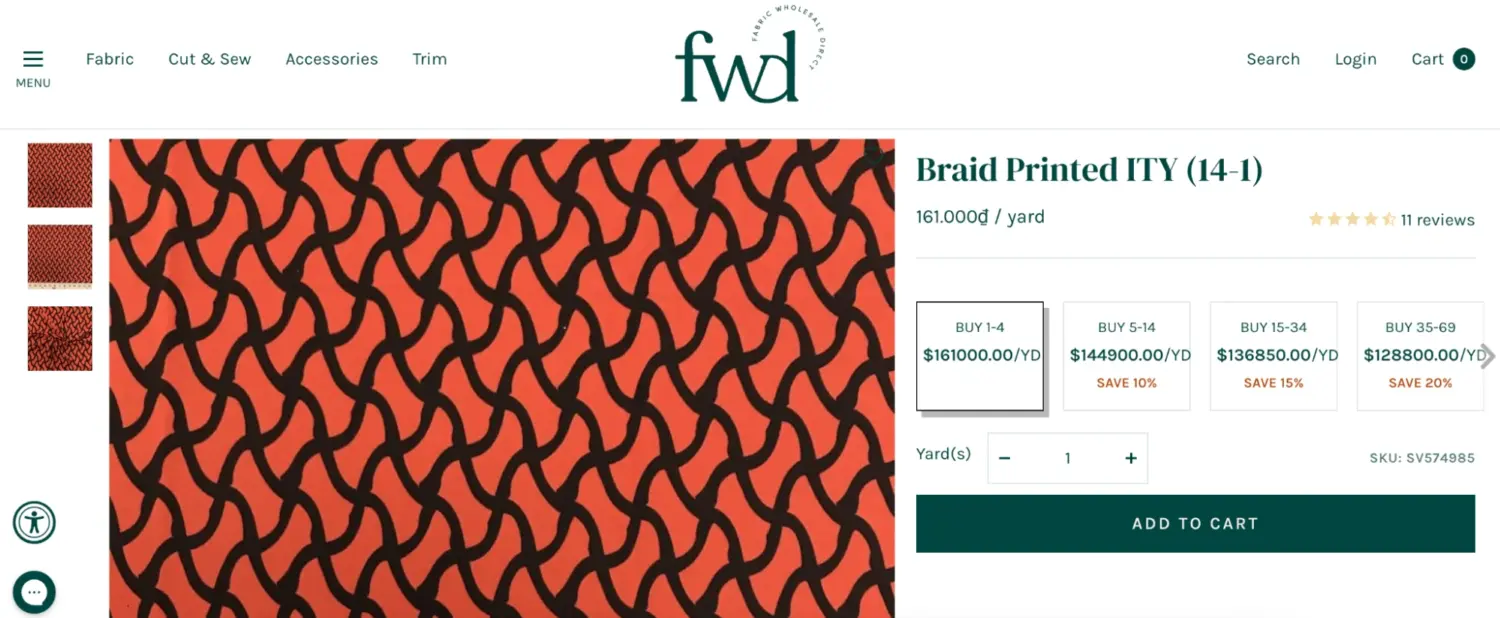
The layout is the thing to copy. Most wholesale ladders stack tiers vertically, which makes them feel like fine print. By spreading the four bands side by side at roughly equal visual weight, FWD makes the entire pricing structure scannable in one glance and frames the bulk options as primary, not secondary.
The quantity selector sits below the tier display, so customers can see exactly which band they’re entering as they adjust yardage. For made-to-order or cut-to-size products, this layout removes the mental load of figuring out which tier applies to your order.
Death Wish Coffee sells dark-roast coffee in a 2-lb bag for $39.98. The product page stacks two volume mechanics on top of each other: first, shoppers pick a size (1, 2, 3, or 5 lbs), then choose between a one-time purchase or Subscribe and Save at $27.99, a 30% discount, with delivery cadence options of 30, 60, or 90 days.
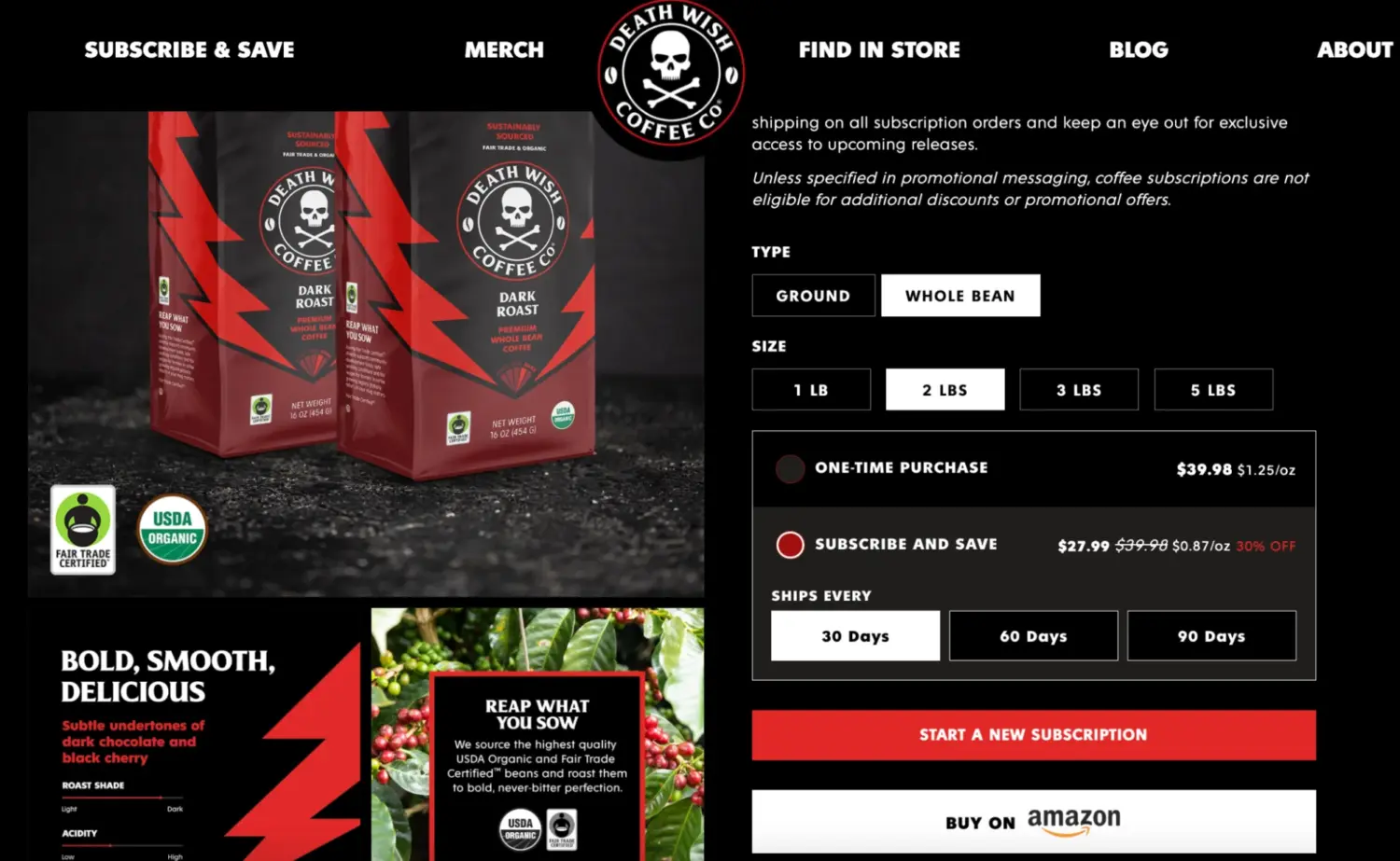
Each lever solves a different objection. Size handles the customer who wants more product per shipment. Subscription handles the customer worried about running out. Cadence handles the customer who is worried about getting too much, too fast.
A small note also confirms subscriptions aren’t eligible for additional promotions, which protects margin without making the offer feel restrictive. When you sell something, people buy on a predictable rhythm. Stacking these mechanics gives every type of buyer a reason to commit deeper on the same page.
BIOptimizers sells a magnesium supplement called Magnesium Breakthrough that combines seven forms of magnesium in a single capsule. The product page offers three pack tiers: 1 bottle for $35 (save 12%), 3 bottles for $87 (save 27%), or 5 bottles for $136 (save 32%). Sitting just below those options is a Subscribe’N Save toggle that takes an additional 12% off whichever pack the customer chooses.
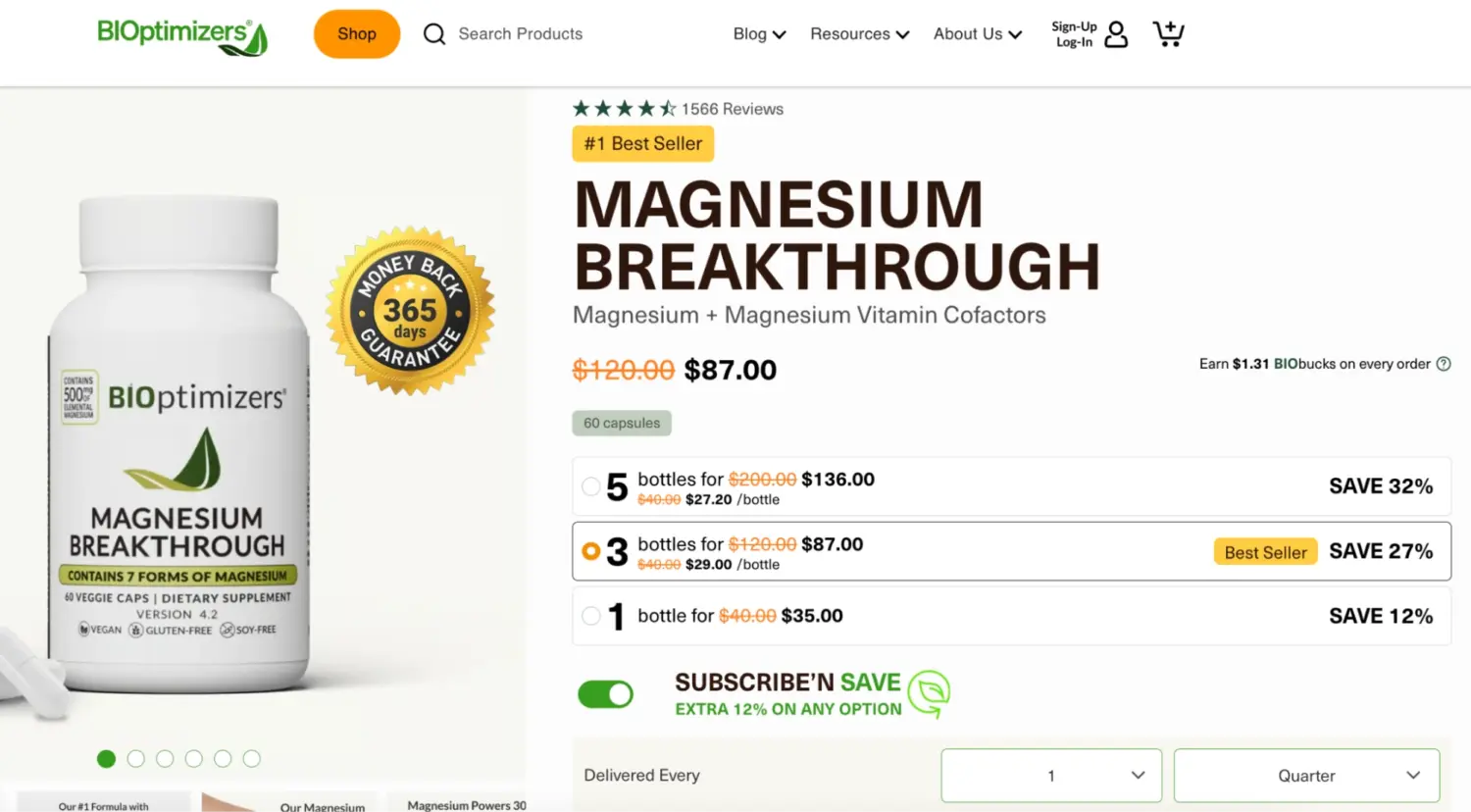
The detail worth studying is the layering logic. Quantity tiers and subscription discounts are usually presented as competing choices, but BIOptimizers stacks them so customers feel rewarded for committing to both axes at once.
The 3-bottle option is also pre-selected and tagged Best Seller, which quietly steers shoppers away from the cheapest tier without removing it. It’s a useful pattern when you want to push a specific middle option without making the other choices feel punished.
The real power of volume pricing lies in its ability to turn ordinary buyers into highly valuable customers without needlessly sacrificing your profit. Whether you implement fixed bundles or spend-based tiers, these progressive discounts naturally guide your shoppers toward larger carts and long-lasting loyalty.
It works for single-SKU stores. In fact, some of the cleanest examples in this article (Double Wood Supplements, KnitPatch) run entirely on one or two products. The key is that the product needs a natural reason to be bought in multiples, such as consumables, replenishables, or anything where running out is a real inconvenience.
Most DTC stores apply the discount to all units, which is simpler to communicate and easier for customers to understand. The incremental model, where only units above a threshold receive the discount, better protects the margin but can confuse shoppers. Unless you have specific margin pressures that demand it, the all-units model is the better default for consumer-facing stores.
Three is the sweet spot for most product pages. One tier gives no real progression. Two feels binary. Four or more starts to overwhelm casual shoppers who aren’t doing the math. The exception is wholesale-oriented stores like BagsInBulk, where professional buyers expect and understand a detailed price ladder.

Australia is one of the first markets many Shopify stores expand into. It is large, English-speaking, and home to...
Canada is a promising international market for Shopify merchants, especially those shipping from the US. But reaching Canadian shoppers...
![[2026] Shopify Testimonials: 3 Ways To Add Them + Best Apps](https://bogos.io/wp-content/uploads/2026/10/Shopify-Testimonials-400x225.jpg)
Shopify testimonials help new visitors trust a store they have never bought from. Most guides stop at “install an...