

Charlie Ngo
•
Last updated: 9 October, 2026
Shopify Shipping To Australia: The Complete 2026 Guide
Australia is one of the first markets many Shopify stores expand into. It is large, English-speaking, and home to...
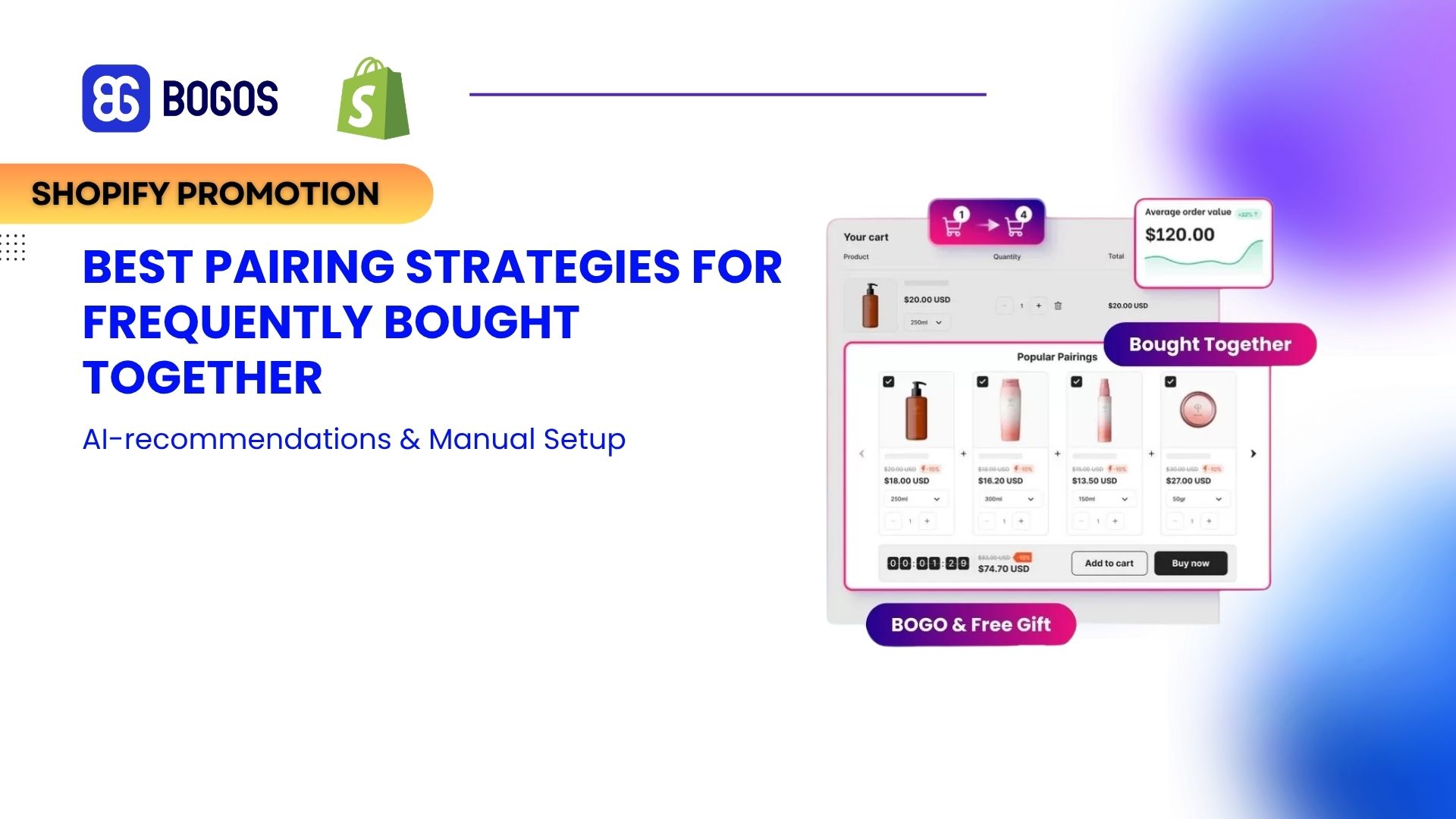
Best Pairing Strategies For Frequently Bought Together: AI-recommendations & Manual Setup

Digital Marketing Specialist
Summarize this post with AI
Most Shopify apps that offer Frequently Bought Together recommendations, including Shopify’s free Search & Discovery app, can generate product pairings automatically. But those automated recommendations depend on specific conditions. If your store is new, your product descriptions aren’t in English, or you haven’t built up enough order history, the algorithm doesn’t have much to work with.
That doesn’t mean you can’t build effective FBT offers. Automated recommendations run on a small set of logical patterns. Once you understand those patterns, you can apply them manually to create pairings that feel just as relevant to your customers.
This article breaks down how automated FBT logic works, then gives you six manual pairing strategies built on the same principles.
👉 If you are looking for a way to implement Frequently Bought Together strategy for your Shopify store, read this detailed guide: How to Set Up Shopify Frequently Bought Together (Free & Paid)
Most FBT apps recommend products based on order history, product descriptions, and collection structure. When those signals aren’t available, you can pair products manually using six strategies: product completion (what does the customer need to use it?), same routine or occasion (what else fits this activity?), problem and solution (what related problem does this customer also have?), price anchoring (what low-cost add-on pairs with this higher-ticket item?), variant or format extension (what other version of this product line would they try?), and marketplace research (what do Amazon and competitors pair together?). Launch a few pairings, track results, and refine as your store collects data.
Before you start pairing products manually, it helps to understand what automated tools are actually doing behind the scenes. The logic isn’t as complex as it seems.
Most Shopify FBT apps, including the free Search & Discovery app, rely on three core signals to generate recommendations:
Beyond these standard signals, some apps build their own AI recommendation logic using proprietary algorithms. These tools can identify related products on your store even without sales history, by analyzing product attributes, catalog structure, images, and other data points. They tend to come at a higher price point, and they work best with larger catalogs where the algorithm has more products to analyze. If you’re evaluating these tools, see our guide on the best Frequently Bought Together apps for Shopify.
Whether your store doesn’t meet the conditions for standard recommendations or you want direct control over what gets paired, the strategies below give you a structured approach. Each one mirrors a pattern that automated tools would eventually learn from your data, but you can apply it right now using your own product knowledge.
These strategies are organized around the same logic that powers automated recommendations. Each one gives you a repeatable method for identifying strong FBT pairs using what you already know about your products and customers.
You don’t need to use every strategy. Start with the one that best fits your product catalog and customer behavior, then expand from there.
This is the most straightforward FBT strategy, and it’s the pattern that co-purchase data surfaces first. When customers consistently buy a product alongside its functional complement, the algorithm picks up on it quickly. You can skip the data collection and apply this logic directly.
The idea is simple: pair a primary product with something the customer needs to use it, complete it, or get the full benefit from it. Customers already intend to buy the complementary item at some point. FBT just puts it in front of them at the right moment, reducing the chance they forget or buy it somewhere else.
To identify completion pairs, ask yourself two questions about each product:
If you have access to customer support emails or product Q&A, check what customers commonly ask about after purchasing. Those questions often point directly to the complementary product they need.
Here are examples across different product types:
This strategy works best for products with clear functional dependencies, especially stores selling products that require setup, maintenance, or accessories.
One thing to watch: avoid pairing with items the customer likely already owns. If someone is buying a replacement phone case, they probably already have a charger. The complement should feel like something they still need, not something they bought two years ago.
When automated tools track browsing sessions, they often find that customers view multiple products belonging to the same routine or occasion in a single visit. A customer shopping for camping gear doesn’t just look at tents. They browse sleeping bags, portable stoves, and headlamps in the same session. The algorithm picks up on these browsing patterns and creates recommendations based on them.
You can replicate this by thinking about the context in which your customer uses your products.
The core idea: group products that belong to the same usage context, routine, or occasion, even if they aren’t functionally dependent on each other. A tent doesn’t “require” a sleeping bag the way a phone requires a charger. But they belong to the same trip, and customers shopping for one are very likely thinking about the other.
To identify routine-based pairs, ask yourself:
Some examples:
This strategy works especially well for stores in lifestyle, wellness, beauty, food, hobby, and seasonal product categories, where purchases are driven by activities and occasions rather than strict product dependencies.
The key difference from product completion pairing is the nature of the relationship. Completion pairs are functional necessities. Routine pairs are contextual. The customer could use the primary product without the suggested one, but they’re very likely to want both because they’re preparing for the same occasion.
AI recommendation engines often group customers with similar profiles and surface “customers like you also bought” suggestions. What drives those recommendations, in many cases, is that similar customers are dealing with related problems and buying products that address multiple angles of the same issue.
You can apply this same thinking without customer segmentation data. The core idea: pair a product that solves a primary problem with a product that addresses a related or secondary problem the same customer likely has.
Customers searching for one solution are often dealing with a broader issue. Someone buying an acne cleanser isn’t just dealing with breakouts. They may also be concerned about acne scars, oily skin throughout the day, or post-treatment sensitivity. A product that addresses the next concern in that chain makes a strong FBT pair.
To find problem-solution pairs, work through these questions:
Examples:
This approach works especially well in health, wellness, pet care, fitness, and home improvement niches, where customers are actively trying to solve a specific problem and are open to products that help from multiple angles.
One important guardrail: the connection between the two products should be obvious to the customer without explanation. If you need a paragraph of copy to justify why the products are related, the pairing is too much of a stretch. The customer should see the FBT suggestion and immediately think, “Oh, that makes sense.”
Automated tools detect a specific purchase behavior: customers frequently add small, low-cost items to their cart after committing to a larger purchase. This is add-on behavior, and it shows up clearly in cart sequence data. You don’t need data to apply this pattern. You just need to think about price relationships between products.
The principle is straightforward. When a customer is already committing to a larger purchase, a small add-on feels insignificant by comparison. A $15 garment bag barely registers when you’re buying a $120 jacket. This is the “would you like fries with that” principle applied to ecommerce.
To apply this strategy:
Examples:
This strategy works across almost all product types, as long as your catalog has a range of price points. It’s one of the easiest strategies to implement because the price relationship does most of the selling. The customer has already mentally committed to the larger spend, so the add-on feels like a small, smart addition.
One thing to be careful about: don’t pair two high-ticket items together unless your customers typically make large orders. If someone is buying a $200 espresso machine, suggesting a $180 coffee grinder can create sticker shock. Instead of increasing AOV, it can make the customer hesitate on the original purchase. Keep the FBT suggestion in the “easy yes” range.
AI models that use product metadata, such as tags, category, and product line, often surface items from the same product line in different formats or variants. The algorithm sees shared attributes and treats the products as naturally related. You can apply this same logic manually.
The core idea: pair a product with a different variant, size, or format of a related product that extends the customer’s usage or lets them try something new from the same line.
This works because customers who like one product in a line are likely to try another variant, especially at a small incremental cost. A customer buying a full-size shampoo they already love is a strong candidate for a travel-size conditioner from the same brand. A customer buying medium roast coffee beans might want to sample the dark roast.
To identify variant-based pairs, ask yourself:
Examples:
This strategy is strongest for beauty, food and beverage, personal care, and supplement stores, or any store with product lines that offer multiple variants or formats. It also works well for encouraging product discovery within your own catalog. Instead of the customer buying one product and never exploring the rest of the line, FBT introduces them to another option at the right moment.
This strategy doesn’t mirror a specific AI signal. Instead, it uses external data as a shortcut when you don’t have your own purchase history to draw from.
Major marketplaces like Amazon have years of purchase data driving their FBT suggestions. Competitor Shopify stores have already tested and refined their pairings. You can use both as research inputs for your own manual setup.
Here’s how to do it:
This approach works best when you sell products in competitive categories where marketplace data is abundant. If your product type has hundreds of listings on Amazon, you’ll find plenty of FBT pairings to reference.
The important caveat: don’t copy pairings blindly. Amazon’s customer base may have different buying behavior, budget range, or intent than your store’s audience. A pairing that works for a mass-market Amazon listing might not resonate with your niche audience. Use external data as a starting point for ideas, then filter each pairing through your own product knowledge and customer understanding before implementing it.
Manual pairing gives you a strong starting point, but it’s not a set-and-forget setup. You need to track whether your pairings are actually working and adjust when they’re not.
Here’s what to monitor after launching your FBT offers:
When you see underperformance, here are common signals and what to adjust:
As your store collects more orders over time, you can start using Shopify’s built-in “Frequently bought together” report, found under your Reports tab, to see which products customers actually buy together. This data lets you validate your manual pairings against real purchase behavior and replace any underperforming pairs with data-backed ones. For a deeper look at what to measure and how to interpret the numbers, see our guide on how to measure product bundle performance on Shopify.
You don’t need AI or months of purchase data to build FBT pairings that increase AOV. Automated recommendation tools run on a small set of logical patterns: co-purchase frequency, product similarity, customer behavior clustering, and add-on sequencing. Every strategy in this article is built on the same logic, applied through your own product knowledge instead of an algorithm.
Start with the strategy that fits your catalog best. If you sell products with clear functional dependencies, begin with product completion pairs. If your store is built around routines or occasions, start there. If your catalog has a wide price range, price anchoring pairs are a quick win.
Launch a few pairings, track the results, and adjust based on what you see. As your store builds up order history, your manual pairings become the foundation for data-driven optimization, whether you stick with manual control or eventually switch to an AI-powered tool.

Australia is one of the first markets many Shopify stores expand into. It is large, English-speaking, and home to...
Canada is a promising international market for Shopify merchants, especially those shipping from the US. But reaching Canadian shoppers...
![[2026] Shopify Testimonials: 3 Ways To Add Them + Best Apps](https://bogos.io/wp-content/uploads/2026/10/Shopify-Testimonials-400x225.jpg)
Shopify testimonials help new visitors trust a store they have never bought from. Most guides stop at “install an...