Allan Vu is a Digital Marketing expert and the driving force behind BOGOS’s blog content. With a deep understanding of eCommerce and Shopify promotions, he is passionate about helping merchants unlock the full potential of their stores.
At BOGOS, Allan creates valuable, practical content focused on strategies like Free Gifts, Buy X Get Y, product bundles, and upsell offers to empower Shopify sellers to grow their businesses effectively.
Known for his clear, insightful writing, Allan is dedicated to delivering actionable advice that makes a real difference for BOGOS’s readers.
Most Shopify merchants know that product bundles can increase Average Order Value. Fewer know how to design bundles that actually move the number.
The problem is rarely the bundle itself. It’s that the bundle wasn’t built with a specific AOV target in mind. The products were grouped by convenience, the pricing was arbitrary, and the offer was buried where shoppers never saw it.
This guide covers how to structure bundles specifically to increase AOV — from choosing the right products and pricing the offer to placing it where customers will act on it. You’ll also learn how to measure whether your bundle is working and what to fix if it isn’t.
👉 If you’re new to Shopify bundles or want a broader overview of bundle strategies, start with our Shopify Product Bundle Completed Guide. This article assumes you have the basics and goes deeper on one goal: increasing AOV.
1. Why Bundles Increase AOV (and Why They Sometimes Don’t)
Bundles increase AOV by shifting customers from buying a single item to buying a group of items at a higher total price. Even when the bundle includes a discount, the total cart value goes up because the customer is purchasing more than they originally planned.
This is the core trade-off: you give up a small amount of per-item margin in exchange for a larger total order. A customer who was going to spend $35 on one product now spends $55 on a bundle of three. Your margin per item drops slightly, but the absolute profit per order increases.
That’s how it works when it’s designed well. Here’s why it often doesn’t work:
The bundle price is too close to what the customer was already going to spend. If your AOV is $45 and you create a $47 bundle, there’s no meaningful upward shift. The bundle needs to pull the customer above their default spending level.
The products aren’t relevant to each other. A phone case bundled with a scented candle doesn’t feel like a deal — it feels random. Customers need to see a logical connection between the items.
The bundle is poorly placed or hidden. If the offer only lives on a dedicated collection page that gets little traffic, most shoppers will never encounter it.
The discount is too deep. A 40% bundle discount might drive volume, but if the total cart value barely exceeds your original AOV after the discount, you’ve just compressed your margin without gaining much.
Before building a bundle, get clear on the numbers. Know your current AOV. Set a target bundle price that meaningfully exceeds it. Then design backward from that target.
2. Which Bundle Types Work Best for AOV Growth
Not every bundle type has the same effect on AOV. Some are built for it. Others are better suited to clearing inventory or increasing purchase frequency.
Here’s how each of the six main bundle types performs when the specific goal is lifting Average Order Value.
Fixed Bundle: A pre-built set of products sold at a set price. The set price anchors customers to a higher cart value than any single product would, making this one of the strongest formats for AOV growth.
Mix & Match Bundle: Customers choose a set number of products from a defined group (e.g., “Pick any 3 for $60”). The flexibility drives conversion while still guiding customers toward a higher total spend.
Frequently Bought Together: Suggests complementary products alongside the item a customer is already viewing. AOV impact is moderate since the add-ons are typically lower-priced accessories, but it stacks well as a secondary strategy.
Volume Discount (Buy More, Save More) — Offers increasing savings as the customer adds more of the same product. Strong AOV driver for consumables and replenishable products, less effective for one-time purchases.
Build Your Own Bundle: Customers select products across categories to create a personalized set. The cross-category flexibility encourages exploration, and the customization helps justify a higher bundle price.
BOGO (Buy X Get Y) — Offers a free or discounted item when the customer buys a qualifying product. AOV impact varies — minimal if the free item is low-cost, meaningful if the offer requires a minimum purchase to trigger (e.g., “Buy 2, Get 1 Free”).
Comparison Table: Bundle Types for AOV Growth
Bundle Type
AOV Impact
Best Product Fit
Margin Risk
Fixed Bundle
High
Curated kits, product pairings
Low — price is controlled
Mix & Match
High
Wide catalog in one category
Low to Moderate
Frequently Bought Together
Moderate
Products with natural accessories
Low
Volume Discount
High
Consumables, replenishable products
Moderate — tiered discounts add up
Build Your Own Bundle
High
Diverse, cross-category catalogs
Low to Moderate
BOGO
Moderate
New products, inventory clearance
High — free item impacts margin
❓ How to decide: Start with your catalog. If you sell consumables, Volume Discount is the natural fit. If your products come in logical sets, use Fixed Bundles. If your catalog is wide and customers have varied preferences, Mix & Match or Build Your Own Bundle gives them flexibility while still guiding toward a higher cart value. Use Frequently Bought Together as a secondary strategy alongside any primary bundle type — it catches incremental AOV on the product page.
3. How to Select Products for AOV-Focused Bundles
Product selection is where most AOV-focused bundles succeed or fail. The right combination pulls customers above their default spending level. The wrong one either doesn’t sell or sells without moving AOV.
#1 Start From Your Current AOV
This is the non-negotiable first step. If you don’t know your current AOV, you can’t design a bundle that exceeds it.
Check your Shopify Analytics dashboard under “Average order value” for the last 30–90 days. That number is your baseline. Every bundle you build should have a total price that lands above it.
If your AOV is $48, a bundle priced at $44 might sell well but won’t help. You need the bundle to push carts into the $55–$70 range.
#2 Anchor With a High-Intent Product
Pick a product that already gets strong, consistent sales. This becomes the anchor — the item the customer came to buy. Then add complementary products around it to build the bundle value above your AOV target.
The anchor does the selling. The complementary items do the AOV lifting.
#3 Make Sure Products Are Related
Bundled products should solve a related problem or be used together in a natural way. A cleanser paired with a toner and a moisturizer makes sense. A cleanser paired with a kitchen sponge does not.
When the connection between products is obvious, customers perceive the bundle as a better deal — even when the discount is small. When the connection is weak, the bundle feels like a clearance grab, and conversion drops.
#4 Avoid Bundling Items Customers Already Buy Together
This is a common mistake. If your order data shows that customers already buy Product A and Product B in the same transaction, bundling those two items at a discount just gives away margin. The customer’s behavior doesn’t change — you just earn less from it.
Look for products that are related but not currently purchased together. Those are the combinations that actually shift behavior and lift AOV.
💡 Tip: Use the “Frequently bought together” report under Shopify’s Reports tab to see which products shoppers already purchase in the same order. Then specifically avoid those pairings for your AOV bundle. Instead, find complementary products from the same category that don’t already appear in the same cart.
#5 Balance Product Price Tiers
Avoid bundles where every item is expensive. Sticker shock kills conversion.
A more effective approach is to pair one mid-price anchor product with one or two lower-price add-ons. The anchor drives the perceived value. The add-ons push the total above AOV without making the price feel unreasonable.
Example: Building an AOV-Focused Bundle
A skincare store has a current AOV of $48. Here’s one way to build a bundle:
Anchor product: Cleanser — $32 (best seller, high purchase intent)
Add-on 1: Hydrating serum — $22
Add-on 2: Travel-size moisturizer — $15
Combined retail price: $69. Bundle price at a 15% discount: $59.
The bundle price ($59) is $11 above the current AOV ($48). The customer gets visible savings ($10 off the combined retail). And the store increases the order value by 23% compared to a customer who buys only the cleanser.
This is the math that matters. Design every AOV bundle around this kind of calculation.
4. How to Price Bundles to Lift AOV Without Losing Margin
Getting the price right is the difference between a bundle that grows revenue and one that just gives away profit. You need the total high enough to lift AOV, low enough to convert, and structured so your margins stay healthy.
#1 Set a Target Bundle Price Above Your Current AOV
This is the starting point for every pricing decision. If the bundle doesn’t pull the customer above your current AOV, it isn’t doing its job — no matter how well it sells.
Use a simple target: set the bundle price at least 15–30% above your current AOV. If your AOV is $50, aim for a bundle price between $58 and $65.
#2 Work Backward From Margin
Before you set the discount, know your floor.
Calculate the combined cost of goods (COGS) for all products in the bundle.
Set your minimum acceptable margin percentage for the bundle.
Calculate the lowest bundle price that still meets that margin.
Everything above that floor is your pricing range. The bundle price should land somewhere between the margin floor and the combined retail price, with the discount sized to create visible savings for the customer.
#3 Make the Savings Visible
Customers respond to perceived value. Show the original combined price next to the bundle price so shoppers can see exactly what they save.
A 10–20% discount range works well for most bundles. Below 10%, the savings feel insignificant and won’t motivate the customer to switch from buying a single item. Above 25%, you risk signaling low quality or cutting too deep into the margin.
⚠️ Watch out: Don’t rely on percentage alone. A “15% off” label is less concrete than “$12 savings.” Show the actual dollar amount wherever possible — it makes the value tangible.
#4 Use Tiered Pricing for Volume Bundles
If you’re using a Volume Discount structure, set each tier to pull the cart above AOV.
Example for a store with $50 AOV and a product that retails at $20:
Quantity
Price Per Unit
Total
Savings
vs. Current AOV
1
$20
$20
—
Below AOV
2
$18 (10% off)
$36
$4
Below AOV
3
$17 (15% off)
$51
$9
Above AOV ✓
5
$16 (20% off)
$80
$20
Above AOV ✓
Notice that the first two tiers are below AOV. That’s fine — those tiers still increase units per order. But the real AOV shift starts at Tier 3. If your primary goal is AOV, promote the tier that crosses the AOV threshold most aggressively.
#5 Price the Bundle, Not the Discount
Frame the offer as a set with a price, not as a collection of individually discounted products.
“The Complete Skincare Kit — $59” is stronger than “Cleanser $32 + Serum $22 + Moisturizer $15, each at 15% off.” The first positions the bundle as a product with its own value. The second invites the customer to evaluate each item’s discount separately — and potentially decide they don’t need one of them.
Example: Pricing Walkthrough
Here’s a complete example for a store with a $50 AOV and 60% gross margin:
Pricing range: $52.36 (margin floor) to $72 (full retail)
Chosen bundle price: $59 (18% discount off combined retail)
Actual margin: ($59 − $28.80) ÷ $59 = 51.2%
AOV lift: $59 vs. $50 current AOV = +18%
This bundle hits above AOV, offers visible savings ($13 off), and maintains a 51% margin — above the 45% floor.
5. Where to Place Bundles for Maximum AOV Impact
A well-designed bundle that nobody sees won’t increase anything. Placement determines how many customers encounter the offer and at what moment in their buying decision.
#1 Product Page
Show the bundle on the product page of the anchor product — the item the customer came to buy.
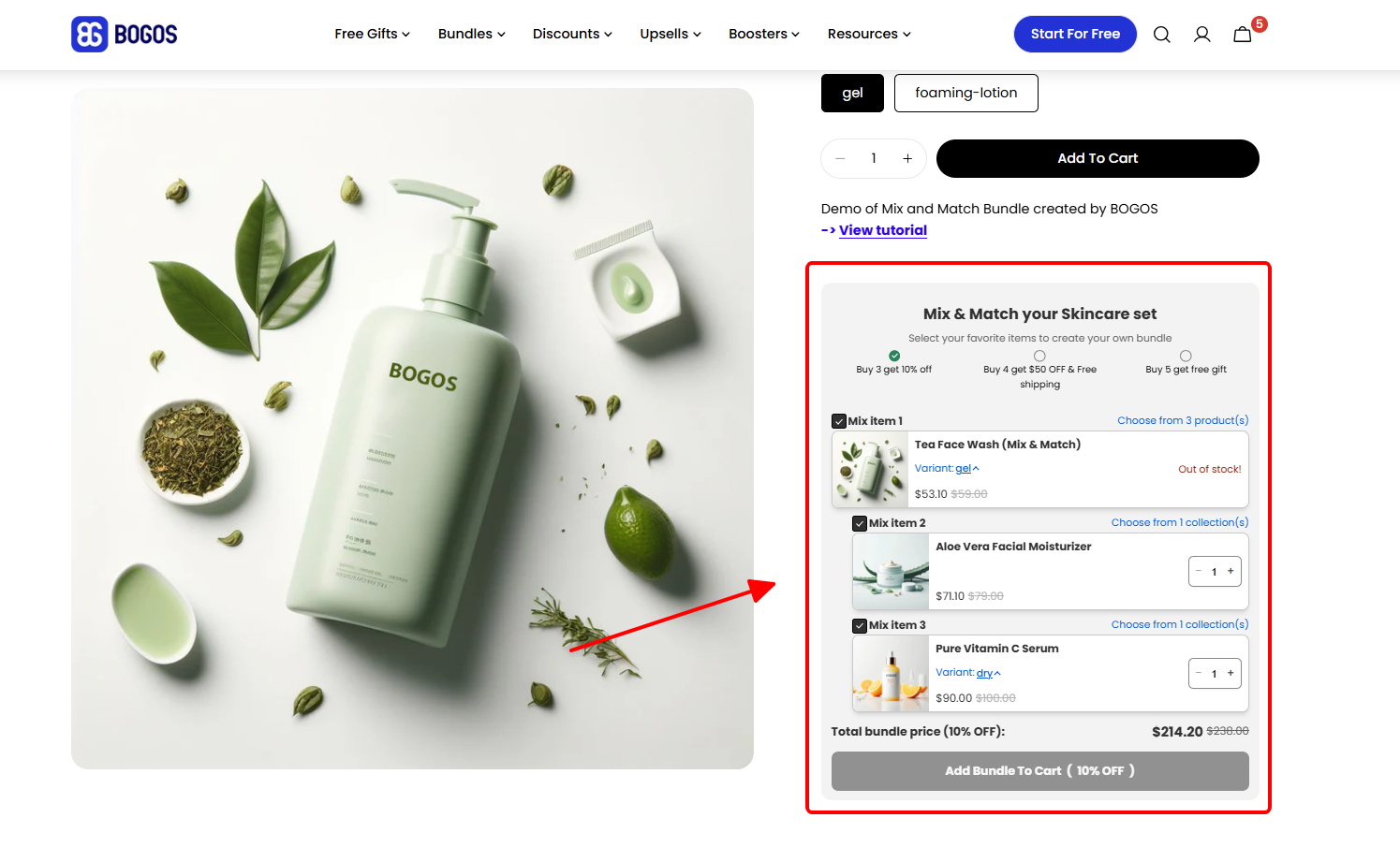
This is the highest-intent placement. The customer is already considering the anchor product. Presenting the bundle here offers a natural upgrade path: “You’re about to buy the cleanser. For $27 more, get the full routine.”
Display the bundle below the Add to Cart button or as a visible section on the product page. Include the price comparison (individual total vs. bundle price) so the value is immediately clear.
Bundle widget on product page
#2 Cart Page or Cart Drawer
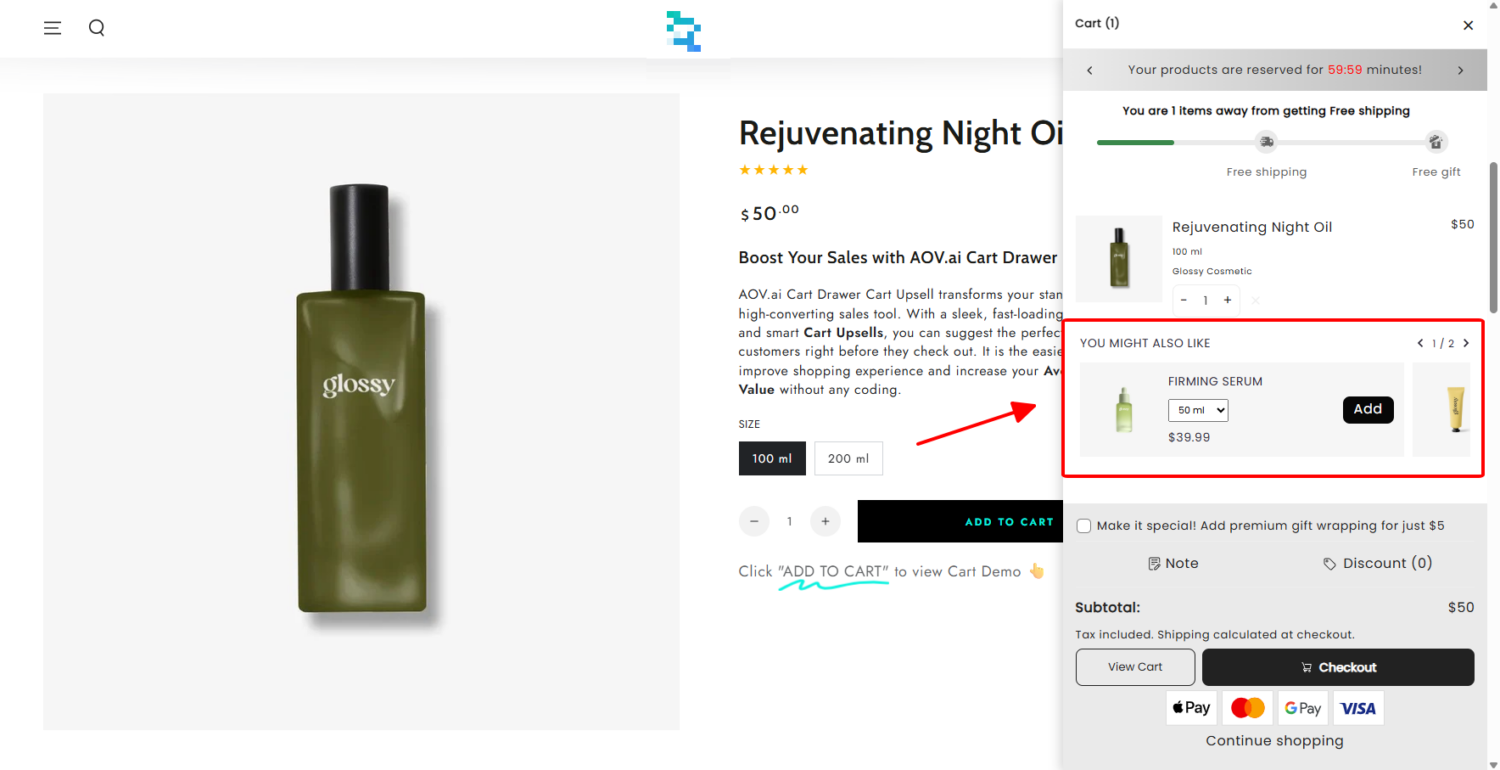
The cart is where AOV is finalized. Presenting a bundle here — especially a “Frequently Bought Together” or “Complete the Set” offer — catches customers at the moment they’re reviewing what they’ll spend.
Cart-based bundle offers work well for adding complementary items. The customer has committed to buying. The bundle gives them a reason to add more before checkout.
Tip: Keep cart-based bundle offers tight — one or two add-on items, not a full kit. You want to increase the cart value, not overwhelm the customer with decisions when they’re ready to check out.
Promote bundle inside your cart drawer
#3 Dedicated Bundle Page or Collection
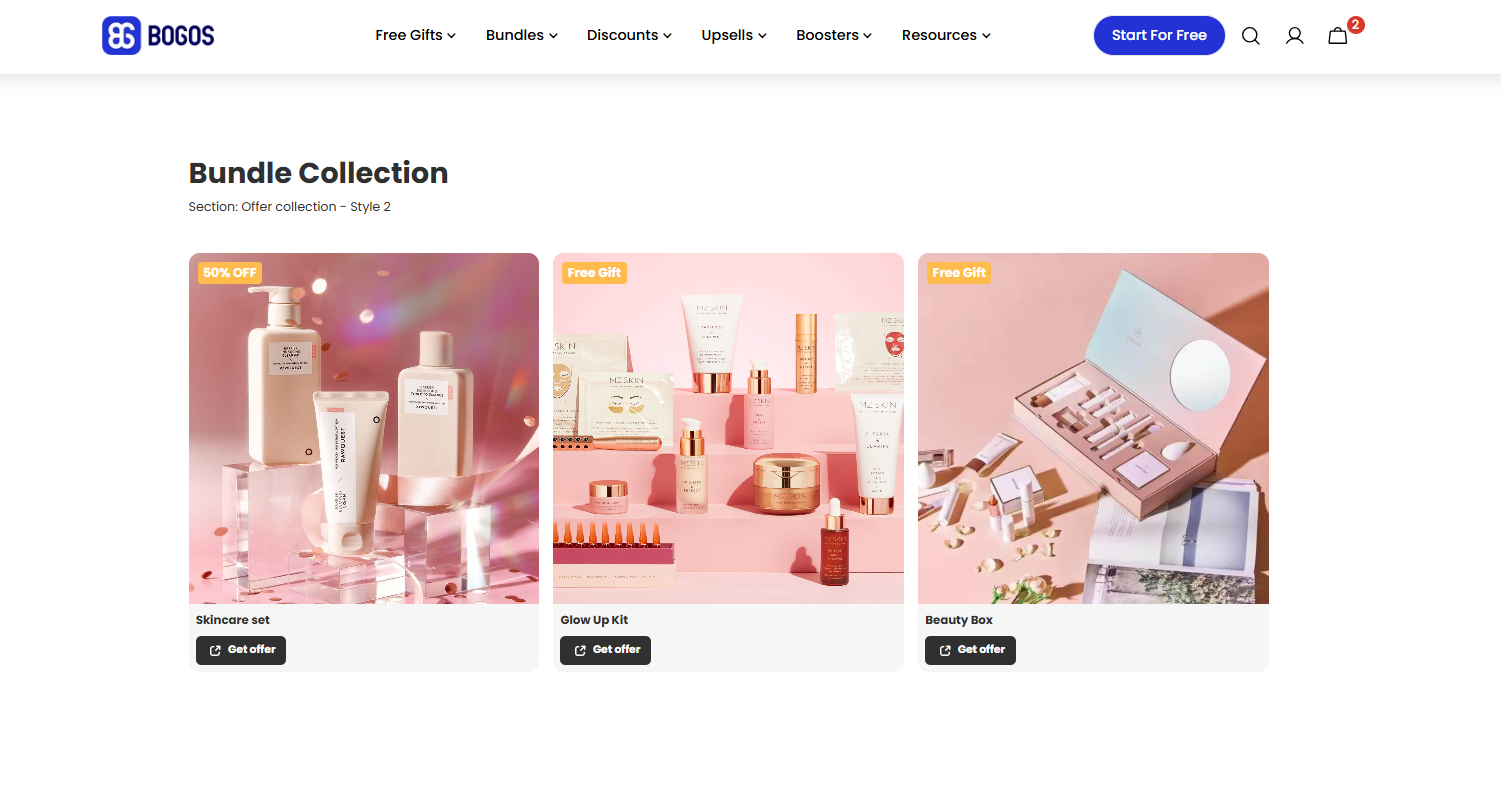
Create a page or collection specifically for your bundles. This works well when you offer multiple bundle options and want customers to browse and compare.
Link the bundle page from your homepage, main navigation, or a banner. Without visible traffic paths to this page, it won’t generate sales on its own.
Bundle Page Showcase Collection
#4 Homepage Feature
Feature your highest-value or seasonal bundle on the homepage. This drives traffic directly to the offer and works especially well during promotional periods or product launches.
Homepage placement is best for one featured bundle at a time. Rotating between multiple bundles dilutes focus and reduces click-through.
Placement Principles
Place bundles where customers are making purchasing decisions, not where they’re casually browsing. Product pages and cart pages outperform collection pages for AOV impact because the customer is closer to buying.
Always display the price comparison at the point of placement. If a customer has to click through to calculate the savings, most won’t.
Test placements by running the bundle in one location for 2 weeks, then adding a second location and comparing performance. This tells you which placements actually drive bundle purchases — and which ones just add visual clutter.
6. How to Measure Whether Your Bundle Is Actually Increasing AOV
Launching the bundle is only half the work. You need to track whether it’s actually lifting AOV — or just shifting revenue from one product to another.
#1 Compare AOV Before and After Launch
Pull your Average Order Value from Shopify Analytics for a baseline period of 2–4 weeks before the bundle launched. Then compare it against the same duration after launch.
If AOV rose, the bundle is likely contributing. If AOV is flat or declined, something in the design, pricing, or placement isn’t working.
Keep in mind that other factors — promotions, traffic changes, seasonality — can also affect AOV during this period. The comparison is directional, not conclusive. For a cleaner read, avoid launching other major promotions at the same time as your bundle test.
#2 Segment Bundle Orders vs. Non-Bundle Orders
Compare the AOV of orders that include the bundle against orders that don’t.
If bundle orders have a significantly higher AOV but your overall AOV hasn’t changed, the bundle may be cannibalizing purchases the customer was going to make anyway. They’re buying the bundle instead of the individual products — not in addition to them.
This is one of the most important signals to watch. A bundle that replaces existing behavior without adding value is just a margin reduction.
#3 Track Bundle Attach Rate
Attach rate tells you what percentage of total orders include a bundle. Calculate it: bundle orders ÷ total orders × 100.
Low attach rate (under 5%) usually points to a visibility problem. The bundle might be well-designed but poorly placed. Check where it appears on the store and whether customers are actually seeing it.
High attach rate with flat overall AOV may mean the bundle price is too low, or the bundle is replacing individual purchases rather than adding to them.
#5 Monitor Margin Alongside AOV
AOV going up while profit per order goes down means the discount is too aggressive. Always track both metrics together.
Pull your gross profit per order for the same baseline and post-launch periods. If AOV increases by 15% but gross profit per order only increases by 3%, most of your AOV gain is being eaten by the bundle discount.
Key Metrics to Review
Track these five metrics over a 2–4 week post-launch window:
Overall AOV (before vs. after launch) — The primary measure of success.
Bundle order AOV vs. non-bundle order AOV — Tells you whether the bundle is additive or cannibalistic.
Bundle attach rate (bundle orders ÷ total orders) — Measures reach and adoption.
Average gross profit per order — Confirms the AOV lift is actually profitable.
Bundle conversion rate (bundle views ÷ bundle purchases) — Shows how well the offer converts once seen.
If AOV is up, margin is healthy, and attach rate is climbing, your bundle is working. If any of those three signals are off, adjust the specific element — pricing, product selection, or placement — before scaling.
Increasing AOV with bundles requires intentional design across four areas: product selection, pricing, placement, and measurement.
Choose products that pull the cart above your current AOV. Price the bundle to offer visible savings while protecting your margin floor. Place the offer where customers are making buying decisions — not where they’re casually browsing. And measure the results with enough specificity to know whether the bundle is creating new value or just rearranging existing revenue.
Your next step: Pull your current AOV from Shopify Analytics. Pick an anchor product — your strongest seller in the category you want to grow. Build one test bundle using the pricing framework in this article, with a bundle price at least 15% above your AOV. Launch it on the anchor product’s product page, and run it for 2–4 weeks. Then evaluate using the five metrics from the measurement section.
One well-designed bundle, tested and measured, will teach you more about what moves your AOV than a dozen untested offers running simultaneously.