Charlie Ngo is an eCommerce expert with 7 years of experience in the marketing field, specializing in SaaS and digital growth. A graduate in Marketing Communication, Charlie currently serves as the Marketing Manager of the BOGOS Shopify App, where he leads strategic initiatives to drive user acquisition, engagement, and brand positioning.
Summary
Section 1: Clarifies what tiered pricing is and how different business models use it, with concrete examples.
Section 2: Highlights why tiered pricing is so powerful for profit, behaviour, and market coverage.
Section 3: Breaks down 4 real tiered pricing models (feature-based, usage-based, quantity-based, and three-tier models) with examples.
Section 4: Compares tiered pricing vs volume pricing with super simple math.
Section 5: Lists the key situations when tiered pricing makes sense, including diverse customer segments, usage growth, clear product packaging, and upsell journeys.
Section 6: Shares marketing strategies such as the decoy effect, best-value highlighting, annual billing incentives, and strategic tier naming to increase conversions.
Tiered pricing is one of the most popular sales promotion strategies used across many business models. From SaaS subscriptions to physical products in e-commerce, tiered pricing remains highly effective. Its biggest advantage is that it encourages customers to spend more by offering increasing value at higher purchase levels.
As for BOGOS, when we built our app for Shopify merchants, tiered pricing became one of the core features we developed and included across various types of promotions—from simple quantity-based tiered discounts to flexible mix-and-match bundles. Tiered pricing also helps our customers scale by increasing average order value and encouraging repeat purchases.
In this guide, we’ll break down how tiered pricing works, where each model fits best, and the strategies that turn pricing tiers into real revenue lifts.
1. What is tiered pricing?
Tiered pricing is a structured way to sell one product or service at multiple price levels, with each level tied to a specific bundle of features, usage limits, or units.
Under the surface, tiered pricing always follows one simple logic: you decide what you measure (seats, usage, scope of work, quantity, etc.), you split that value into levels, and you attach a clear price to each level. Customers then either pick one tier (for example, a plan on your pricing page) or, in some models, their usage flows through several tiers on the bill.
Tiered pricing is used widely across business models, but each sector measures value in a slightly different way:
In SaaS, tiers are usually feature-based or usage-based. Plans scale by things like seats, feature sets, emails sent, API calls, or storage.
In services, tiers are built around scope. You might see a one-time audit, then audit plus implementation, then a full ongoing program with management, reporting, and strategy.
In e-commerce and other product businesses, tiers often follow quantity and bundles. For example, 1–2 items, 3–5 items, 6+ items, or small, medium, large bundles.
You may also see tiered pricing described with different labels, for example:
Tiered pricing/tiered plans
Tiered discounts
Quantity discounts/volume discounts (in ecommerce, this often shows up as simple “buy more, save more” offers)
In this guide, “tiered pricing” is the umbrella term. Later, when we talk about the math, we will separate classic tiered pricing from pure volume pricing so you can see how each one affects margin.
Quick examples of tiered pricing
Example 1: a SaaS tiered plan
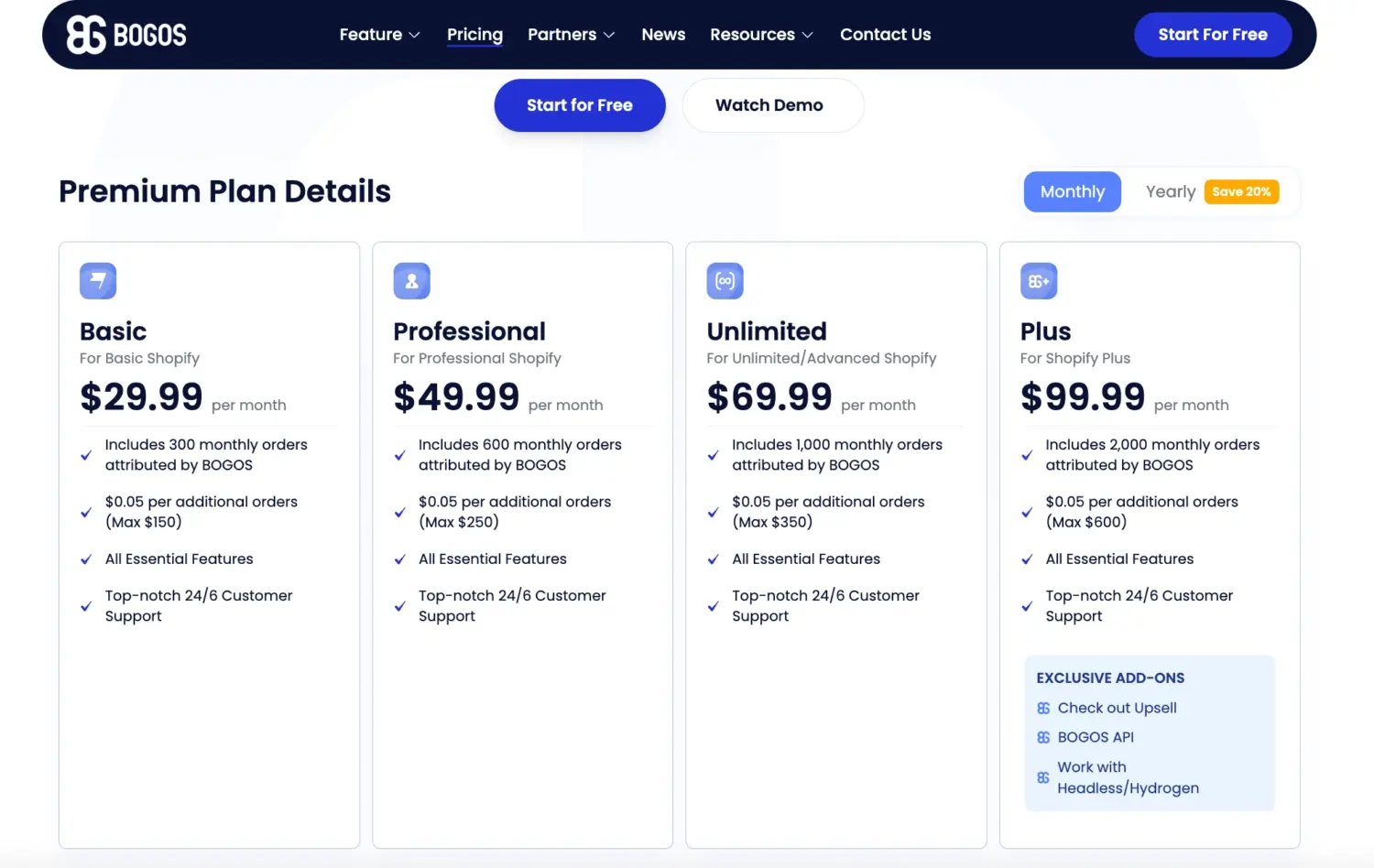
On BOGOS’s pricing page, four tiers scale by monthly orders and unlock extras like checkout upsell and API access, so small stores start low and only move up when their promotions grow.
Example 2: an ecommerce quantity tier
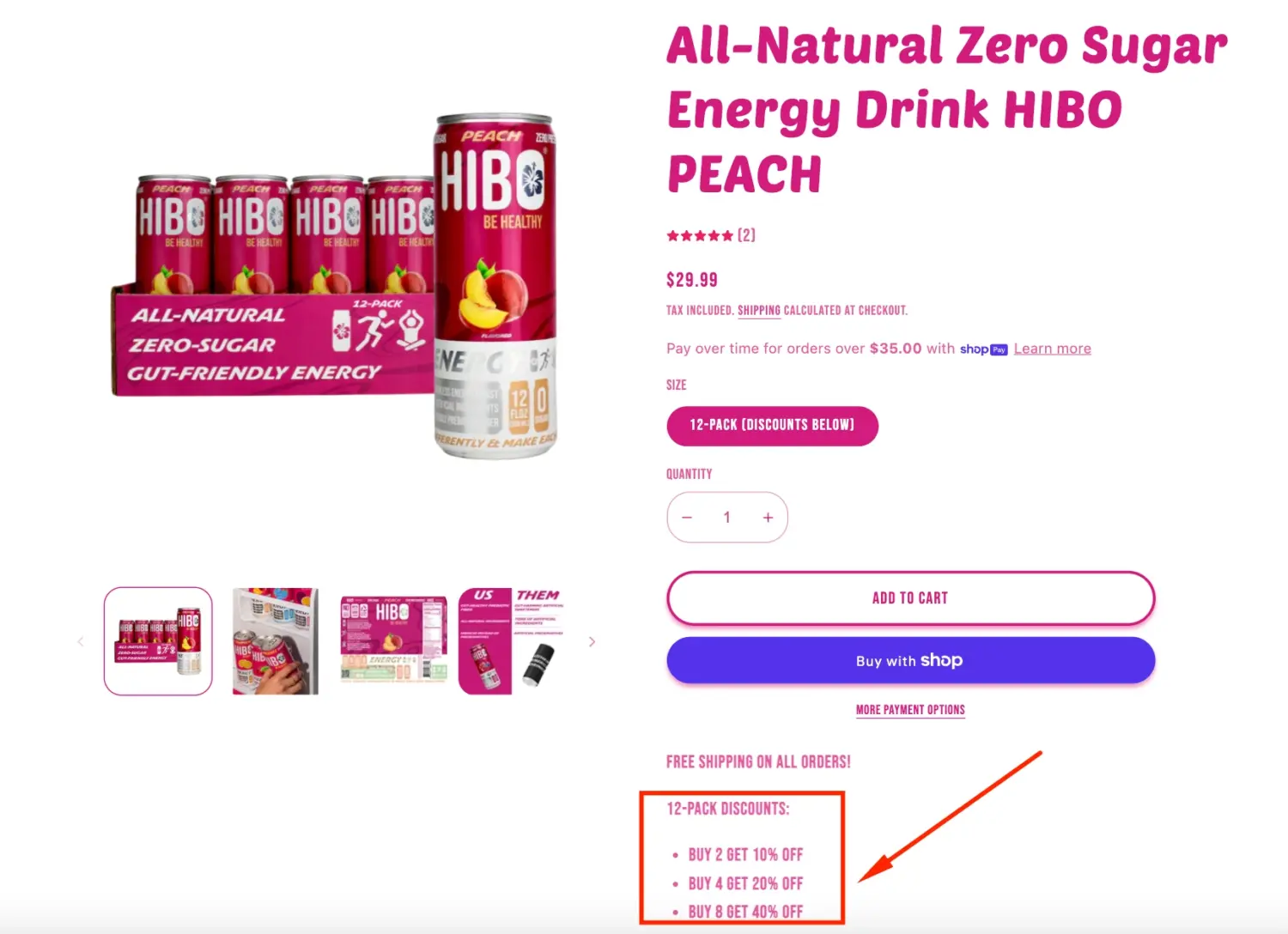
HIBO Energy sells 12 can packs with a “12 pack discounts” box (2, 4, 8 packs = higher % off), so the product stays the same, but bigger orders get a better effective price per pack.
If you look around, almost every mature pricing system today is tiered, from software plans to agency retainers to subscription boxes. That’s because clear tiers make it easier to keep good customers close, win higher value buyers, and do all of that without burning margin on endless blanket discounts.
BOGOS follows that same logic with pricing designed for different Shopify store sizes, and what we care about most is showing merchants how to turn those tiers into a long-term growth habit, not a one-season campaign.
2. Benefits of tiered pricing
The obvious upside of tiered pricing is more choice and smoother upgrades, but its real power shows up in how it changes behaviour and profit, not just “flexibility”. Here are 3 angles that matter in practice:
Better monetization of different usage levels
In most markets, light users and power users sit side by side. Tiered pricing lets casual users stay on a basic tier while heavy users, agencies, or B2B buyers move into richer tiers and so pay more. According to Wharton’s Z. John Zhang, if your customers are not identical and you care about profit, you eventually need to move to tiered or differentiated pricing.
Make bigger commitments easier to choose
Pricing tiers not only change what people pay but also how they act. A 2024 park-and-ride study cited showed that switching from flat to tiered pricing increased high-value user participation by 13% and boosted average revenue per vehicle by 385% purely by changing the structure, not the product.
Balance reach and profitability
Well-designed tiers let premium customers, who choose the top plans, effectively subsidise a solid basic tier for a wider audience. This is why you see many subscription brands keep a low, starter option while still investing in support, content, or features paid for by higher tiers. Doing this right will help you get both reach and resilience instead of a race to the bottom on price.
3. Tiered pricing models and examples
Tiered pricing is one idea, but it shows up in different ways depending on what you sell. Below are 4 common models and real examples that show how they work in practice.
3.1 Feature-based tiered pricing
Feature-based tiered pricing means every tier is its own package. Customers are not paying for “more of the same unit” but for more capability: extra software, services, or accessories.
On a pricing page, this usually appears as 2-3 columns with a tier name, price, and a short list of what is included. The entry tier covers the essentials. Higher tiers add depth: more tools, more support, more assets.
The upside is reach. You can cater to beginners and advanced users on the same page. The risk is clutter. If tiers differ only by tiny details, or if basic must-have features live only in the top tier, people feel confused.
Example – Canva
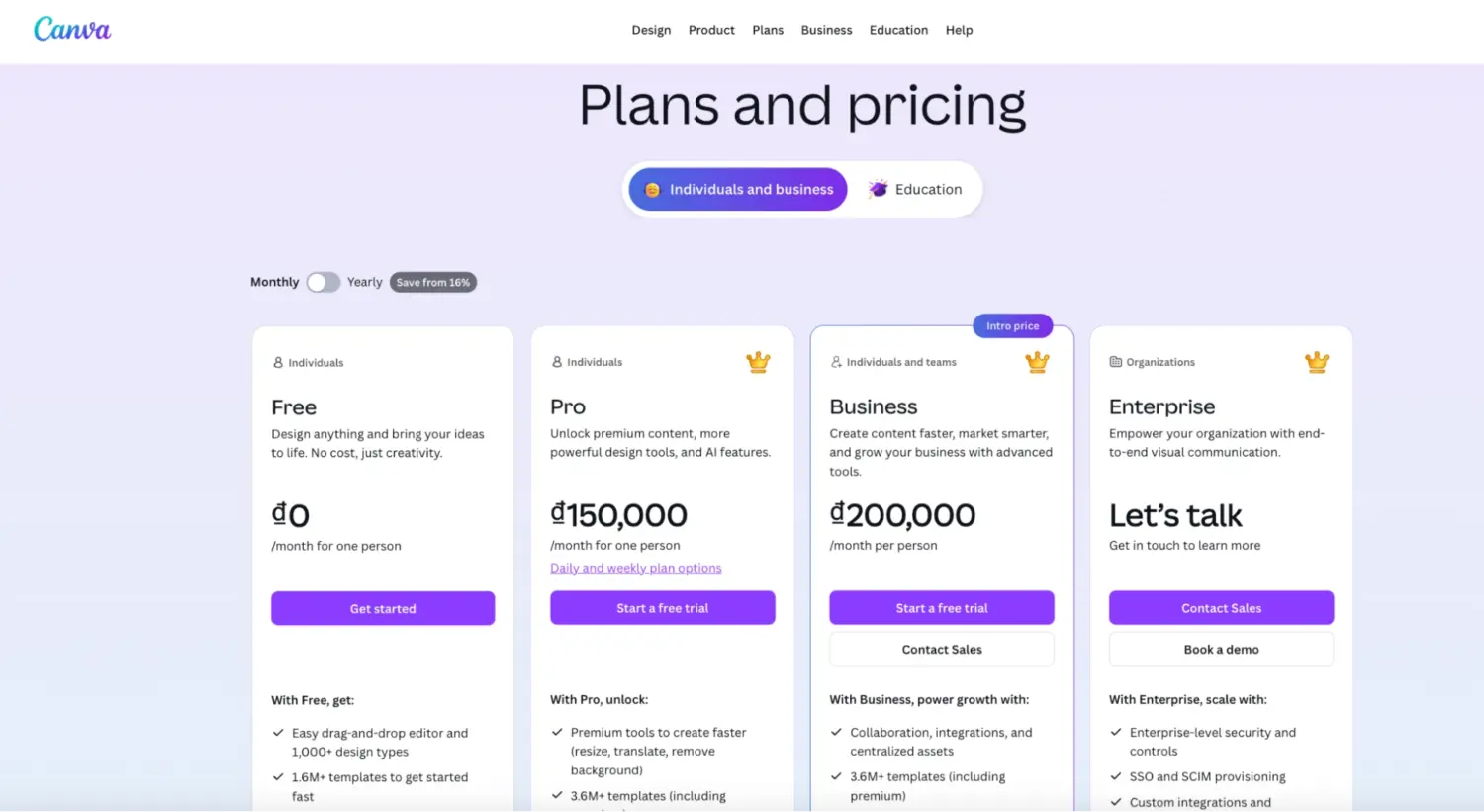
Canva shows feature-based tiered pricing very clearly because each tier solves a different level of creative work. Pro gives individual creators the tools to move faster with premium content and AI features, while Business adds the collaboration and brand controls teams actually need. The jump between tiers matches real workflow needs, not just extra add-ons.
Best for:
Complex physical products that need accessories and software: cameras, photo booths, studio gear
Service offers with clear layers of support: audits, implementation, and ongoing management
Digital products
3.2 Usage-based and user-based tiered pricing
Usage-based tiered pricing charges people according to how much they use over time.
User-based tiered pricing ties the bill to how many people are active on the account. In both cases, the “meter” is ongoing consumption, not a one-off quantity in the cart.
On a pricing page, these tiers usually show up as plans named by volume: number of items per month, number of users, number of shipments, or similar. People with small, occasional needs stay on the lower tiers without feeling restricted, while heavier users move into higher tiers because they get far more value from the extra capacity.
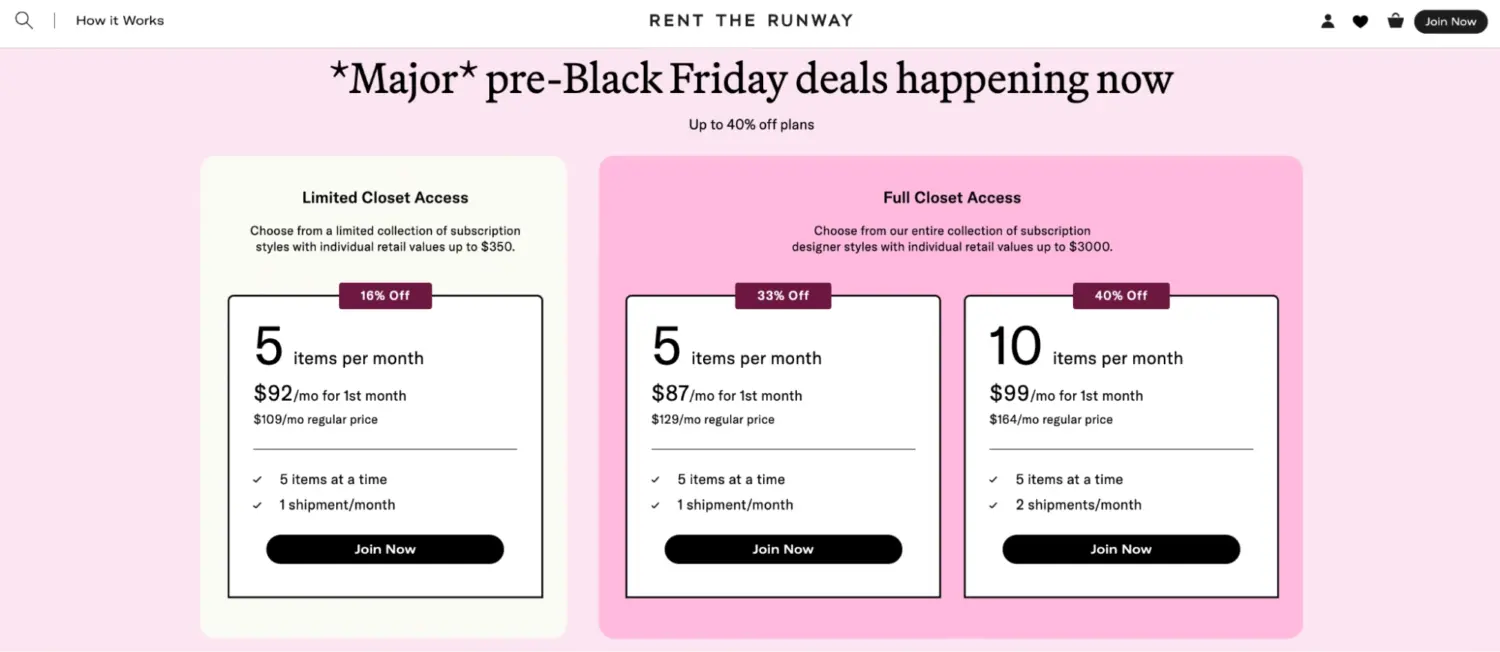
Example – Rent the Runway subscription plans
Rent the Runway offers plans like 5 items per month from a limited closet, 5 from the full closet, and 10 items from the full closet, each at a different price and discount level.
Nothing about the core service changes. Shoppers simply pick how many items they want to rotate each month and what level of access they need.
Good fit for:
SaaS products with clear usage metrics: emails sent, API calls, storage & seats
Subscriptions where people can scale consumption up or down: content, learning, or product subscriptions
Rental models where value grows with rotation and access: fashion, gear, or equipment rental
3.3 Quantity or volume-based tiered pricing
Quantity or volume-based tiered pricing adjusts the price within one order.
The product doesn’t change, but the price per unit becomes better when a customer reaches specific quantity breaks.
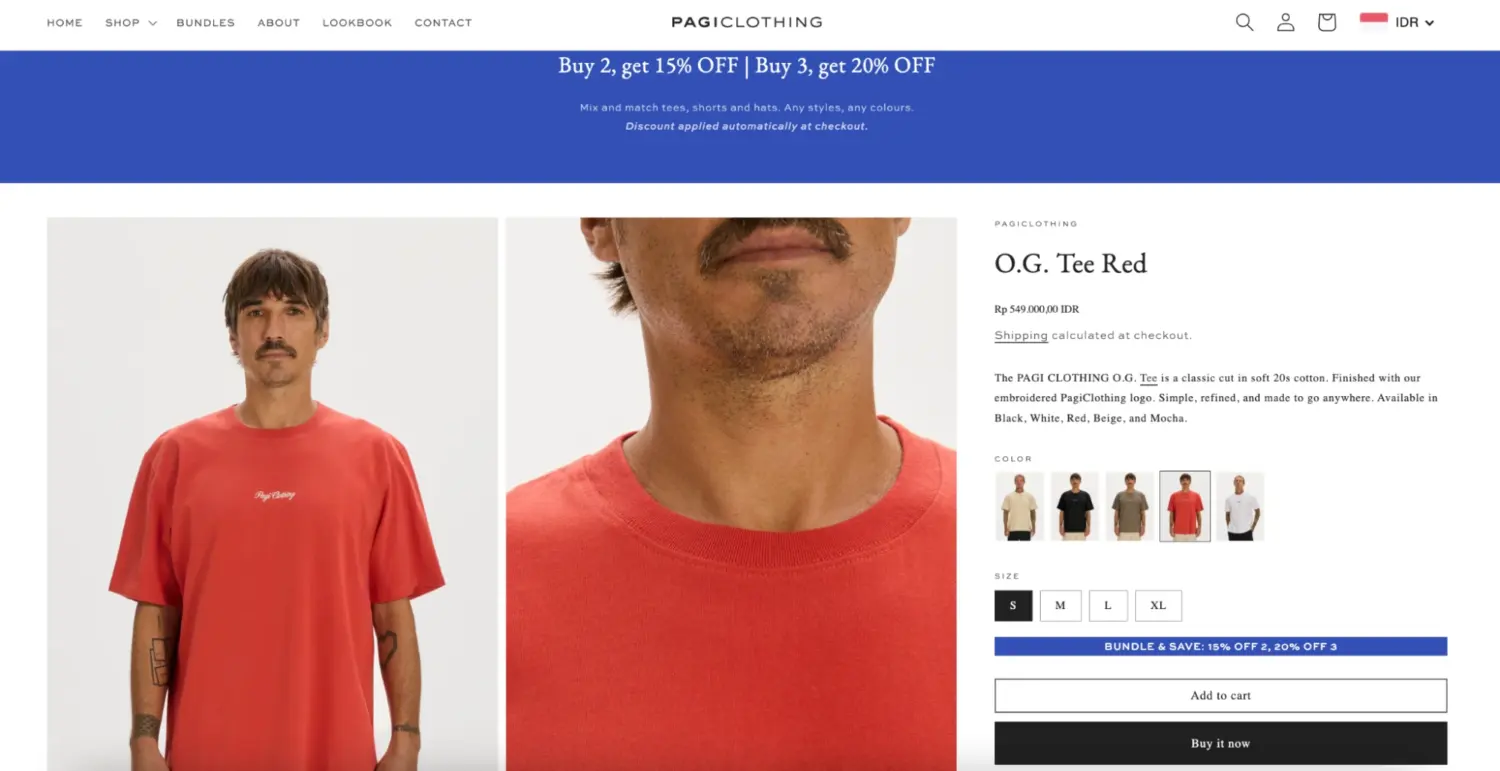
On a storefront or order page, this usually appears as a short line or table such as “Buy 2 get 15% off, Buy 3 get 20% off,” or as a “Bundle and save” strip above the main call to action.
The model is intuitive, but you need to balance the discounts carefully. If the highest tier is too generous or always available, shoppers may start buying only in bulk and ignore full-price single items.
If you are using Shopify for your business, tiered pricing can be a crucial strategy for boosting your average order value (AOV) and driving upsells. Creating tiered pricing on Shopify is simple and can be done without using a third-party app—although apps do provide more flexibility and advanced functionality.
Example – Pagiclothing bundle & save
Pagiclothing shows a banner on the site that says “Bundle & Save on Tees, Hats, and Shorts. 15% off 2, 20% off 3. Automatic discount.” Shoppers can mix any styles and sizes. When they add two items, they unlock the first tier; at three or more, they unlock the second.
Good fit for:
Products people often buy multiples of, likedrinks, protein bars, razors, sheet masks, vitamins, socks, T-shirts
Categories where “stocking up” is common, likepantry items, pet food, cleaning supplies, and personal care refills
Situations where you want to accelerate sell-through, likeseasonal colors, end-of-line SKUs, and slow-moving variants
3.4 Three-tiered pricing model
A three-tiered pricing model gives customers three clear options side by side, usually positioned as “entry”, “recommended”, and “advanced”. All three are still feature-based (each tier adds more capability), but the focus here is on how many choices you show and how you guide the decision, not on the exact feature list.
You often see this with plans like Personal, Professional, and Business. The entry tier is priced to feel safe for smaller users, the middle tier is framed as the best value for most customers, and the top tier is reserved for complex or high-stakes use cases.
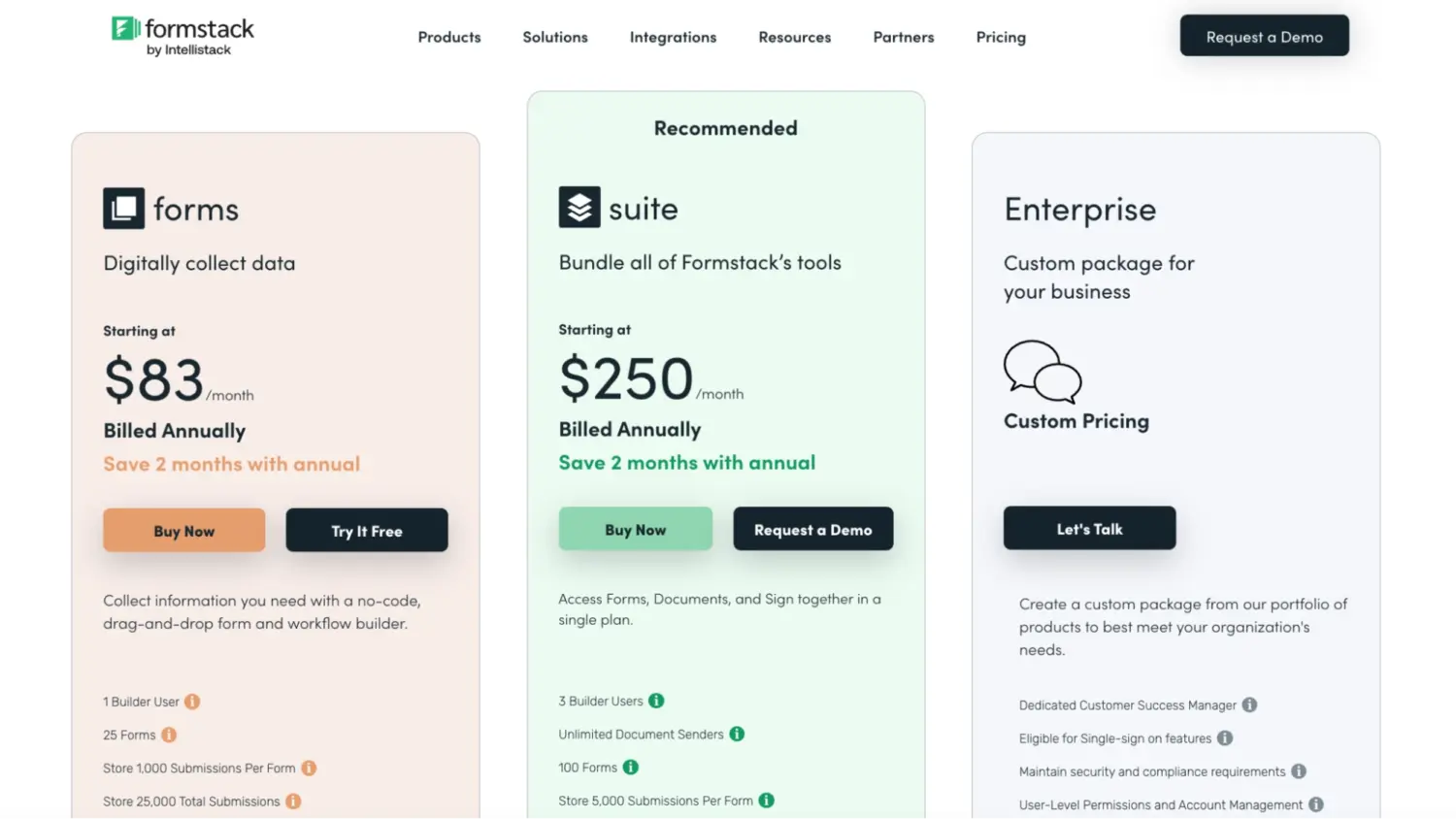
Example – Formstack’s three-plan layout
Formstack uses a clear three-tier model with Forms, Suite, and Enterprise. Forms is the entry option for teams that only need online forms, while Suite is the “recommended” middle tier that bundles Forms, Documents, and Sign for a fuller workflow. Enterprise is a custom, top-tier offering for larger organizations that need advanced security, compliance, and dedicated support.
Good fit for:
Streaming, design, and productivity tools with clear quality or seat upgrades
Services that split naturally into basic, full-workflow, and enterprise levels
Funnels where you want most buyers to choose a strong, best-value middle tier
To help you apply these concepts to your own business, you need a flexible tiered pricing template that can handle your specific data. We have designed two “plug-and-play” frameworks tailored for SaaS and E-commerce strategies.
For SaaS: The Universal Metric Matrix. This template helps you define clear “Good/Better/Best” tiers, ensuring you capture revenue from small users while forcing growing companies to upgrade.
For E-commerce: The Volume Profit Simulator. Instead of blindly offering discounts, this template calculates the exact impact of bulk bundles on your Net Profit and ROAS, so you can increase your Average Order Value (AOV) without losing your margin.
4. Tiered pricing vs volume pricing: same goal, different math
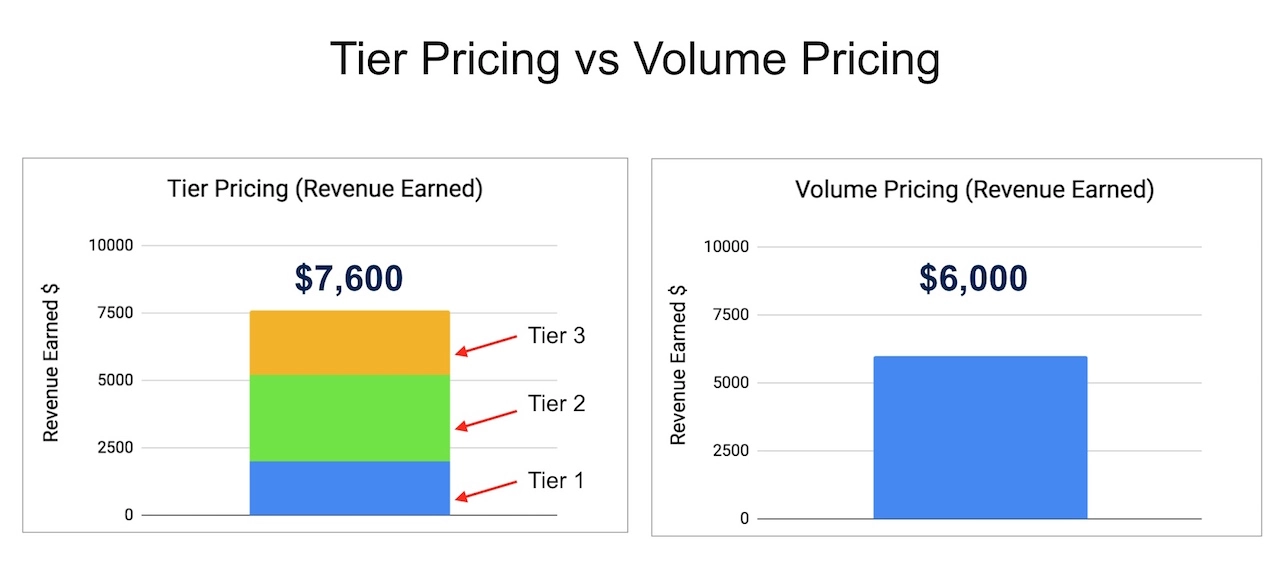
In ecommerce, both tiered pricing and volume pricing start from the same idea: you set quantity breaks and offer a better deal when someone buys more. The difference is in how the discount is calculated:
Volume pricing (all-units): once the customer buys enough to reach a break point, the lower unit price applies to the entire order.
Tiered pricing: each break point has its own unit price, and that price only applies to the units that fall within that range.
Image source: SpeechSilver
For example, you sell a product with this price schedule:
1–100 units: $1.00 per unit
101–200 units: $0.80 per unit
201+ units: $0.60 per unit
A customer orders 250 units. A comparison table:
Model
Unit price applied
How the order is charged
Total
Tiered pricing
$1.00 for 1–100 $0.80 for 101–200 $0.60 for 201–250
100 × 1.00 = 100 100 × 0.80 = 80 50 × 0.60 = 30
$210
Volume pricing (All-units)
$0.60 for all 250 units (because the order falls in the 201+ tier)
250 × 0.60
$150
You see the same quantity, the same bands, but:
Volume pricing gives the customer the lowest price on every unit, which is very attractive but cuts margin on large orders.
Tiered pricing still rewards higher volume with better unit prices, but keeps more revenue on the earlier units, which matters a lot when you have big buyers or heavy users.
The pattern we see in healthy businesses is that they let tiered pricing do the heavy lifting on repeat orders and B2B buyers, and treat volume pricing as a short, sharp lever during events like BFCM, clearance, or big partner promos where they accept thinner margins on purpose.
5. When to use tiered pricing?
5.1 Serving multiple customer segments
If you serve very different segments, one flat price will always be wrong for someone.
In SaaS, that might mean plans for Personal, Team, Business, and Agency, where each tier adds things like more seats, better support, or advanced features.
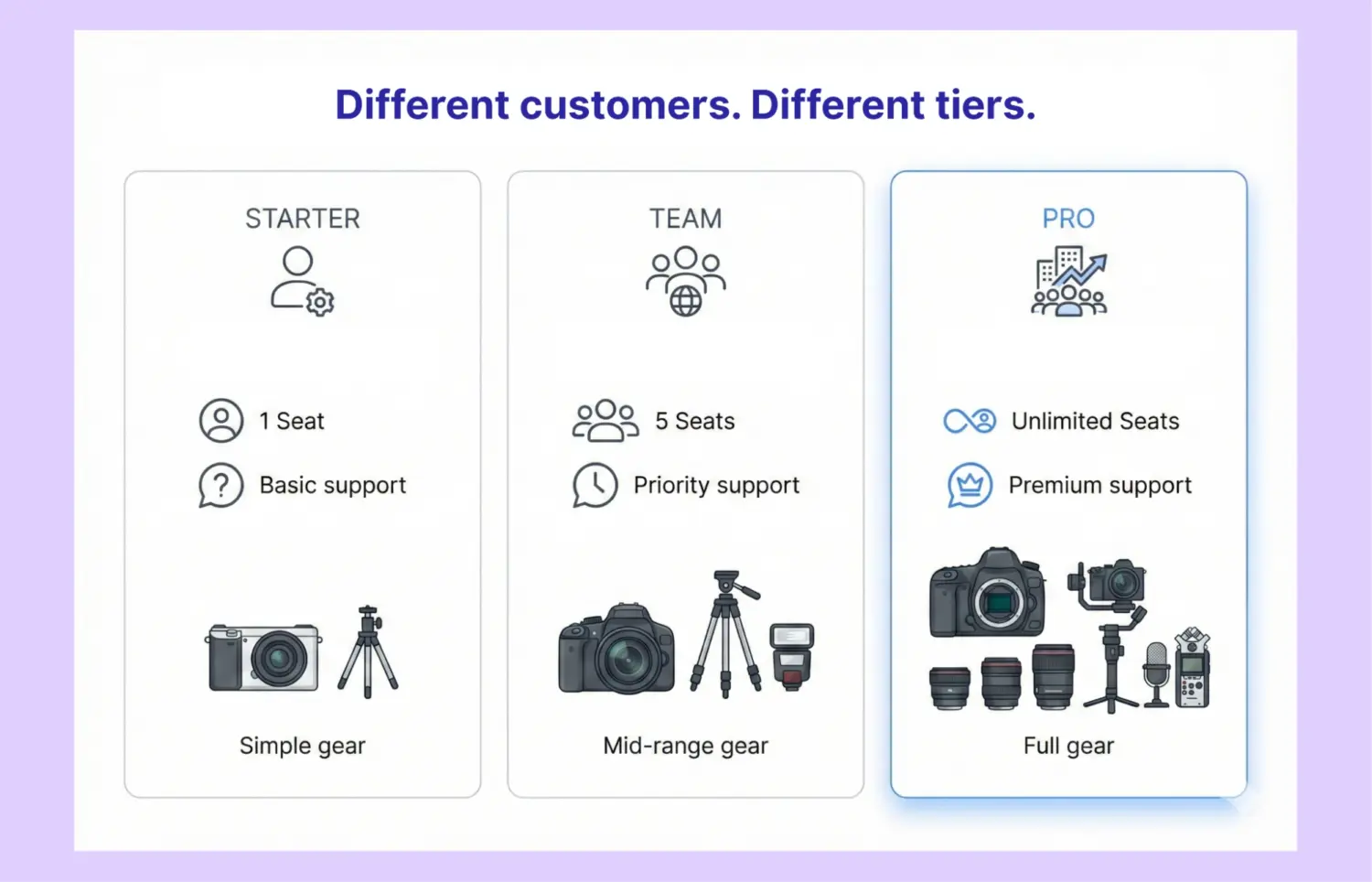
In ecommerce, you can do the same with tiered bundles. A camera brand can sell a Starter kit for beginners (body plus simple lens) and higher tiers that add pro lenses, tripod, and audio gear for serious creators.
One product family, but each group sees a tier that fits their level.
5.2 When value scales with usage
If customers get more value the more they use your product, tiered pricing helps you capture a fair share of that growth. This is a strong fit when your costs rise with usage (storage, bandwidth, API calls) or when the benefit comes from many people using it together.
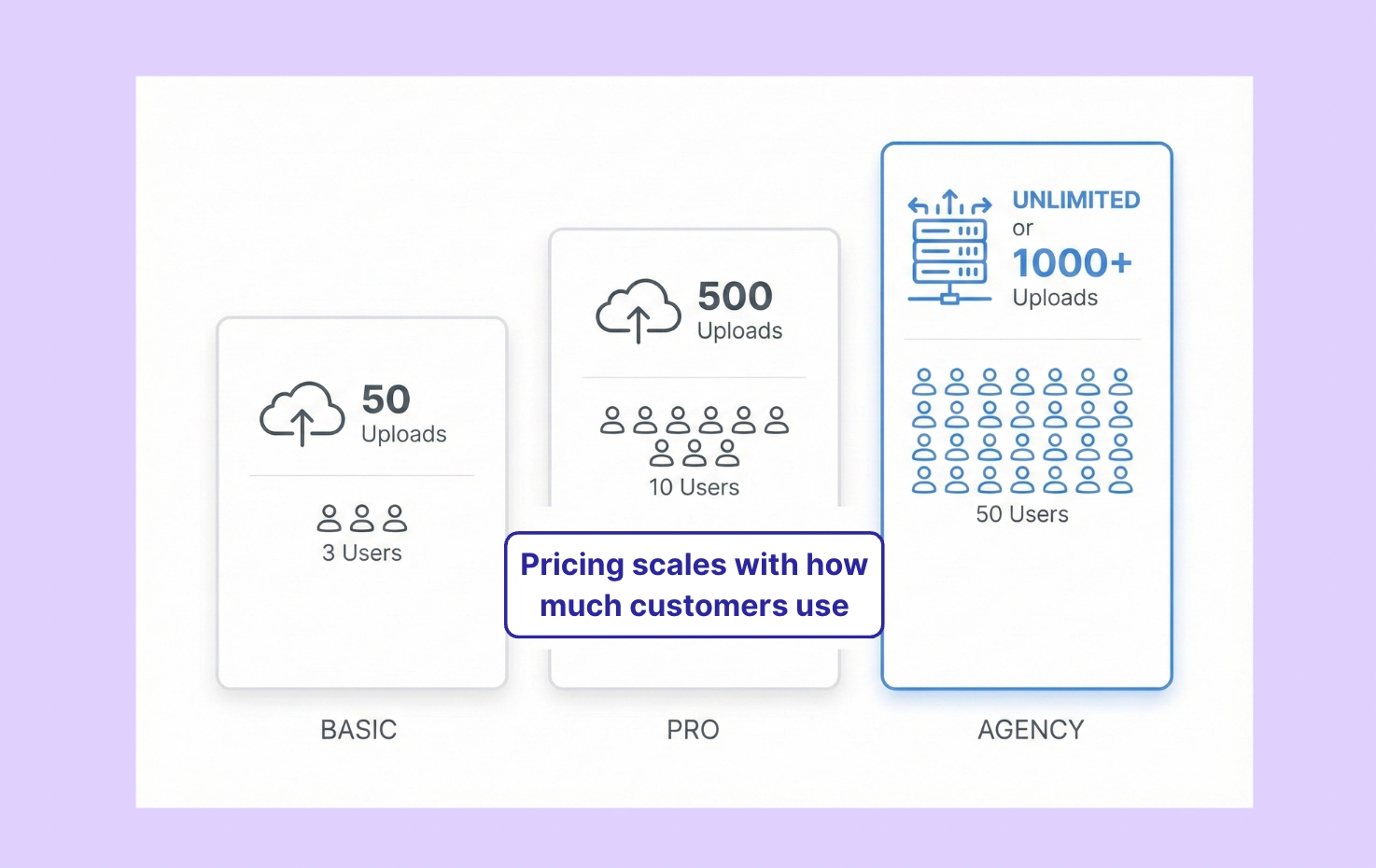
A video hosting platform can set a Basic plan with 50 uploads, a Pro plan with 500, and higher tiers for agencies that host thousands of videos. A collaboration tool like Slack or Asana can charge per active user, so a 3-person team and a 50-person team do not pay the same, but both feel the price is linked to the value they get.
5.3 When you can package clearly
Tiered pricing works well when you can turn your offer into clean packages that grow in value. A good sign is when you can split features into must-haves, nice-to-haves, and power user extras without overthinking it.
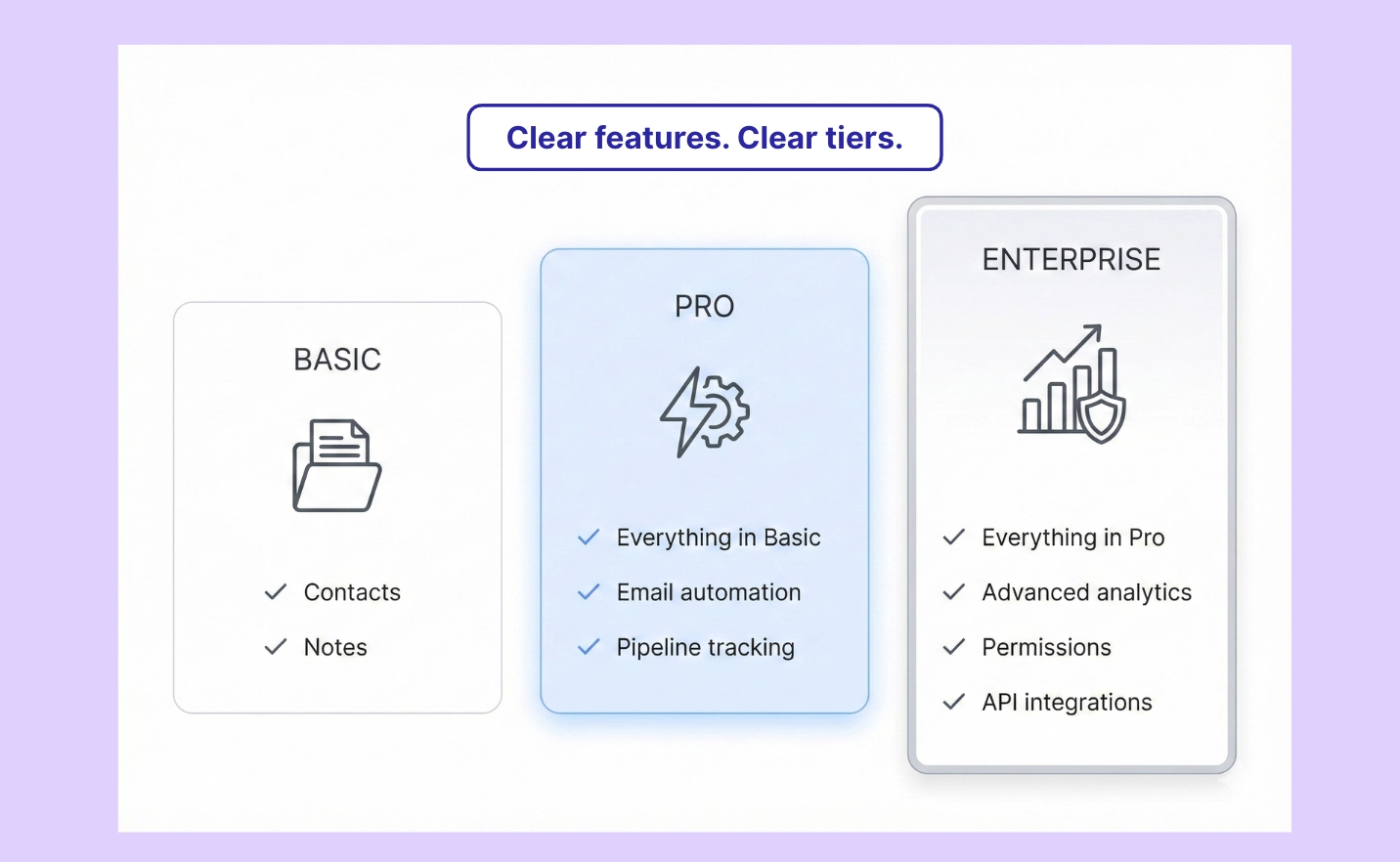
A CRM shows this clearly. A Basic tier might include contact management and simple notes. A Pro tier adds email automation and pipeline tracking. An Enterprise tier adds advanced analytics, permissions, and API integrations.
On Shopify, you can copy this idea with product sets or memberships that add more depth at each tier instead of just more items.
5.4 When upsells and LTV matter
Tiered pricing is very useful when your business model depends on customers growing with you. You let people start small, then make it easy to pay more when their needs expand.
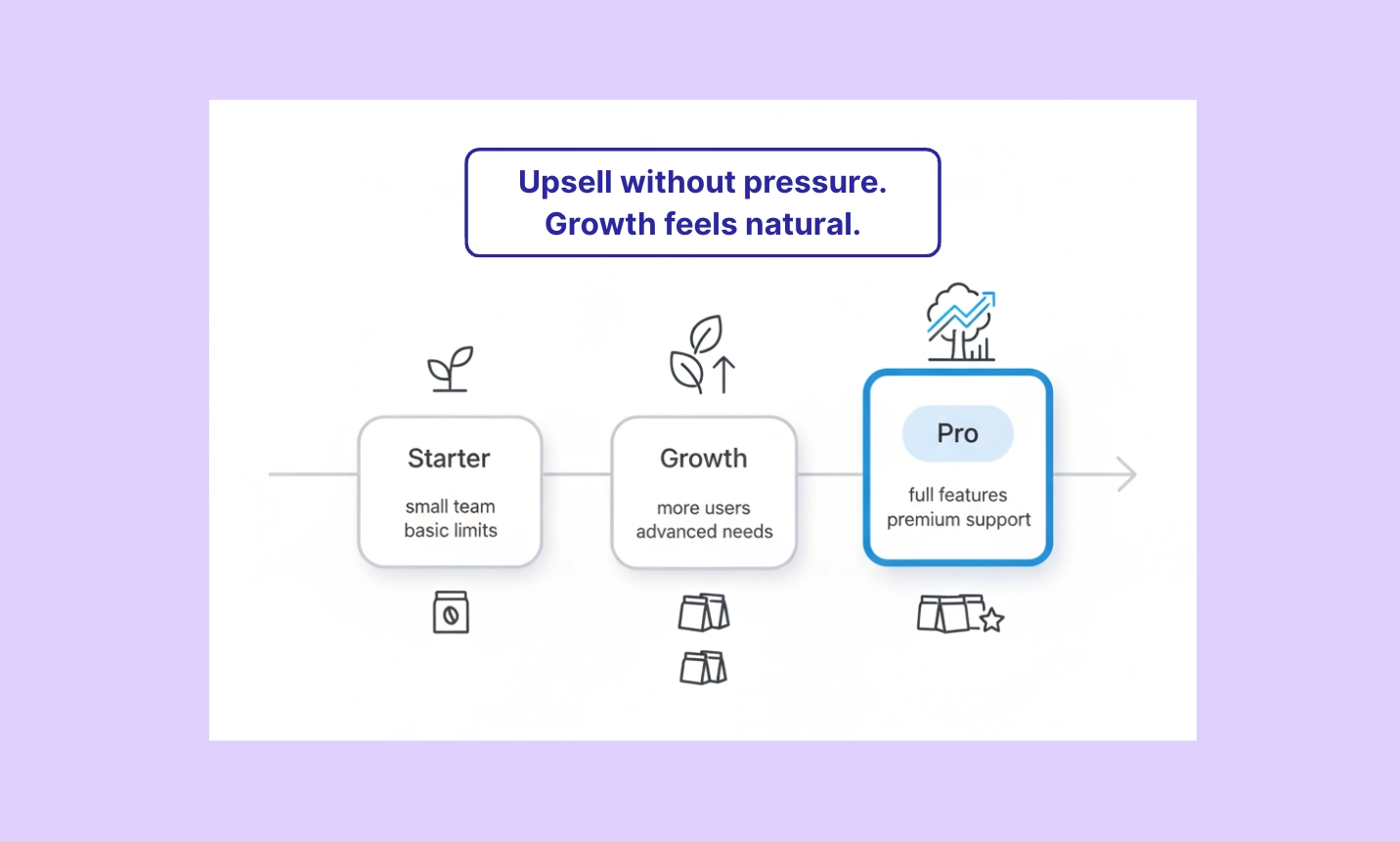
A startup may begin on a Starter plan with low limits and basic features. After a year, they have a bigger team and need better reporting, more usage, or stronger support, so upgrading to a Growth or Pro plan feels like a natural next step, not a hard sell.
In ecommerce, the same idea can move a loyal buyer from a small coffee subscription to a larger plan with more bags and extra perks as their household or office consumption increases
6. Marketing strategies to make your tiered pricing model sell like magic
Here are 4 tiered pricing strategies that work effectively because they align with how people make decisions, not how businesses think they should.
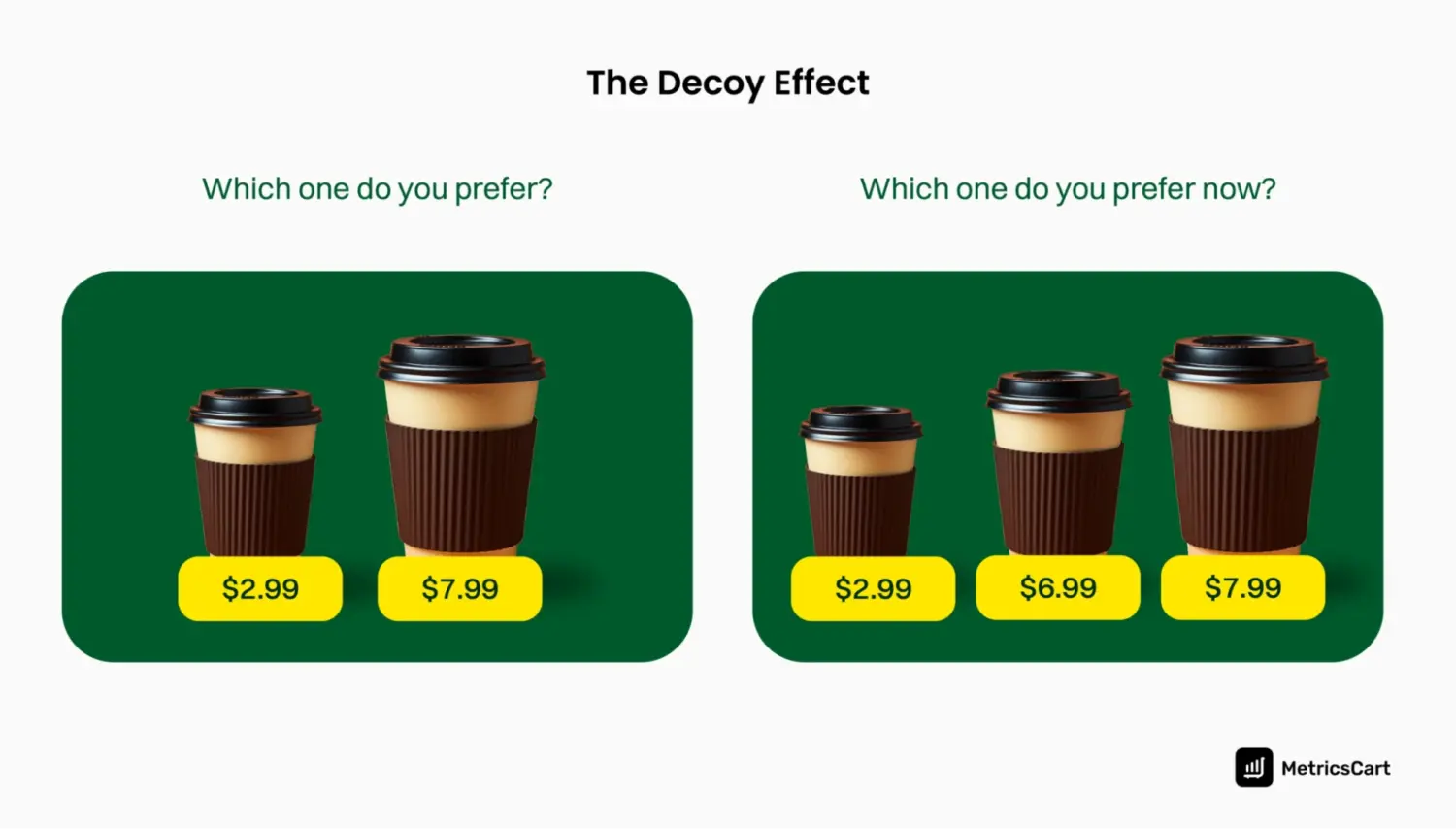
6.1 Decoy effect
Image source: MetricsCart
The decoy effect is one of the most powerful psychological tools in pricing. You introduce a high-priced “anchor” tier so the tier you actually want customers to choose suddenly looks like an amazing deal.
Here’s how smart brands build it:
The Starter tier is simple and affordable. It signals: “Anyone can begin here.”
The Premium tier is intentionally expensive and loaded with features that only a small group truly needs. Its main job is to anchor the price high.
The Middle tier is the star. You price it close to the Starter tier, and fill it with the features that matter most. Customers feel they’re getting almost all the premium benefits without the premium cost.
It works because people compare relative value, not absolute numbers. When the Premium tier feels “too much,” the middle tier looks like a smart, safe, rewarding choice.
Example:
Basic: $10 per month
Pro (your target tier): $25 per month
Enterprise: $75 per month
The $75 anchor makes $25 feel incredibly reasonable. Most customers will choose Pro because it feels like the smartest jump in value.
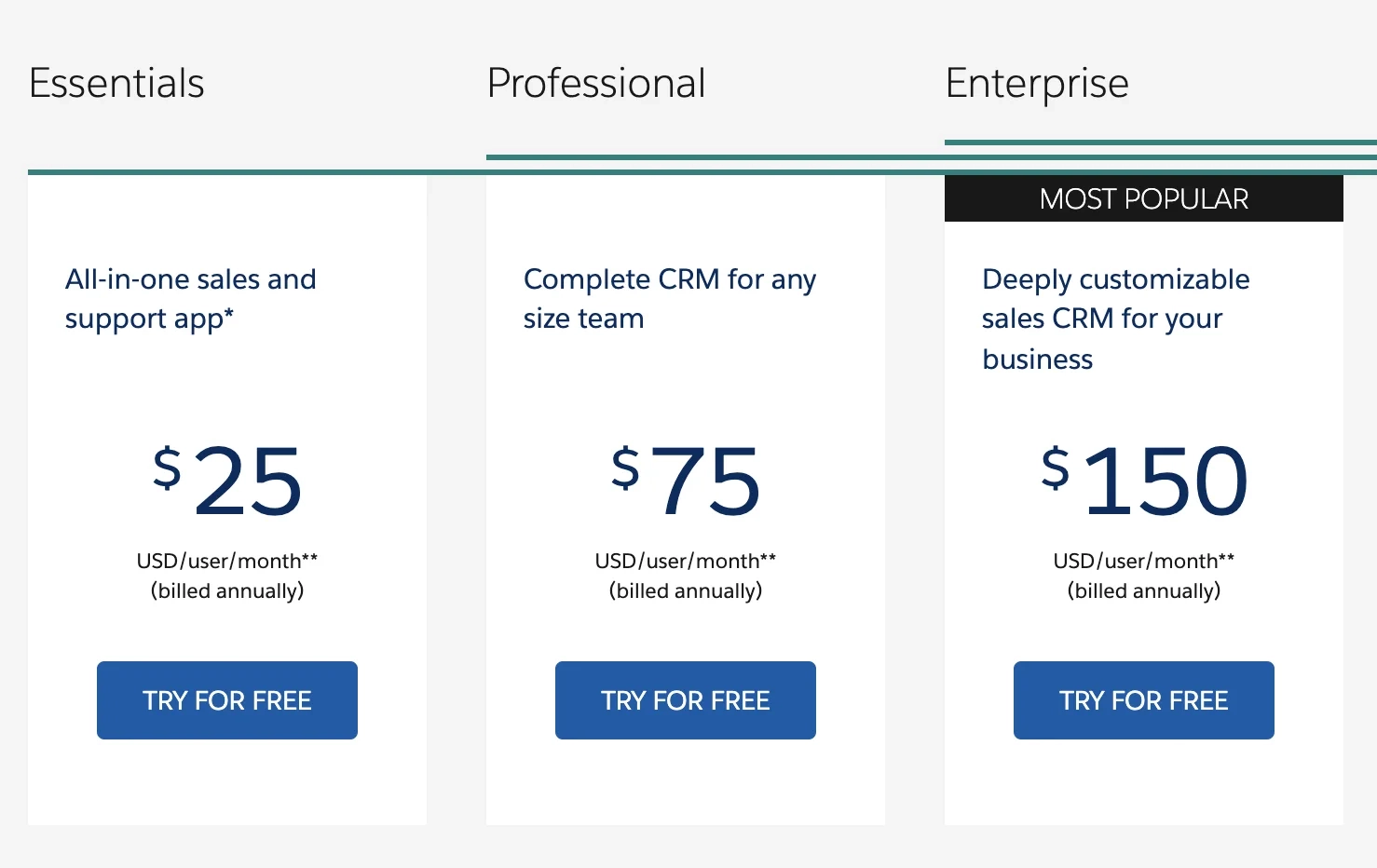
6.2 Best value highlight
Image source: CloudZero
Even a perfect tier layout can fail if customers feel lost. Your job is to gently point their eyes toward the option that gives them the best experience for the price.
Here are simple but powerful ways to do that:
Add a Most Popular or Best Value badge. This works because people trust social proof.
Use color, size, or a subtle border to make the “hero tier” look just a little more special.
Preselect the recommended tier. When a customer lands on the page, they instantly see what most people choose.
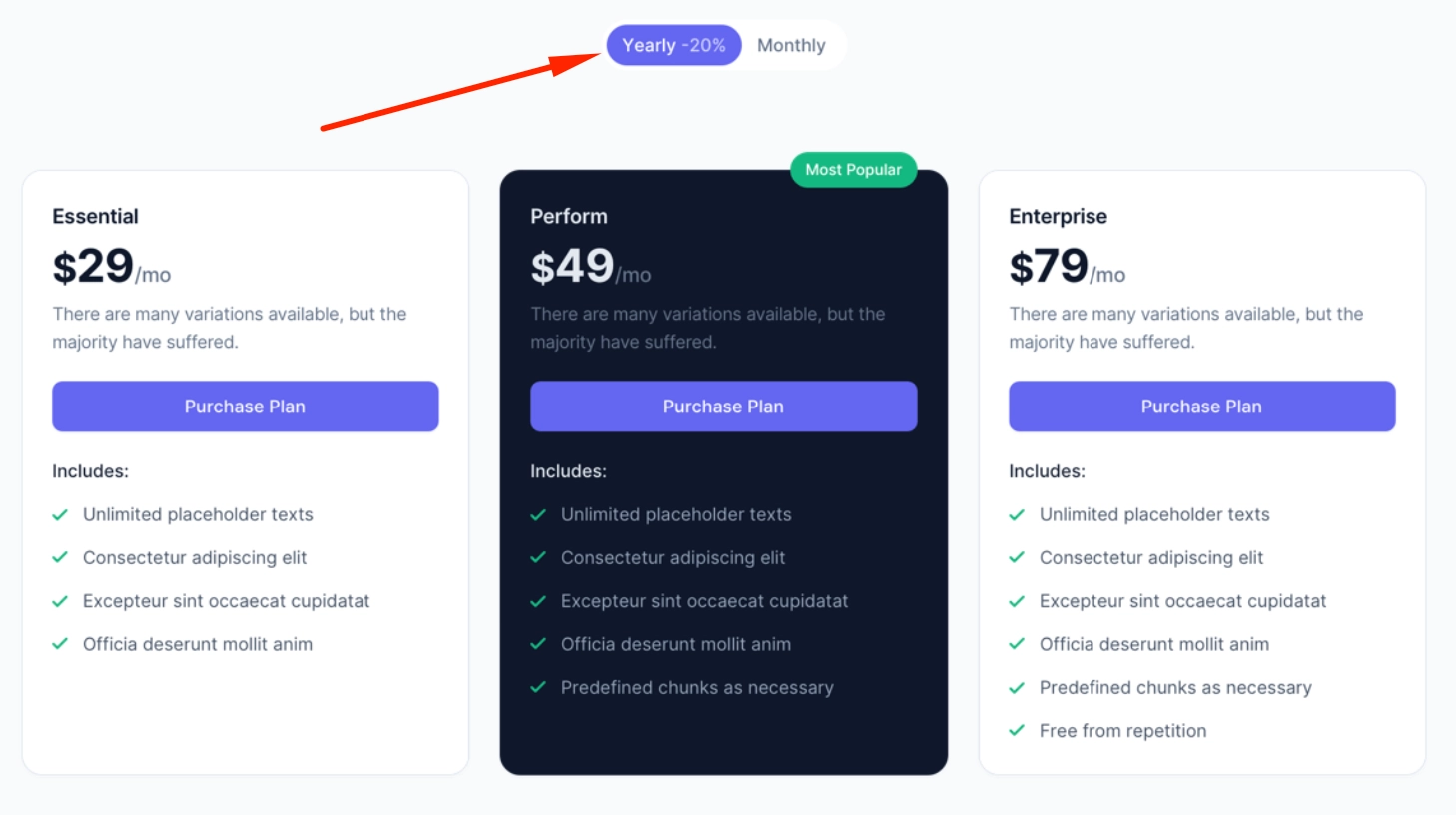
6.3 Annual billing incentive
Image source: Cruip
Many customers want stability and savings. Many merchants want predictable revenue. A strong annual discount gives both sides what they want.
This tiered pricing strategy works when:
The yearly savings are big enough to feel rewarding
You clearly show the price difference between monthly and yearly
You reinforce the benefit: less billing friction, more savings, and long-term value
Annual incentives can dramatically improve retention because people commit for a year instead of month to month. It also gives you more time to prove your product’s value, which leads to upgrades later.
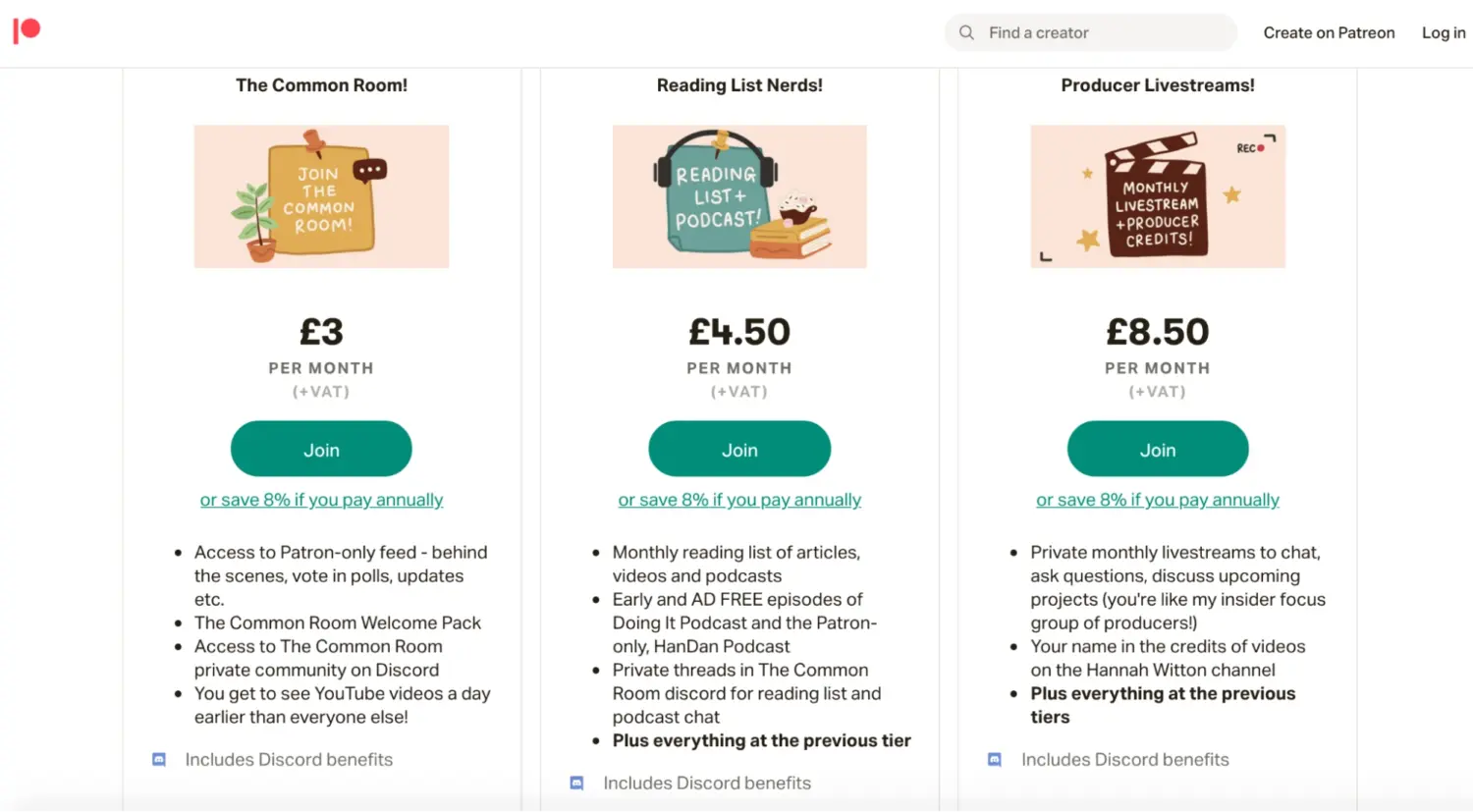
6.4 Strategic tier names
Image source: Podcast.co
This part seems small, but it makes a huge impact. One of the most common mistakes I see (especially from BOGOS merchants using volume discounts or tier-based bundles) is naming tiers Tier 1, Tier 2, Tier 3. Customers learn nothing from those names, and the tiers feel generic and forgettable.
Better tier names do two things:
They explain who the tier is for
They express the feeling or benefit of the upgrade
For example:
Starter – Growth – Pro
Basic – Plus – Premium
Beginner – Creator – Studio
Essential – Business – Elite
Names like these help customers instantly understand where they belong and what they gain by moving up. The right words create momentum. They turn “another price option” into “a step up that matches who I am.”
8. Conclusion
Honestly, after testing lots of promotions, we find that tiered pricing is one of the best ways to grow sales while keeping customers happy. If you haven’t tried tiered pricing yet, now’s the time to see how powerful it can be.
FAQs
What is tiered pricing?
Tiered pricing is a strategy where you sell different versions of the same product or service at different price points. Instead of a “one-size-fits-all” cost, you offer choices—usually structured by features, usage limits, or quantity. This allows you to capture budget-conscious customers on the lower end while maximizing revenue from power users who are willing to pay for premium capabilities.
What is 3-tier pricing?
This is the “Goldilocks” approach to pricing, typically structured as Good, Better, and Best. The strategy uses behavioral psychology to guide the buyer’s decision: the lowest tier acts as a low-risk entry point, the expensive top tier makes the others look affordable, and the middle tier is positioned as the “smart choice” where the majority of customers are intended to land.
What are the disadvantages of tiered pricing?
The biggest risk is complexity. If the differences between your tiers aren’t immediately obvious, customers can suffer from “analysis paralysis” and leave without buying. There is also a risk of “cannibalization”—if your lower tier is too generous, customers may never feel the need to upgrade to the more profitable plans.
What are examples of tiered pricing?
You see tiered pricing everywhere, from SaaS platforms (Free vs. Pro vs. Enterprise) to travel (Economy vs. Business Class). In e-commerce, it often appears as volume discounts (e.g., buying a single bottle of vitamins vs. a 3-month supply). In the service industry, it distinguishes between “do-it-yourself” support and “done-for-you” management.
What are tiered pricing synonyms?
Common synonyms include variable pricing and differential pricing. Economists technically call it price discrimination. Depending on the specific industry, you may also see it referred to as volume discounts, sliding scale fees, or package pricing.