Allan Vu is a Digital Marketing expert and the driving force behind BOGOS’s blog content. With a deep understanding of eCommerce and Shopify promotions, he is passionate about helping merchants unlock the full potential of their stores.
At BOGOS, Allan creates valuable, practical content focused on strategies like Free Gifts, Buy X Get Y, product bundles, and upsell offers to empower Shopify sellers to grow their businesses effectively.
Known for his clear, insightful writing, Allan is dedicated to delivering actionable advice that makes a real difference for BOGOS’s readers.
Loyalty programs aren’t optional anymore. They’re the difference between a store that survives and one that scales.
Here’s a number that should stop you in your tracks: 85% of consumers say a loyalty program directly influences their decision to buy from a brand again. And yet, most Shopify stores skip it entirely. Or they set up a bare-bones points system – and wonder why nobody uses it.
This guide breaks down the 12 most effective tips to make your Shopify loyalty program actually convert – plus the best apps to use, real brand examples, a side-by-side comparison table, and a decision framework to pick the right app for your store.
1. What Is a Shopify Loyalty Program?
A Shopify loyalty program rewards customers for repeat actions – buying, referring friends, leaving reviews, following on social, and more.
Instead of giving a flat discount to everyone, you give points, perks, and exclusive access to customers who stick with you. That creates a reason to come back. And a reason to spend more.
The core mechanics are simple:
Customers earn points or rewards for qualifying actions
Points accumulate toward a reward (discount, free product, VIP status)
Customers redeem rewards at checkout or through a dedicated loyalty portal
The cycle repeats – building habit, trust, and lifetime value
Done right, your loyalty program becomes your cheapest, most reliable customer acquisition and retention channel.
2. 4 Types of Shopify Loyalty Programs
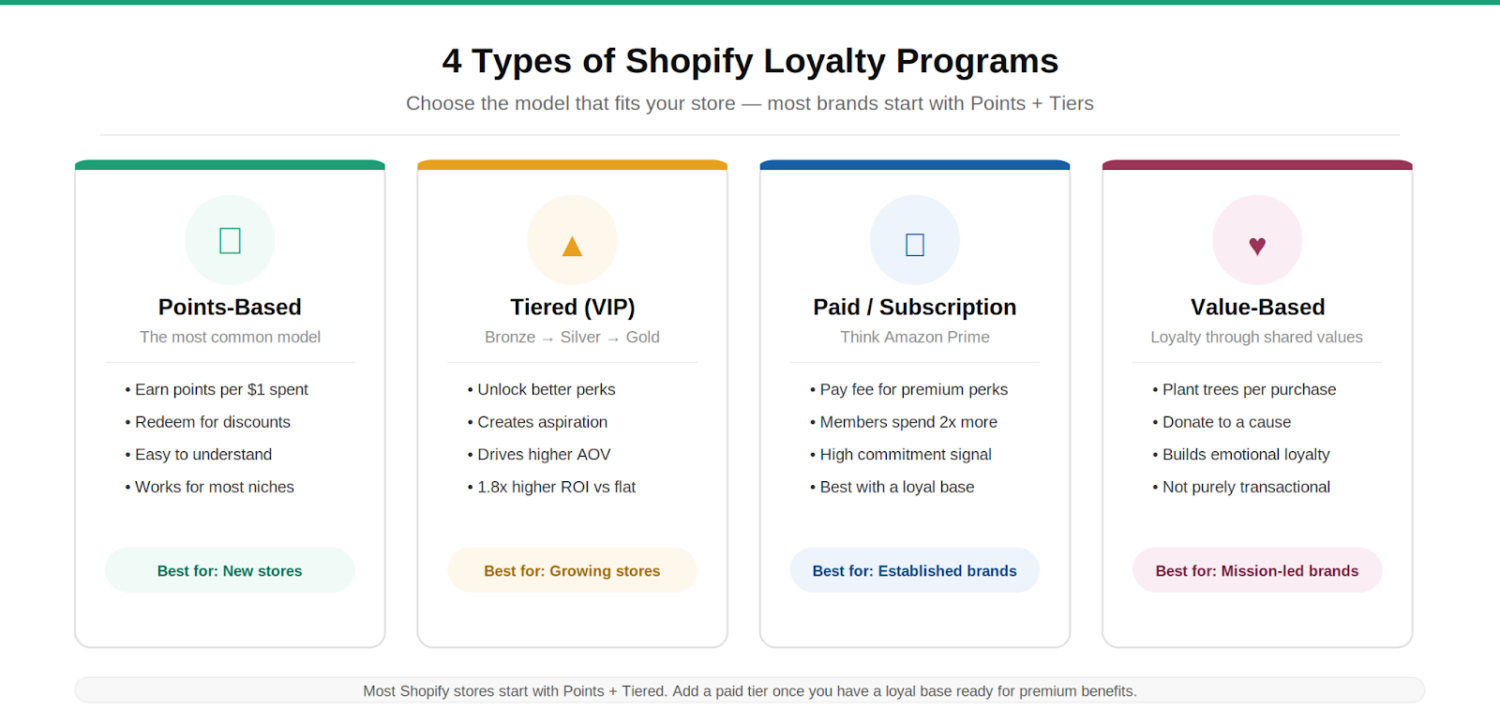
Not all programs work the same way. Pick the model that fits your store:
Points-based – The most common. Customers earn points per dollar spent and redeem them for rewards. Easy to understand. Works for most niches.
Tiered (VIP) – Customers unlock better perks as they spend more. Bronze → Silver → Gold. Creates aspiration and drives higher-order values.
Paid/Subscription – Customers pay a fee (monthly or yearly) for premium perks. Think Amazon Prime. Prime members spend roughly 2x more than non-members – proving the paid model works when benefits are compelling enough.
Value-based – Rewards tied to shared values, like planting a tree per purchase or donating to a cause. Builds emotional loyalty, not just transactional.
Most Shopify stores start with points + tiers. Add a paid tier when you have a loyal base ready for premium benefits.
3. Why Most Shopify Loyalty Programs Fail
Most stores launch a program, give customers 1 point per dollar, and forget about it.
That’s not a strategy. That’s a checkbox.
The brands winning right now are using loyalty as a full retention engine – not just a discount mechanism. Tiered loyalty programs achieve 1.8x higher ROI than non-tiered structures, and VIP customers generate 73% higher average order values than standard customers.
The 4 most common reasons programs fail:
Rewards aren’t valuable enough to motivate behavior
The program is invisible – customers forget it exists
Points are too hard to earn or redeem
There’s no communication strategy after launch
The gap between a mediocre program and a great one? Strategy, structure, and the right app.
4. The 12 Best Tips to Improve Your Conversion Rate (And What Makes Each One Work)
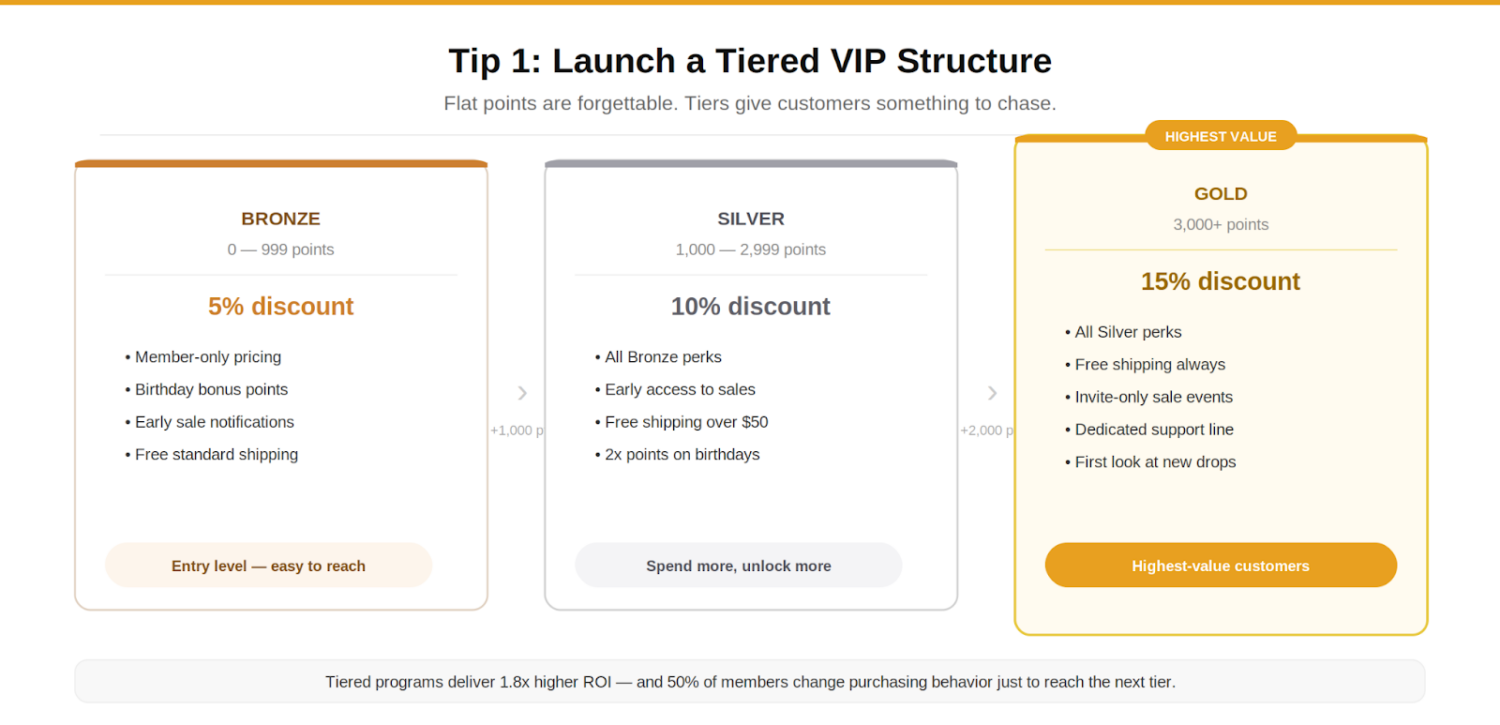
Tip 1: Launch a Tiered VIP Structure (Not Just Flat Points)
Flat points programs are forgettable. Tiers give customers something to chase.
A Bronze → Silver → Gold structure creates what behavioral psychologists call the “goal gradient effect” – people work harder as they get closer to a goal.
Start with 3 tiers maximum to keep it simple
Make tier benefits meaningfully different (not just 10 vs 12 points)
Show customers exactly how far they are from the next level
Reward the journey, not just the destination
Best app for this: Smile.io and Yotpo both offer powerful tiered structures. Rivo excels for Shopify Plus brands wanting deep customization. Yuko also lets you stack tiered loyalty directly alongside your review and referral programs – no extra apps needed.
Tip 2: Hook New Members With a Sign-Up Incentive
Getting customers to join is step one. Most stores skip the welcome offer and wonder why enrollment is low.
Give people an immediate reason to sign up:
100 bonus points on first purchase
10% off their first order as a member
“Welcome gift” unlocked after account creation
Double points on the first 7 days after joining
Offering incentives for signing up – like bonus points for a first purchase – directly increases conversion rates and program enrollment.
Why it matters: A customer who earns points on their very first purchase has a reason to come back for the second. Without that hook, they’re just another one-time buyer.
Quick win: Add a pop-up or banner on your product pages advertising the sign-up bonus. Retainful makes this easy – its exit-intent and timed popup builder integrates with your loyalty triggers so new sign-up incentives fire at exactly the right moment. Most loyalty apps also let you configure this in under 10 minutes.
Tip 3: Reward More Than Just Purchases – Then Gamify the Experience
Most stores only give points for buying. That’s a missed opportunity.
Every touchpoint is a chance to deepen the relationship:
Leave a review → 50 points
Follow on Instagram → 25 points
Refer a friend → 200 points
Birthday bonus → double points that week
Complete a quiz → 30 points
BFCM 2024 saw 454% more customer-earning activities than an average weekend – stores that diversified their reward triggers captured massive engagement spikes.
Why it works: Customers who earn points through social or engagement actions are more emotionally invested in your brand. They’ve given you something beyond money.
Once you’ve broadened what earns points, take it one step further: gamify the experience.
Gamification turns loyalty from a passive transaction into something people actually enjoy participating in:
Challenges: “Buy 3 times this month for a bonus 500 points”
Streaks: “Shop 4 weeks in a row to unlock Gold status”
Badges: “First purchase badge,” “Product explorer badge,” “Brand ambassador badge”
Progress bars: Show members exactly how close they are to their next reward – visible progress alone drives action
60% of consumers aged 18–24 prefer point-based loyalty programs, and 20% would stop shopping with a brand if those programs were removed. Gamification is especially powerful with this audience – but it works across all age groups when the rewards feel worth chasing.
Best app for gamification: Smile.io and LoyaltyLion both support progress bars and milestone rewards natively. Yuko connects review activity directly to loyalty points – so a customer who leaves a photo review automatically earns rewards, making engagement feel natural rather than forced.
Tip 4: Make Your Program Visible at Every Stage
A loyalty program nobody knows about converts nobody.
Place your program in these spots:
Product pages (show how many points this item earns)
Cart page (show total points after checkout)
Post-purchase email (confirm points earned, show balance)
Dedicated loyalty landing page (full explainer)
Checkout page (points balance reminder)
High-performing programs have an FAQ page, clear earning instructions, and regular email comms – brands that do this have redeeming members powering up to 70% of their revenue.
Quick win: Add a sticky widget to your storefront showing a customer’s points balance at all times. Most Shopify loyalty apps include this as a default feature. Pair it with Retainful’s post-purchase email flows to confirm points earned after every order – keeping your program front of mind without any manual effort.
Tip 5: Use Near-Threshold Emails to Drive Conversions
This is one of the most underused tactics in loyalty marketing – and one of the most effective.
When a customer is close to their next reward or tier, send them a targeted nudge.
Example: “You’re only 150 points away from your $15 reward. Here’s what you could get.”
Configure a trigger in your loyalty app at 80–90% of the next tier threshold
Make the email highly specific – show the exact reward they’re close to unlocking
Include a direct CTA that goes straight to product or checkout
Send it within 24 hours of them reaching that threshold
Best apps for this: Smile.io + Klaviyo makes this automation easy to build. LoyaltyLion has this built natively. Retainful is another strong option – its customer journey builder lets you set near-threshold triggers with dynamic coupon codes and personalized product recommendations in the same flow, without needing a separate ESP.
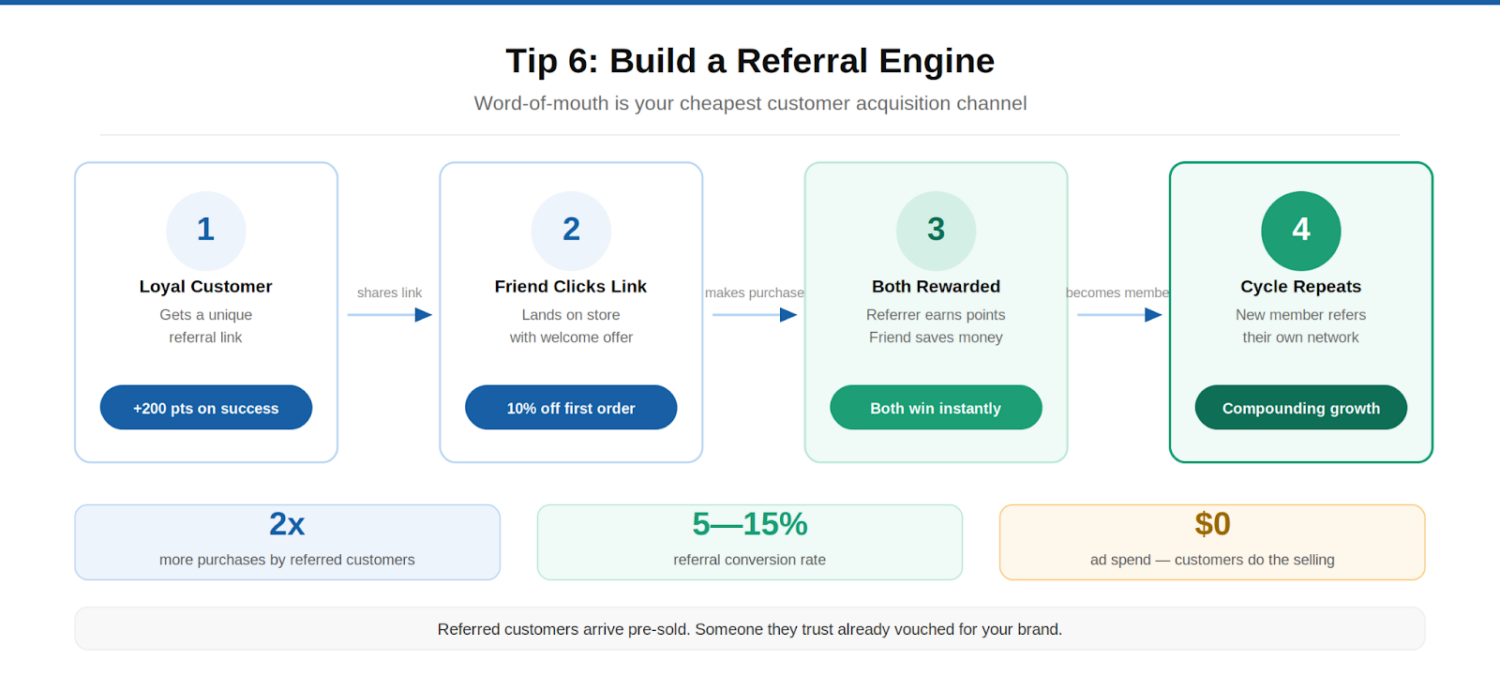
Tip 6: Build a Referral Engine Inside Your Loyalty Program
Word-of-mouth is the cheapest customer acquisition channel you have.
Referred customers make 2x more purchases than non-referred customers – and they arrive already trusting your brand because someone they know vouched for it.
Referral program structure that converts:
Give the referrer a meaningful reward (not $2 off)
Give the referred friend a first-purchase discount
Make sharing a one-click action (email, link copy, social share)
Show referral progress inside the loyalty dashboard
Best app for this: BON Loyalty has an anti-cheat referral system built in. Smile.io integrates referrals directly into its loyalty hub. Yuko is worth considering here too – it combines referral marketing with loyalty and reviews in a single dashboard, so your referral rewards, review incentives, and loyalty points all share the same customer data without any integration overhead.
Stat: Referral conversion rates for well-structured programs run between 5–15% – significantly higher than cold traffic channels.
Tip 7: Personalize Rewards Based on Purchase History
Generic rewards feel like generic brands. Personalization makes customers feel seen.
Offer bonus points on product categories a customer already buys
Send personalized “You’re almost Gold!” emails based on real spend data
Create birthday rewards tied to their actual wishlist items
Use purchase history to trigger “restock reminder” with bonus points
Apps that do this well: Yotpo and Rivo both offer advanced segmentation. Klaviyo integrations (available on Smile.io and LoyaltyLion) take personalization to another level. Retainful’s segmentation lets you filter by purchase history, cart value, and email engagement – making it straightforward to build personalized loyalty follow-ups without enterprise-level complexity.
Tip 8: Add an Expiry Date to Points (With Smart Reminders)
Expiry isn’t cruel – it’s urgency.
Points that never expire have no urgency. Customers accumulate them, forget about them, and never redeem. That’s bad for engagement – and it’s a growing financial liability on your books.
The global average loyalty program redemption rate is 49.8% – meaning nearly half of all issued points go unused. An expiry policy with well-timed reminders is the most direct lever for closing that gap.
Set a 12-month expiry window
Send a “Your points expire in 30 days” email at the 11-month mark
Make the CTA in that email direct: “Redeem now →”
Show exactly what they can get with their current balance
Pro tip: Frame it positively – “Don’t lose your 450 points” – not “Your points will expire.” Loss aversion outperforms neutral reminders every time.
Tip 9: Connect Your Loyalty Program to Email, SMS, and Social
Your loyalty program alone won’t drive conversions. You need to talk about it everywhere.
Automated emails produce 320% more revenue than broadcast emails – and loyalty-triggered flows are some of the highest-performing automations you can build.
Loyalty email flows to set up:
Welcome to the program → immediate points confirmation
Points earned → triggered after every purchase
Almost at next tier → triggered at 80% of tier threshold
Points expiry warning → 30 days before expiry
VIP unlock → celebrate the milestone with exclusive access
Social media: Promote your program on Instagram and TikTok with content showing the benefits. Use program-specific hashtags. Run giveaways that reward sign-ups. The average shopper is enrolled in 16.7 loyalty programs worldwide – social proof and visible promotion help yours stand out.
Best integrations: Smile.io + Klaviyo for email. Yotpo for bundled SMS + loyalty. Retainful is the most beginner-friendly option if you want email, SMS, and WhatsApp automation under one roof – its pre-built loyalty flow templates cover welcome series, points confirmation, near-threshold nudges, and expiry warnings out of the box, with no developer required.
Tip 10: Offer Exclusive Perks, Not Just Discounts
Discounts train customers to wait for deals. Exclusivity makes them feel special.
72% of shoppers are motivated to enroll in a loyalty program specifically by early access to sales. And 65% say members-only offers add significant value.
Exclusive perks that convert better than discounts:
Early access to new product drops (24 hours before everyone else)
Free shipping for VIP members only
Invite-only sales events for Gold tier
Access to a private community or Discord
First look at limited edition items
These perks cost you less than blanket discounts but feel more valuable to customers. That’s the sweet spot.
One powerful addition: gift-with-purchase campaigns. BOGOS.io is a Shopify-native promotion app trusted by 50,000+ merchants that lets you create BOGO deals, free gifts with purchase, tiered bundle offers, and spend-to-unlock promotions – all configurable from one dashboard. Instead of offering a flat discount to VIP members, you can set rules like “Gold tier members get a free gift when they spend $75” or “Silver members unlock a bundle at checkout.” With BOGOSreal-time analytics and AI-powered upsell suggestions, you can pair gift promotions with loyalty tiers to increase AOV while making members feel genuinely rewarded – not just discounted. BOGOS integrates with Shopify POS and major apps, so promotions work seamlessly whether customers shop online or in-store.
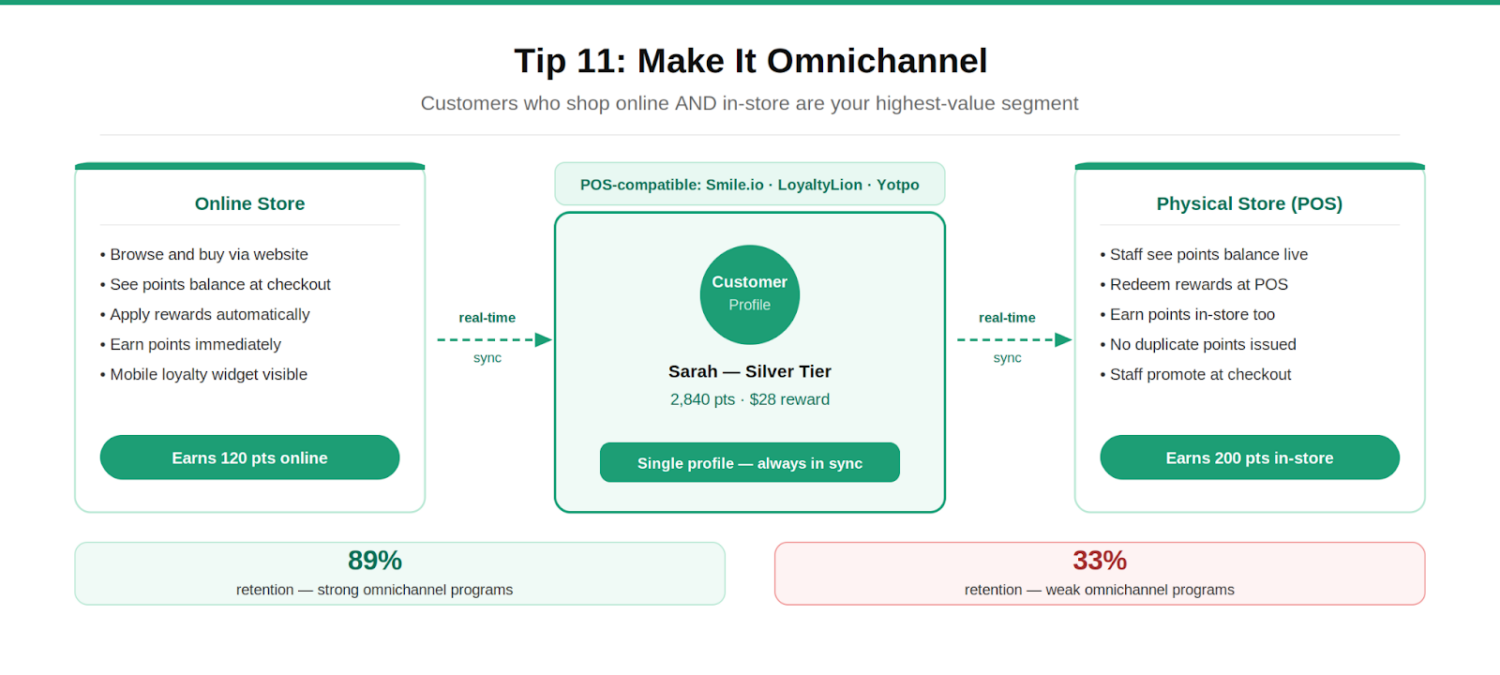
Tip 11 (Bonus): Make It Omnichannel – Reward In-Store and Online
If you run a Shopify store with physical locations, this one is non-negotiable.
Customers who shop both online and in-store are your highest-value segment. A loyalty program that doesn’t connect both experiences frustrates them – and sends them to competitors.
How to build an omnichannel loyalty experience:
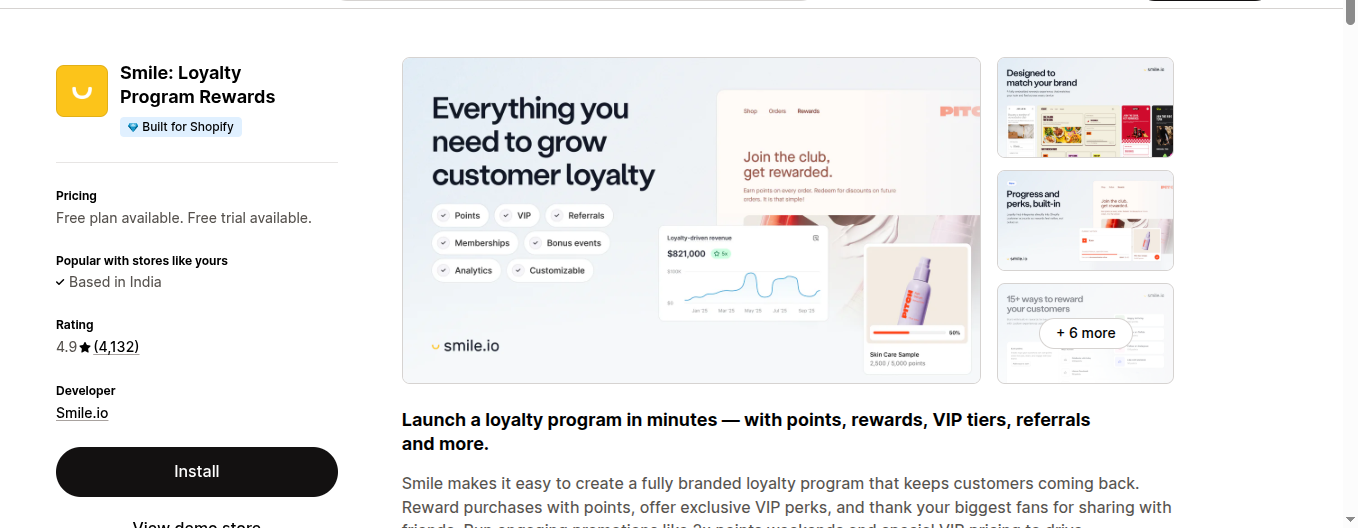
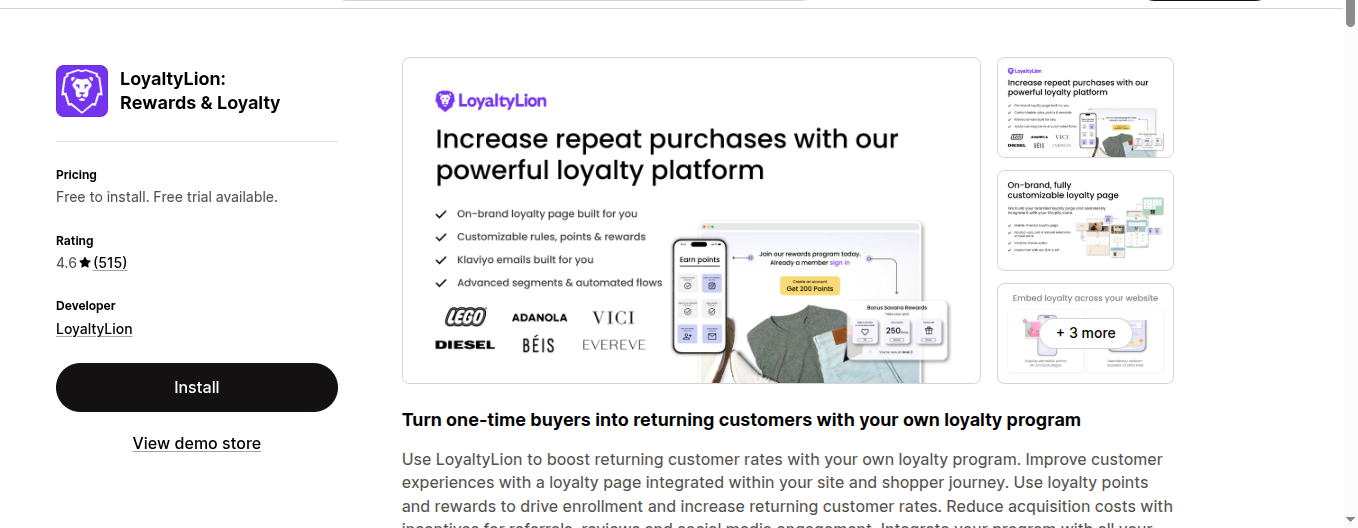
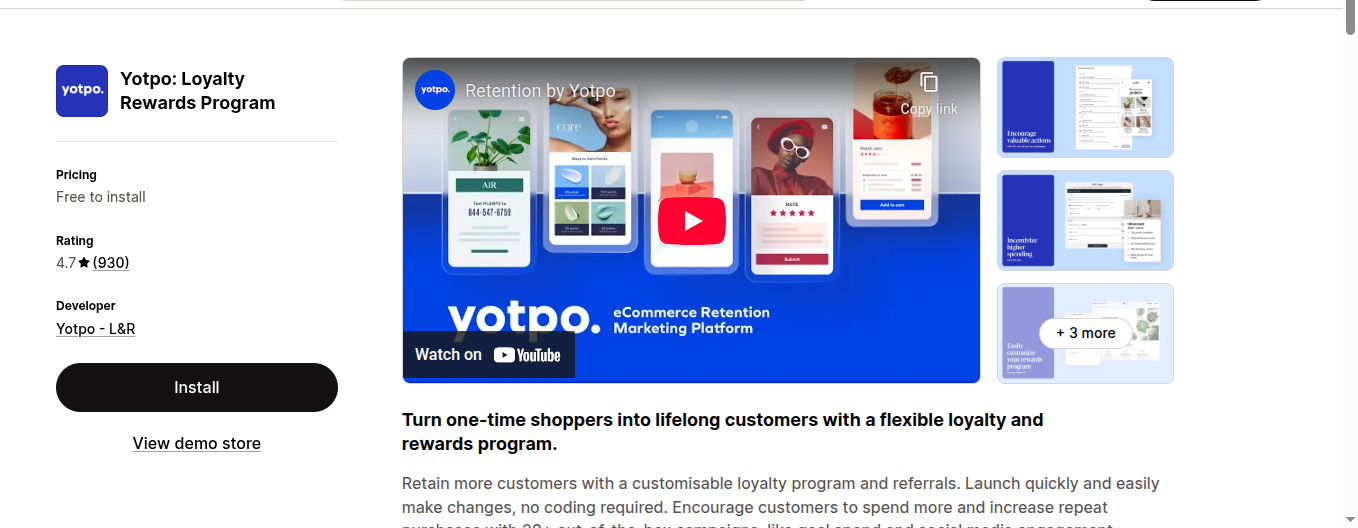
Use a Shopify POS-compatible loyalty app (Smile.io, LoyaltyLion, Yotpo all support this)
Let customers earn and redeem points whether they shop in-store or online
Sync customer profiles automatically so points are never lost or duplicated
Train your store team to promote the program at checkout
2. Program Participation Rate Formula: (Enrolled Members ÷ Total Customers) × 100 Benchmark: Target 5%+ in year one, with growth each quarter.
3. Repeat Purchase Rate Formula: (Customers with 2+ Purchases ÷ Total Customers) × 100. Benchmark: The ecommerce average is 28.2%. Loyalty members should be running 10–15 points higher.
5. Breakage Rate Formula: (Unredeemed Points ÷ Total Points Issued) × 100 A high breakage rate means customers aren’t redeeming – the program isn’t engaging. It’s also a financial liability. Aim to keep it low with expiry reminders and compelling rewards.
Action: Review these five metrics monthly. Kill what doesn’t move the needle. Double down on what does.
5. Top 8 Shopify Loyalty & Promotion Apps: In-Depth Breakdown
Now that you know what your program needs to do – here are the best Shopify apps to actually build it. The first seven are loyalty-first platforms. The eighth is a promotions layer that makes your loyalty perks dramatically more compelling.
The analytics-first loyalty platform built for retention-obsessed DTC brands.
Rating: 4.7/5
Free tier available (limited)
Paid plans from ~$199/month
What makes it stand out:
Deepest analytics and segmentation of any loyalty app
Built-in revenue predictor to forecast loyalty ROI before you scale
Free design services worth ~$1,500 on the Classic tier
Ranks top for conversions of one-time buyers into loyal customers
Advanced referral performance tracking and competitive benchmarking
Native near-threshold email triggers built in
Best for: Data-driven Shopify stores that need deep insights into customer behavior and loyalty-attributed revenue.
#3 Yuko – Best All-in-One for Reviews + Loyalty + Referrals
An emerging unified customer retention platform built for Shopify and WooCommerce.
Rating: Growing (early adopter pricing available)
Free migration from existing tools
Competitive pricing for what’s included
What makes it stand out:
Combines reviews, loyalty programs, and referral marketing in one dashboard – no app-stacking required
Customers who leave photo/video reviews automatically earn loyalty points, creating a compounding engagement loop
Sophisticated referral marketing with branded sharing tools that feed back into loyalty tiers
Zero-hassle setup – launch in minutes, customize without code
Customers earning loyalty points for reviews show 2.4x higher repeat purchase rates and 67% better retention
Replaces Judge.me + a loyalty app + a referral tool with one integrated system – typically saving $100–200/month
Best for: Stores tired of juggling multiple apps for reviews, loyalty, and referrals – or brands that want reviews to actively fuel their loyalty program rather than sit in a separate silo.
A full marketing platform. Loyalty is one powerful module inside it.
Rating: 4.7/5
Limited free features
Starts at $199/month
What makes it stand out:
Reports an average 8.5x ROI within the first 90 days of program activation
Loyalty redeemers see 164.4% higher repeat purchase rates
Integrates reviews, SMS, UGC, and loyalty in one ecosystem
20+ predefined campaign types
Best for: Brands where reviews and user-generated content are core to conversion – fashion, beauty, lifestyle.
6. How to Choose the Right App for Your Store
Not every app fits every store. Use this framework:
If you’re just starting and have zero budget → Use BON Loyalty (free up to 250 orders/month) or Growave (starts at $19/month). Both give you a real program without the enterprise price tag.
If you have 500+ orders/month and want to scale → Use Smile.io. The most battle-tested app on Shopify, with POS support and Klaviyo integration that makes retention marketing easy.
If you need deep analytics and ROI forecasting → Use LoyaltyLion. No other app gives you the same level of data on loyalty-attributed revenue and customer behavior.
If you’re Shopify Plus doing $1M+ and need custom-built loyalty → Use Rivo. It’s built for brands like yours, not a generic solution bolted onto an ecommerce store.
If reviews, UGC, and SMS are core to your strategy → Use Yotpo Loyalty. The unified ecosystem means your reviews, loyalty, and SMS all share the same data layer.
If you sell in multiple countries or languages → Use BON Loyalty. No other app comes close on multilingual support.
If you want reviews + loyalty + referrals without running three separate apps → Use Yuko. One platform replaces the usual stack and connects all three channels into a single customer record.
If your budget is near zero but you want loyalty + reviews + wishlist → Use Growave. One app replaces three.
If you want email + SMS + WhatsApp automation to power your loyalty flows → Use Retainful. Its pre-built workflows cover every loyalty touchpoint – from welcome series to near-threshold nudges to expiry warnings – and it pairs cleanly with any of the loyalty apps above.
If you want to make your VIP tier perks feel genuinely exclusive (not just another discount) → Use BOGOS.io. Pair it with any loyalty app above to set gift-with-purchase and BOGO promotions that trigger specifically for loyalty tier members – turning “Gold status” into something customers can feel at checkout, not just see on a dashboard.
FAQs
What is the average conversion rate for Shopify loyalty programs?
Loyalty program members convert at significantly higher rates than non-members. Members are 10–25% more likely to repeat purchase within 60 days and spend 5–20% more per order. The industry benchmark for repeat purchase rate is 28.2% – loyalty programs push this to 35–45% for active members.
How do I measure if my loyalty program is working?
Track five key metrics monthly: redemption rate (healthy range: 20–50%), program participation rate (target 5%+ in year one), repeat purchase rate (benchmark: 28.2%), loyalty member revenue vs. non-member, and breakage rate (% of points never redeemed). If your redemption rate is below 20%, your rewards need to be more compelling or more visible.
What is a good loyalty program redemption rate?
The global average redemption rate is 49.8%. Below 20% is considered low and usually signals unattractive rewards or poor program visibility. Between 20–50% is healthy. Above 50% is strong.
What’s the difference between a loyalty program and a referral program?
A loyalty program rewards existing customers for repeat purchases and engagement. A referral program rewards existing customers for bringing in new ones. The two work best together – loyal members are your most likely referrers, and referred customers are your most likely to become loyal members. Yuko is one of the few platforms that handles both natively, alongside reviews, in a single dashboard.
Do loyalty programs work for small Shopify stores?
Yes – and they’re arguably more important for small stores. BON Loyalty and Growave both offer generous free plans. Even a simple points + referral structure can drive meaningful repeat purchases. The key is promoting the program consistently and making sign-up genuinely worthwhile. Retainful pairs well with any of these – its free plan covers abandoned cart recovery and basic email automation, giving small stores a complete retention setup from day one.