Tracy serves as Content Marketing Specialist at BOGOS, a Shopify marketing platform trusted by 60,000+ merchants since 2014. She specializes in eCommerce growth strategies, promotional optimization, and helping online retailers maximize revenue without sacrificing margins.
An interview with Stefan Chiriacescu, founder and CEO of eCommerce Today, on turning AI from a chat window into a system that writes on-brand email at scale.
Email remains one of the most affordable marketing channels, offering a high return on investment for promoting offers to customers. AI has also come a long way since 2023, becoming a powerful tool for streamlining email marketing workflows. Yet many marketing emails still sound like they were written by an early version of ChatGPT: generic, lacking a distinct brand voice, and filled with vague messages that offer little value.
eCommerce Today has worked with 200+ Shopify brands as a Shopify Plus Partner and Klaviyo Master Platinum Partner. We spoke with Stefan about why AI-generated emails often fall short and how his team built a smoother AI workflow that reduces time-consuming back-and-forth while combining it with smarter offer promotions to help merchants increase email revenue.
TL;DR
AI knows the average of the internet, not your brand. Left to fill the gaps, it invents codes, makes claims you can’t make, and promises free shipping you don’t offer.
Typing was never the slow part. The hours sit in gathering context, checking facts, and rewriting off-brand drafts. Files that hold your decisions collapse those steps.
Write clear rules, not vague descriptions. A 40-page brand guide explains how you want your brand to sound. A one-page set of practical rules tells AI exactly how to write in that voice.
Never let AI pick or combine offers. Put the allowed offer, code, terms, and stacking rules for each flow in a matrix. The draft reads [CODE NEEDED] instead of guessing.
Keep the human gate. The better AI writes, the easier a wrong price slips through. That’s the error customers screenshot.
Meet the Expert
Q1: Tell us about yourself and eCommerce Today. What kinds of Shopify brands do you work with, and what role does email play in their growth?
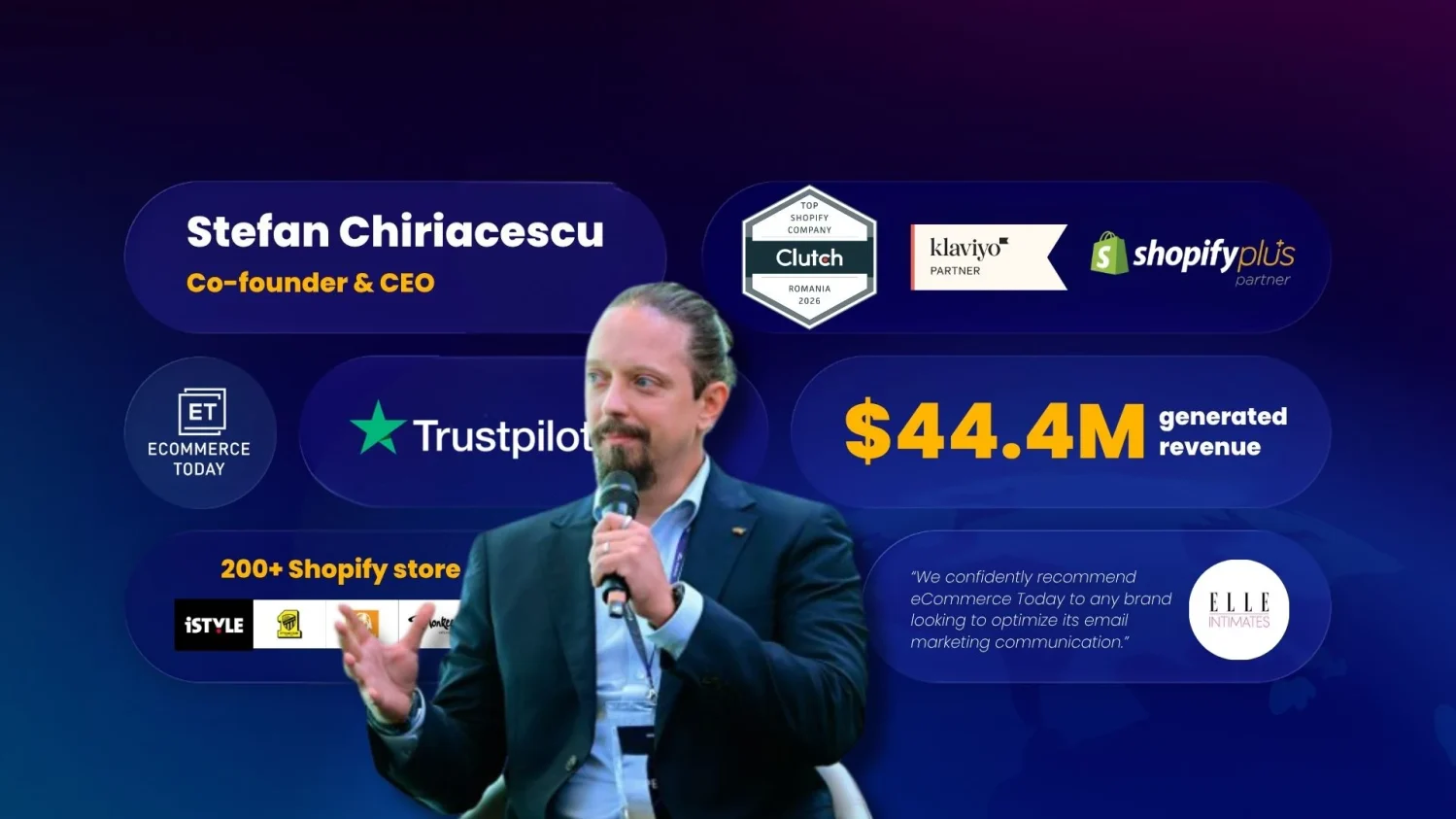
Stefan Chiriacescu:I’m Stefan Chiriacescu, founder and CEO of eCommerce Today. My co-founder Valentina and I started in ecommerce in 2016, working exclusively with US clients, and in 2019 we founded eCommerce Today as a fractional ecommerce department for Shopify and Shopify Plus brands: one retainer, one account manager, and a senior team across development, CRO, Klaviyo, SEO, paid media, and design.
We’ve worked with 200+ brands across North America, Europe, and the Middle East, and we’re a Shopify Plus Partner and Klaviyo Master Platinum Partner. Email is the one channel our clients fully own, and it compounds.
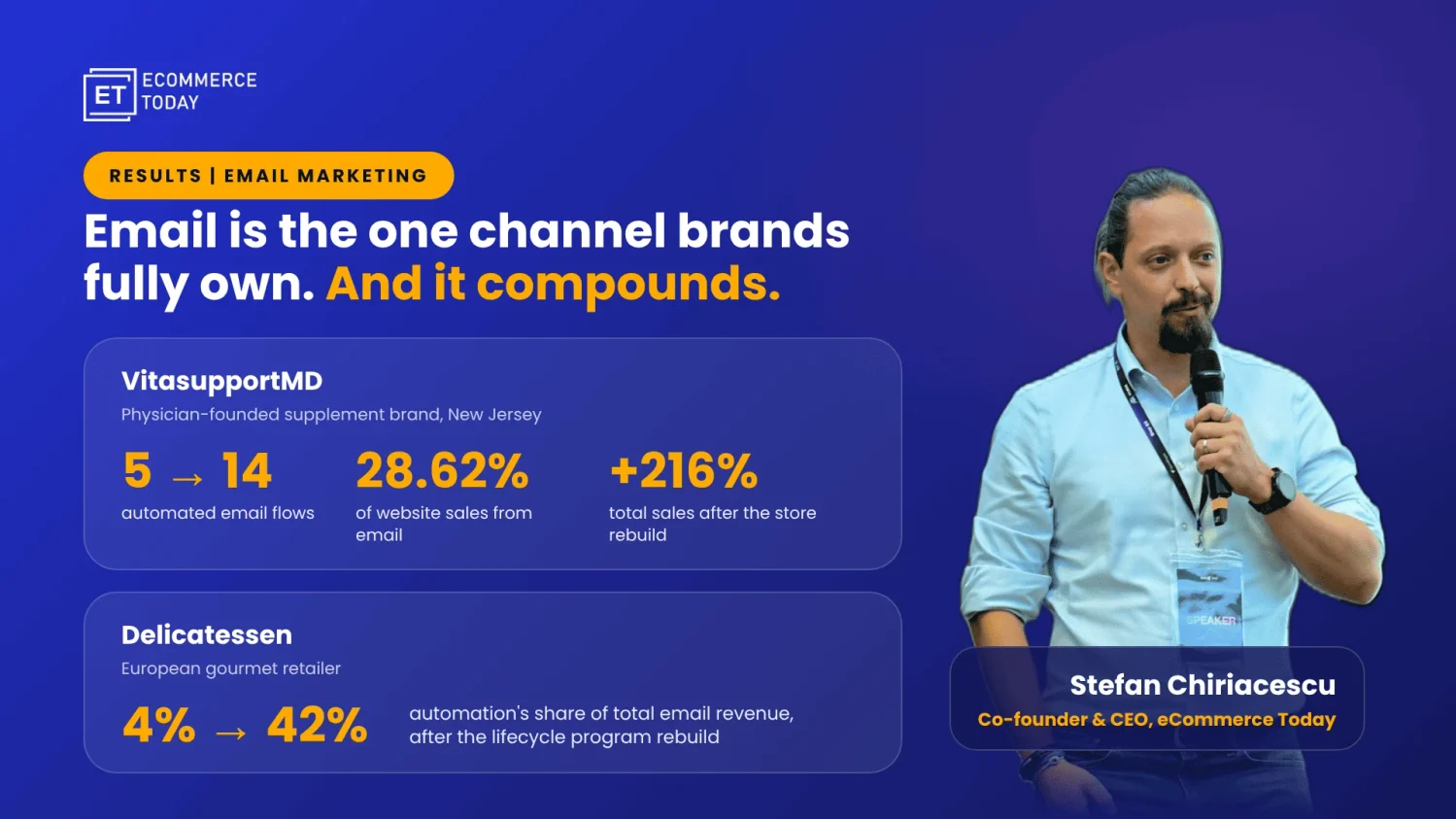
When VitasupportMD, a physician-founded supplement brand in New Jersey, came to us in 2023, it had no email automation at all. We launched with 5 flows, scaled to 14, and email grew to 28.62% of the website’s sales, alongside a 216% increase in total sales after the store rebuild.
For Delicatessen, a European gourmet retailer, automation went from 4% to 42% of total email revenue after we rebuilt its lifecycle program.
AI entered Stefan’s workflow the way it did for everyone: chat windows, fluent copy, hours of rewriting.
It became useful, he says, when they started treating it like a senior hire who needs onboarding. A clear methodology replaced the tool’s defaults, and the results showed up across real client accounts.
Below, we unpack what that methodology actually is, and why most teams never get there.
From Generic AI To A System That Writes Like Your Brand
Q2: Many Shopify brands now use AI for email. When it doesn’t deliver the time savings or results they hoped for, what’s usually going on?
Stefan Chiriacescu:Adoption isn’t the issue anymore. Litmus’s 2026 State of Email found that only 5% of marketers don’t use AI for email at all. The issue is expectation. Merchants expect the tool to know their brand. It doesn’t. It knows the average of the internet.
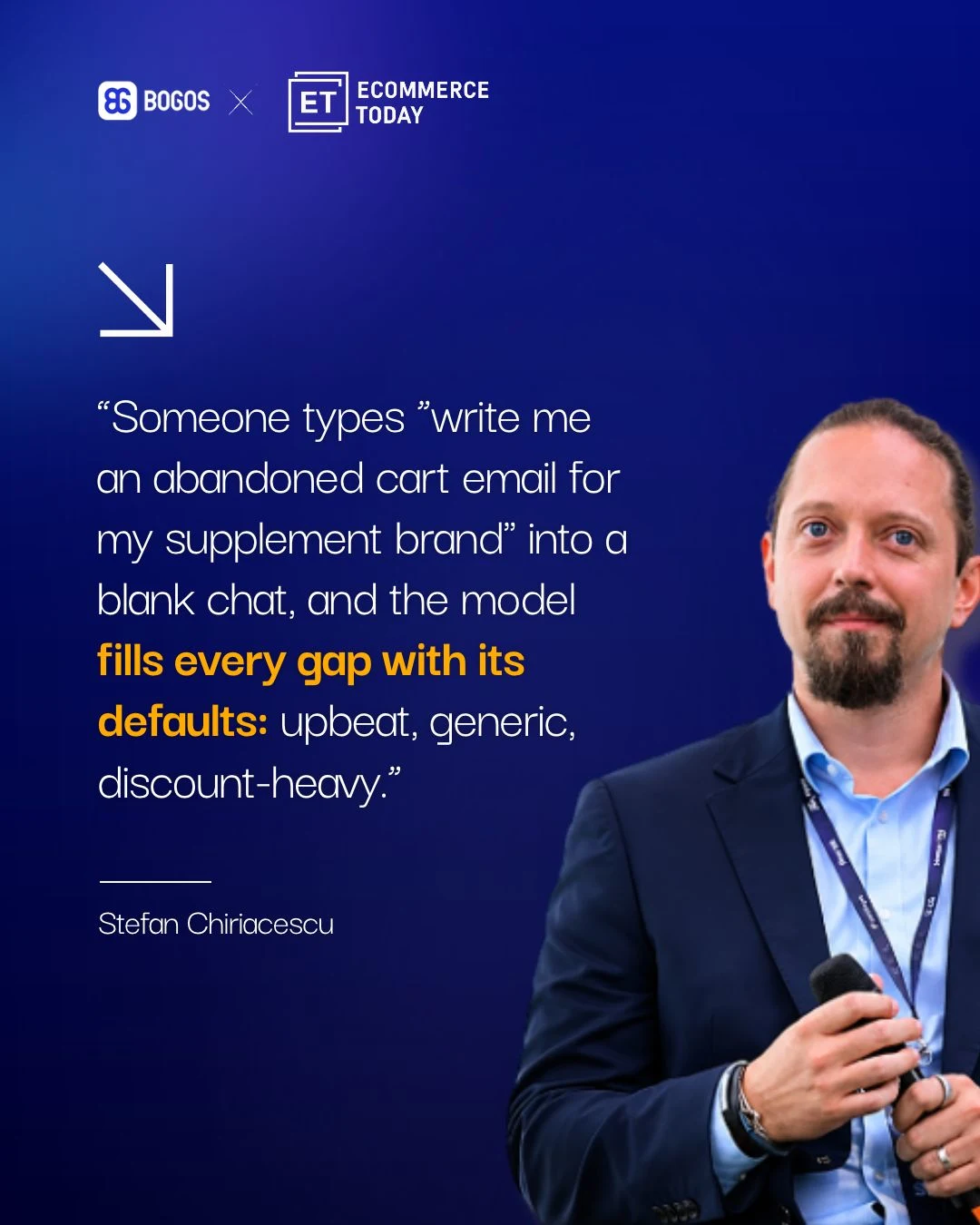
So the problem is rarely the tool. It’s the way it’s used. Someone types “write me an abandoned cart email for my supplement brand” into a blank chat, and the model fills every gap with its defaults: upbeat, generic, discount-heavy. When I say our AI follows our methodology instead of its own, I mean those gaps are closed in writing before it starts.
Supplements show the risk clearly. For a brand like VitasupportMD, every line has to stay factual and within structure/function framing, never drifting into medical claims. A typical generic draft in that category opens with “Don’t miss out! Your cart is waiting!”, offers a 15% code that doesn’t exist in Shopify, calls the product “clinically proven,” and promises free shipping on all orders when the brand has a threshold.
That’s four errors, each one a missing piece of context, and together they’re worse than sending nothing.
Customers notice, too. Klaviyo’s 2026 consumer research, a survey of 8,000 shoppers, found that 31% trust a brand less when its marketing is clearly AI-generated, while only 7% trust it more. Generic AI copy carries a cost even when nobody complains.
Shopify merchants expect the tool to know their brand. It doesn’t. It knows the average of the internet.
Q3: According to Litmus’s State of Email report, 62% of email teams took two weeks or more to launch an email. By 2026, 78% could launch one in three days or less. That’s a major improvement, but why does the process still take days when AI can generate a draft in seconds? So, which parts of the email creation process still take the most time
Stefan Chiriacescu:AI made the typing fast, but typing was never the slow part. When we mapped our own process, most of the hours sat before and after the writing.
The longest step was gathering context: digging through brand decks, past flows, Slack threads, and founder notes to work out who the customer is and what the brand sounds like.
Second was fact-checking: prices, ingredients, shipping thresholds, return windows, and whether a discount code exists and doesn’t stack with something else.
Third was rewriting drafts that were grammatically fine but off-brand. Then came the review rounds.
A three-email cart abandonment brief used to take us four hours, split across context, facts, offer, drafting, rewriting, and review. With the playbook in files, context gathering mostly disappears because the AI already has it. Fact-checking becomes verification against one source-of-truth file.
The offer decision becomes a lookup in our offer rules. The first draft lands close to on-voice, so rewriting turns into editing. Today the same brief takes one to two hours, about a quarter of the original time. That’s where the 75% comes from.
The one step we deliberately didn’t shrink is human review, because that’s where quality is protected. And the hours we saved didn’t vanish. They went into testing offers and segments, which is where email revenue actually moves.
Q4:What changes when a team stops writing one-off prompts and starts putting its playbook into files that AI reads every time?
Stefan Chiriacescu:With one-off prompting, quality depends on whoever is typing that day and how much they remembered to include. With a project setup, quality depends on the playbook, and the playbook doesn’t have bad days.
That’s what “stop engineering prompts, start writing your playbook into files” means: you write your decisions down once, clearly, instead of retyping context into every chat and hoping nothing gets left out.
If you’ve never set one up, think of it as a dedicated workspace for one brand. You give it two things. First, standing instructions: a short “here’s how you work for this brand” note. Second, reference files: your fact sheet, voice rules, offer rules, and a few of your best past emails. Every conversation in that workspace starts with all of it already loaded, so nobody has to explain the brand again.
All three major tools work this way. In Claude, Projects hold a knowledge base and instructions for every chat, and Skills package a repeatable procedure, like our brief-writing SOP, that Claude loads when the task calls for it. In ChatGPT, Projects and custom GPTs do the same job. In Gemini, Gems played that role, and Google is now moving them into skills.
Because the tools keep changing, we write our playbooks as plain documents we own. If a platform renames a feature, we move the files, not the thinking.
With an AI project setup, quality depends on the playbook, and the playbook doesn’t have bad days.
Q5:How do you know the emails are actually qualified enough, then performing better?
Stefan Chiriacescu:Two gates, in this order.
First, qualification: the email sounds exactly like the brand, every fact and code is verified, and the offer follows our rules. A reviewer who knows the brand shouldn’t be able to tell whether AI was involved. If a draft sounds generic, it doesn’t ship, however fast it was produced.
Second, performance. We track email revenue as a share of total store revenue, revenue per recipient by flow, placed-order rate, AOV, and repeat purchase rate, with bounces, spam complaints, and unsubscribes as guardrails.
We benchmark flows against Klaviyo’s 2026 data, where abandoned cart averages $6.77 in revenue per recipient and welcome $5.75, and we use holdout groups where volume allows, because attributed revenue isn’t the same as revenue the email actually caused.
Stefan walked us through a real client example to show how these two checks work in practice.
Stefan Chiriacescu:Delicatessen is a good example. We replaced fragmented sends with a full lifecycle system: welcome, price-drop and low-stock alerts, four abandonment flows, a new customer flow, review requests, and a sunset sequence.
Automation went from 4% to 42% of total email revenue, automated revenue grew 50.8%, and recipients reached grew 34.2%. Just as important, the list got healthier while volume grew: bounce rate under 0.3%, spam complaints down 47.2%, unsubscribes down 12%.
That combination is what “qualified” looks like in the data. When emails are genuinely relevant and on-brand, revenue goes up, and complaints go down at the same time.
Q6:What should go into those files so AI writes like the brand and starts generating more conversions?
Stefan Chiriacescu:Start with what a new senior copywriter would need in week one. A brand fact sheet: products, current prices, ingredients or materials, shipping thresholds, return policy, and the claims the brand can and cannot make. A customer file: who buys, why, what makes them hesitate, and the exact words they use in reviews.
Then voice rules, offer rules, and three to five past emails the brand loves. Keep voice rules few and concrete, five to seven at most. Give a model twenty adjectives, and it averages them into mush. Every rule should show what to do and what not to do.
For The Vitamin Store, a Canadian practitioner-grade supplement retailer, we built the entire 16-email journey on one positioning line, “clinical yet accessible,” plus an explicit rule to lead with education rather than discounting. That single line does more work than a page of adjectives.
Category, stage, and AOV all change the setup. Supplements need a strict list of allowed and forbidden claims. High-AOV brands need deeper objection handling on delivery, warranty, and returns. Low-AOV brands lean on bundles, thresholds, and replenishment timing. Young brands need more trust-building; established ones need more customer language and segment detail.
Here’s how a voice rule and a brand fact look in the file:
VOICE RULE 3 — Confident, never loud. State the benefit plainly and let the product carry it. Do: “Built for 10-mile days. Still comfortable at mile 11.” Don’t: “The ULTIMATE shoe you NEED right now!!!” No exclamation marks in subject lines. Maximum one per email.
FACT — Shipping: Free standard shipping on orders over [threshold]. Below that, flat rate [amount]. Never write “free shipping on all orders.”
Want to try this workflow? 👉 Download Stefan’s free email AI starter kit for FREE.
Q7:How do you decide which offer goes into which email flow, and how do you get AI to follow those offer rules instead of improvising?
Stefan Chiriacescu:Every flow has a job, and the offer has to fit it. Welcome can carry a first-purchase incentive: a percentage for low-AOV brands, a gift or sample for premium ones. The first cart abandonment email carries no offer. It reassures and answers objections, and the biggest objection is usually cost: Baymard’s research shows 40% of US shoppers who abandon do so because of extra costs like shipping.
A free-shipping threshold reminder often beats a discount. Browse abandonment emails help them choose. Post-purchase gets education and cross-sell, never a discount on what they just bought. Win-back escalates from value to store credit or a gift, and only then to a discount.
Segments matter as much as flows. VIPs get early access, not deeper discounts. Discount-only buyers get capped. Full-price buyers don’t receive codes they don’t need.
To make it clearer, we asked Stefan what that looks like on real Shopify stores.
Stefan Chiriacescu:Two examples from our work. Delicatessen’s new customer flow drives the second order with complimentary product picks, curated pairings rather than a coupon. The Vitamin Store’s journey is education-led by design, so the clinical reassurance does the selling. In both cases, the offer was decided in the strategy, not left to the copywriter or the AI.
To stop AI improvising, those rules live in an offer matrix: for each flow and segment, the allowed offer, exact code, terms, stacking, and expiry. The instruction is simple: never invent a code, price, or term; if it isn’t in the file, write [CODE NEEDED]. A human then checks every code and price in a real test send.
Q8:During a big sale like Black Friday, when the whole store is already discounted, how should the offers in automated flows be set up?
Stefan Chiriacescu:Adjust most flows, pause a few, and never let any of them undercut or stack on the sale. Plan it before November: build sale versions of the key flows, schedule them on for the sale window, and schedule the evergreen versions back on afterwards.
In practice, the welcome flow swaps its evergreen code for the live sale message, because a 10% welcome code looks odd next to a 25% sitewide banner.
Cart and browse abandonment keep running with the extra discount removed, since the sale price is already the incentive. Post-purchase keeps running, with cross-sells timed to when the order actually arrives.
Win-back gets more cautious during peak week, because lapsed subscribers are the most likely to complain in a crowded in
To protect margin and avoid training customers to wait, sale offers are time-boxed with a hard end date, and flows return to evergreen automatically. Value levers like gifts with purchase, spend thresholds, and early access do more than going deeper on price. You won’t win a price war in an inbox.
AOV changes the playbook. For a $35 order, thresholds, bundles, and gifts lift the basket more than another 5% off. For a $400 order, tiered “spend X, save Y” offers make sense, and the emails do more reassurance work. Delicatessen’s Christmas season is a good illustration: the work centered on a branded holiday catalog and separate landing pages for retail shoppers and B2B corporate gifting, not on deeper discounts.
Adjust most flows, pause a few, and never let any of them undercut or stack on the sale
At this point, the playbook looks complete, at least on paper. The files are ready, the brand voice is defined, the offer rules are set, and there’s a plan for the sales season.
But a playbook that works well on paper may not work as smoothly when a real team puts it into practice under tight deadlines.
So we asked Stefan about the practical challenges: what mistakes merchants make when building their first playbook, and what the day-to-day work looks like once the system is up and running.
How To Run The AI Playbook Day-to-Day
Q9:What’s the most common mistake Shopify merchants should avoid when setting this up for the first time?
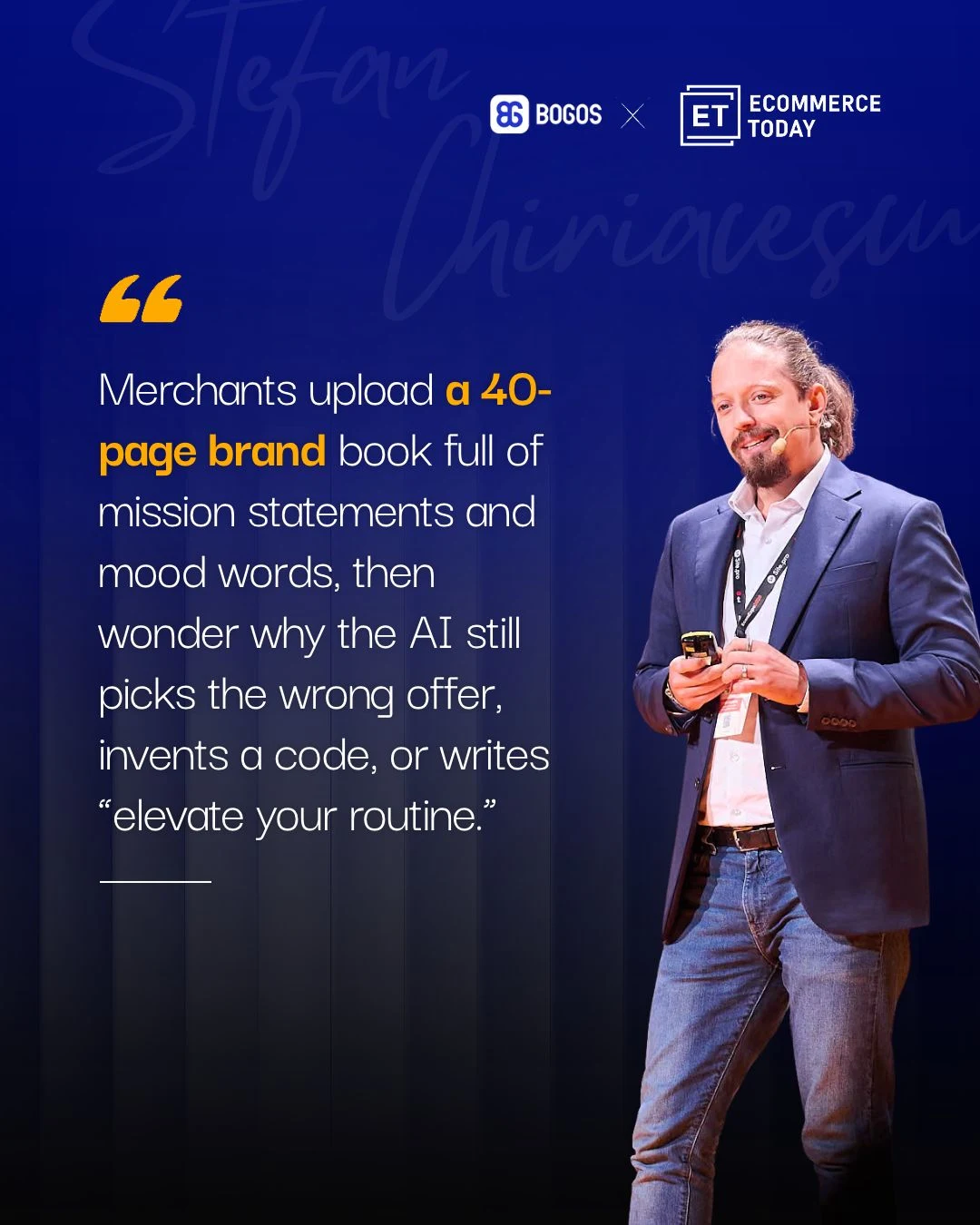
Stefan Chiriacescu:The most common mistake is writing files that describe the brand but not the decisions. Merchants upload a 40-page brand book full of mission statements and mood words, then wonder why the AI still picks the wrong offer, invents a code, or writes “elevate your routine.” A brand book tells the AI who you’d like to be. It doesn’t tell it what to do on a Tuesday afternoon when it’s writing email two of a cart flow for a returning customer.
The fix is to write down the decisions your best person makes without thinking: which offer goes where, which claims are off-limits, what the shipping threshold is, what a good subject line looks like for this brand, and what a bad one looks like. Short, specific, and current beats long and inspirational every time.
A close second is skipping the human gate because the drafts look good. The better AI writes, the easier it is for one wrong price or expired code to slip through, and that’s exactly the kind of error customers screenshot. Fluent copy can still be wrong.
Third, loading everything at once. Start with one brand, one flow, and one set of files. Get it right, watch where the AI still goes wrong, and turn every repeated correction into a rule. That’s how a playbook improves. Nobody writes a perfect one on day one.
The most common mistake is writing files that describe the brand but not the decisions.
Q10:Once the system is set up, what does a normal working session with AI look like for your team?
Stefan Chiriacescu:It’s fairly undramatic, which is the point. A strategist opens the brand’s project and writes a short request, something like “BFCM version of the cart abandonment flow, three emails, new-customer segment, hero product X.” Nobody re-explains the brand, because the files do that. The AI returns a brief with the angle and offer for each email, subject line options, objections to address, and product facts, each pointed back to the fact sheet. The strategist adjusts it, the copywriter and designer build from it, and the account team gets brand approval.
There are three fixed human checkpoints. The strategist approves the brief before any copy is written. The final copy gets a brand-voice read. Every price, code, link, and term is checked in a real test send against Shopify and Klaviyo. Nothing goes out without all three.
On upkeep, the fact sheet changes the same day a price, product, or policy changes, because a stale fact file is how wrong prices end up in inboxes.
Offer rules are reviewed monthly and always before a major sale. Voice rules rarely change. When a reviewer corrects the same thing twice, it becomes a rule in the file, so it’s fixed once instead of every week.
And when a test shows an angle or offer wins, the winning pattern goes into the playbook. The system gets smarter because the team’s learning is written down, not because the model chan
Everything we’ve covered so far assumes merchants already have a playbook in place. But many are starting from scratch, with Black Friday just three weeks away.
So we wrapped up by asking Stefan where merchants should start and what key advice he’d want them to take away from our conversation.
Takeaways From The Interview
Q11:For a merchant heading into the holiday season who hasn’t set any of this up yet, what’s the first step, and what’s the one thing you’d want them to remember?
Stefan Chiriacescu:Black Friday is November 27 this year, so you have about three weeks. Don’t try to build the whole system. This week, write two short documents.
The first is a one-page fact sheet: current prices for your top products, your shipping threshold, your return policy, and the exact BFCM offer with its code, terms, start and end dates. The second is half a page of offer rules: what each flow does during the sale and what goes back to normal afterwards.
While you’re at it, open every live flow and check its codes against your sale so nothing stacks or undercuts
Then create a project in whichever AI assistant you already pay for. Upload those two documents along with two or three of your best past emails, and ask it to brief the BFCM version of your cart abandonment flow. Compare that brief with what you’d have written yourself. You’ll see immediately where the AI still guesses, and every guess tells you which rule to write next.
The one thing to remember: AI is only as good as the decisions you’ve written down, and a human still signs off on everything that reaches a customer. Write the playbook first, then let the AI follow it.
AI is only as good as the decisions you’ve written down, and a human still signs off on everything that reaches a customer.
Conclusion
The biggest lesson from this interview is simple: AI works best when your team gives it clear direction. Generic emails often come from a lack of brand context, not just limitations in the AI itself.
By documenting their brand voice, offers, and key information in a structured workflow, teams can spend less time going back and forth with AI and more time improving their campaigns.
As Stefan’s team showed, this approach can cut email brief creation time by 75% while supporting healthier email lists. The key is to build a clear playbook, let AI handle the repetitive work, and keep people in control of the final output.
Frequently Asked Questions
#1. Which AI tool should I use for this?
Any of the three major ones works. Stefan’s team uses Claude Projects and Skills, but notes ChatGPT Projects and custom GPTs, and Gemini’s Gems, do the same job. Because features get renamed, they keep their playbooks as plain documents they own and move the files, not the thinking.
#2. How long does it take to set it up?
You don’t build it all at once. Start with one brand, one flow, and a small set of files, then turn every repeated correction into a rule. Heading into a sale, Stefan says a one-page fact sheet and half a page of offer rules is enough to start this week.
#3. Won’t customers trust AI-written email less?
They trust generic AI email less. Klaviyo’s 2026 research found 31% trust a brand less when marketing is clearly AI-generated, while only 7% trust it more. The fix is making the output genuinely on-brand and fact-checked, so a reviewer who knows the brand can’t tell AI was involved.
#4. Do I still need a human reviewer if the drafts are good?
Yes. Stefan keeps three fixed checkpoints: the brief is approved before any copy is written, the final copy gets a brand-voice read, and every price, code, and link is checked in a real test send. Fluent copy can still carry a wrong price, and that’s the error customers screenshot.