Charlie Ngo is an eCommerce expert with 7 years of experience in the marketing field, specializing in SaaS and digital growth. A graduate in Marketing Communication, Charlie currently serves as the Marketing Manager of the BOGOS Shopify App, where he leads strategic initiatives to drive user acquisition, engagement, and brand positioning.
The gift is what determines whether a customer who’s $15 short of your threshold adds another item or closes the tab. A threshold sets the target, but the gift is what makes reaching it feel worth it.
This article covers specific gift ideas with strong AOV-driving potential, organized by type, with notes on which store types they suit best and why each one works.
1. What Is Gift With Purchase (GWP)?
Gift With Purchase (GWP) is a promotion where customers receive a free item when their order meets a minimum cart value. For example: “Spend $60 and get a free travel-size moisturizer.” The customer adds products to their cart, hits the threshold, and the gift is automatically added at checkout.
GWP is primarily used as an AOV driver. The free item creates an incentive for customers to spend more than they originally planned in order to qualify. A customer with $44 in their cart who sees a $60 threshold and a compelling gift has a clear reason to add another item.
It’s also used to introduce new products, increase perceived order value, and improve conversion rate. AOV lift is the most common goal and the one this article focuses on.
GWP is not the only strategy Shopify merchants can use to increase AOV. Product bundles, free shipping strategies, and AI product recommendations can also help boost your store’s average order value. In this article, we’ll break down 10 common strategies Shopify merchants use to increase their store’s AOV: Shopify AOV: What It Is, 2026 Benchmarks, and 10 Ways to Increase It
GWP is one of the most widely used sales promotions among Shopify merchants. It’s easy to set up, works across most product categories, and doesn’t require discounting your core products to drive results. If you’re looking for a way to run a GWP promotion on your Shopify store, read our detailed guide here: How to Set Up a Free Gift With Purchase on Shopify? (4 Methods)
⚠️Note: GWP is different from a discount. A discount reduces the price of what the customer already planned to buy. A GWP promotion adds value on top of the purchase, which protects your margins while still giving customers a reason to spend more.
2. Rules to Follow When Choosing a Free Gift
Before diving into the ideas, run any gift candidate through these rules first. A gift that breaks one of them will underperform regardless of how relevant it is.
Perceived value must justify the extra spend. If your threshold is $60 and a customer’s cart sits at $44, they need to spend $16 more. The gift has to feel worth at least that gap, ideally more.
Relevance matters more than cost. A $4 sample from a product the customer already wants will outperform a $12 item they don’t care about.
Avoid gifts that require variant selection at checkout. Asking customers to pick a size, color, or scent adds friction right before they complete the order. Keep the gift simple to claim.
Don’t use the GWP slot to move slow inventory. Customers recognize clearance items. Gifting them signals low value, not generosity, and it reduces the motivation to qualify.
Keep gift COGS within a safe margin of the AOV gain. A rough guideline: your gift cost should stay below 20% of the extra revenue the threshold generates. If your threshold pushes customers to spend $20 more and your gift costs $8, the math works. If the gift costs $18, you’re giving back most of the gain.
Show the offer before the cart page. If customers only discover the gift at checkout, it’s too late to change what they’ve added. Display the GWP offer on product pages and use acart progress barso customers can see how close they are.
3. Gift Ideas That Increase AOV
#1 Samples and Trial Sizes
Samples are one of the highest-ROI gift options available for product-based stores. Your cost is minimal, but the perceived value is anchored to whatever the full-size product retails for.
This works particularly well when the sample comes from a higher-ticket product in your line. A customer who receives a trial size of your $45 face oil and loves it has a clear next purchase. The gift does double duty: it motivates the qualifying spend now and creates a reorder reason later.
Best for: Beauty, skincare, haircare, supplements, food, and beverages.
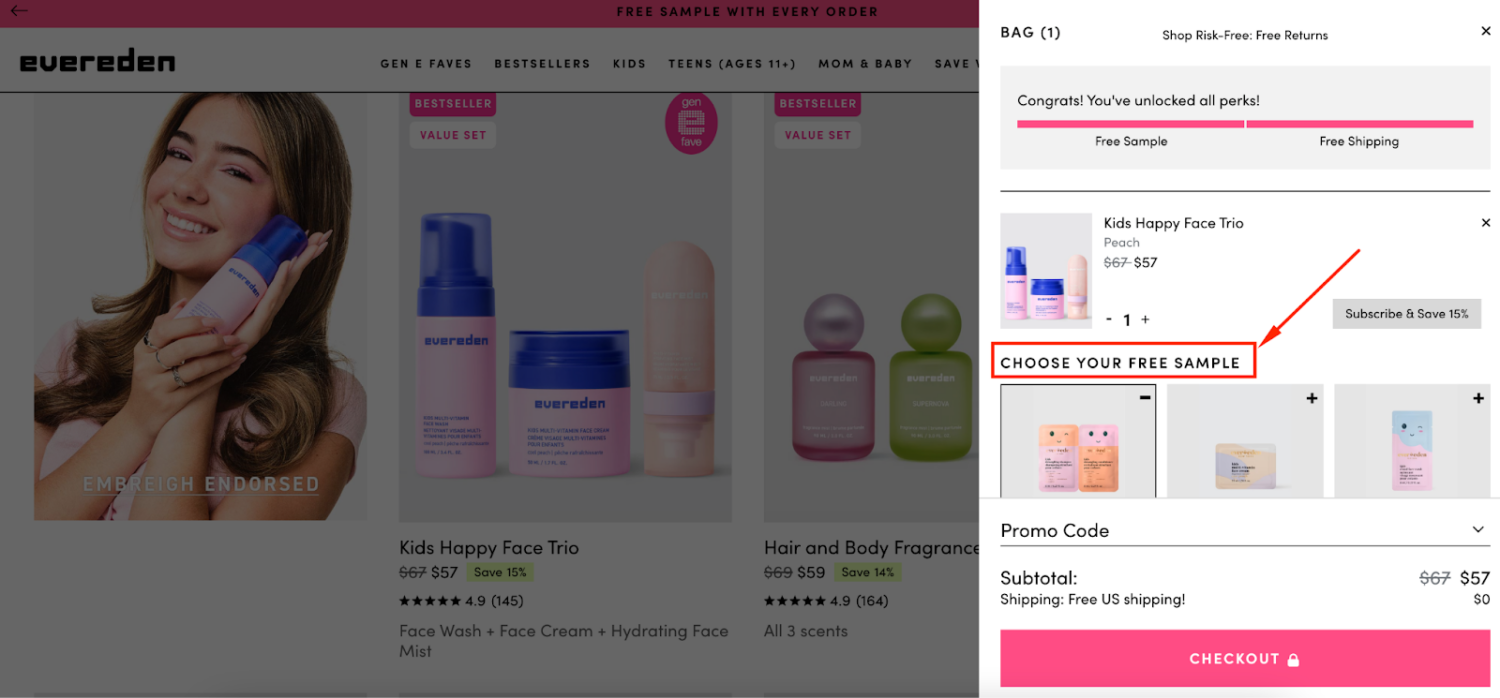
Example:Evereden uses a cart progress bar to show shoppers exactly when they unlock a free trial item. Once the spend threshold is met, customers can pick their preferred sample packet directly inside the slide-out cart. Giving buyers the power to select their own trial ensures they receive a product they genuinely want to test. This small element of choice drastically increases the chances that the freebie will turn into a future full-size purchase.
Evereden’s free sample gift
💡Tip: Choose a sample from your most desirable or highest-priced product, not the SKU with the most excess stock. The sample’s appeal is what drives the qualifying spend, so pick accordingly.
#2 Complementary Accessories
A complementary accessory works because it feels like the gift was designed specifically for the order. Customers aren’t just getting a random item. They’re getting something that completes what they were already buying.
The key is choosing an accessory that the customer would realistically want alongside the primary purchase. If they had searched for it separately anyway, it would make a strong gift.
Best for: Apparel, fitness, footwear, electronics, accessories, home goods.
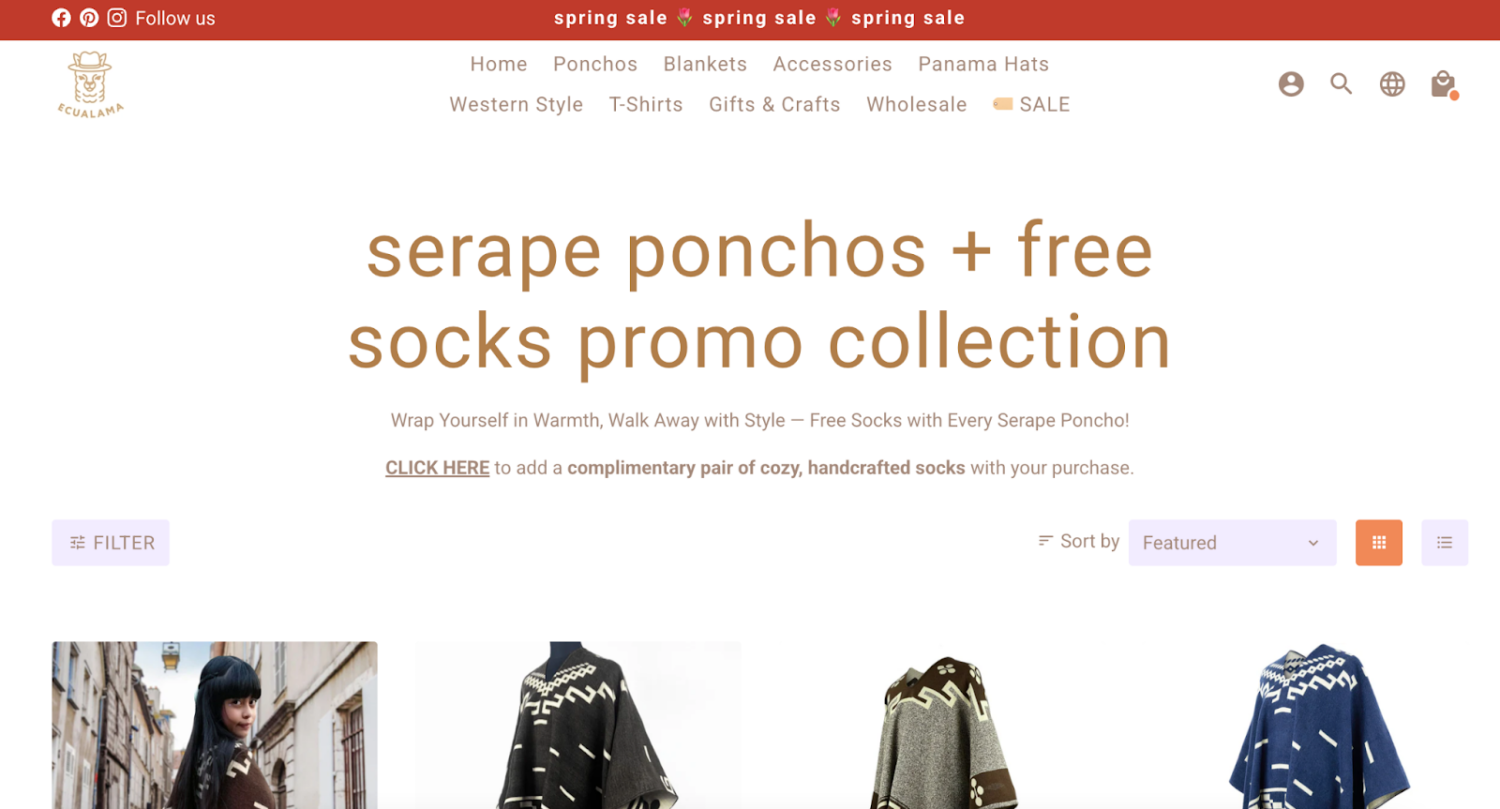
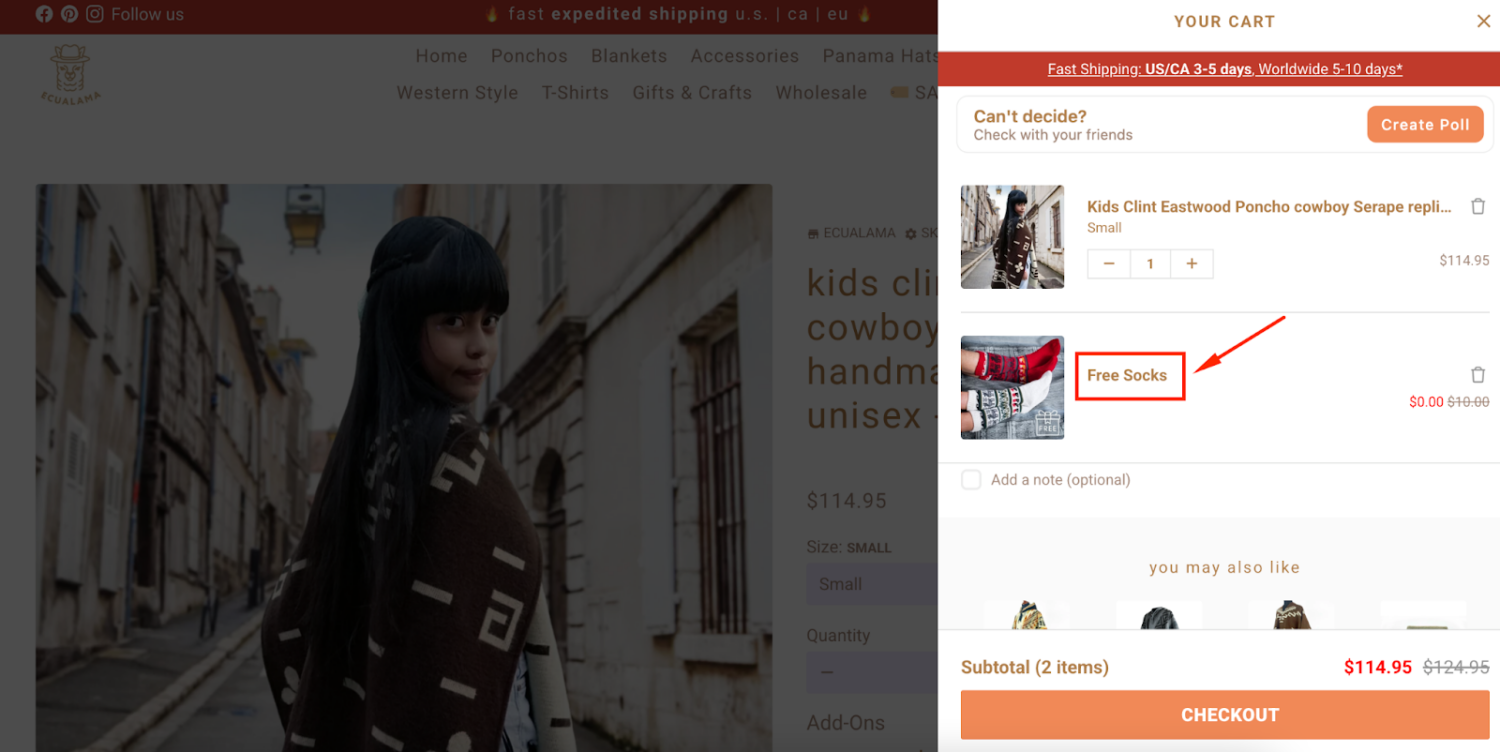
Example:Ecualama successfully drives AOV by gifting free socks to anyone purchasing from their serape poncho collection.
Ecuadama offers free socks with any purchase from its serape poncho collection.
They smartly list the gift as a separate item in the cart, showing a 10-dollar value discounted to zero. This transparency helps shoppers visualize exactly how much they are saving by upgrading their purchase. It turns a simple accessory into a compelling reason to complete the transaction without any hesitation.
💡Tip: Test the accessory idea by checking what customers frequently buy in a second order after their first purchase. If a specific item keeps appearing, it’s a strong gift candidate. Customers clearly want it alongside your core products.
#3 Exclusive or Branded Merchandise
Branded items work differently from standard products. Their perceived value isn’t tied to a market price. It’s tied to exclusivity. Customers can’t buy this anywhere else, which makes the gift feel like a genuine reward rather than just a product you’re throwing in.
This is especially effective for brands that already have a community or repeat customer base. When customers feel connected to the brand, branded merchandise carries identity value on top of functional value.
Best for: Lifestyle brands, coffee and beverage, apparel, beauty, and any brand with an active repeat customer base.
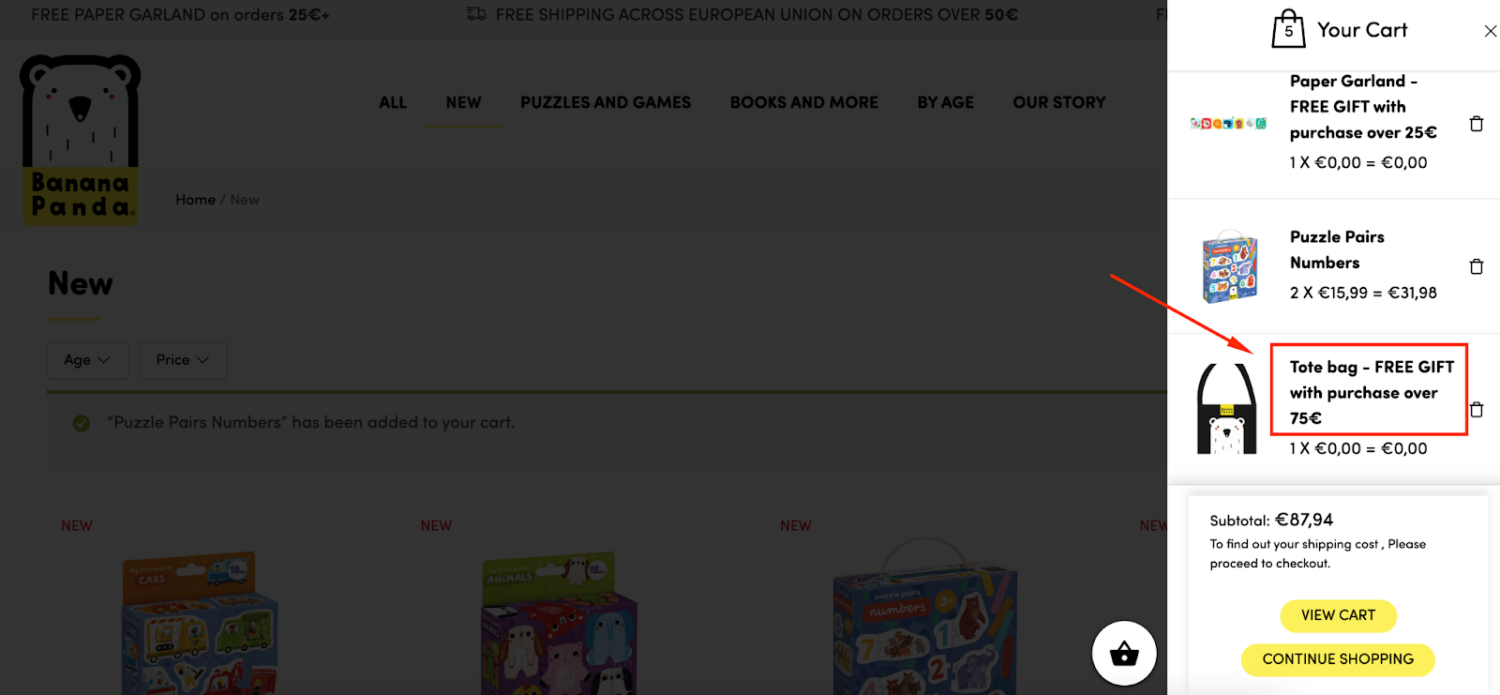
Example:Banana Panda uses a tiered system to offer branded items like paper garlands and tote bags based on the customer’s total spend. By featuring their iconic mascot on these gifts, they create a sense of exclusivity that standard products cannot match.
This strategy effectively encourages shoppers to reach higher thresholds – €75, to secure the more desirable branded merchandise. It turns a routine purchase into an opportunity for fans to collect limited-edition items that represent the brand’s identity.
Banana Panda offers a free tote bag based on the customer’s total spend.
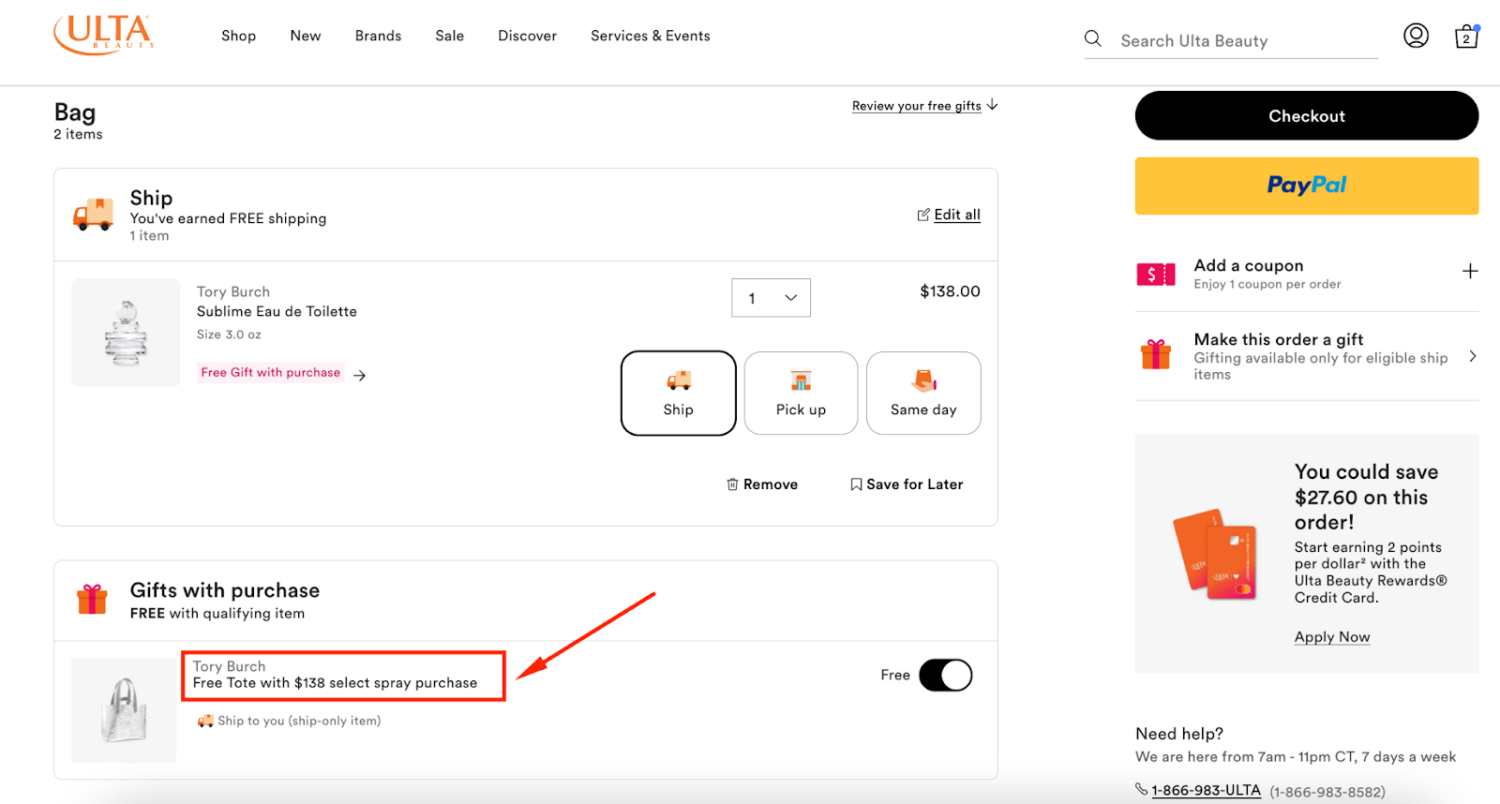
Another exciting example is Ulta Beauty. They include exclusive, branded tote bags as gifts with purchase for high-end fragrances like Tory Burch. This gift feels like a premium reward because it allows customers to own a luxury accessory that isn’t typically available for individual sale.
The clear callout in the shopping bag helps shoppers recognize the significant added value they receive for their spend. This approach effectively justifies the fragrance’s premium price while strengthening the customer’s emotional connection to the brand.
Ulta Beauty offers exclusive tote bags for high-end fragrances like Tory Burch
💡Tip: Branded merchandise performs best when the item is genuinely usable in daily life: a tote bag, a mug, a water bottle, a pouch. Branded stickers or low-utility items feel more like marketing material than a reward.
#4 Bundle Add-Ons
A bundle add-on turns a standard order into a complete kit. Instead of the customer walking away with a single product, the gift closes a functional gap. They’re getting everything they need in one order.
This framing shifts the customer’s perception of the purchase. They’re not just spending $15 more to qualify for a freebie. They’re getting a complete solution. That psychological reframe often makes the extra spending feel easier to justify.
Best for: Candles, beauty sets, wellness, hobby and craft, and home goods.
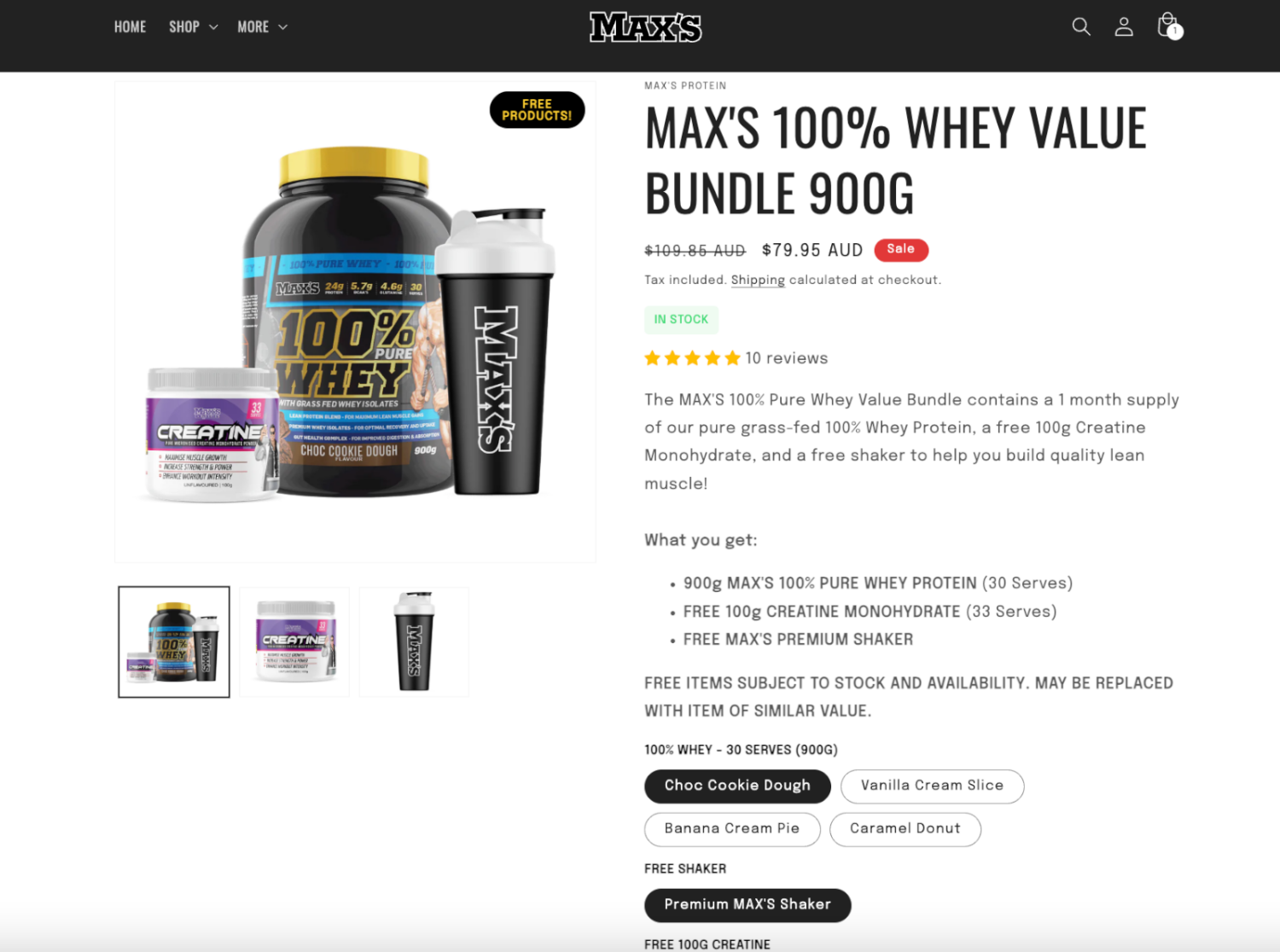
Example:MAX’s protein stack is a strong example of bundle add-ons. Instead of selling whey protein as a standalone product, they include creatine and a shaker as free additions. On its own, whey solves only part of the problem. Users still need a way to consume it conveniently and often look for additional supplements to improve performance.
By adding these items to the bundle, the purchase becomes a complete training setup rather than a single product. The customer isn’t thinking about buying extra accessories later; they already have everything needed to start.
Max’s bundle add-ons include a free creatine monohydrate & premium shaker
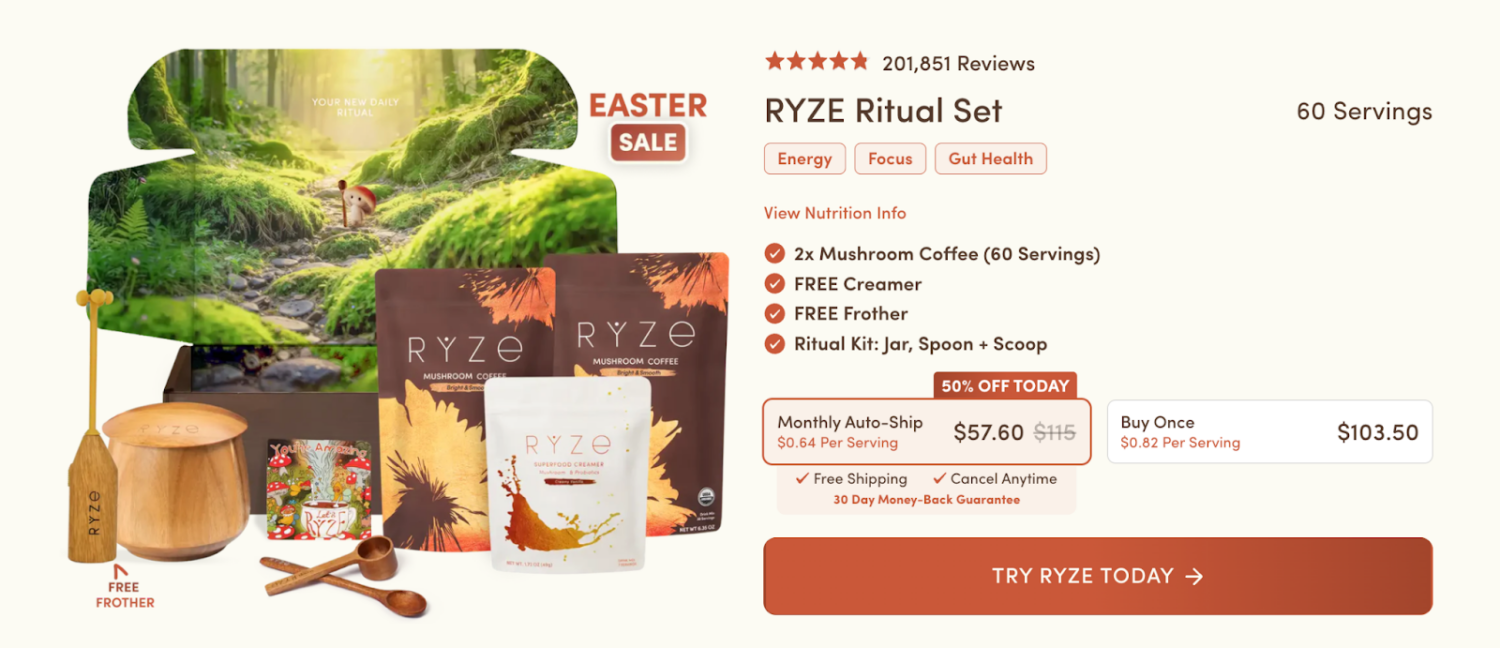
Another example is the RYZE Ritual Set, which reframes coffee as a daily ritual rather than just a drink. A single bag of coffee leaves gaps in the experience, such as texture, preparation, and consistency. By including a creamer, frother, and ritual tools like a jar and spoon, the bundle removes those gaps entirely.
The result is a complete system where nothing feels missing. This shifts the perception from buying coffee with a bonus to investing in a fully formed routine, making the higher spend feel more justified.
Ryze Ritual Set that includes a free creamer and frother
💡Tip: The most effective bundle add-ons are items with high utility but low purchase priority. Customers want them — they just wouldn’t order them on their own. That’s exactly what makes them feel like a valuable gift rather than an item they could have bought themselves.
#5 Digital Products
Digital product gifts have no COGS and no shipping complexity. When the content is specific and genuinely useful, they can carry real perceived value, often more than a physical item of similar cost.
The critical requirement is specificity. A recipe guide only works as a gift if it’s directly relevant to what the customer just purchased. Generic content like “The Ultimate Wellness Guide” reads as filler. A “30 Recipes Using Our Hot Sauces” guide reads as a reward.
Best for: Food and beverage, fitness, beauty, home décor, nutrition.
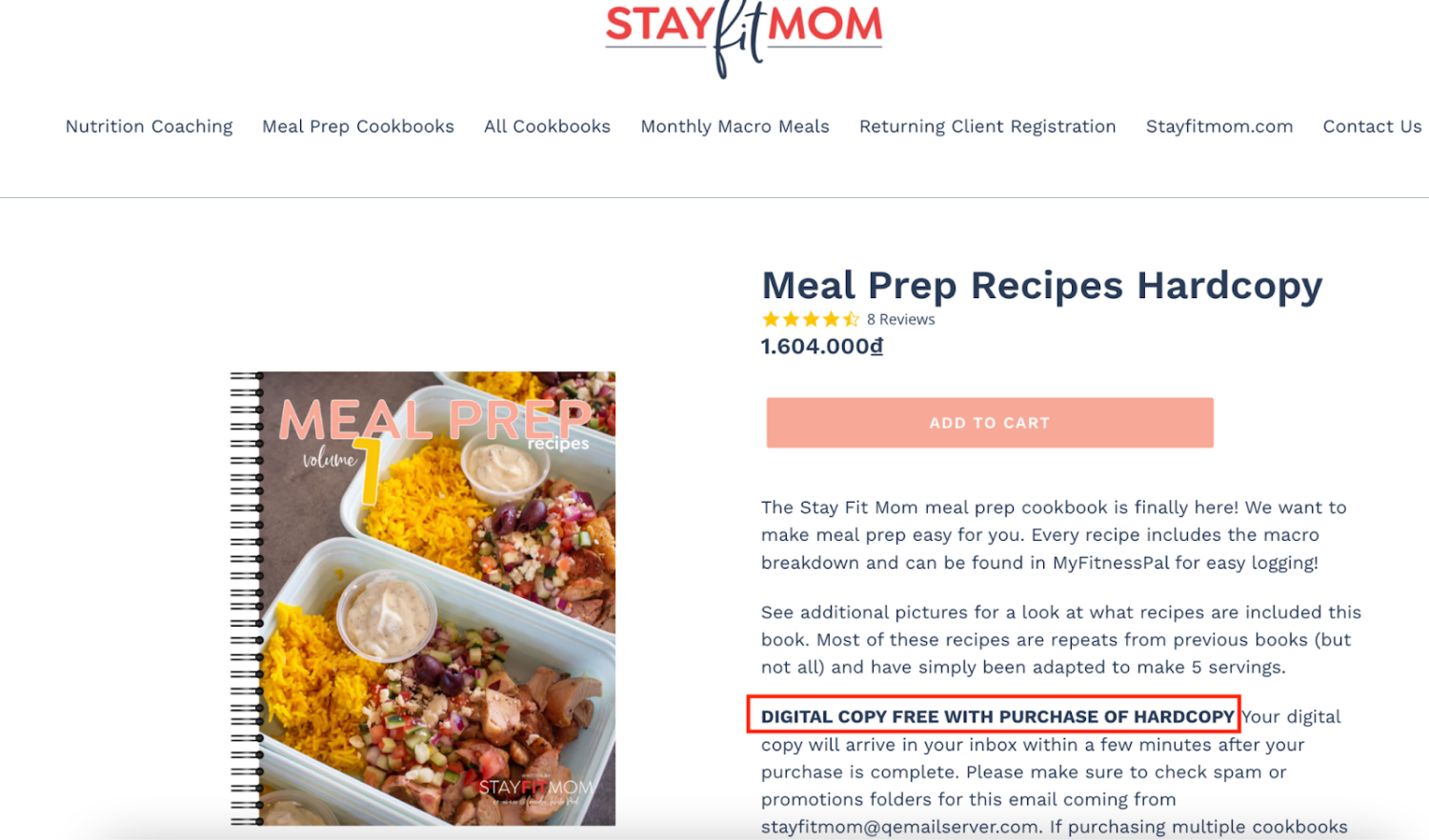
Example:Stay Fit Mom’s cookbook shows exactly this idea, where buying the hardcopy includes a free digital version. The digital file adds instant access and convenience, but more importantly, it’s the exact same content in a more usable format. That makes the gift feel directly relevant and genuinely useful, not like filler.
Free digital copy with purchase of hardcopy
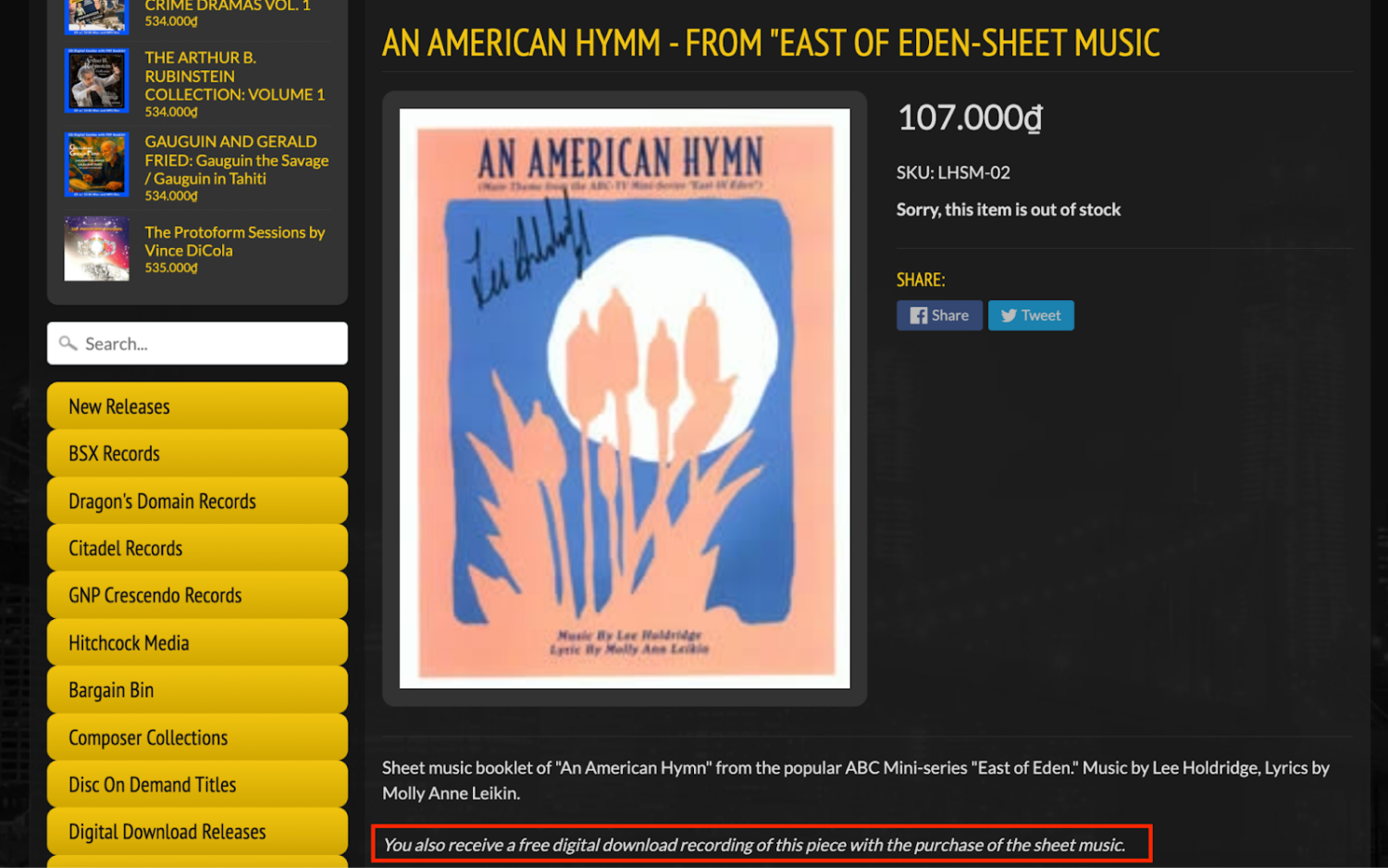
Another example is BSX Records, where purchasing sheet music includes a free digital recording of the same piece. The customer isn’t just buying the score. They also get a reference track to hear how it should sound. This makes the product immediately more usable, especially for learning and performance. Because the digital gift is tightly tied to the exact item purchased, it feels purposeful and high-value, not like generic bonus content.
BSX Records offers a free digital recording of the same piece with the purchase of sheet music
💡Watch out: Don’t repurpose a blog post or existing content page as the gift. The digital product needs to feel like something customers would pay for on its own: exclusive, well-formatted, and directly tied to their purchase.
#6 Tiered Gifts
Tiered gifts replace a single spending milestone with two. Instead of one threshold that only captures customers near that price point, you create two levels that lift AOV across a wider range of cart values.
The lower tier captures customers who wouldn’t make the jump to a high threshold. The upper tier pushes your highest-intent buyers to spend more than they originally planned. Both tiers need a meaningful gift attached. If the second tier’s gift isn’t noticeably better than the first, customers have no reason to keep spending.
Best for: Stores with a wide product price range, stores with high AOV variance across customer segments.
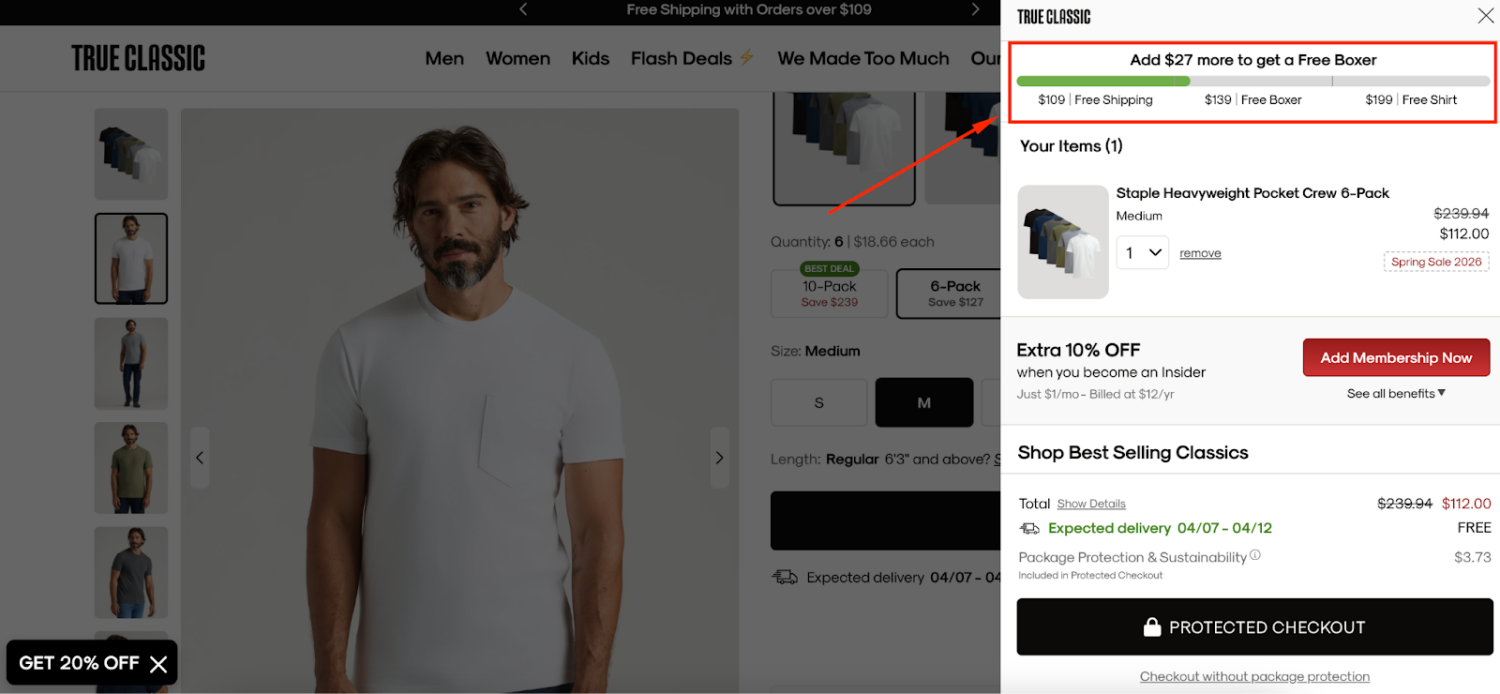
Example:True Classic’s tiered cart incentives: spend $109 for free shipping, $139 for a free boxer, and $199 for a free shirt. Instead of one threshold, customers are guided through multiple steps. Lower-intent buyers stretch a little to unlock the first gift, while higher-intent buyers keep going for the better reward. Each tier adds noticeable value, which keeps customers climbing rather than stopping early.
True Classic’s tiered cart free gift
💡Watch out: Keep tiered gifts to two or three levels maximum. More tiers than that create confusion. Customers lose track of where they are and what they’re working toward, and the motivational clarity of each milestone disappears.
4. Testing Which Gift Is Actually Increasing AOV
Choosing the right gift is the first step. Knowing whether it’s working and when to replace it is what keeps your GWP promotion profitable over time.
#1 Metrics to Track
Track these three numbers for every GWP promotion you run.
AOV before vs. after launch. Compare your store’s average order value in the 30 days before the promotion to the 30 days after. Segment by customers who redeemed the gift and customers who didn’t. This isolates the AOV impact of the gift itself rather than seasonal or traffic changes.
Redemption rate. This is the percentage of customers who reached the threshold and actually claimed the gift. A low redemption rate (below 15–20%) usually means one of two things: the threshold is set too high relative to the gift’s appeal, or the gift isn’t compelling enough to motivate the qualifying spend.
Threshold crossing rate. Track how often customers who were below the threshold added items specifically to qualify. This is the clearest signal that the gift is working as an AOV driver. If customers are reaching the threshold without adding items, the gift is not changing their behavior.
#2 How to Test
Run one gift at a time for at least 3–4 weeks before making changes. Switching gifts too early makes it impossible to separate the gift’s performance from normal order fluctuation.
To compare two gift options, run an A/B test: same threshold, two different gift products, split by time period or traffic source. Keep every other variable the same so the gift is the only thing changing between the two periods.
Watch your cart abandonment rate at the threshold price point. If abandonment spikes at $58–$65 when your threshold is $60, customers are seeing the gap and deciding not to close it. That’s a signal the gift isn’t motivating enough.
#3 When to Replace the Gift
Redemption rate stays below 15–20% after 30 days
No measurable AOV lift compared to the pre-promotion baseline
High redemption rate but no AOV increase. Customers were already spending enough to qualify without the gift changing their behavior.
If all three metrics are flat after 30 days, the gift is the most likely cause. Move to the next idea on your list and run the same test window before drawing conclusions.
Conclusion
The threshold sets the target. The gift determines whether customers bother reaching it. A weak gift selection is the most common reason a GWP promotion fails to move AOV, not a threshold that’s set too high.
Start with one idea from this list that fits your current catalog. Match it to a threshold that’s realistic for your average order value, and run the promotion for 30 days. Use redemption rate and AOV lift as your primary signals before testing a second option.
FAQs
What is a good free gift for a GWP promotion?
The best free gift is one that feels directly relevant to what the customer is already buying. A complementary accessory, a sample from a higher-ticket product, or a branded item that isn’t sold separately all tend to perform well. The gift doesn’t need to be expensive — it needs to feel worth more than the extra spend required to qualify.
How much should a free gift cost?
A practical guideline is to keep your gift COGS below 20% of the extra revenue the threshold generates. If your threshold pushes customers to spend $20 more than their typical order, your gift cost should stay under $4–5. Perceived value matters more than actual cost — a $4 sample from a desirable product will outperform a $15 generic item.
Can I use slow-moving inventory as a GWP gift?
It’s best to avoid this. Customers often recognize when a gift is clearance stock, and it signals low value rather than generosity. A gift that customers don’t want reduces the motivation to hit the threshold and can hurt redemption rates. Use samples, accessories, or branded items instead.
How do I know if my GWP gift is increasing AOV?
Track three metrics: AOV before vs. after the promotion launched, redemption rate, and how often customers below the threshold added items specifically to qualify. If redemption rate is above 15–20% and AOV has lifted compared to your pre-promotion baseline, the gift is working. If both are flat after 30 days, the gift likely isn’t compelling enough.
What’s the difference between a tiered gift and a standard GWP?
A standard GWP has one threshold and one gift. A tiered gift sets two or three thresholds, each with a progressively better gift. Tiered gifts capture AOV lift from a wider range of customers — those who wouldn’t reach a single high threshold can still be pushed toward a lower one, while high-intent buyers have a reason to keep spending past the first milestone.