Charlie Ngo is an eCommerce expert with 7 years of experience in the marketing field, specializing in SaaS and digital growth. A graduate in Marketing Communication, Charlie currently serves as the Marketing Manager of the BOGOS Shopify App, where he leads strategic initiatives to drive user acquisition, engagement, and brand positioning.
In 2025, retail eCommerce sales are estimated to exceed $3.6 trillion, with approximately 2.8 billion people worldwide making at least one online purchase. Notably, 38%of these transactions involve a coupon code or discount. It is no exaggeration to say that there is a huge opportunityfor Shopify merchants to scale orders through promotions.
However, the numbers below reveal fierce competition lying ahead:
Shopify now powers over 4.8 million stores, with thousands more launching daily.
Cart abandonment rates are climbing steadily, hitting 70.19% in 2025.
Fewer than one million stores generate meaningful annual revenue.
This is why simply running a sale is no longer enough. You need a well-designed offer strategy that covers the entire buying journey, helping you convert traffic into high-value orders for long-term growth. In this post, I will break down the 4 winning offer types with a comprehensive guide on exactly how to execute them that I’ve learned from helping over 10,000 global stores during the last 11 years.
1. Free Gift With Spending
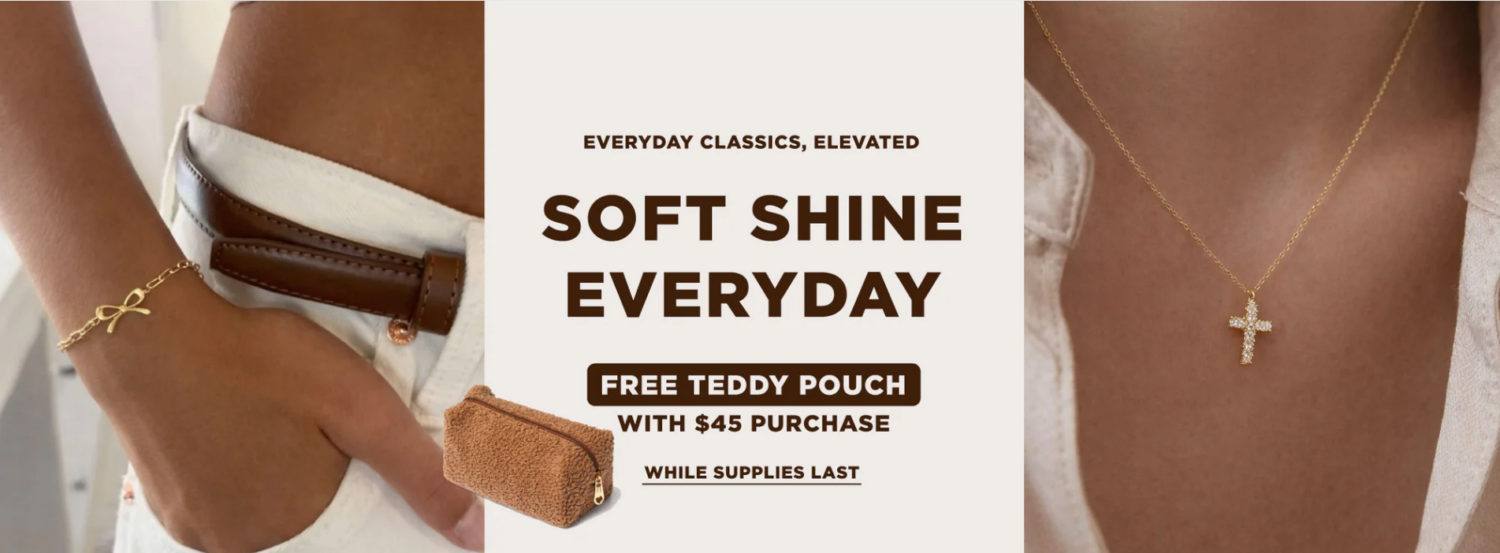
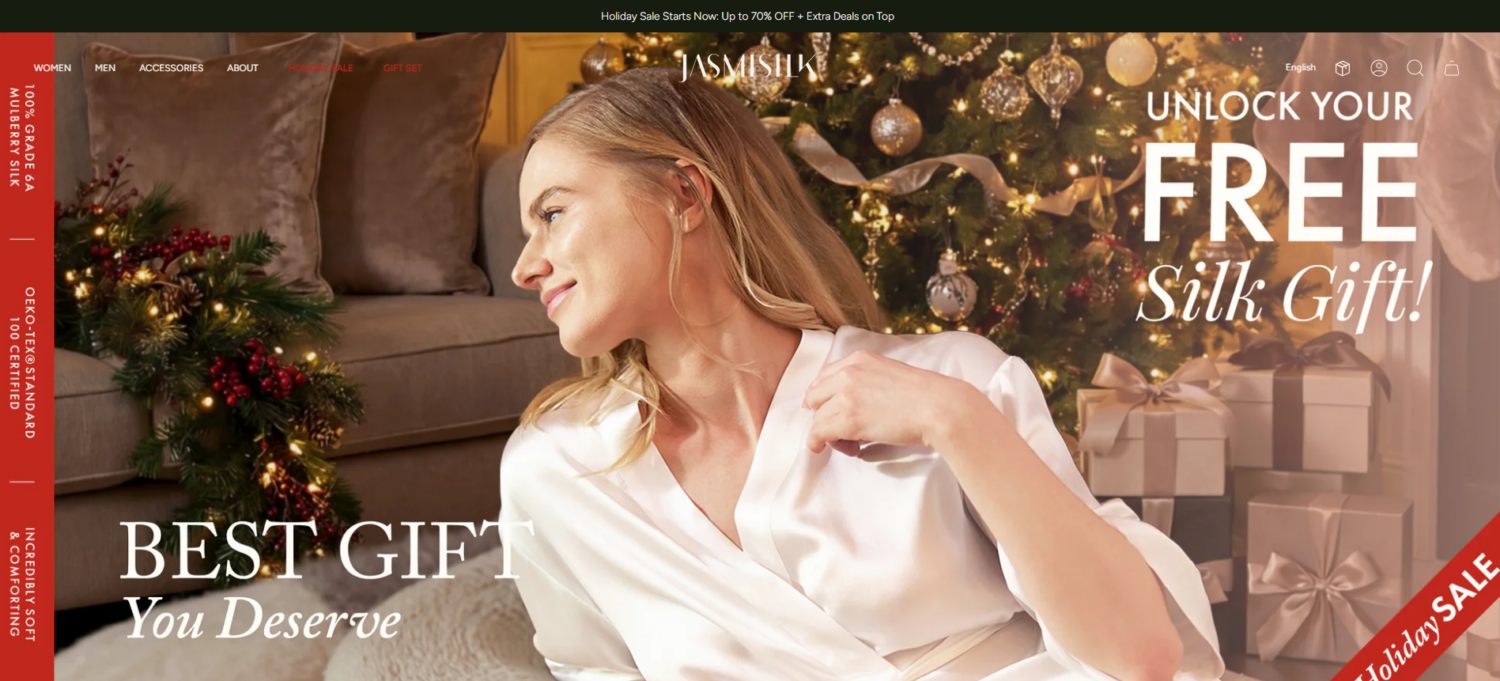
Interestingly, free gift with spending was pioneered by Estée Lauder in the 1940s. For many retail brands, this offer type has become a foundational promotion strategy, giving customers a free product or service when they qualify for a purchase condition.
Decades later, this idea still remains one of the most effective sales drivers. It leverages the perceived value of the gift to make the main product more compelling at both functional and emotional levels when customers are comparing similar options.
While its roots lie in beauty and cosmetics, free gift with spending is now widely used across fashion, electronics, home goods, and food & beverage. But in today’s crowded eCommerce landscape, where millions of stores fight for the same attention, the real challenge is knowing when and how to structure it so it truly drives sales.
1.1. When To Use
Gift with spending is designed to drive AOV by anchoring the gift to a specific spending threshold. Through this approach, you psychologically motivate customers to add more to unlock the reward, which naturally stretches their cart.
Furthermore, this tactic shines brightest during emotional, gift-giving occasions like Valentine’s Day, Mother’s Day, or Brand Anniversaries, where the free item serves as a bonus present and adds significant emotional appeal to each transaction.
1.2. How To Set Up
Over the past decade, working with eCommerce brands, the most common pitfall I’ve seen is reliance on guesswork. To increase AOV without sacrificing profits, a data-backed setup is essential built around three core pillars 👇
Set Trigger Conditions
Merchants often set thresholds too low, which quietly hurts margins through shipping and fulfillment costs, or push them so high that customers disengage. The ideal trigger condition should be set at 15-20% above your current AOV. This percentage is high enough for a profitable margin but affordable enough to avoid frustration.
Choose The Right Gift
The key is balancing value and cost. Choose gifts that feel valuable to customers but cost very little for you to produce. You can add more emotional value to this gift by making it exclusive, limited-time, or unpurchasable. More importantly, make sure the gift is closely related to the main product or brand category. When the gift feels relevant, customers are more excited to complete the purchase.
Implement Frictionless UX Components
Don’t make customers manually work to get their reward. The gift should be added to the cart automatically the moment they reach the spending threshold. If customers have to search for the gift or enter a discount code, many will drop off due to unexpected friction.
1.3. How To Deliver
An invisible offer is a useless offer. Make yours impossible to miss and visible at every key touchpoint without disrupting the shopping experience. To maximize conversion rates, implement:
Key Message
Focus on a benefit-driven message that clearly highlights the reward and the requirement, rather than just generically announcing a sale. More importantly, keep this message consistent across all marketing channels to build recognition. Finally, include soft urgency to act as a psychological nudge, motivating shoppers to complete their purchase immediately rather than delaying.
Channel Strategy
With 47.2% of Shopify stores actively engaging customers on Instagram, followed by 28.2% on Facebook and 12.2% on TikTok, one thing is clear: an omnichannel approach is no longer optional. In addition to social platforms, email remains a powerful channel for re-engaging existing customers.
As a result, a GWP campaign shouldn’t exist only on your website; it needs to be consistently reinforced across these high-engagement social channels to drive traffic back to your store.
On-Site Display
To make sure no customer misses the offer, start with a sticky header bar on your online store to keep the promotion top of mind across every page. As customers browse, reinforce the offer with promo badges on collection or product pages. Finally, close the loop with a smart progress bar in the cart drawer, showing exactly how close shoppers are to unlocking the reward.
👉 Learn how to set up the Progress Bar with BOGOS
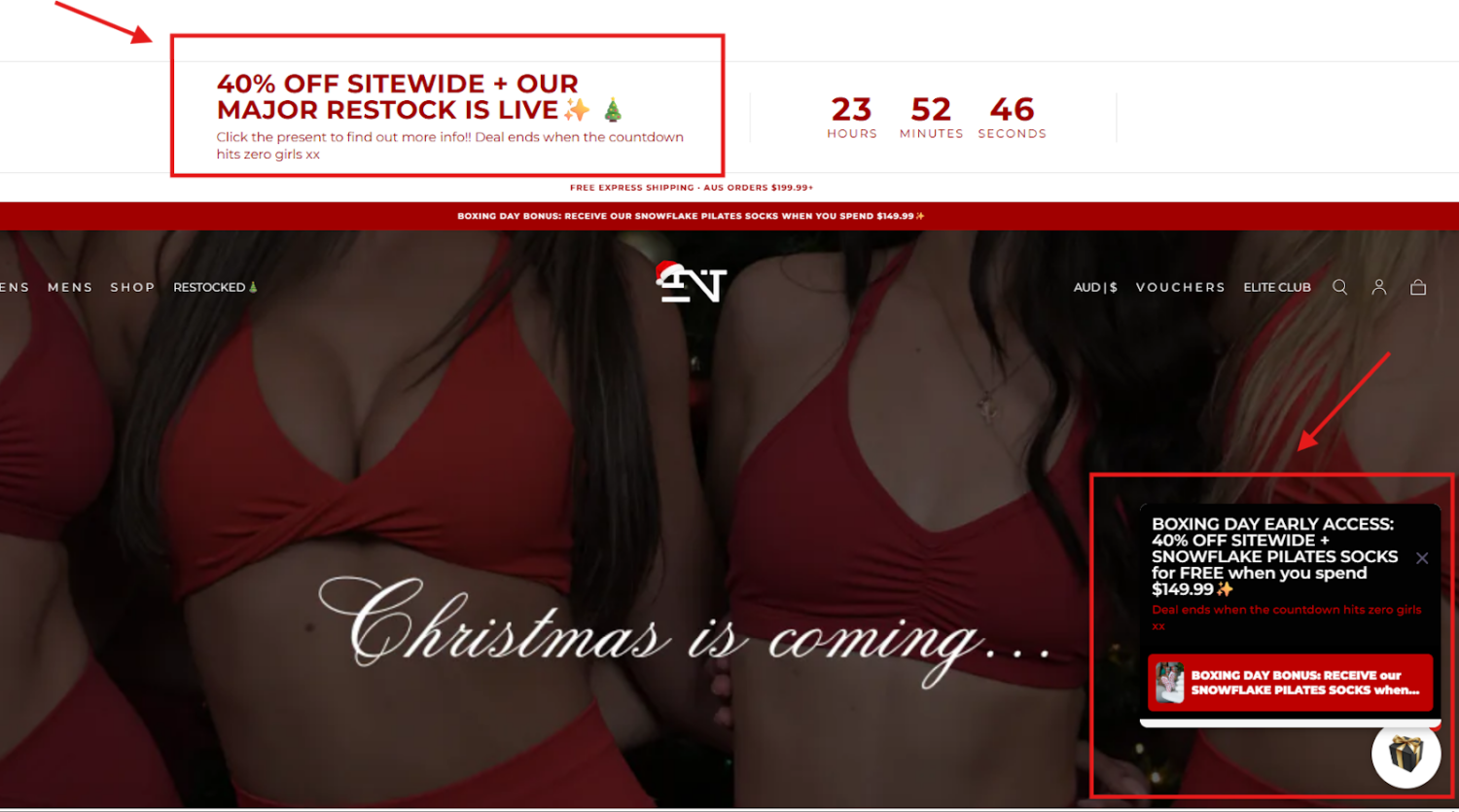
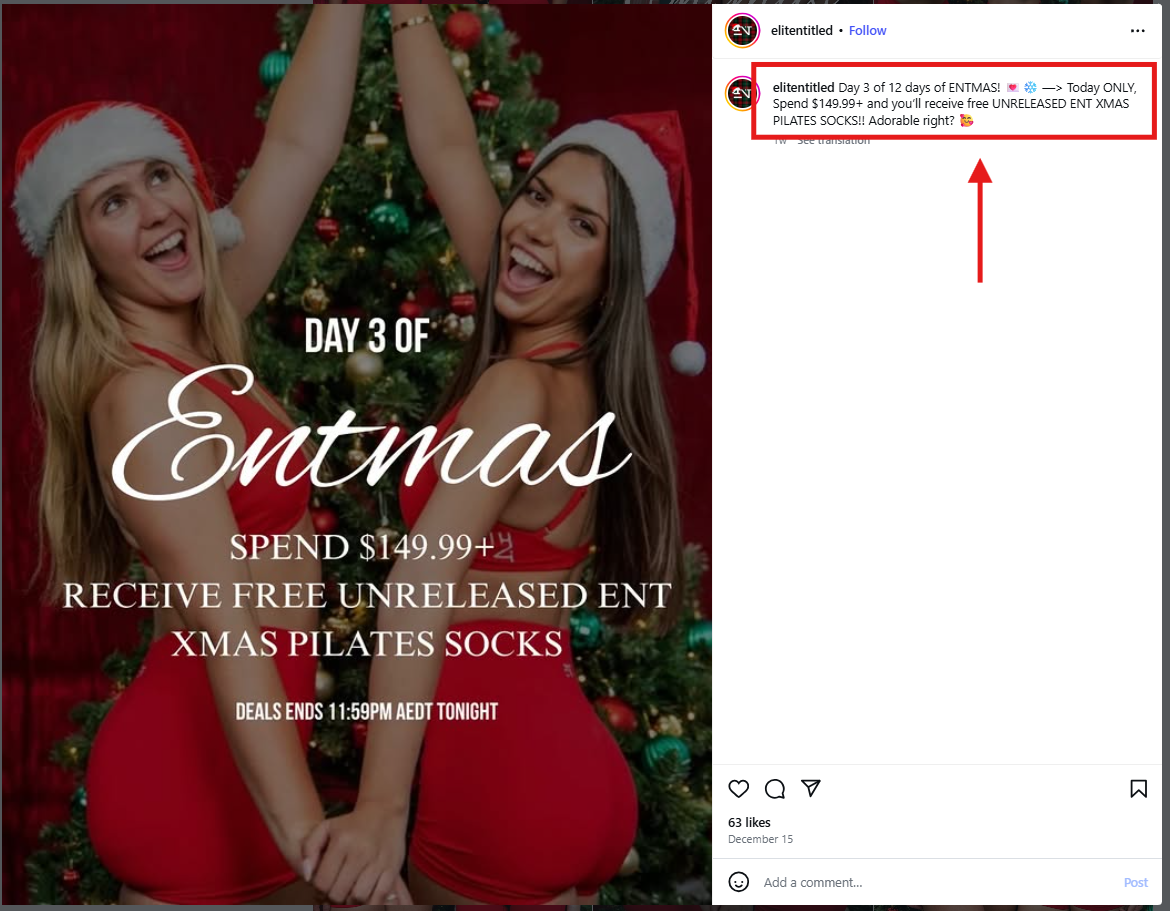
Take Elite-N-Titled, an Australian activewear brand, as a practical example. During its 2025 Christmas campaign, the brand consistently communicated a clear and benefit-driven message “Get snowflake pilates socks when you spend $149.99,” across its main channels.
On the website: the offer was highlighted through a hero banner and BOGOS’s Today Offer widget.
On Instagram: the same message was reinforced visually through festive imagery and concise captions.
Beyond just keeping the message consistent, there is a bigger lesson here. Elite-N-Titled proved that a campaign works best when you add a “holiday touch” to every part of it, not just the text. By choosing snowflake socks instead of a regular item, they made the gift feel special and relevant to Christmas.
👉 This simple step of matching the gift to the season made the offer much more attractive and helped them reach nearly $280K in sales with BOGOS in November.
1.4. Use Case
Klower Pandor, a fragrance brand, achieved a staggering 13x sales increase in just one month by leveraging a strategic mix of gift with purchase and tiered spending thresholds.
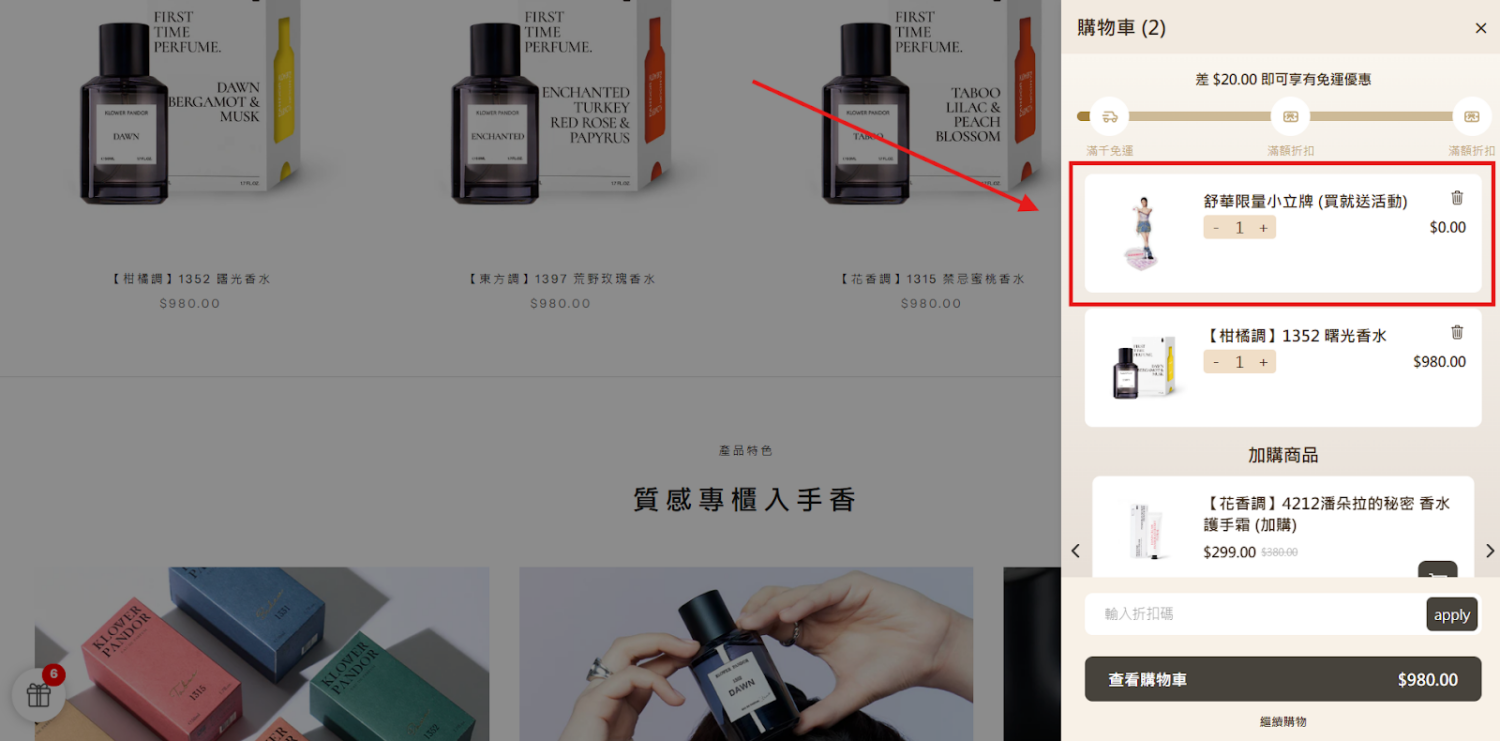
Their approach was two-fold. First, they hooked buyers with exclusive merchandise featuring their ambassador, Shuhua from i-dle, a famous K-pop group.
Klower Pandor update customers’ carts in real time with BOGOS progress bars
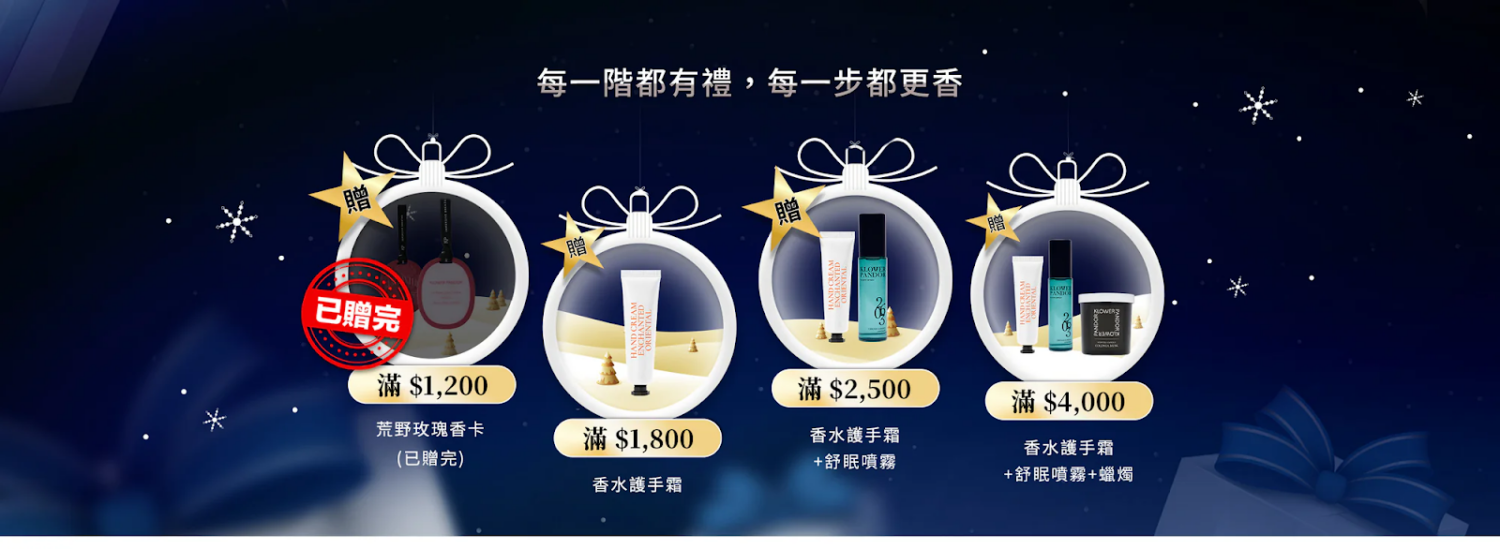
Then, they elevated the strategy by implementing a tiered-offer tactic. Every threshold and reward was thoughtfully selected to maximize AOV:
1️⃣ Spend TWD 1,200: Get a perfume pendant
2️⃣ Spend TWD 1,800: Get a pendant + scented hand cream
3️⃣ Spend TWD 2,500: Get a pendant + hand cream + sleep spray
4️⃣ Spend TWD 4,000: Get everything above + a scented candle
This strategy worked because the thresholds were smartly designed. The TWD 1,200 tier required only small add-ons like hand cream that replenish quickly, bringing customers back sooner.
Alternatively, premium perfumes could also hit this threshold while maximizing profit. Higher tiers, meanwhile, were strategically designed for specific customer groups: loyal repeat buyers and high-spenders who are likely to stock up in single orders.
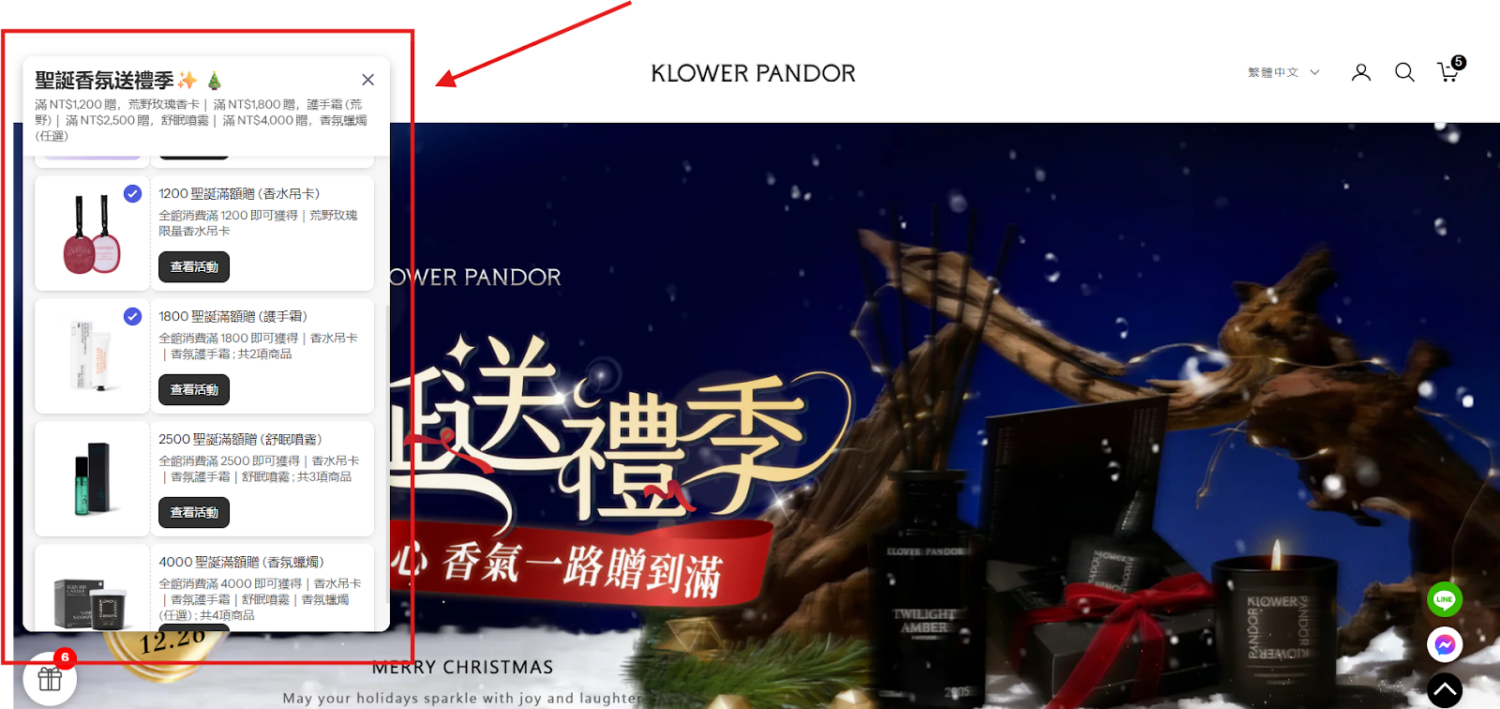
Klower Pandor took visibility one step further with BOGOS’s Today Offer feature – a storefront badge that gave every visitor instant access to the promotion details without disrupting the browsing experience.
This strategy fully utilized the psychology of gifting. By blending functional rewards (skincare products) with emotional incentives (fandom merch) and ensuring high visibility via the storefront badge, Klower Pandor created an ecosystem where every order felt like a win for the customer, and a profit boost for the brand.
2. Product Bundle Offer
Just as the “Happy Meal” revolutionized fast food by selling a complete meal rather than a single burger, product bundling has transformed eCommerce by shifting the focus from individual SKUs to a curated collection of items.
It is the strategy of grouping complementary products into a single package, often sold at a slight discount, to create an irresistible value proposition. This strategy is now common across cosmetics, supplements, technology, and gift-focused stores because it taps into two motivators:
Completeness: Customers get everything they need in one purchase without second-guessing or forgotten items.
Convenience: One decision, one checkout. Less friction, faster buying.
While customers get everything they need in one decision, merchants benefit from higher AOV. However, bundling isn’t about combining products at random. The challenge lies in creating bundles that feel logical to the customer while remaining profitable for your bottom line.
2.1. When To Use
Product bundling serves as an AOV engine, designed to multiply the value of a single transaction by encouraging customers to purchase complete solutions. Beyond revenue, this tactic is also leveraged to clear inventory by grouping high-demand products to drive clicks with slower-moving stock.
While bundles work effectively as an “always-on” strategy year-round, they become indispensable during seasonal gifting periods, where pre-curated sets solve the “what to gift” dilemma for shoppers.
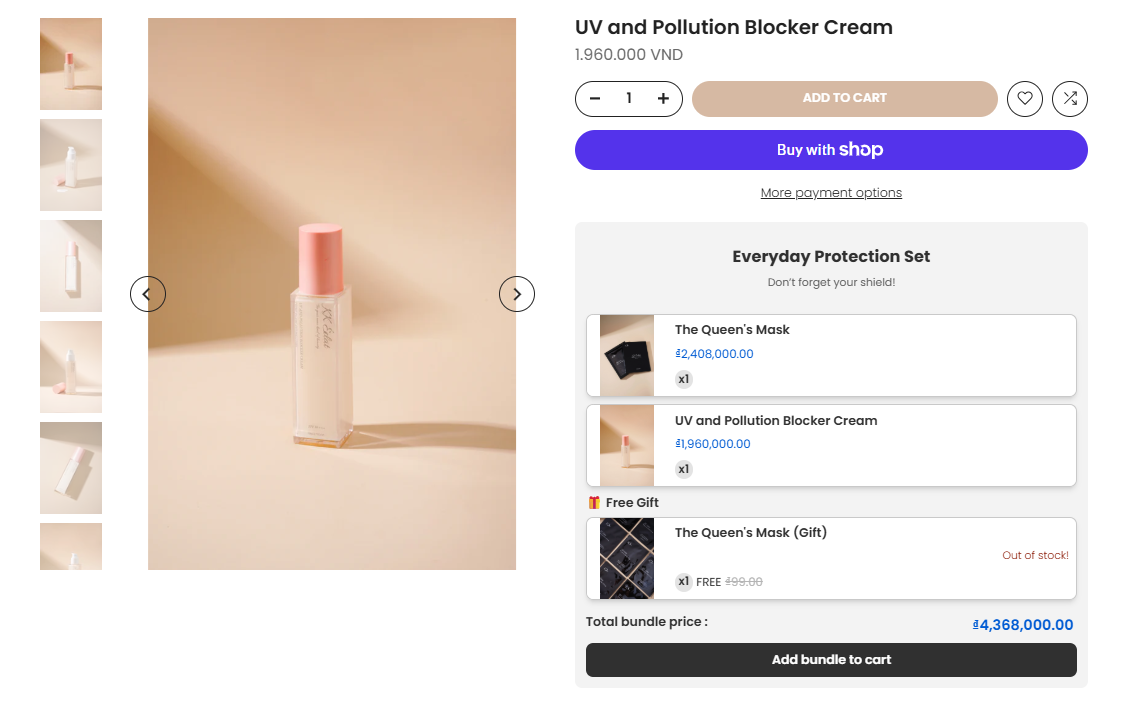
💡 Pro tip: If you want to unlock even higher engagement, consider elevating this offer type with a Build Your Own Bundle option, giving customers the flexibility to make their bundle for a more personalized buying experience.
2.2. How To Set Up
The most dangerous trap in bundling is hurting your profit margin with random discounts. A sustainable bundle strategy must be mathematically sound before it is visually appealing.
To maximize AOV while staying profitable, follow these steps:
Select Products Strategically
Your pairing logic must be obvious. Don’t force random items together; instead:
Complete the routine: Group related products to complete a routine or “ecosystem.” This is ideal for cosmetics, supplements, or outdoor gear, where customers naturally need multiple items to achieve the best result
Replenishment bundles: Create multi-packs of the same product type (with variant options like size/color) to encourage stocking up. This is ideal for high-frequency items like t-shirts, socks, or underwear, allowing customers to replenish their essentials without the friction of searching.
Set Up A Reward
Do not discount blindly. Your pricing strategy must be dictated by your margin structure.
For high margins (beauty & cosmetics, supplements & wellness, fashion accessories):You can afford to shave 20% to 25% off the subtotal. This is the “sweet spot” that makes the bundle irresistible.
For tight margins (electronics & gadgets, hardware & tools, food & beverages): If you operate with slimmer margins, a discount of 10% to 15% is sufficient. The primary value proposition here should be “convenience” rather than deep savings.
Use free gifts instead of bigger discounts: Giving a free gift often costs less than increasing the discount, while still making the bundle feel more valuable.
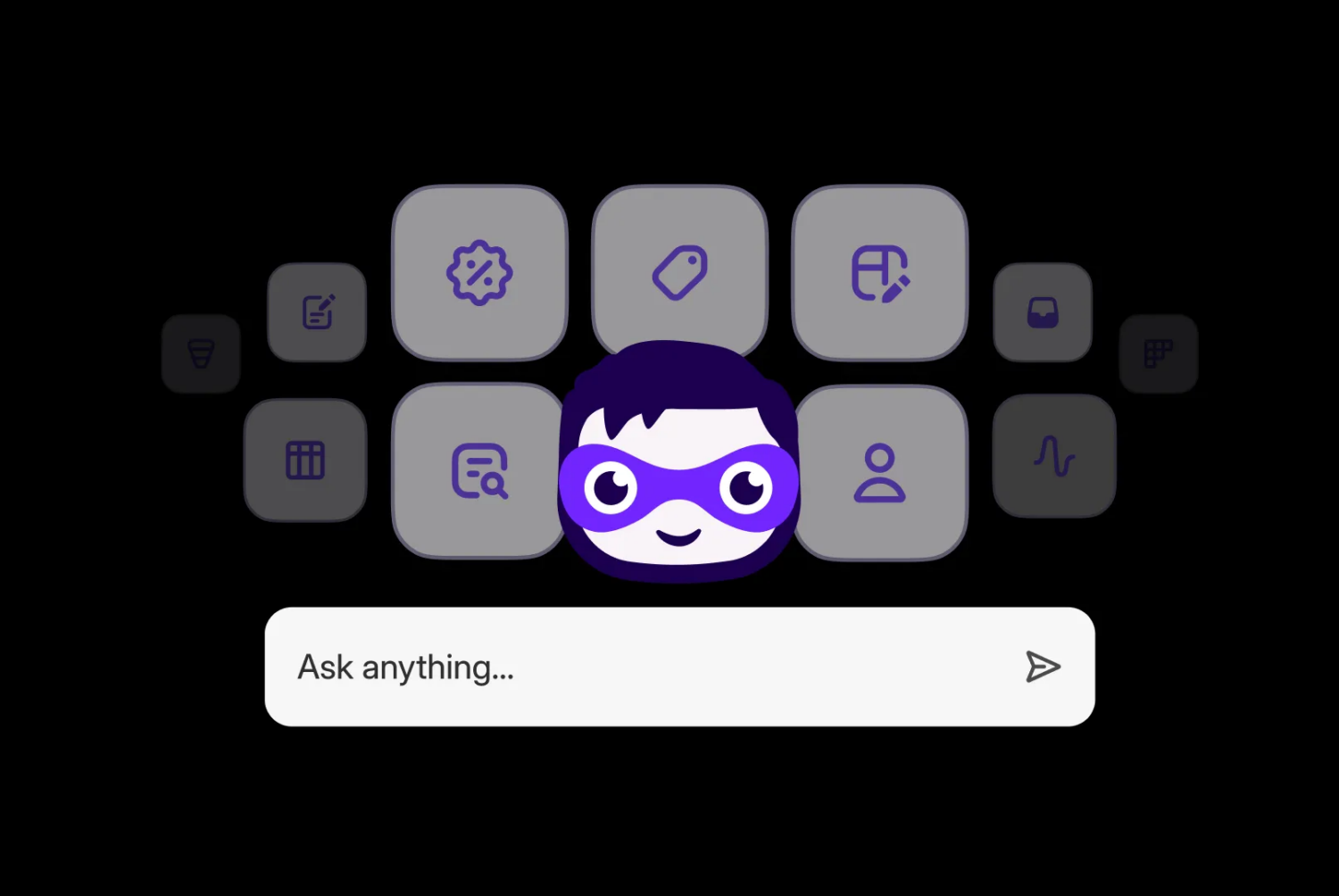
💡 Pro tip: Stuck on what to bundle? Sidekick, Shopify’s AI, can help. Just ask it to find products customers often purchase together, and you’ll have a data-backed bundle ready in minutes.
2.3. How To Deliver
Even the best bundle will fail if customers don’t realize the savings or the convenience it offers. That’s why you should focus on educating the customer and visualizing the value.
Key Message
Don’t just list what’s in the bundle, sell the why. Customers buy bundles for three reasons: to save money, save time, or get better results. Your messaging should tap into one of these motivations directly:
Savings-focused: “Buy together and save $15.”
Convenience-focused: “Everything you need in one click.”
Results-focused: “Your complete morning routine! Double the results, half the effort”
When customers see their motivation reflected in your message, the bundle stops feeling like a sales pitch and starts feeling like a smart decision.
Channel Strategy
For smaller stores, relying solely on owned channels to promote bundles often feels repetitive and yields limited results due to low organic reach. To break through the noise, you must pivot from talking about yourself to leveraging social proof.
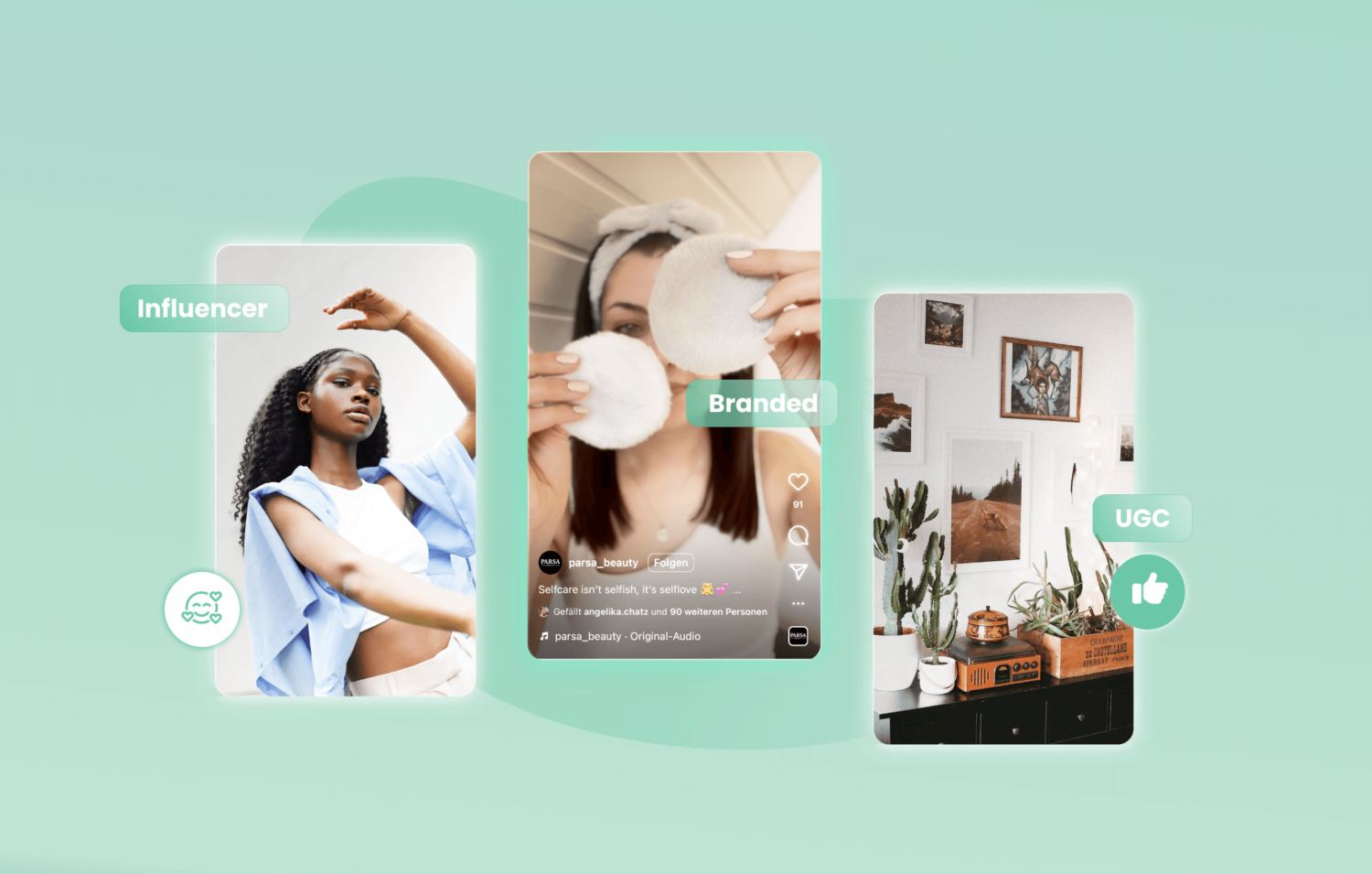
Start by partnering with KOLs to unbox and demonstrate the synergy of the “whole set,” then arm them with exclusive and time-sensitive discount codes to create immediate urgency.
Additionally, for visual industries like Beauty, Fashion, and Home Goods, User-Generated Content (UGC) is a cost-effective powerhouse. Formats like unboxing videos, before-and-after reveals, or “get ready with me” clips. These formats feel genuine, build trust faster than polished ads, and drive traffic that’s ready to buy.
On-Site Display
Make your bundle offer impossible to ignore by integrating it throughout the browsing experience. Start by adding a widget with a title like “Buy more to complete a set” on your product pages, so shoppers see the bundle while viewing individual items.
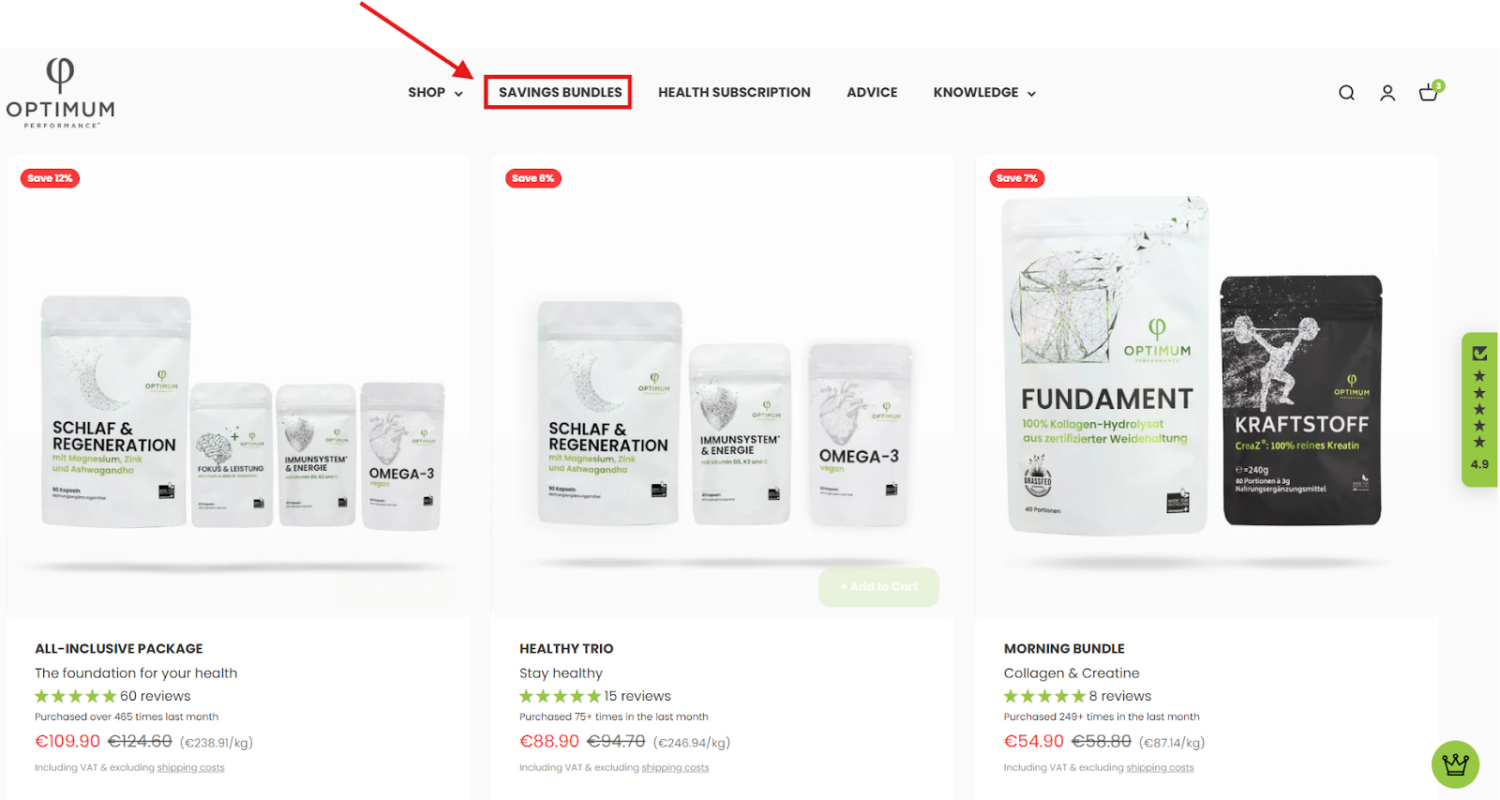
Next, create a dedicated page for the bundle, use a benefit-driven title, and feature it prominently in your website menu. This is particularly effective for Beauty or Supplement brands, where customers often need to review product ingredients or details before purchasing.
Optimum Performance, a German supplement brand, created bundles titled Saving Bundles and featured them prominently in the menu bar
Finally, showcase your best bundles on the homepage banner and link directly to the bundle page, ensuring customers can easily access the deal they just saw without having to search.
2.4. Use Case
RC Outfittersincreased their sales by 50% simply by making it easier for beginners to buy the right gear.
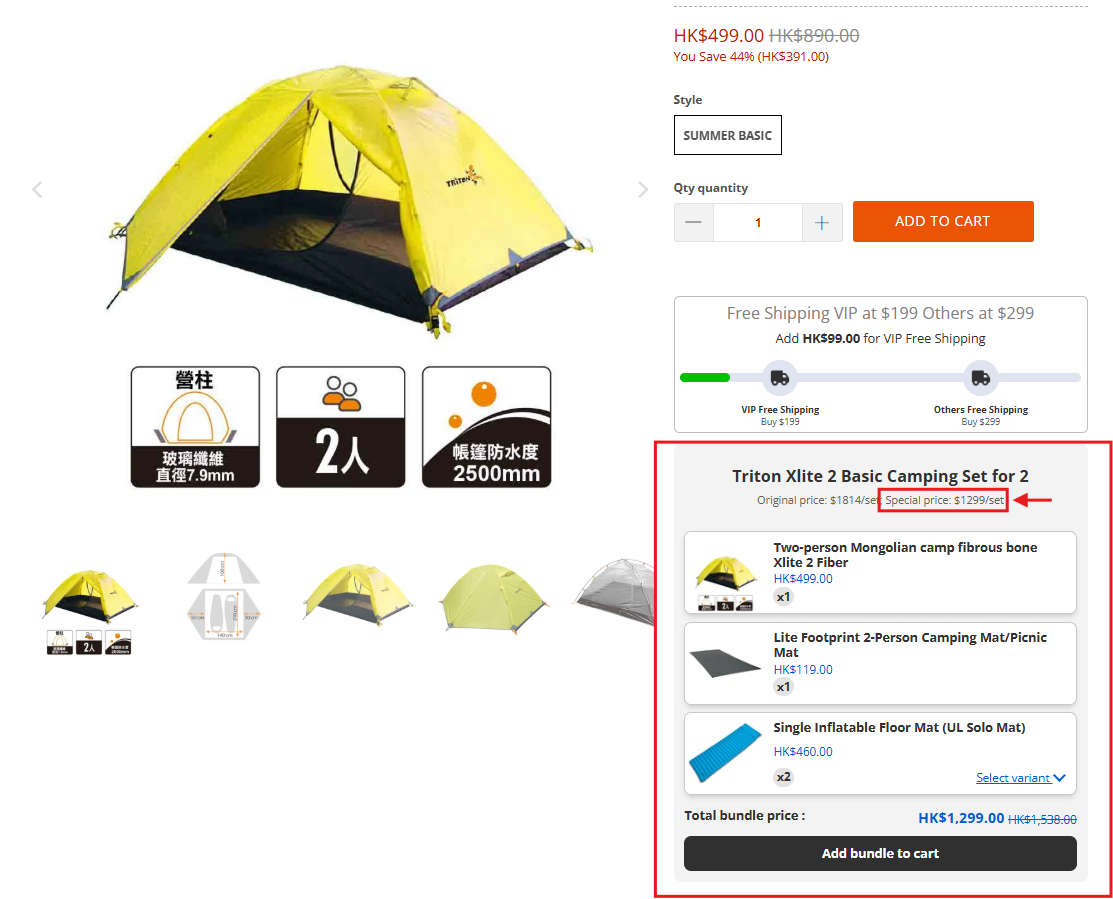
They noticed that customers rarely buy just a tent, so they used BOGOS to create a bundle that included a tent, ground mat, and a floor liner with a 15% discount. To make the deal even better, they displayed a Free Shipping progress bar right next to the offer.
This showed customers that buying the bundle was the smartest move: they got the complete kit, the 15% discount, and free shipping all at the same time. By putting this entire deal on one screen, customers didn’t have to search around for separate items, making it an easy choice to buy the full set.
Volume discount is a sales strategy where customers receive discounts based on the number of products they purchase. It is broader than quantity discount, which is based on the number of units or total cart value.
This strategy is particularly effective for industries with high consumption rates like food & beverage, health & wellness, or fragrance and personal care because it taps into two primal drivers:
High consumption: Products with high and frequent usage, making repurchasing inevitable and quick.
Easy storage: These products are typically small in size and have long shelf lives (excluding food and beverages), making them easy to store and manage.
Customers feel like “smart shoppers” by getting a better deal when purchasing in bulk, while merchants can clear inventory faster and increase sales. However, the challenge is not just discounting; it’s calculating the tiers so that selling more items at a lower price still boosts overall profits.
3.1. When To Use
Volume discounts are designed to shift customer behavior from single-unit purchasing to bulk buying. Beyond simply increasing AOV, this tactic is the most powerful tool for inventory clearance.
So, it becomes indispensable during high-volume events like End-of-season clearance, Back-to-school, or Mega Sale Days (like Black Friday, double day). However, volume discounts can also be run as an always-on promotion strategy throughout the year and still perform effectively.
While the immediate goal of a Volume Discount is to drive a bigger sale, it serves a powerful second purpose: ensuring your product actually works for the customer. This is vital for reducing churn and boosting retention, especially in industries like Beauty and Supplements, where results take time.
3.2. How To Set Up
Volume discounts create a double win: you boost AOV while giving customers enough product to see real results. Here’s how to structure this effectively in 3 steps 👇
Identify Products Based On Your Goal
Not every product is suitable for bulk offers. Your choice depends on your business goal:
For profit growth: You can choose products with high-frequency consumables and healthy margins. Customers are already planning to re-buy, so you are simply capturing future revenue.
For cash flow: Apply volume discounts to slow-moving or seasonal products. The primary goal here isn’t to maximize profit per unit, but to convert dead stock back into cash.
Map Tiers With Smart Threshold And Discounts
Don’t just pick random numbers. Think of your quantity levels as a way to target three different types of shoppers:
Tier 1: This targets buyers who are interested but need to verify if the product works before turning into loyal customers. For this group, you can set the target at Buy 1 and get a free gift.
Tier 2: This aims at customers who trust your brand with some orders previously but have a defined budget. They want a few months’ supply but cannot afford to spend too much at once. Shift to a discount strategy here, such as Buy 2 or 3 to save 10-15%.
Tier 3: This tier is for loyal customers who love your product and rarely switch brands. Set a high target like Buy 4+ with a discount starting from 20%.
This lets you offer a great deal to attract customers while making sure you never lose too much money on a single order.
3.3. How To Deliver
Customer behavior has shifted significantly due to the rise of social media and AI, but one thing remains constant: the thrill of a good deal. According to Retail Times, 86% of consumers experience a “dopamine rush” when they find a bargain.
To tap into this, your Volume Discount campaign must be visible from your storefront to your marketing channels to turn every visitor into a profitable order.
Key Message
Your messaging should straightforwardly highlight how much customers save after purchasing your volume discount offers. Make this offer more irresistible by adding a soft urgency, like a limited time, low stock, or make it a flash sale.
Channel Strategy
Your messaging should clearly show how much a customer “wins” by buying more. The trick? Show them how much cheaper each item gets when they buy more.
For example, if one shirt costs $40 but three shirts cost $90, highlight that each shirt drops to just $30. This shifts their thinking from “I’m spending more” to “I’m paying less per item,” and that’s a win they can brag about.
Then add scarcity tactics, which tap into FOMO with phrases like “Limited time only,”“Only 12 left,” or “Flash sale ends tonight.” Did you know? Scarcity tactics still drive 45% of shoppers to make a purchase, and 50% of marketing campaigns using these tactics see higher conversion rates, according to Amra & Elma, a leading digital agency in New York.
On-Site Display
Volume discounts are usually high-impact events designed to drive massive GMV (Gross Merchandise Value) in a short time. So, they need to be visible everywhere to maximize potential sales.
Above the fold: To catch customers’ eyes the second they land on your site, use hero banners and sticky bars.
Product page: This is the most important spot. Use a volume discount widget to make the offer obvious.
Cart page: Use this as a last-second boost with a progress bar displaying a message like: “Add just 1 more to unlock 20% OFF your entire order!” to reduce exit rates and increase your AOV naturally.
3.4 Use Case
RadiantXI is a US-based beauty brand specializing in premium anti-aging solutions. By focusing on a specific niche – skin rejuvenation, they have mastered the art of turning a single-product purchase into an increased order.
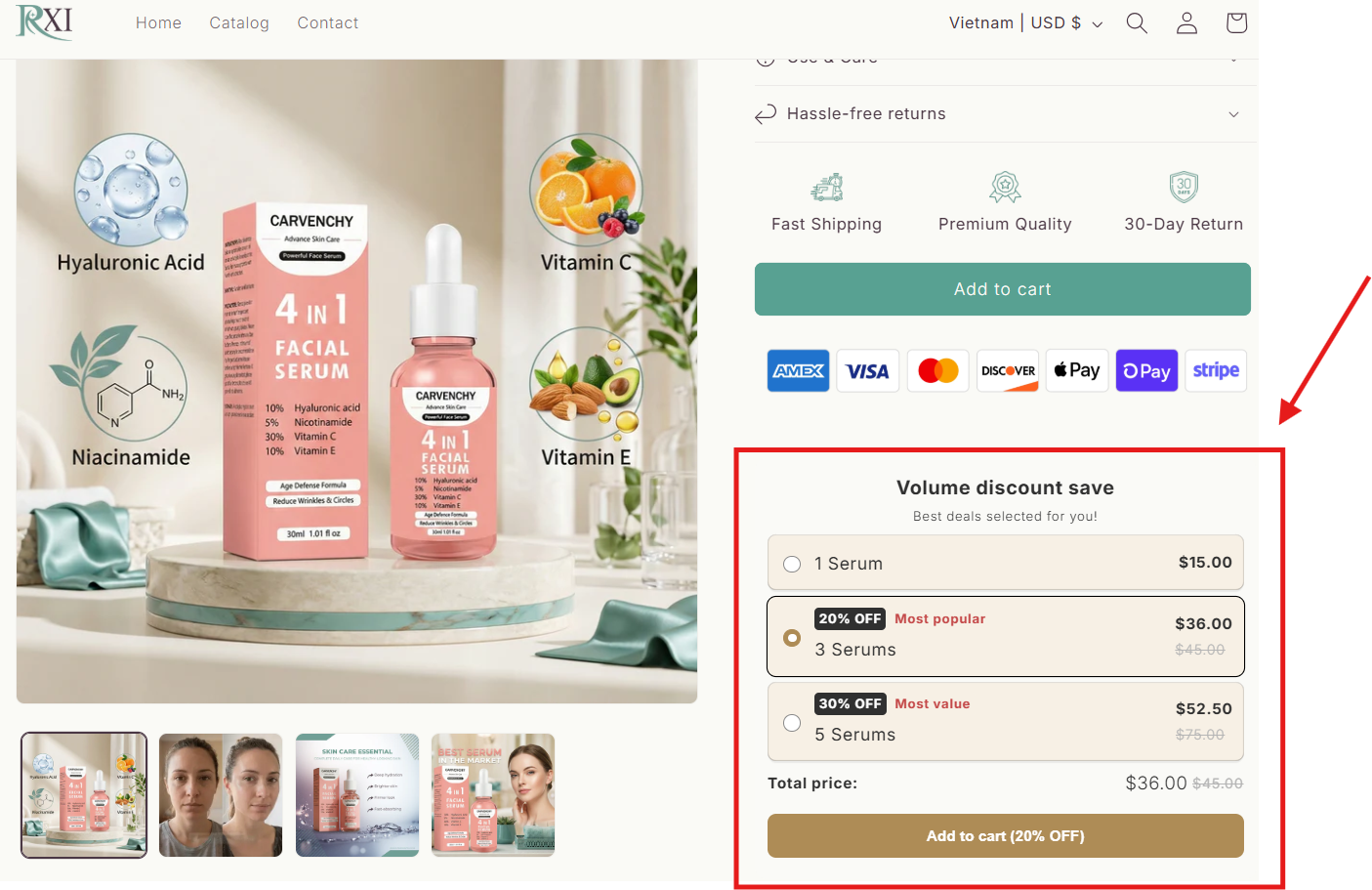
In the anti-aging niche, using a single bottle of serum rarely comes to quick results; it requires a long-term commitment. Thats why RadiantXI suggests a “Volume Discount Save” offer within the product page with discounts from 20 to 30%. This is deep enough to stop a customer from scrolling but still maintains a healthy profit margin.
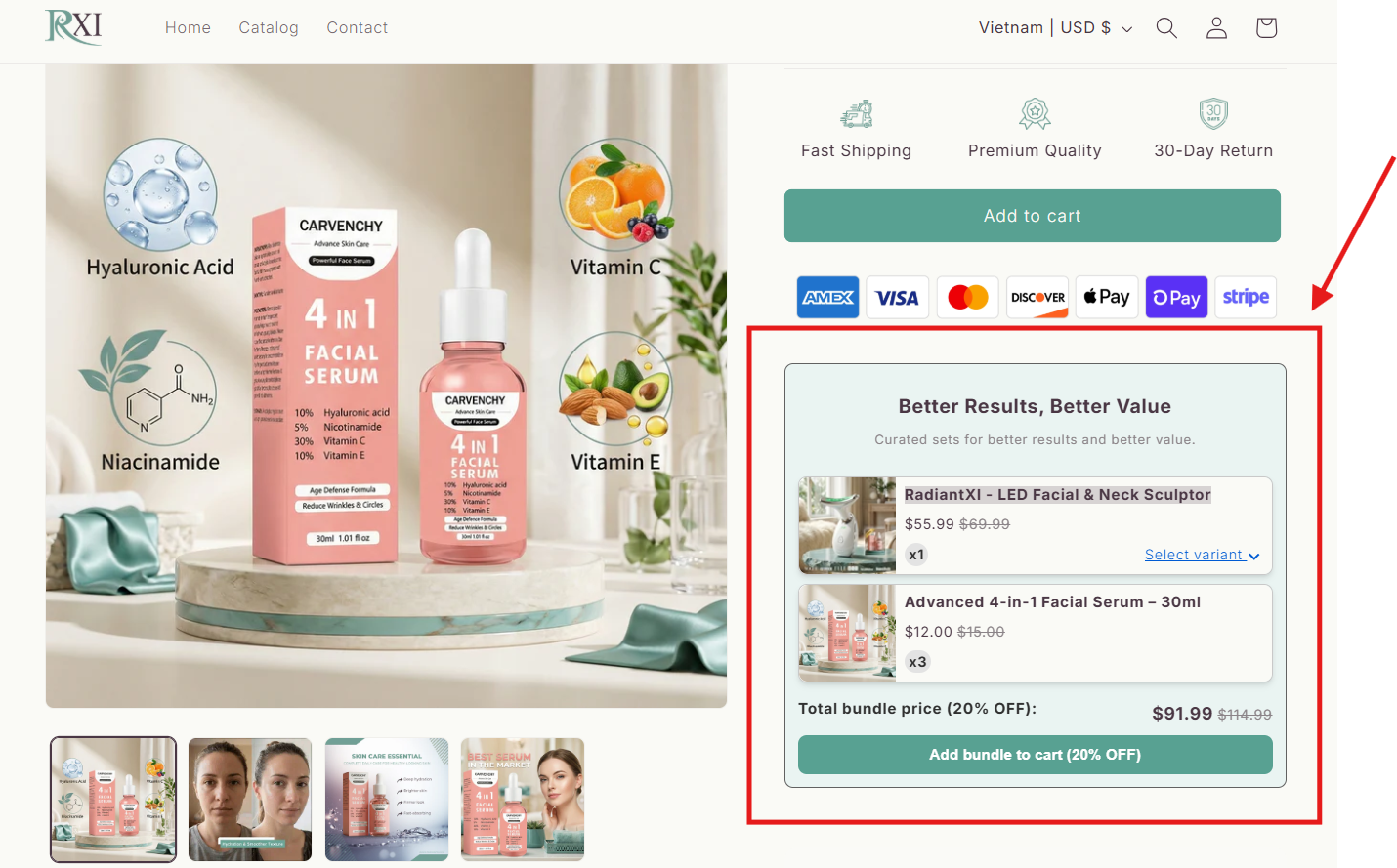
To maximize the value of every visit, RadiantXI also features the “Better Results, Better Value” bundle, encouraging shoppers to upgrade from a single serum to a complete rejuvenation set.
By strategically pairing three serums with an LED Facial & Neck Sculptor, they provide a premium alternative that supports their volume discounts rather than competing with them. This approach offers customers more ways to shop while significantly increasing AOV.
Frequently bought together offer is a strategic suggestion of related or complementary products that enhance the value of the primary item in the cart. While this promotion approach is applicable across all industries, it works exceptionally well for categories where one item “needs” another to function better, look better, or complete a routine, such as Electronics & Accessories, Beauty & Cosmetics, or Home Goods.
4.1. When To Use
Unlike volume discounts, which work best during high-impact sales events, this typical upsell offer can run year-round. There’s no need to wait for a seasonal push. As long as you’ve set a sustainable discount and have the stock to support it, upselling quietly boosts your AOV in the background, month after month.
4.2. How To Set Up
An effective frequently bought together offer is a fine balance between offering an attractive deal and maintaining a healthy bottom line. Since you have already paid the marketing cost to get the customer to the cart, the upsell is your chance to maximize profit.
Follow these 3 steps to unlock its full potential:
Define the upsell condition
Any upsell widget should never appear randomly. Instead, use clear logic to ensure the offer shows up at the right moment when customers are most likely to accept it. You can choose one of the following methods:
Product-based: Use your best-selling or highest-traffic products as the trigger. When a customer adds one of these products to the cart, the upsell appears naturally, without disrupting the shopping flow.
Cart condition: Trigger the upsell based on cart quantity or cart value. Make sure the threshold is achievable for customers while still high enough to cover operational and fulfillment costs.
Customer order history: For a more personalized experience, show upsell offers based on what the customer has purchased before. This approach often leads to higher acceptance rates.
Choose The Right Upsell Product
Relevance is everything. The most effective upsell products are those that naturally complement the main purchase and feel useful rather than forced. A helpful tip is to follow the 25% rule: the price of an upsell shouldn’t be more than 25% more than the product they are already looking at or buying.
When add‑ons are significantly more expensive than the main product, customers often take longer to decide, which may result in purchase delays or buying the main product only.
Set A Margin-Safe Discount
Your upsell discount should be compelling enough to trigger an impulse purchase, but still protect your margins.
For low-margin industries such as electronics or furniture: keeping discounts conservative at 10–15%.
For higher-margin categories such as fashion or beauty: offering 20–30% off on the upsell item is often sustainable and more effective.
4.3. How To Deliver
Getting the offer right is only half the battle. Where and how you present it determines whether customers actually convert.
Key Message
Lead with the outcome, not only the discount. Instead of “Buy these two together for 10% OFF,” try “Complete your routine for maximum rejuvenation and save 10%.” The first sounds like a sales pitch. The second sounds like helpful advice.
Channel Strategy
Some customers need a second chance. Send a follow-up email 24 hours after purchase, suggesting the complementary item they skipped. Sweeten it with a limited-time “completion discount” to create urgency.
On-Site Display
Don’t scatter your offers randomly. Match each placement to the customer’s mindset at that moment:
Product page: This is the discovery phase. Add a “Frequently Bought Together” widget right below the Add to Cart button. Customers are still exploring—show them what pairs naturally.
Cart drawer: This is your most powerful touchpoint. When a customer adds an item, highlight the “missing piece” to complete their set. They’ve already committed to buying—now help them buy smarter.
Checkout page: On the checkout page, where purchase intent peaks, offering a small, low-cost add-on can elevate the order total just enough to secure free shipping.
4.4. Use Case
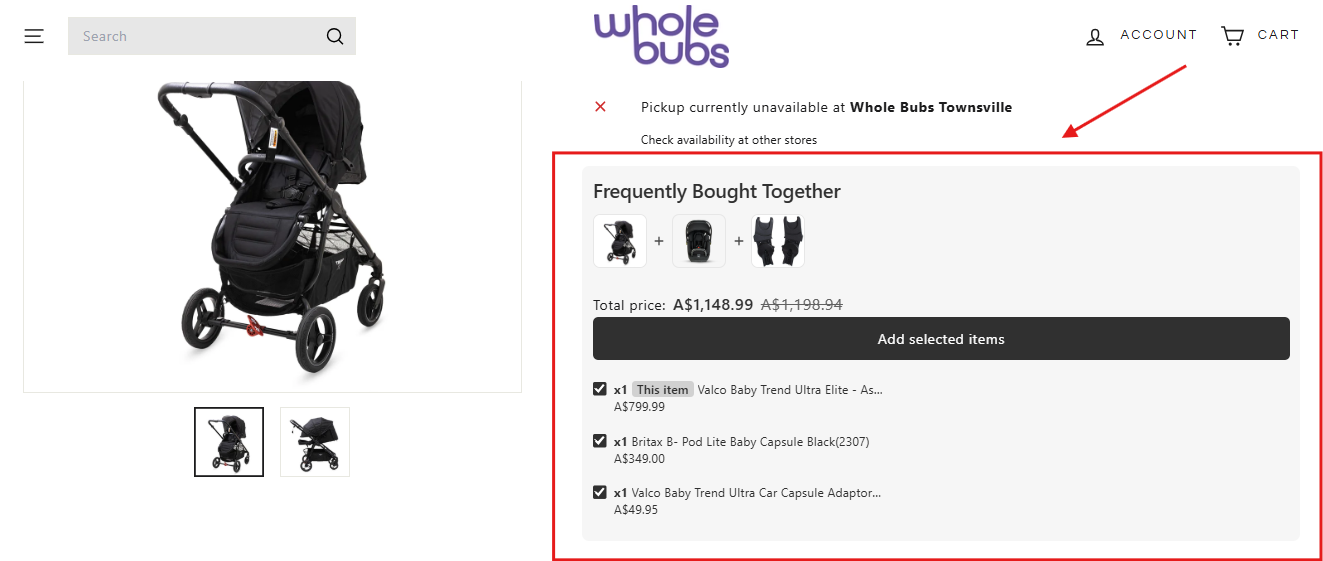
Here is how Wholebubs, an Australian premium baby retailer, put this into practice. They anchored their frequently bought together strategy on their high-traffic stroller by pairing it with a car capsule and car capsule adaptors.
This was a solution to a real pain point: moving a sleeping baby without waking them. Furthermore, with a 5% discount, they positioned the offer as a necessary lifestyle upgrade rather than an extra cost, effectively turning a single-product purchase into a high-value transaction.
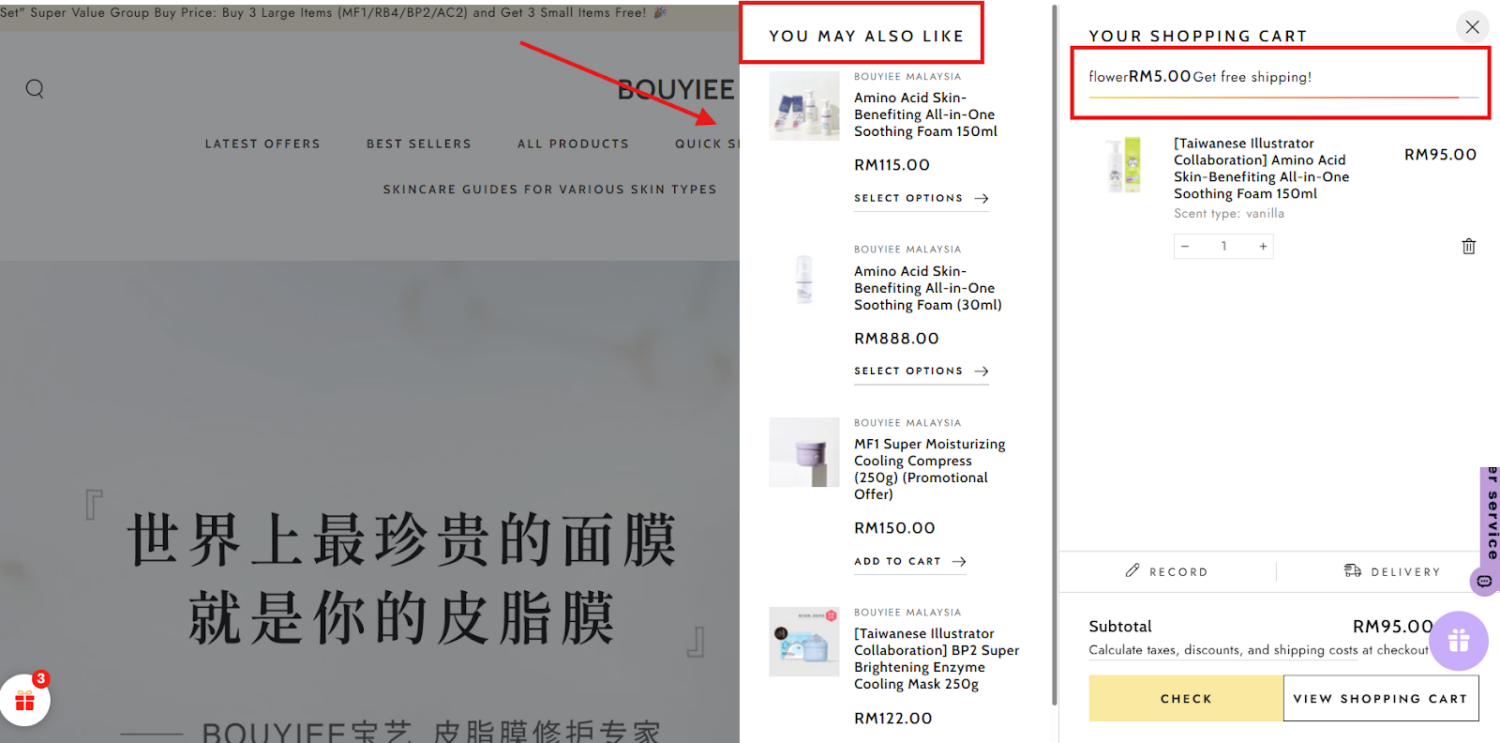
Another great example of an upsell strategy comes from Bouyiee, a Malaysian skincare brand, . They don’t just show upsell offers in the cart drawer – they pair it with a progress bar that shows how close customers are to free shipping.
So when a shopper adds a product, they instantly see the notice “Add [value_remain] for free shipping” alongside matching suggestions. It turns the cart drawer into the hardest-working touchpoint in the entire buying journey.
5. Key Takeaways: Turning Every Offer into Profitable Growth
After breaking down these four offer types, one pattern stands out: The best promotions don’t just attract clicks. They’re carefully designed journeys that reward customers at the right moments.
Here’s how to remember each strategy and when to use it:
1️⃣ Free Gift with Spending
Best for: Seasonal campaigns, gifting holidays, and brand anniversaries
Key tactic: Set your threshold 15-20% above current AOV
Quick win: Make your gift exclusive and auto-add it to the cart to reduce friction
2️⃣ Product Bundles
Best for: Categories where items naturally go together
Key tactic: Group products that complete a routine or solve a problem together
Quick win: Use a “Build Your Own Bundle” option to let customers personalize their experience
3️⃣ Volume Discounts
Best for: High-consumption products like wellness, food & beverage, or personal care
Key tactic: Map tiers to three buyer types: curious shoppers, budget-conscious buyers, and loyal fans
Quick win: Cap your discount percentage to protect margins on large orders
4️⃣ Frequently Bought Together
Best for: Electronics, beauty, and any category where one item needs another to work better
Key tactic: Follow the 25% rule: your upsell should cost no more than 25% of the main product
Quick win: Place your upsell widget in the cart drawer for the highest visibility
6. Conclusion
Running promotions isn’t hard. Running profitable promotions that actually grow your business, that’s the real challenge. The four offer types above aren’t just tactics. They’re strategic tools, each designed for a specific goal. But picking the right offer type is only half the battle. The real solution is making customers say yes without sacrificing the profits that keep your business growing.
We see this versatility in action with real-world examples from brands like Klower Pandor, RC Outfitters, RadiantXI, and Wholebubs. Across categories from Fragrance and Beauty to Outdoor Gear and Baby Products, brands effectively aligned offer types with their unique customer tastes and margin structures, achieving long-term outcomes.
Ready to put these strategies to work? Start with our free plan to test what works for your store. When you’re ready to scale, unlock advanced features with a 7-day free trial.