Allan Vu is a Digital Marketing expert and the driving force behind BOGOS’s blog content. With a deep understanding of eCommerce and Shopify promotions, he is passionate about helping merchants unlock the full potential of their stores.
At BOGOS, Allan creates valuable, practical content focused on strategies like Free Gifts, Buy X Get Y, product bundles, and upsell offers to empower Shopify sellers to grow their businesses effectively.
Known for his clear, insightful writing, Allan is dedicated to delivering actionable advice that makes a real difference for BOGOS’s readers.
Every merchant knows the stress of dead stock taking up valuable warehouse space. Your instinct might be to slash prices just to get rid of it, but deep discounting can train your customers to wait for sales. A strategic Shopify Buy X Get Y offer lets you move slow-moving inventory while maintaining the perceived value of your core products.
We are going to explore the mechanics behind successful campaigns, from selecting the perfect “X” and “Y” products to using margin math for safe discount ceilings, topped off with real-world examples of brands scaling their revenue. Let’s check them out!
1. Understanding the real objective of buy X get Y campaigns
A Buy X Get Y promotion works by requiring a customer to meet a specific purchasing condition: buying product X or reaching a spending threshold, to unlock a reward on product Y.
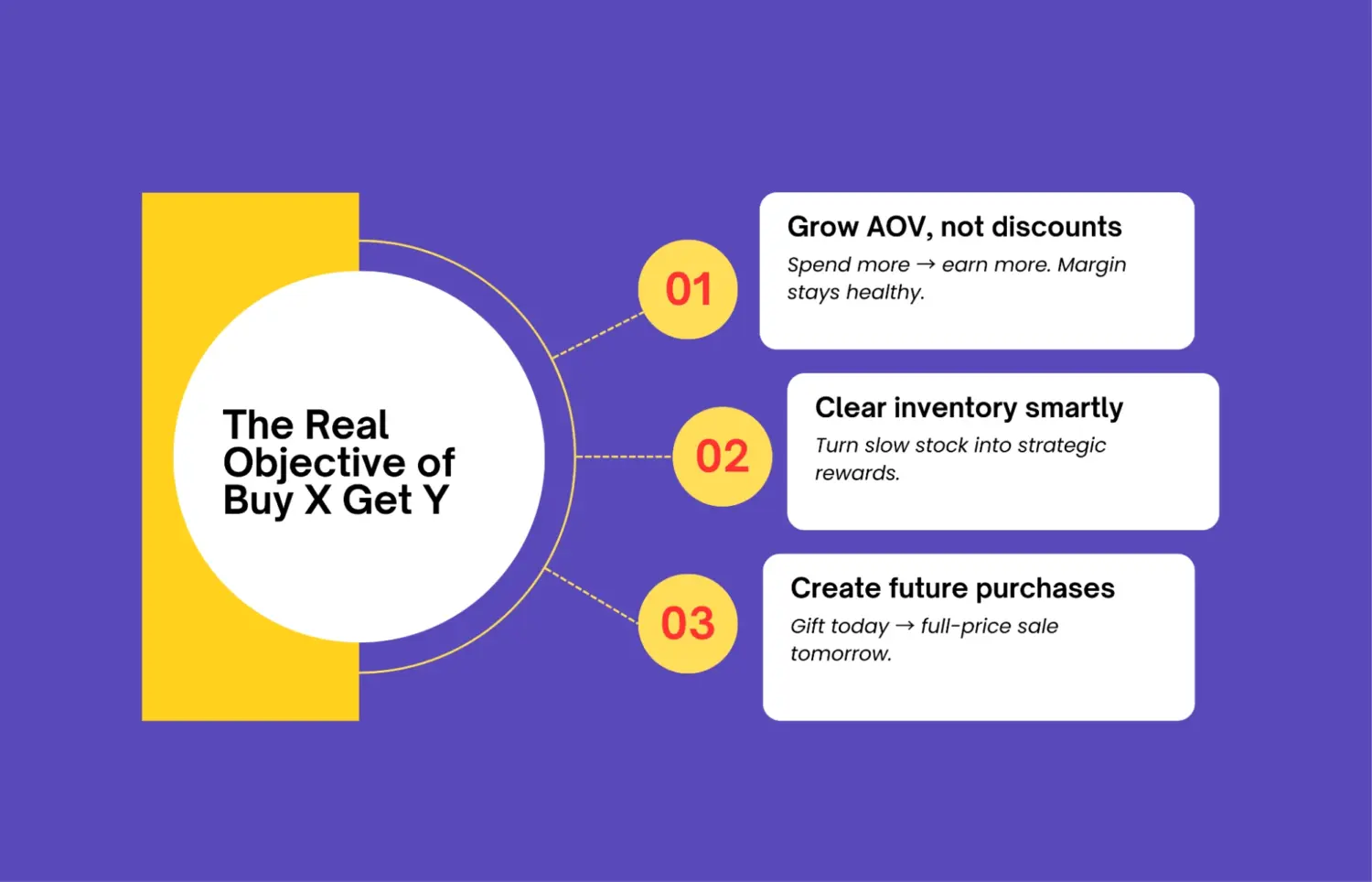
Unlike a flat percentage discount that cuts into your margin on every single item, this structure only costs you the wholesale price of the gifted item while securing the full sale value of X. That difference is exactly why the model exists beyond simply “boosting sales.” The real objectives merchants are chasing are:
Increase AOV without discounting your core catalog
Move slow inventory by pairing it as a reward with your best-sellers
Drive product discovery by gifting trial sizes that bring customers back for a full-price purchase later
To know whether a campaign is actually working, track these four numbers closely:
AOV: Did the promotion push customers to spend more than their usual habits?
Incremental Revenue: How much additional revenue came specifically because of this offer, compared to your baseline?
Spend Ratio: Is the gross profit from the campaign worth what you gave away?
Conversion Rate: Did the “free gift” trigger stronger purchase intent than a standard coupon would?
The strategy falls apart, however, when merchants skip the math. Gifting a heavy product without accounting for the added shipping cost can wipe out the profit from the extra sale. Overly complicated eligibility rules frustrate shoppers and drive cart abandonment. And using your highest-margin best-seller as the free reward cannibalizes the full-price sales you would have made anyway.
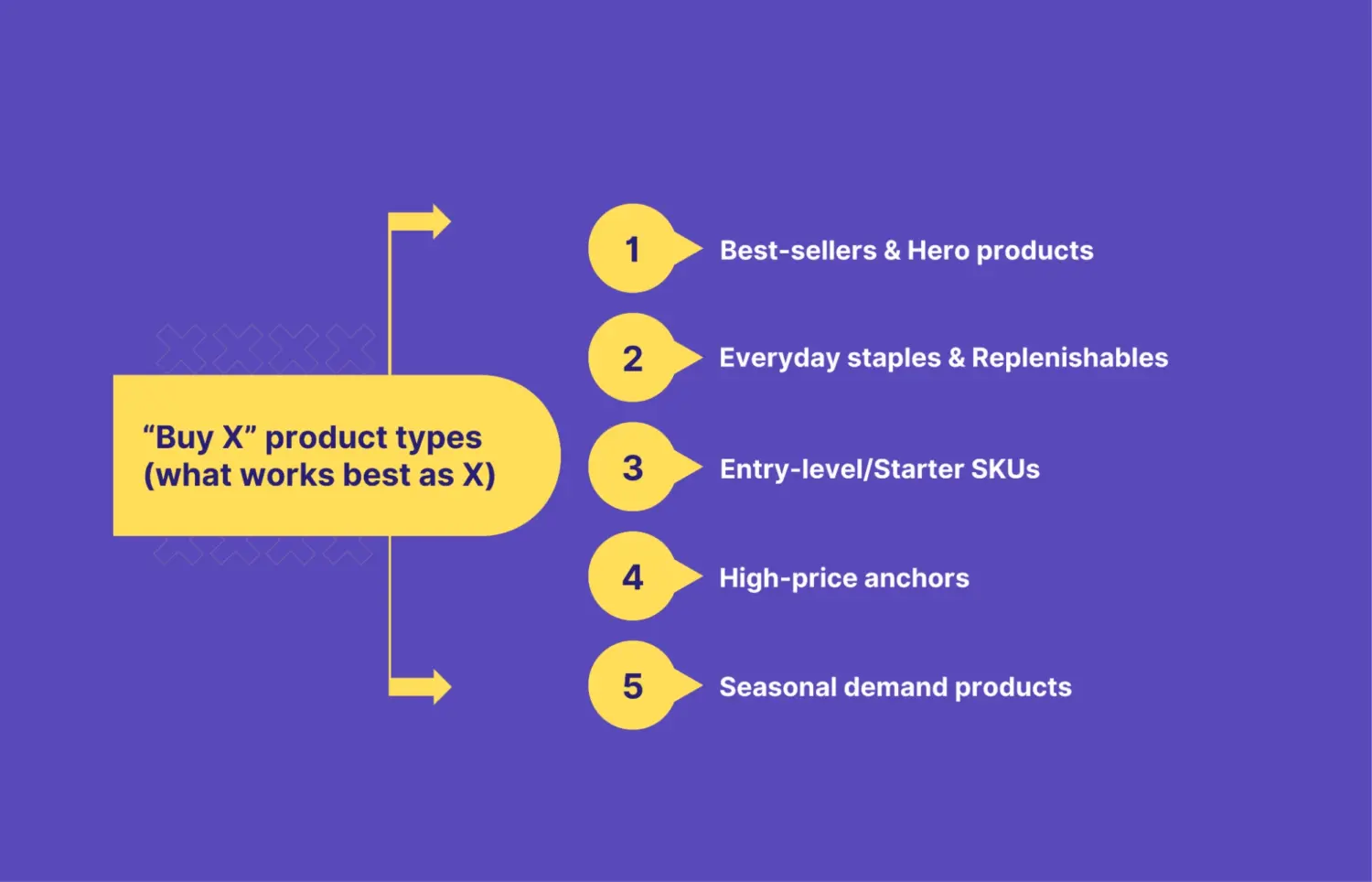
These products already have proven demand and organic traffic, meaning the customer’s intent to buy exists before they even see your promotion. Attaching a reward to them does not require extra selling; it simply removes the last hesitation before checkout. A best-seller used as “X” will always outperform a niche or hard-to-find product because the audience is already there.
2.2 Everyday staples & Replenishables
Products that customers regularly consume and repeatedly purchase, such as skincare, supplements, or cleaning supplies, are natural candidates for volume triggers like “Buy 3, Get Y.” The logic is simple: since the customer will eventually need to restock anyway, buying in bulk today feels rational rather than impulsive. This category is particularly strong for pulling future revenue into the current transaction.
2.3 Entry-level/Starter SKUs
A low-priced, accessible product makes the “X” condition feel easy to meet, which lowers the barrier for new customers to enter your funnel. The real goal here is not high margins on the first purchase. It is getting your product into more hands for the first time, with the reward serving as an extra incentive.
2.4 High-price anchors
Premium products are vulnerable to discount damage. Once you publicly mark down a $500 item, customers start to question its original value. Using a high-ticket product as “X” protects the retail price in full, while the attached gift creates perceived value without affecting the original product’s positioning. The customer feels rewarded; the brand stays premium.
2.5 Seasonal demand products
Items with a natural seasonal spike, like winter gear, sunscreen, or holiday decorations, already have built-in market intent at a specific time of year. When you attach a reward to these during their peak period, you convert traffic that would have landed on your store into larger, more profitable orders.
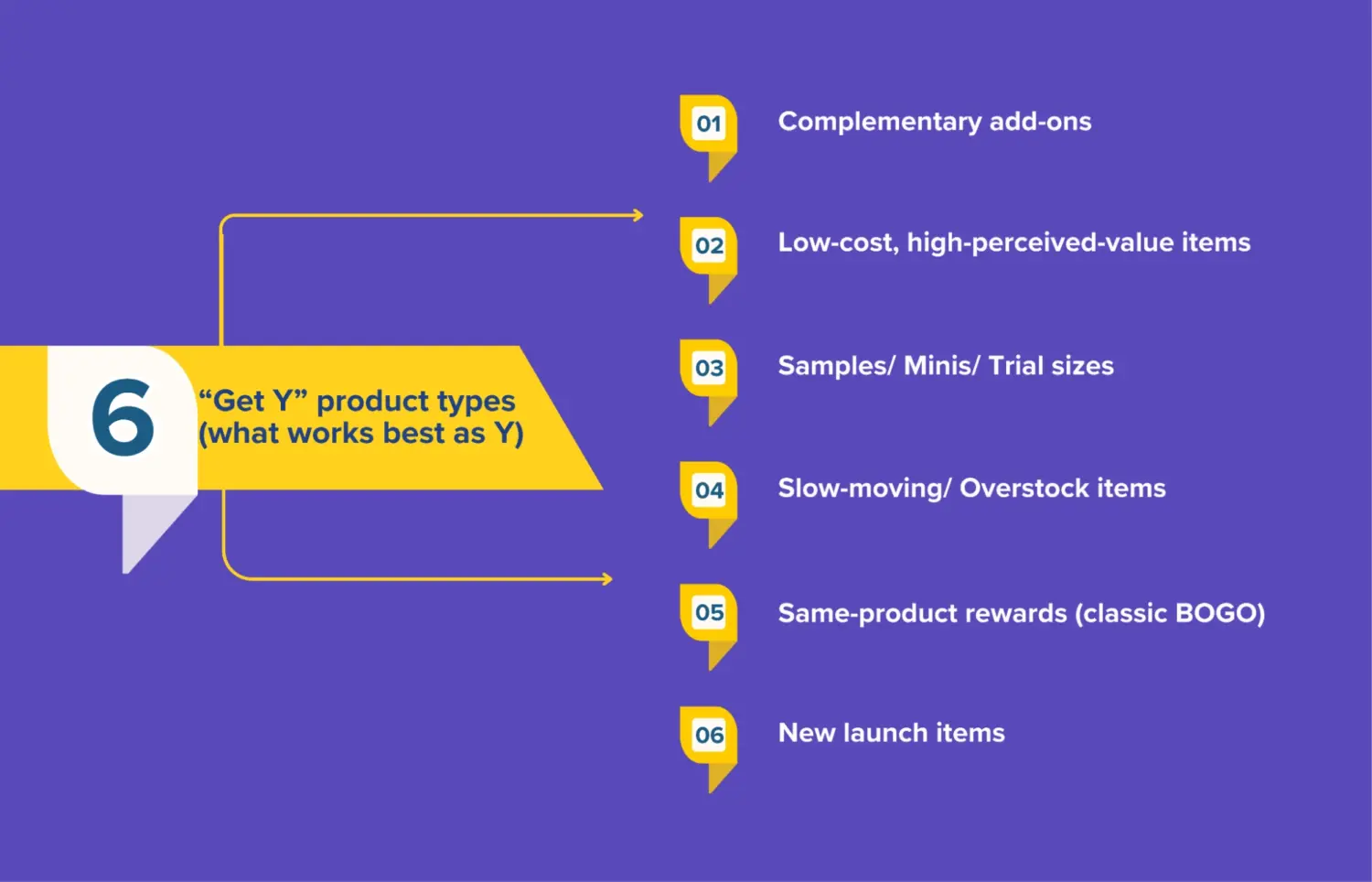
3. “Get Y” product types (what works best as Y)
3.1 Complementary add-ons
The most effective rewards are items that naturally enhance the main product’s use. This makes the offer feel logical and highly useful rather than like a random freebie. If a customer buys a camera, throwing in a free SD card or carrying case immediately solves a future problem for them. The perceived value is high because the customer knows they would have eventually had to buy that accessory.
3.2 Low-cost, high-perceived-value items
To protect your bottom line, look for items where the gap between your cost of goods sold (COGS) and the retail price is massive. Small accessories, branded apparel, or digital products (like an exclusive workout guide paired with fitness gear) cost you very little to produce but hold significant retail value in the customer’s eyes. The customer feels like they are getting a $30 gift, even if it only costs you $3 to source.
3.3 Samples/ Minis/ Trial sizes
Using travel sizes or miniature versions of your products as the “Y” reward is a brilliant customer acquisition tool. It allows shoppers to test out a new product line completely risk-free. Because the production cost of a mini is low, you can afford to give it away, knowing that a percentage of those customers will return to buy the full-size, full-margin version once they realize they like it.
3.4 Slow-moving/ Overstock items
Dead inventory eats up capital and warehouse space. Instead of running a brand-damaging 70% off clearance sale, you can reposition that slow-moving stock as a premium “Free Gift”. Paired with a popular “X” item, the overstock product regains its perceived value. Customers view it as a generous reward, and you quietly clear out your warehouse without cheapening your brand image.
3.5 Same-product rewards (classic BOGO)
Offering the exact same product as the reward (“Buy 1, Get 1 Free”) works incredibly well for items that are consumed quickly, like vitamins or coffee beans. It guarantees volume movement. However, use this cautiously: a true BOGO is mathematically identical to a 50% off discount. You should only use this model if your margins on that specific product are high enough to absorb a half-price hit.
3.6 New launch items
When introducing a new product to the market, the biggest hurdle is getting the first wave of people to try it and leave reviews. By offering the new item as the “Y” reward alongside a proven best-seller, you force immediate distribution. Customers get to experience the new product without financial risk, generating rapid feedback and word-of-mouth momentum for your launch.
4. How to set the right discount value to maximize performance?
Setting a discount value without doing the math first is one of the most common ways merchants end up running unprofitable promotions. Below are the 3 core strategies for pricing your Buy X Get Y offers safely and effectively.
4.1 Full free vs. percentage discount
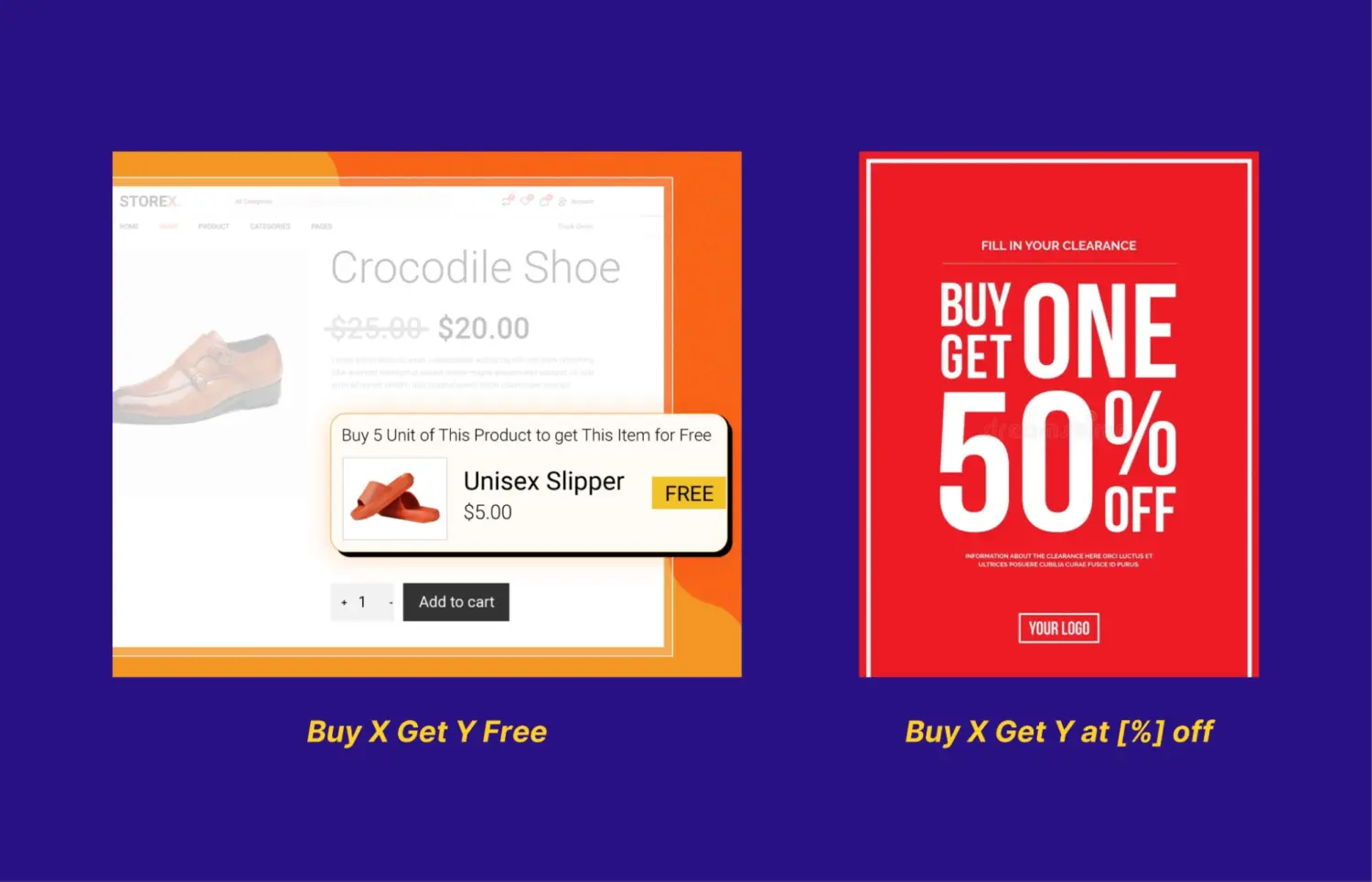
The word “free” carries disproportionate psychological weight compared to any percentage figure. Customers respond to “Get Y Free” far more emotionally than “Get 50% Off Y,” even when the financial value is identical. This makes “Get Y Free” your strongest closing tool, but only when the conditions are right.
Get Y Free works best when your “Y” product has a low cost of goods but a high retail perceived value, such as a small accessory or a branded sample. It also works well when you need to move overstock quickly, since you are effectively turning an inventory problem into a marketing asset. The critical rule is that the COGS of Y should never exceed the additional gross profit you gain from the “X” sale.
Get Y at [%] off is the safer choice when Y has a retail value comparable to or higher than X’s, or when your margins are too thin to absorb a full giveaway. You can combine this with higher-volume offers, such as “Buy 3, Get Y at 50% Off,” to maximize AOV while keeping the total discount cost manageable. The customer still feels rewarded. Your margin stays intact.
4.2 Using margin math to find your safe discount ceiling
Never set your discount value based on gut feeling. The actual profit equation for any Buy X Get Y order is:
Profit = Revenue from X — COGS of X — COGS of Y — Shipping and Packaging Costs
Before launching any campaign, calculate your current gross margin on product X. That margin percentage tells you the maximum amount you can afford to spend on the Y reward before the order breaks even.
For example, you sell a premium coffee machine (Product X) for $200. The cost of goods sold (COGS) for the machine is $100, leaving you with $100 in gross profit. You decide to run a “Buy X, Get Y Free” promotion, offering a premium bag of coffee beans (Product Y) as the gift. The retail value of the beans is $30, but your COGS for them is only $10.
If we plug this into the formula (assuming shipping and packaging remain steady at $15 for this example):
Profit = $200 (Revenue) — $100 (COGS of X) — $10 (COGS of Y) — $15 (Shipping/Packaging) = $75.
In this scenario, your profit on the bundle is $75. By using the wholesale cost of the beans rather than a $30 flat discount on the machine, you protect your margin while still giving the customer a high-value $30 reward.
One cost merchants routinely forget is the shipping trap. Adding product Y to a package often increases its weight and box size, which can push the order into a higher shipping tier. That incremental freight cost must be factored into your discount ceiling calculation, as shown in the formula. Otherwise, what looks profitable on paper can quietly eat your margins during fulfillment.
4.3 Using tiered discounts to push basket size
Instead of a single fixed offer, a tiered structure creates a ladder of progressive incentives that encourage customers to buy more than they originally planned. A simple example looks like this:
Buy 1 → Get Y at 10% Off
Buy 2 → Get Y at 25% Off
Buy 3 → Get Y Free
Each tier makes the next one feel achievable, and customers who intended to buy just one unit often end up buying two or three simply to reach the better reward. This is one of the most effective tactics for increasing basket size without discounting your entire catalog.
💡 Implementation note: The tiered “Buy X, Get Y” logic is where basic Shopify discount rules tend to break down. Overlapping conditions, incorrect gift quantities, and rule conflicts are common when merchants try to build multi-tier offers natively. To overcome this problem, you can utilize a third-party “Buy X, Get Y” app. This guide includes our review of the 6 best Shopify “Buy X, Get Y” appsthat Shopify merchants should try.
5. Common mistakes that kill performance
Mistakes
Why it hurts
Practical solution
Discounting high-cost, low-margin products
Giving away expensive items turns a high-volume promotion into a net financial loss.
– Only gift items where the cost is below 20–30% of the profit from product X.- Prioritize branded samples, small accessories, or digital add-ons.
Cannibalizing full-price sales
Discounting items customers were already going to buy trains them to wait for the next sale.
– Gate the offer behind a customer tag (e.g., “first order only”).- Rotate the reward product regularly so it does not become the expected “deal item.”
Not setting usage limits
A viral promotion without caps can generate a wave of redemptions that your margins cannot absorb.
– Set a hard cap on total redemptions before the campaign goes live.- Add a limit of one use per customer to block reseller abuse.
Ignoring shipping cost impact
Adding a physical reward increases package weight and dimensions, often bumping the order into a pricier shipping tier.
– Weigh a test package containing both X and Y and check it against your carrier’s rate table.- If the reward spikes shipping costs, switch to a lighter physical alternative or a digital gift.
Overcomplicating promotion rules
Multi-condition eligibility rules and manual promo codes create friction that leads to cart abandonment.
– Keep the offer condition simple enough to write in a single sentence.- Use an app that auto-applies the reward the moment the cart qualifies, removing any manual steps for the shopper.
6. Case studies: How brands win with Buy X Get Y
6.1 Optimum Performance — Tiered buy X get Y to drive 8X growth
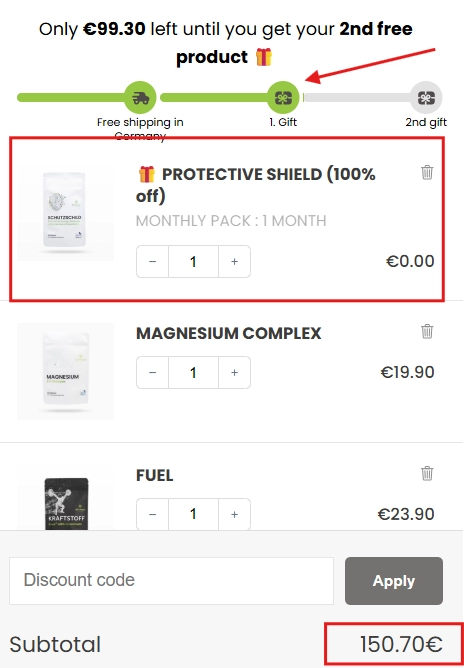
Optimum Performance used the BOGOS app to build a tiered Spend X Get Y system based on cart value. Customers unlocked free gifts when they reached specific thresholds, such as €150 and €250, and the gifts were full-size supplements instead of low-value samples. A real-time progress bar in the cart showed how much more shoppers needed to spend, and once they qualified, the free product was automatically added at 100 percent off.
Clear lift in average order value as customers aimed to reach higher gift tiers
Strong perceived value without relying on heavy percentage discounts
6.2 Klower Pandor — Tiered spend X get Y to replace discounts
Klower Pandor set up a tiered Spend X Get Y structure in the BOGOS app, rewarding customers with different gifts at TWD 1,200, 1,800, and 2,500 or more. Instead of offering percentage discounts, they focused on meaningful fragrance-related gifts that matched their brand image. With a real-time progress bar and automatic gift addition, customers could clearly see how close they were to the next tier, which naturally motivated them to add more items to their cart.
The result:
13x revenue growth within one month
Noticeable increase in AOV as shoppers aimed for higher reward tiers
Preserved a premium positioning while still driving a strong sales performance
6.3 PTC Auto — Volume buy X get Y to drive repeat purchases
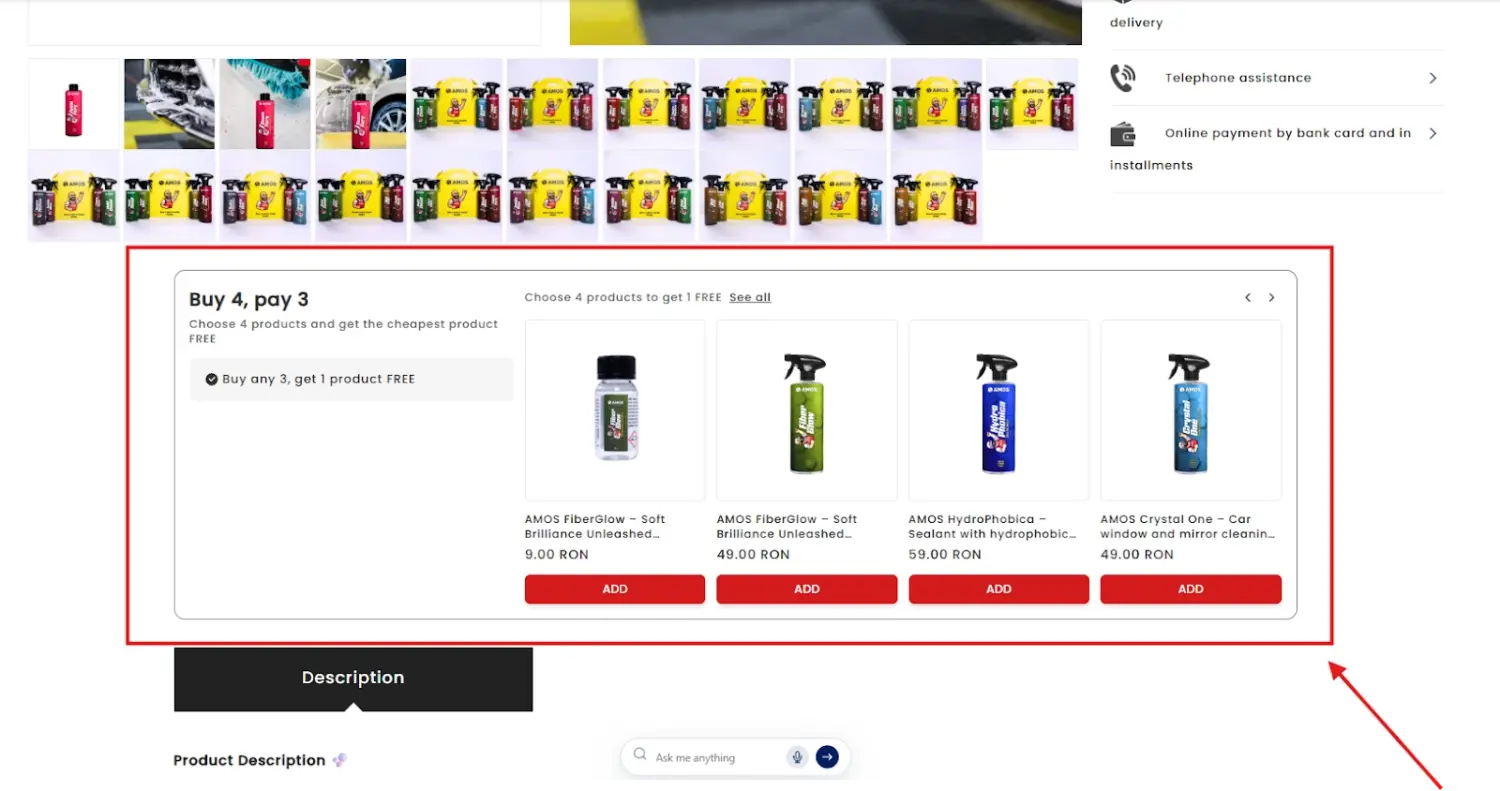
PTC Auto used the BOGOS app to introduce a Buy 4, Pay 3 offer (or Buy 3, Get 1 free), where the lowest-priced item in the cart was free, focusing on car care consumables that customers often replace. They also paired products, such as offering a free detergent with the purchase of a microfiber towel. By doing this, they encouraged customers to try products that run out faster rather than rely solely on durable accessories that may not be repurchased for years.
The result:
Over $10,000 in added revenue within a little more than one month
More than 150 orders generated from the campaign
Began building repeat-buying habits around consumable products rather than depending solely on long lifecycle items
Conclusion
At the end of the day, flat percentage discounts are a race to the bottom, while Buy X Get Y is a tool for smart growth. When you choose the right reward, whether it is clearing out dead stock or gifting a high-value sample, you give customers a genuine reason to spend more. We have seen time and again that getting the product pairing right is all it takes to turn casual browsers into highly profitable buyers.
FAQs
Can Shopify natively auto-add the “Y” product to the cart?
No. By default, Shopify requires the customer to manually add both the “X” and the “Y” items to their cart before the discount applies. To automatically drop the free gift into the cart when conditions are met, you must use a third-party app.
Can I set up a “Buy 2, Get 1 Free, Buy 4, Get 2 Free” structure natively?
Yes, but it is limited. Shopify’s native discount rules allow you to set a “Maximum number of uses per order,” which lets the same offer trigger multiple times in one cart. However, for complex tiered rewards (where the gift changes at different levels), an app like BOGOS is recommended.
Does the “Y” item have to be a physical product?
No. Your “Y” reward can absolutely be a digital product, such as an exclusive workout guide, a recipe book, or a warranty. This is highly recommended because digital products have zero cost of goods sold (COGS) and no shipping impact.
Why is my Buy X Get Y discount not working at checkout on Shopify?
The most common reason is that the customer has not added the eligible “Y” product to their cart. Other common issues include conflicting active discounts, out-of-stock items, or incorrect minimum purchase requirements set in the admin panel.