Allan Vu is a Digital Marketing expert and the driving force behind BOGOS’s blog content. With a deep understanding of eCommerce and Shopify promotions, he is passionate about helping merchants unlock the full potential of their stores.
At BOGOS, Allan creates valuable, practical content focused on strategies like Free Gifts, Buy X Get Y, product bundles, and upsell offers to empower Shopify sellers to grow their businesses effectively.
Known for his clear, insightful writing, Allan is dedicated to delivering actionable advice that makes a real difference for BOGOS’s readers.
Build-your-own bundles give customers the freedom to choose what goes in their package — rather than accepting a pre-made set, they pick from products you’ve selected and pay a bundled price. For Shopify stores with diverse catalogs or products that customers like to try in variety, it’s one of the highest-converting bundle formats available.
This guide covers how build-your-own bundles work on Shopify, two ways to set one up (with and without an app), which apps handle it best, real store examples, and when this strategy makes sense for your business.
1. What Is a Build Your Own Bundle on Shopify?
A build-your-own bundle (BYOB) is an offer where customers assemble their own package by choosing products from a set you’ve defined (whether that’s an entire collection, a hand-picked group of items, or specific variants across your catalog) and buy the whole selection at a discounted price. The merchant sets the boundaries; the customer decides what goes inside.
This stands in contrast to a fixed bundle, where every item is predetermined (e.g., “Morning Essentials Kit: face wash + serum + SPF”). With a fixed bundle, customers either buy the entire package or skip it. A BYOB offer reverses that dynamic — customers curate their own selection within the rules you’ve configured.
Common BYOB formats include:
“Pick any 4 for $49” — a flat price applied when customers select a set number of items from a collection
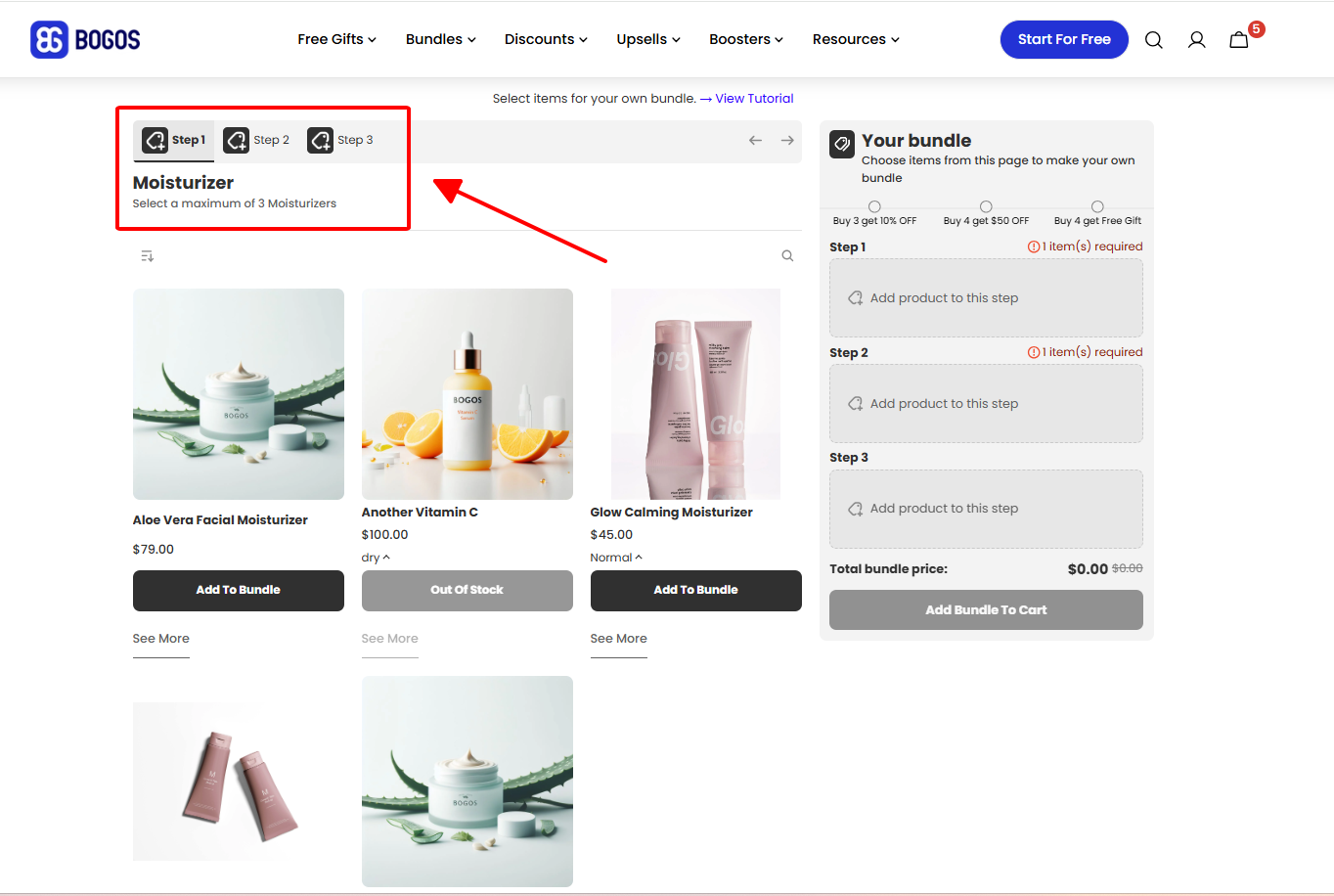
“Build your own box” — a guided, multi-step selection flow where customers choose items category by category (e.g., step 1: pick a protein bar flavor, step 2: pick a trail mix, step 3: pick a dried fruit)
“Bundle from this collection and save” — customers browse a curated product set and unlock a percentage discount once they reach the qualifying quantity
You’ll encounter different labels for this concept depending on the app or store: “bundle builder page,” “custom bundle,” “build-a-box,” or “mix and match.” The terminology overlaps, but there is a practical distinction worth noting. A mix and match bundle typically refers to the broader concept – customers pick items from a shared product pool and get a bundled price. A build your own bundle usually implies a more structured, guided experience: a dedicated bundle page with step-by-step category selection, quantity rules per step, and a visual builder interface. In other words, all build-your-own bundles are mix and match, but not all mix and match setups include the full builder page experience (some are just a collection with a discount attached).
One key limitation to know upfront: Shopify has no native BYOB functionality. The free Shopify Bundles app only supports fixed bundles and multipacks — it doesn’t include a product selection interface, quantity rules per category, or a bundle builder page. To run a genuine build-your-own experience, you’ll need a third-party app or a manual workaround with collections and automatic discounts.
👉 For a complete overview of every Shopify bundle type (fixed bundles, multipacks, volume discounts, cross-sell bundles, and more) see our Shopify Product Bundle Comprehensive Guide.
2. How Build Your Own Bundles Work
Every BYOB offer runs on three connected elements: a product pool, selection rules, and a pricing model. Getting these right determines whether the bundle works both for the customer experience and for your bottom line.
The Bundle Structure
Product pool defines what’s available for selection. This could be an entire Shopify collection (e.g., “Build Your Own Candle Set”), a curated subset of products you’ve hand-picked, or variant options across several product listings. The pool sets the boundaries of the offer — customers choose freely within it but can’t pull in items from outside.
Selection rules determine how many products the customer must (or can) pick. At its simplest, you set a fixed count: “choose exactly 5.” More sophisticated setups allow ranges (“choose between 3 and 8”), minimum thresholds (“at least 2 items”), or category-specific requirements (“include at least 1 item from each category”). These rules serve two purposes: they prevent a customer from applying the bundle discount to a single product, and they cap the total bundle size so your margins stay intact.
Many BYOB setups use a multi-step layout where the selection happens in stages — step 1: pick your main items, step 2: choose add-ons, step 3: review your selections. This guided approach works well when your products span different categories that require separate decisions (e.g., a gift box where the customer first picks chocolates, then selects a card, then chooses a wrapping style). A single-page layout — where all eligible products appear together — is faster to navigate and suits stores where everything in the pool is interchangeable, like a snack sampler with 20 flavor options.
Multi step build your own bundle
Before anything reaches the cart, customers should see a live summary showing their current selections, total item count, and the calculated price. This preview eliminates guesswork at checkout and reduces abandonment. If shoppers can’t see what they’re paying until the payment page, the friction usually costs you the sale.
How Bundle Pricing Works
The discount model affects both your margin and how compelling the offer feels to the customer. Four models dominate BYOB pricing on Shopify.
Flat price: “Choose any 5 for $55.” Customers pay a single price no matter which items they select. This model communicates value instantly and tends to convert well because the math is obvious. The downside: when your product prices vary significantly (e.g., some items cost $8 and others cost $22), customers will gravitate toward the expensive options, and your average margin per bundle drops. Works best when your products are priced within a narrow range.
Percentage off: “Build your bundle, get 20% off.” The discount adjusts to the actual value of the selected items, keeping your margin consistent regardless of what the customer picks. This is the most flexible model for stores with wide price variation. The trade-off is in perception – “20% off” requires the customer to calculate their own savings, which feels less tangible than a fixed dollar figure.
Tiered discount: “3 items = 10% off, 5 items = 15% off, 8 items = 20% off.” Each threshold unlocks a better deal, which motivates customers to add more products than they originally planned. Tiered pricing is one of the most effective AOV levers for BYOB, but it only works when the tiers are simple enough to grasp instantly. Limit it to 2–3 tiers; beyond that, decision fatigue takes over.
Graduated volume discount: “Each additional item increases your discount.” Unlike tiered pricing, where the discount jumps at fixed thresholds, a graduated model increases the discount incrementally with every new item added. For instance: 3 items = 10% off, 4 items = 13% off, 5 items = 16% off, and so on. This creates a “just one more” pull that’s effective for consumable categories, though it’s harder to display clearly on a product page.
How to choose: For catalogs where most items cost roughly the same, a flat price is the clearest offer. If your prices span a wide range, percentage-based discounts keep margins predictable. If you want to push customers toward larger bundles, tiered discounts create that incentive. Pick one model to start, track results over 2–4 weeks, and iterate.
3. How to Create a Build Your Own Bundle on Shopify
There are two ways to set up a build-your-own bundle on Shopify: without an app (using a Shopify collection paired with an automatic discount) or with a dedicated bundle builder app.
Method 1: Collection + Automatic Discount (No App)
The concept is straightforward: group the products you want customers to choose from into a Shopify collection, then configure an automatic discount that kicks in when a customer adds a qualifying number of items from that collection to their cart.
The collection creates a browsable page at a dedicated URL (e.g., /collections/build-your-own-box) where customers can view and select products. The automatic discount applies when conditions are met – for example, “add any 4 products from this collection, get 15% off automatically.”
This approach is free and has zero app dependencies. The biggest gap, however, is discoverability. There’s no bundle builder interface, no progress tracker, and no live price updates. What customers see is a regular collection page – and unless you explicitly communicate the bundle offer through the collection description, a banner, or on-page messaging, many won’t realize they’re looking at a bundle deal.
Pros
Cons
Free, no subscription required
No bundle builder UI or product picker
Works on every Shopify plan
No enforcement of minimum/maximum selections
No third-party dependencies
No live savings display as items are added
Setup takes under 10 minutes
Cannot guide customers through multi-category selections
️🏆 Best for: Stores testing whether a BYOB concept resonates with their audience before investing in an app, or single-category stores with straightforward bundle offers.
️⚠️Watch out: Shopify permits up to 25 active automatic discounts simultaneously, but only one product discount applies per line item — the largest one wins. If you’re running a store-wide “10% off” automatic discount alongside a “buy 4, get 20% off” bundle discount, a qualifying customer receives only the 20% — the two won’t stack. Factor this into your discount planning, especially during site-wide sales.
👉 This method is a low-risk way to validate BYOB demand before upgrading to an app. For a full step-by-step walkthrough – including how to create the collection and configure the automatic discount – see our guide on How to Bundle Products on Shopify without an app.
Method 2: Use a Bundle Builder App
A bundle builder app closes the experience gap by giving you a purpose-built BYOB page – complete with a product selection interface, a progress tracker (“3 of 5 selected”), live pricing that updates as items are added, and a summary screen before checkout.
Apps also open up discount structures that Shopify’s native tools can’t replicate: tiered pricing with multiple thresholds, per-step quantity rules, and conditional discounts. Most include performance analytics (completion rates, popular item picks, revenue per bundle) so you can refine the offer over time.
What we looked at when evaluating apps:
BYOB capabilities — does the app provide a dedicated bundle page with product picker, per-category min/max rules, and live price calculation?
Layout options — can you build both single-page and multi-step bundle experiences?
Discount flexibility — does the pricing engine support flat price, percentage, tiered, and graduated discount models?
Inventory handling — does the app deduct stock for each individual item when a bundle is purchased?
Cost — is there a usable free plan, and are paid tiers justified for the features offered?
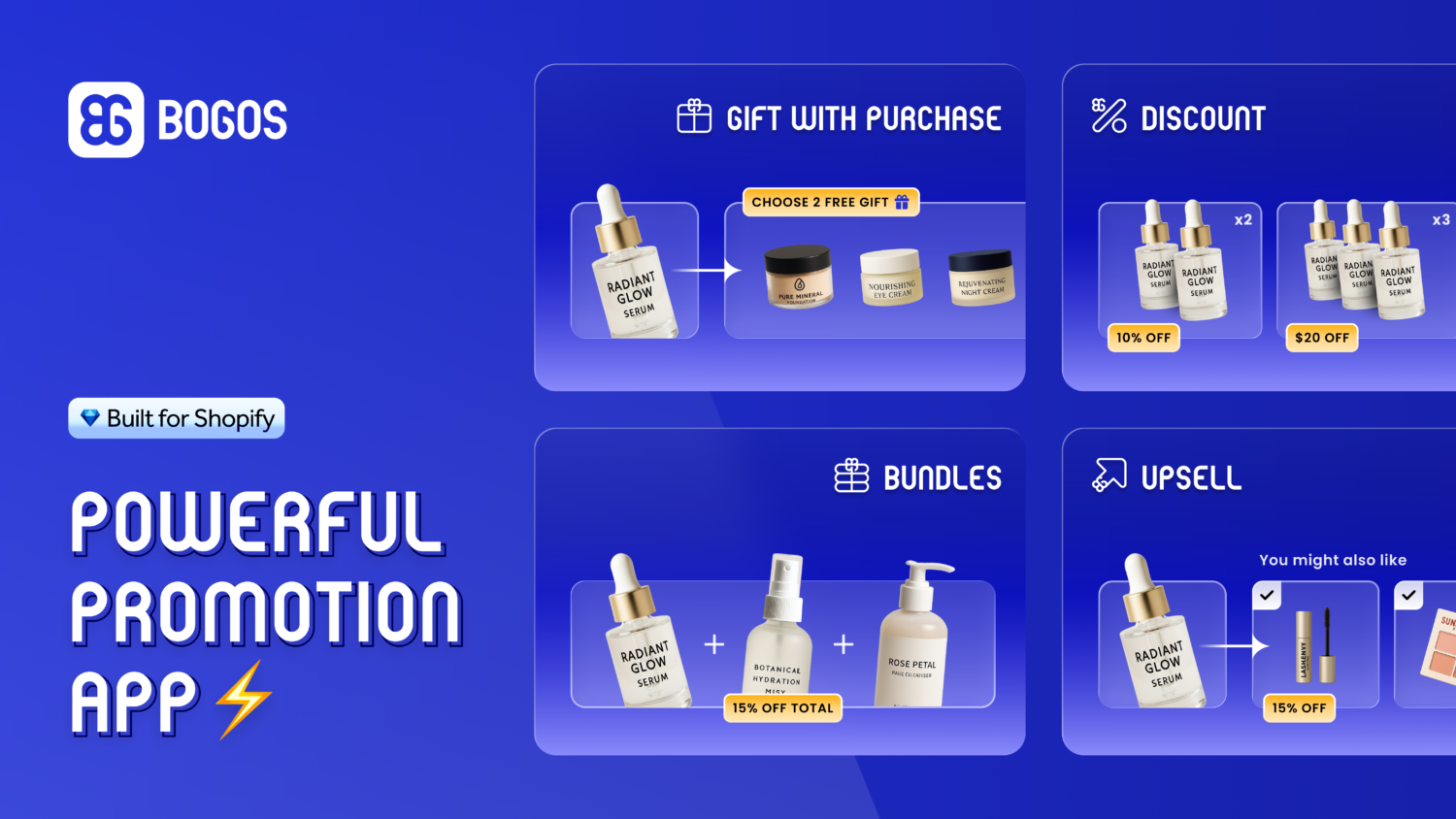
BOGOS approaches BYOB through its Bundle Page feature, supporting both single-page and multi-step layouts with a wide range of discount options (percentage, fixed amount, fixed price, free shipping or free gift). But what makes BOGOS distinct in this category is scope: it’s not a bundle-only tool. The same dashboard manages free gift with purchase offers, buy X get Y deals, tiered discounts, and upsells. Running all your promotions through one app eliminates conflicts between separate tools and keeps your discount logic centralized. The advanced targeting engine (which filters by customer tags, geo-location, purchase history, and sales channel) lets you create BYOB offers that only surface for the right audience. The bundle page widget is also well-designed – clean, modern styling that blends with most Shopify themes without needing heavy CSS overrides.
Key features:
Bundle types: fixed, mix-and-match, BYOB builder page, volume discounts — plus GWP, BOGO, and upsells
Tiered Discounts: percentage, fixed amount, fixed price, free shipping or free gift
Targeting: geo-location, customer segment/tag, order history, specific sales channels (POS, mobile, online), and magic links
Storefront tools: progress bar, today’s offers block, offer page, gift icon on product pages
Analytics: per-offer performance, AOV impact, orders generated, and revenue tracking
Placement: in-product-page widget or standalone bundle builder page — your choice
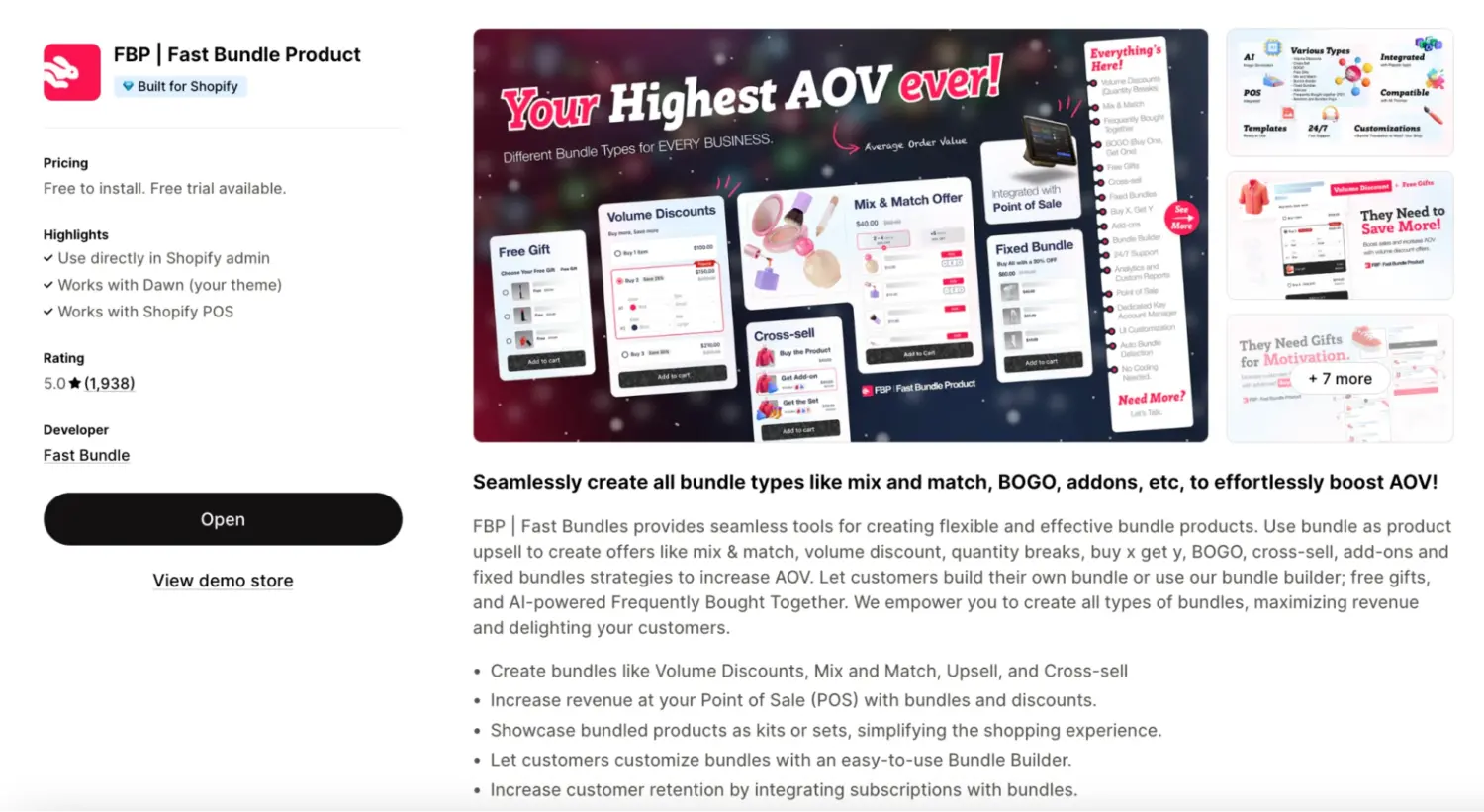
Fast Bundle is one of the top-rated bundle apps on the Shopify App Store, and for good reason — it covers virtually every bundle type available: mix and match, fixed bundles, volume discounts, BXGY, cross-sell add-ons, and AI-powered frequently bought together. Like BOGOS, it provides advanced customization for discount rules and bundle configurations. For BYOB specifically, the builder supports per-step quantity ranges, and the tiered discount engine lets you mix percentage, fixed amount, cheapest item free, and free shipping within the same tier structure. Bundles are created as standalone products, which benefits SEO. The one area where Fast Bundle trails BOGOS is widget appearance — the storefront styling feels more functional than polished, and some merchants find the visual design less refined compared to BOGOS’s cleaner aesthetic. That said, if bundling is your primary revenue strategy and you need the broadest toolkit for it, Fast Bundle is a strong pick.
Key features:
Bundle types: fixed, mix & match, BYOB, volume, BXGY, cross-sell, and AI-powered frequently bought together
Tiered discounts: mix %, fixed amount, fixed price, cheapest item free, and free shipping within the same tier
Product page integration: bundle widget embeds directly on existing product pages — no separate listing required
Best for simple mix & match and BYOB → BundleSuite.
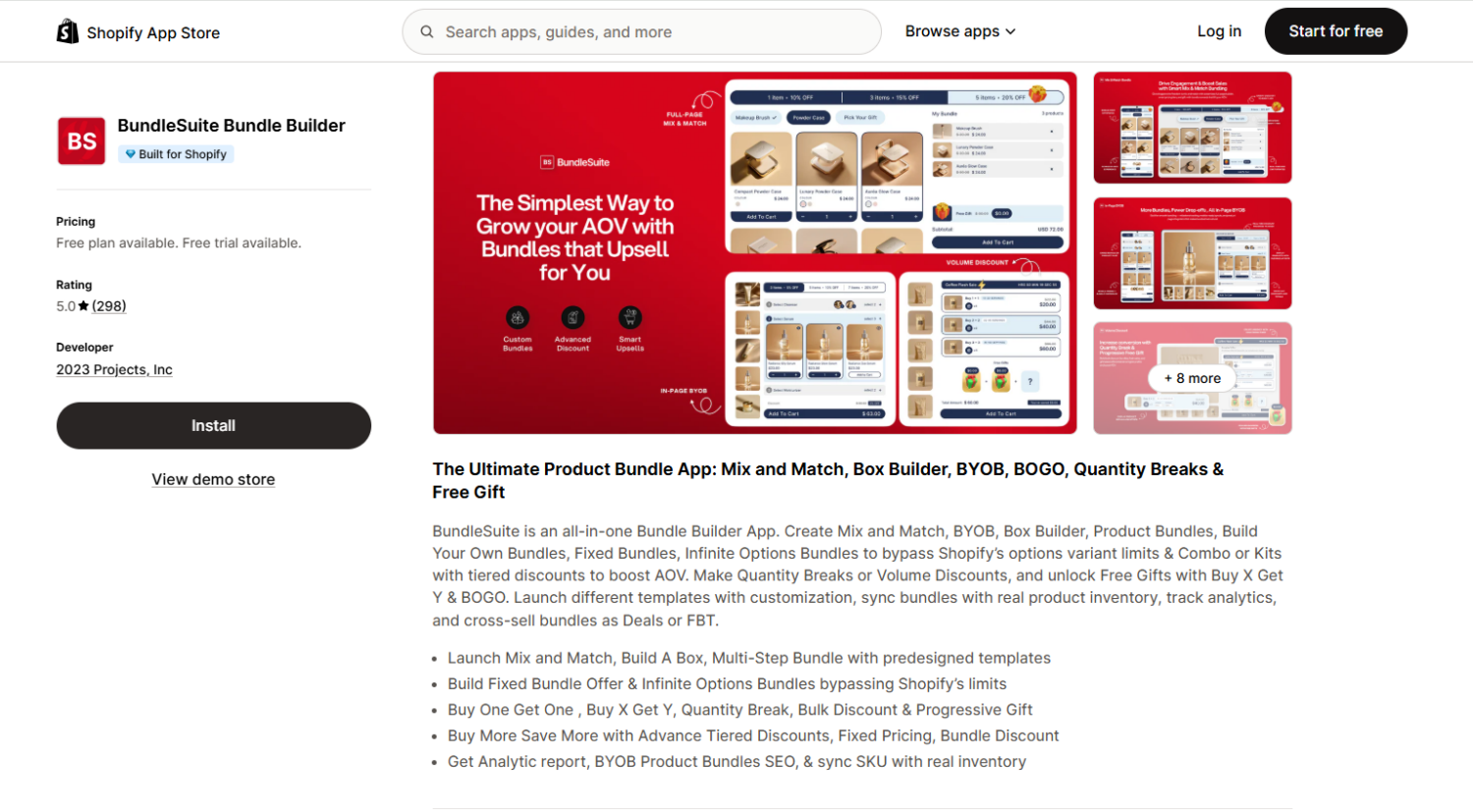
A focused option for stores that only need mix and match or BYOB functionality without the overhead of a full promotion suite. BundleSuite handles those two bundle types well — with volume discounts, per-step quantity rules, and SEO-friendly bundle pages. The setup is straightforward, and the pricing starts at $12.99/month, which sits below both BOGOS and Fast Bundle. The trade-offs: tiered discounts are less flexible (you can only apply a single discount type per tier, not mix them), there are no booster tools like progress bars or offer pages, and the app doesn’t cover other promotion types. A fair trade for stores that want a clean BYOB page without the extras.
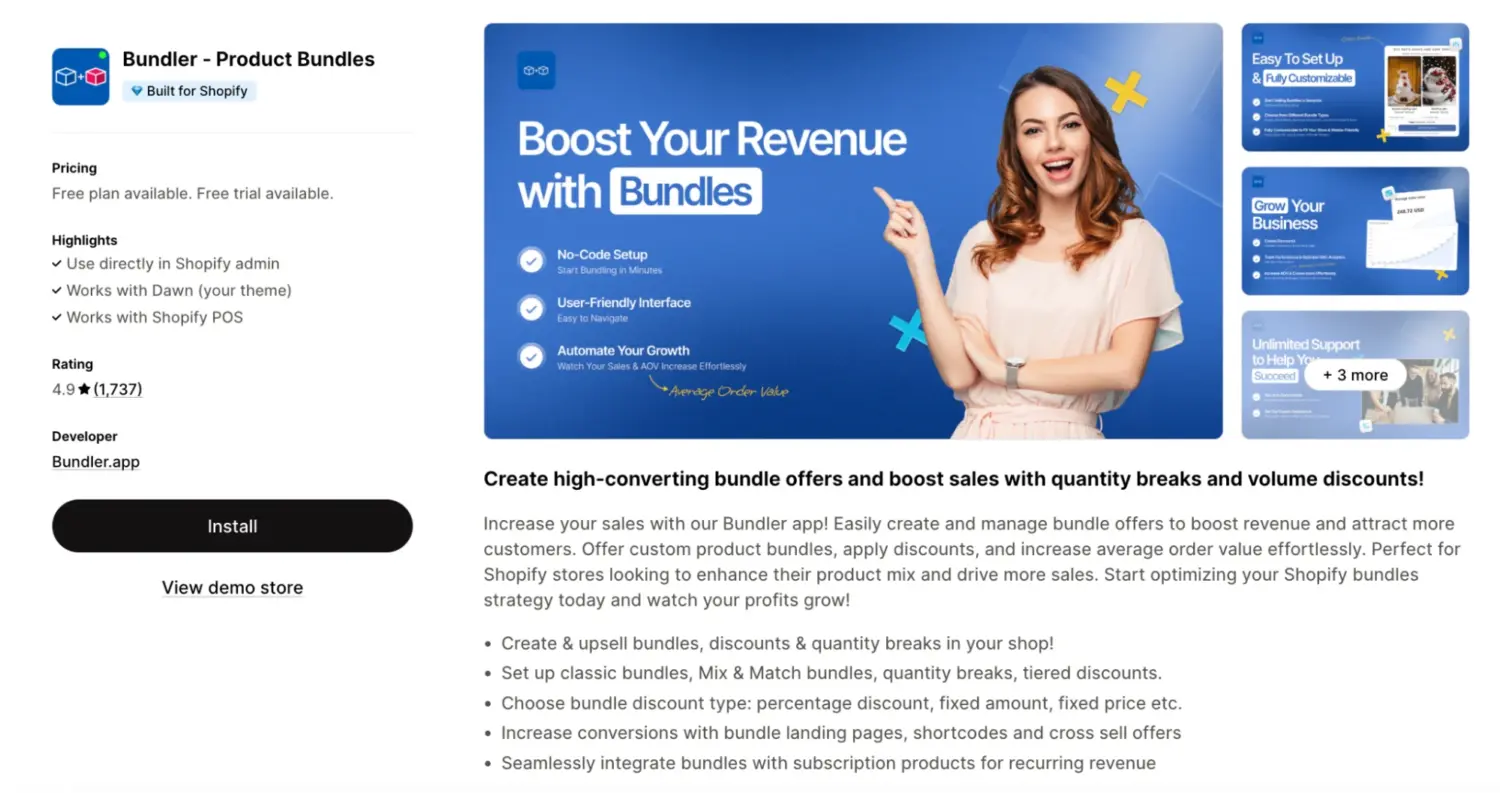
The most affordable path into bundling beyond Shopify’s native tools. Bundler covers classic fixed bundles, volume discounts, and tiered pricing — enough for stores that want basic bundle offers running without a large monthly cost. Paid plans start at just $9.99/month, and a free plan is available for simple setups. However, there are meaningful trade-offs at this price point. The widget customization is very limited — you get minimal control over how the bundle display looks on your storefront, so matching it to your brand’s aesthetic takes work. Some merchants have also noted that the interface can feel frustrating to navigate, particularly when setting up more complex discount rules. For stores on a tight budget that just need a functional bundle offer live on their site, Bundler gets the job done — but if appearance and ease of use matter, the apps above are worth the extra spend.
Key features:
Bundle types: classic fixed bundles, volume bundles, and tiered pricing
Discount options: percentage, fixed amount, and fixed price
Bundle landing pages and shortcodes for promoting offers
Subscription compatibility for recurring bundle orders
4. Which Products and Businesses Work Best With Build Your Own Bundles?
BYOB isn’t effective for every store. The strategy performs best when your product catalog offers enough variety for customers to curate something personal — and when the unit economics support a bundled discount.
Product characteristics that fit:
Consumables and variety-driven products — anything customers buy repeatedly and enjoy sampling different options: coffee, snacks, skincare, supplements, teas
Same-category items at similar price points — when individual prices cluster within a tight range, a flat bundle price works without creating margin problems on expensive picks
Products already purchased in multiples — socks, candles, greeting cards, spice jars — categories where buying more than one is the default behavior
Discovery-oriented catalogs — product lines where customers benefit from sampling before committing to a full-size purchase or a favorite flavor
Here are a few industry examples:
Food & beverage: “Create your own snack box — pick any 6 for $32.” Customers explore flavors they’d never buy one at a time.
Beauty & skincare: “Build your skincare routine — choose any 4 for $85.” Encourages experimentation with new products alongside staples.
Apparel & accessories: “Mix any 3 tees for $55.” Drives multi-item purchases in a category where single-unit orders are the norm.
Pet supplies: “Build a custom treat box — any 5 for $28.” Pet owners can test different flavors without committing to a full bag of one.
High-ticket, single-purchase products — nobody “builds their own bundle” of furniture or electronics. Cross-sells or post-purchase upsells serve these stores better.
Highly technical products — if compatibility matters (e.g., PC components, specialized equipment), a curated bundle or product quiz is a safer format than an open selection pool.
Very small catalogs — fewer than 6 items in the pool makes “build your own” feel hollow. Customers want meaningful variety; a selection of 3 products isn’t a real choice.
Wide margin spread across products — if the cheapest item in your pool costs $6 and the most expensive is $45, a flat bundle price guarantees customers cherry-pick the premium items. Use percentage-based or tiered discounts instead.
5. Tips to Increase Your Product Bundle Sales
Getting the BYOB page live is the starting point. The real revenue gains come from optimizing how the page performs once customers land on it — and most stores have room to improve here.
Place the bundle link where traffic already flows. Homepage banners, collection page callouts, and site navigation are high-visibility spots. Burying the bundle page behind a sub-menu guarantees most visitors will never find it.
Use a progress bar on multi-step bundles. A visual indicator (“3 of 5 selected”) shows customers how close they are to completing (and unlocking) the discount. This reduces drop-off at the halfway point — shoppers who can see they’re almost done are far more likely to finish.
Display savings in real time. Showing a dynamic “You’re saving $12.40 so far” as items are added keeps the value proposition front and center throughout the selection process. Loss aversion does the rest.
Set a free shipping threshold just above the average bundle total. If your typical BYOB order lands around $44, free shipping at $55 gives customers a concrete reason to add one more product to the bundle.
Add social proof directly on the bundle page. Customer reviews, “X bundles built today” counters, or “most popular” badges on frequently selected items help reduce hesitation — especially for first-time visitors who haven’t bought from you before.
Test the full flow on mobile before launching. The majority of Shopify traffic comes from phones, and BYOB pages with multi-step flows are particularly prone to usability issues on small screens — overlapping buttons, hidden progress bars, or a summary that sits below the fold.
For a full walkthrough of each conversion lever (including CTA copy, A/B testing frameworks, and placement strategies specific to bundle pages) see our guide on “How to get more sales for your bundle“.
6. Real-Life Examples of Shopify Build Your Own Bundle
We’ve chosen these great brands – Shay and Blue, Seven Miles Coffee, and Partake Foods—to claim their Shopify BYOB strategies. These really stand out in the areas that improve conversions: clear value propositions, great images, and smart pricing. Let’s check them out!
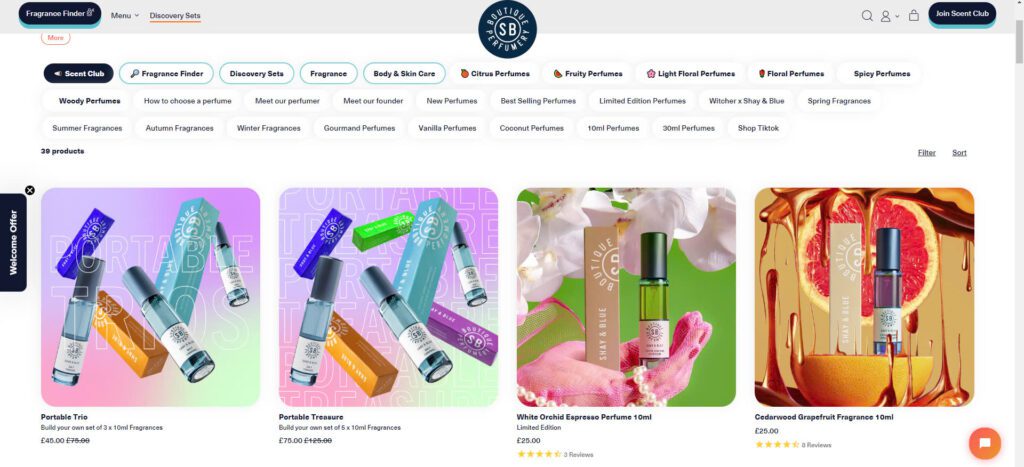
Shay and Blue
Shay and Blue offer a 10ml perfume option. Customers can choose either 3 or 5 fragrances to create a personalized set. The 3-fragrance set (Portable Trio) costs £45, while the 5-fragrance set (Portable Treasure) costs £75. This represents a savings compared to buying individual 10ml perfumes priced at £25 each.
Why do we love this bundle? This bundle is great for fragrance fans who want to try different scents without buying full-sized bottles. The big discount makes it easy to sample more fragrances. The travel-friendly 10ml size is perfect for use on the go or for switching scents often. It’s a smart way for Shay and Blue to show off more of their products while offering good value.
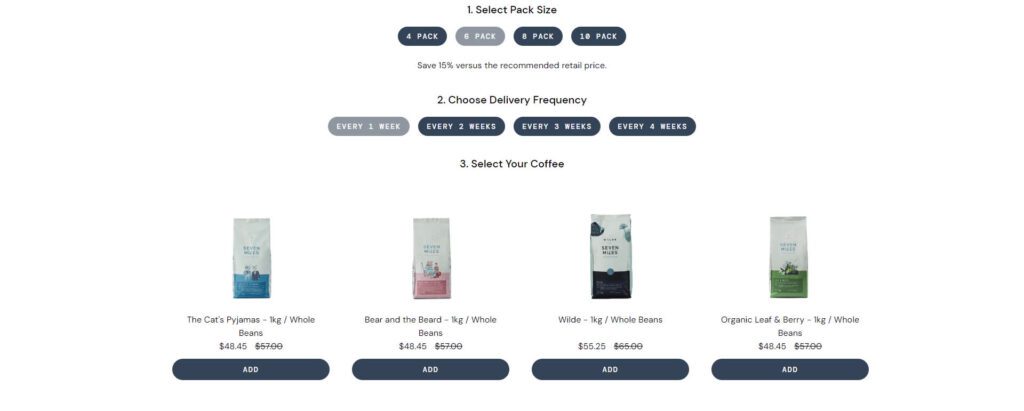
Seven Miles Coffee
Seven Miles Coffee offers a subscription service that allows customers to build their own coffee bundles. This service provides freshly roasted coffee delivered straight to your door, with the flexibility to skip, pause, or cancel anytime.
Customers enjoy a 10% discount on the regular price and free shipping for all 1kg coffee bags. The options include whole or ground coffee beans, coffee pods, cold brew, and decaf.
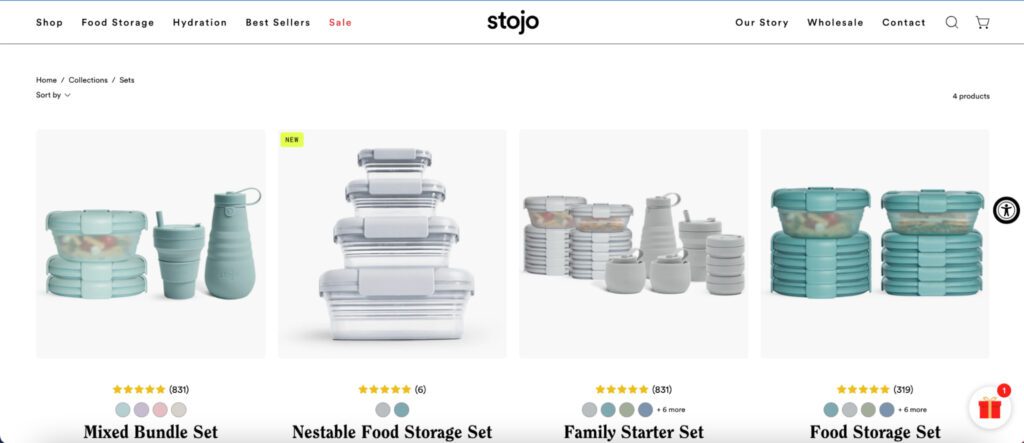
Stojo
Stojo retails collapsible, sustainable food and drink accessories. Their build-your-own bundle strategy enables customers to save 15% off the accumulated product value when purchasing a bundle.
We love this bundle as it offers a flexible bundling strategy, letting customers choose what they want while saving 15%. They have popular bundles, like the back-to-school bundle, and a colorful, eco-friendly brand image that makes them attractive. Plus, their “slot machine” style display of customer reviews shows strong proof.
In this case, what differs are the strategies that these brands use to make their bundles all the more irresistible. So, if you need a little inspiration for your Shopify build your own bundle strategy, take a look at these great examples!
7. Build Your Own Bundle vs. Fixed Bundle vs. Volume Discount
These three bundle formats address different shopping behaviors, and many successful stores run two or all three across different parts of their catalog.
Build Your Own Bundle
Fixed Bundle
Volume Discount
Customer chooses products?
✅ Yes — picks from a defined pool
❌ No — merchant pre-selects items
❌ No — same product, multiple units
Best for
Large, varied catalogs with 8+ eligible products
Gift sets, starter kits, curated pairings
Single-SKU replenishables (supplements, basics)
Setup complexity
Medium–High (requires app for full experience)
Low (can be a single product listing)
Low (automatic discount or app)
Customer engagement
High – active browsing and decision-making
Low – single add-to-cart action
Low – quantity selection only
Personalization
High – every bundle is unique
None – same package for everyone
None – same product, different quantities
Conversion speed
Slower – more decisions required
Fastest – zero friction
Fast – one decision (how many?)
AOV impact
High – cross-category discovery drives larger bundles
Moderate – fixed package, fixed price
Moderate – limited to one product
Inventory complexity
Higher – multiple SKUs per order
Lower – predictable component mix
Lowest – single SKU
App required?
Recommended for full experience
Optional (manual listing works)
Optional (automatic discount works)
“Build your own bundle” fits stores with large, varied catalogs where customers value the ability to personalize. Skincare lines, snack brands, and apparel stores with interchangeable items are natural use cases. The trade-off is a longer customer decision process and more complex setup — you need at least 8–10 eligible products for the “build your own” concept to feel meaningful.
“Fixed bundles” are strongest when curation is the point. A “Complete Starter Kit” with three pre-selected products removes every decision from the process — the customer just adds it to cart. This simplicity means higher conversion rates on the product page, but no personalization and limited engagement. Fixed bundles work best for gift sets, new customer onboarding kits, and small catalogs where pairing decisions are obvious.
“Volume discounts“ apply when you sell a single SKU that customers naturally restock — supplements, coffee pods, basics like socks or underwear. “Buy 3, save 15%” is the simplest bundle to set up and requires minimal page design. There’s no product selection involved, just a quantity decision. For replenishable products with a loyal customer base, volume discounts consistently outperform more complex bundle types.
These formats aren’t mutually exclusive. A skincare brand could offer volume discounts on their bestselling moisturizer, a fixed “Getting Started Kit” for first-time buyers, and a BYOB “Build Your Routine” page for returning customers who already know the product line. Match the format to the buying behavior in each segment of your catalog.
Build-your-own bundles work because they hand customers the one thing most Shopify promotions don’t — choice. Instead of accepting a pre-built package, shoppers curate their own selection, which increases engagement, drives higher average order values, and reduces returns because every item was a deliberate pick.
If you’re testing the concept for the first time, the collection + automatic discount method costs nothing and takes 10 minutes to set up. It won’t give you a dedicated bundle page or a product picker, but it’s enough to validate whether your customers respond to the format before you invest in an app.
When you’re ready for the full experience — a dedicated builder page, per-step selection rules, live pricing, and inventory sync — BOGOS and Fast Bundle are the two strongest options on Shopify. BOGOS is the better fit if you want bundles, free gifts, BOGO, and upsells managed from a single dashboard. Fast Bundle is the better fit if bundling is your primary strategy and you need the broadest range of bundle types. For stores that only need basic BYOB at a lower cost, BundleSuite and Bundler offer functional entry points.
Start with one bundle built around your best-selling products, measure completion rate and AOV impact over 2–4 weeks, and expand from there. The stores that get the most out of BYOB aren’t the ones with the most complex setups — they’re the ones that picked the right product pool, set a clear discount, and made the bundle easy to find.
9. FAQs
Can I create a build your own bundle without an app?
Yes, with trade-offs. You can pair a Shopify collection with an automatic discount (e.g., “Buy 4 from this collection, get 15% off”). This works for basic BYOB testing, but you won’t get a dedicated bundle page, product selection UI, quantity enforcement, or live savings display. For a complete build-your-own experience, a bundle app is the better path.
Does Shopify’s free Bundles app support build your own bundles?
No. Shopify’s native Bundles app is limited to fixed bundles and multipacks — pre-set product groupings where the customer has no selection. It doesn’t include a product picker, quantity rules per category, or a bundle builder interface. You’ll need a third-party app for BYOB functionality.
Can I set a minimum and maximum number of items in a bundle?
With an automatic discount, you can set a minimum quantity condition (e.g., “at least 4 items from this collection”), but Shopify has no native way to enforce a maximum — the discount applies to any qualifying quantity above the minimum. Most bundle apps let you set both floor and ceiling limits per category, which is essential for protecting margins and keeping the offer structured.
How do I promote my “build your own bundle” offer?
Promote it through banners on your homepage, announcement bars, email newsletters, and social media posts to drive traffic to your bundle page.

![[2026] How to Create Shopify Build Your Own Bundle?](https://bogos.io/wp-content/uploads/2024/08/how-to-let-customers-create-custom-bundles-on-shopify.jpg)