Allan Vu is a Digital Marketing expert and the driving force behind BOGOS’s blog content. With a deep understanding of eCommerce and Shopify promotions, he is passionate about helping merchants unlock the full potential of their stores.
At BOGOS, Allan creates valuable, practical content focused on strategies like Free Gifts, Buy X Get Y, product bundles, and upsell offers to empower Shopify sellers to grow their businesses effectively.
Known for his clear, insightful writing, Allan is dedicated to delivering actionable advice that makes a real difference for BOGOS’s readers.
Upselling is a type of promotion that encourages shoppers to buy more by adding relevant items to their initial order. A suitable Shopify upsell app will help merchants create and monitor upsell offers with smart, automated, built-in tools.
There are many smart strategies you can use to sell more. You can offer product bundles, set up volume discounts, or add a “gift with purchase” offer. You can even show relevant products on the checkout page or the thank-you page. However, trying to code this yourself is difficult and time-consuming. This is why using a dedicated Shopify upsell app is essential. It handles the hard work for you and automates the process.
But with hundreds of options available, which one is right for you? We have done the research. We tested the most popular upsell app on Shopify to see what truly works. In this guide, we list the 10 best Shopify upsell apps in 2026 to help you boost your sales today.
1. How Do We Test These Apps?
Finding the right upsell app can be tricky because there are so many options to choose from. To help you decide, we installed and tested these upsell apps to see how they actually work. We focused on:
Ease of use: How simple it is to set up and manage.
Features: How advanced the tools are for creating different offers.
Pricing: The cost, and whether they offer a useful free plan.
Reviews: What other merchants are saying about their experience.
Stability: How the app performs during high traffic times like BFCM.
For a full breakdown of how we evaluate and rank Shopify apps, see our “App Testing Methodology“.
BOGOS is our product. We include it because upselling is one of its core features, and we’ve tested it against every app on this list using the same criteria. We also know BOGOS isn’t the best fit for every upsell use case. Some apps on this list outperform BOGOS in specific areas, such as post-purchase funnels or AI-driven recommendations, and we call that out in the individual reviews. Where we rank BOGOS highly, it’s because our testing supports it, not because we built it.
Because every store is different, one single app might not be the best for everyone. Below, we have categorized the best Shopify upsell apps based on specific upsell types so you can find the right match for your business.
This strategy is about encouraging customers to buy more units of the same product (Volume Discount) or a group of related products (Bundle) to save money. It is the fastest way to increase your Average Order Value.
These upsells appear right on the product page while the customer is browsing. They usually look like “Frequently Bought Together” widgets or “You might also like” sections.
A post-purchase upsell happens after the customer has paid. This is widely considered the highest-converting upsell method because the trust is already established.
A funnel is smarter than a standard upsell. It uses logic: If a customer accepts Offer A, show them Offer B (a higher-priced item). If they reject Offer A, show them Offer C (a cheaper downsell).
People love free things. Using a “Free Gift” or “Free Shipping” bar motivates customers to spend just a little bit more to reach a goal (e.g., “Spend $10 more to get a free t-shirt”).
If you have a large catalog of products, you don’t have time to manually pair every item. AI recommendations do the work for you by analyzing sales data & customer behaviour.
Not all upsell apps work the same way. Some specialize in one placement (cart drawer only, post-purchase only), while others try to cover the full buying journey. Before you install one, here are the features that separate a useful upsell app from one that just adds noise to your store.
Upsell placements. The more touchpoints an app covers, the fewer apps you need to install. Look for product page widgets, cart drawer add-ons, checkout offers, and post-purchase pages. Some stores only need one placement. Others want full-funnel coverage from a single dashboard.
Targeting and trigger rules. A good upsell app lets you control who sees what and when. At minimum, you should be able to target by product, collection, or cart value. Advanced apps add customer tags, order history, geo-location, or discount code triggers. Without targeting, every customer sees the same offer, which limits relevance and conversion.
Auto-add and one-click accept. The fewer clicks between “yes” and “done,” the higher the acceptance rate. For pre-purchase upsells, auto-add removes friction. For post-purchase, one-click accept (no re-entering payment details) is essential.
Display and widget design. Upsell widgets that clash with your theme feel intrusive and hurt trust. Look for apps with styling controls, so offers look native on both desktop and mobile. Progress bars, offer badges, and cart messaging all help communicate the deal without relying on aggressive popups.
Analytics. At minimum: revenue per upsell campaign, acceptance rate, and average order value (AOV) impact. Without this, you can’t tell whether an offer is lifting revenue or just giving away margin. A/B testing is a bonus that pays for itself quickly on high-traffic stores.
Discount stacking behavior. Shopify applies only one product discount per line item. If your upsell conflicts with another active discount, Shopify picks the larger one and ignores the other. Apps built on Shopify Functions handle stacking more predictably. If you run multiple promotions simultaneously, test how the upsell app interacts with your existing discounts before going live.
Pricing and free plan limits. Watch for order caps, revenue caps, and feature gating. Some free plans limit you to a handful of campaigns or cap the monthly revenue generated through the app. Make sure the free tier lets you test the specific upsell type you need before committing to a paid plan.
3. Detailed reviews: How each Shopify upsell app performs
#1 BOGOS
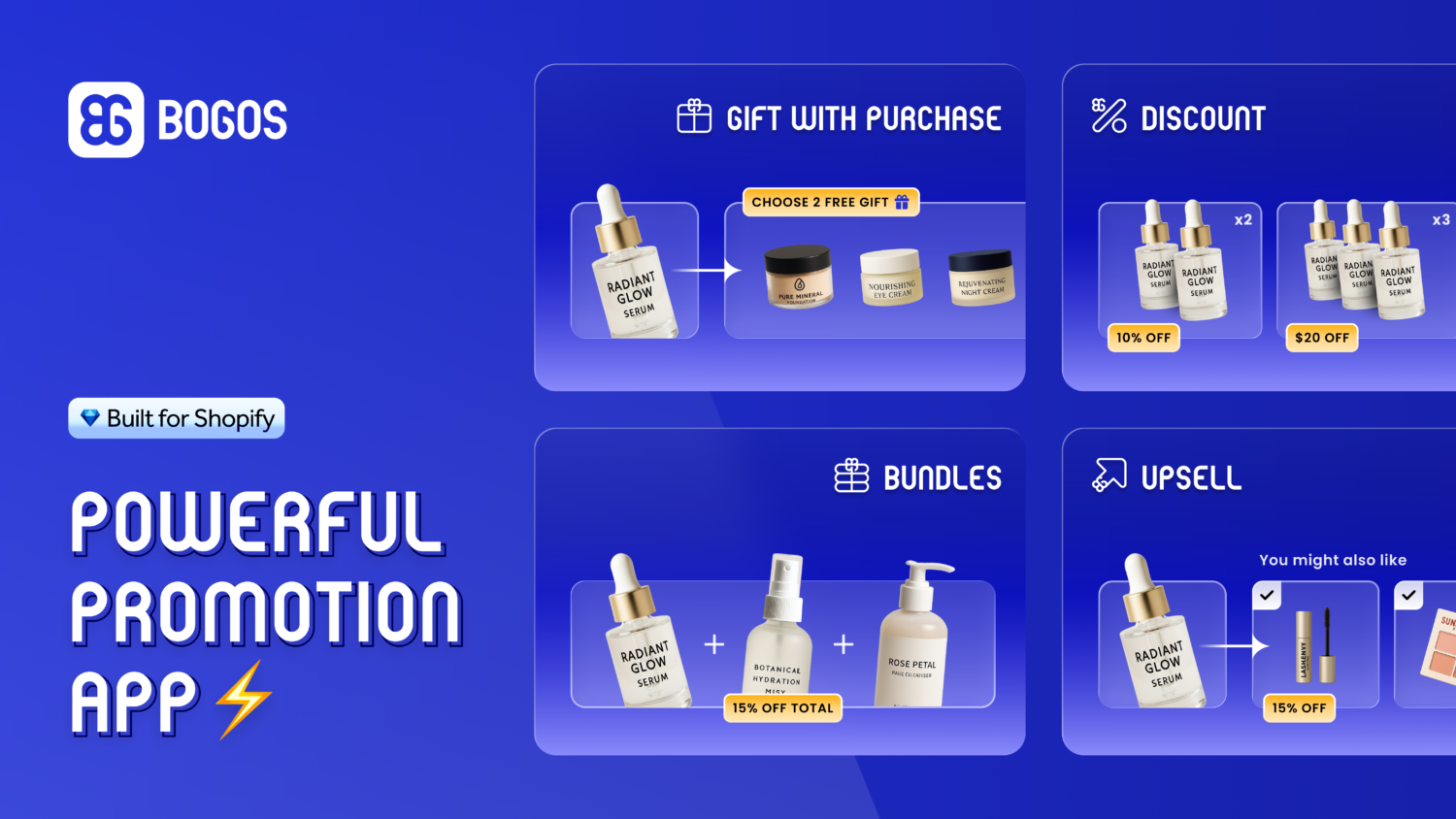
BOGOS is a Shopify upsell and promotion platform we built for merchants who want to raise AOV without turning the storefront into an interruptive sales machine. The goal is to make upsells feel like a natural next step in the buying flow.
That means showing the right add-on at the right moment, such as on the product page, immediately after adding to cart, inside checkout, or on the thank-you page. We also keep the design consistent with your theme, so it feels native, not an afterthought. BOGOS also supports AI-powered recommendations, so you are not stuck manually mapping every pairing when your catalog grows.
Upsell capabilities:
Product page upsells with manual or AI-powered recommendations
In cart upsell pop-up triggered by specific products or actions
Checkout upsells using Shopify checkout extensions where supported
Thank you page upsells to add items after purchase
A/B testing for upsell offers and placements
Upsell analytics so you can see what actually drives AOV
Strengths: We built BOGOS to keep upsells clean and brand safe. You get flexible layouts and styling controls, so widgets look native and stay readable on mobile. The rules are built for real promo stacks too, so when you want to layer upsells with bundles, volume discounts, or gift campaigns, you can run them from one system instead of patching together multiple apps during peak traffic.
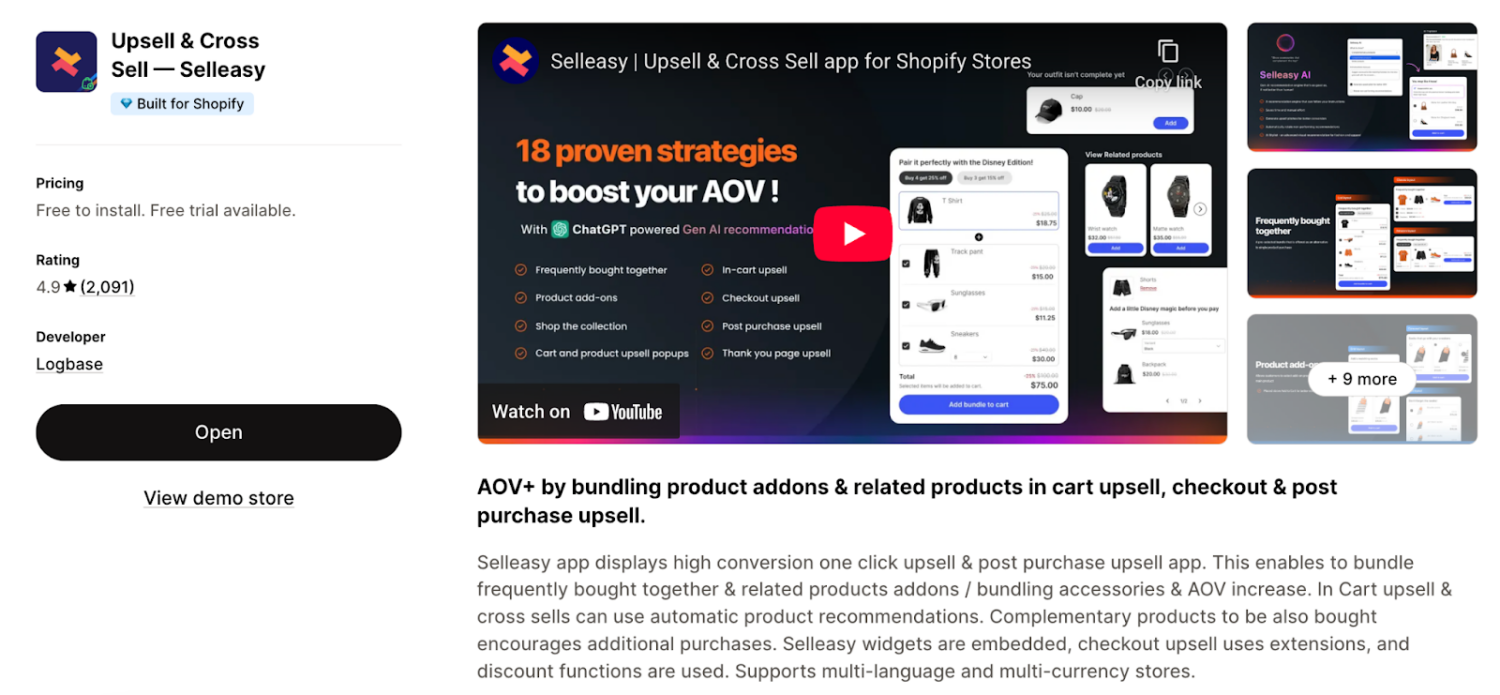
Selleasy is a straightforward upsell tool built around Frequently Bought Together offers. We see it as a reliable choice for merchants with large catalogs, like fashion or electronics, who want to lift AOV through simple, logical pairings instead of attention-grabbing popups. It works best when your add-ons are obvious, so the offer feels helpful, not forced, right on the product page.
Upsell capabilities:
Frequently Bought Together widgets on product pages
Cart and cart drawer add-ons right before checkout
Post-purchase upsells are shown after the order is placed, depending on your Shopify setup
Manual pairing plus automated suggestions to recommend relevant items
Strengths and limitations: Selleasy’s biggest strength is how clean it feels. It fits into most themes without distracting shoppers, and it tends to add less friction than pop-up heavy setups. The limitation is customization depth. Design controls can feel basic if you want a very branded look, and it does not lean into reward style mechanics like progress bars or tiered gift journeys.
#3 WISER AI Upsell & Cross Sell
Best for: Stores that want one app to manage upsells and cross sell across the entire customer journey. (search → product page → cart → checkout → post-purchase)
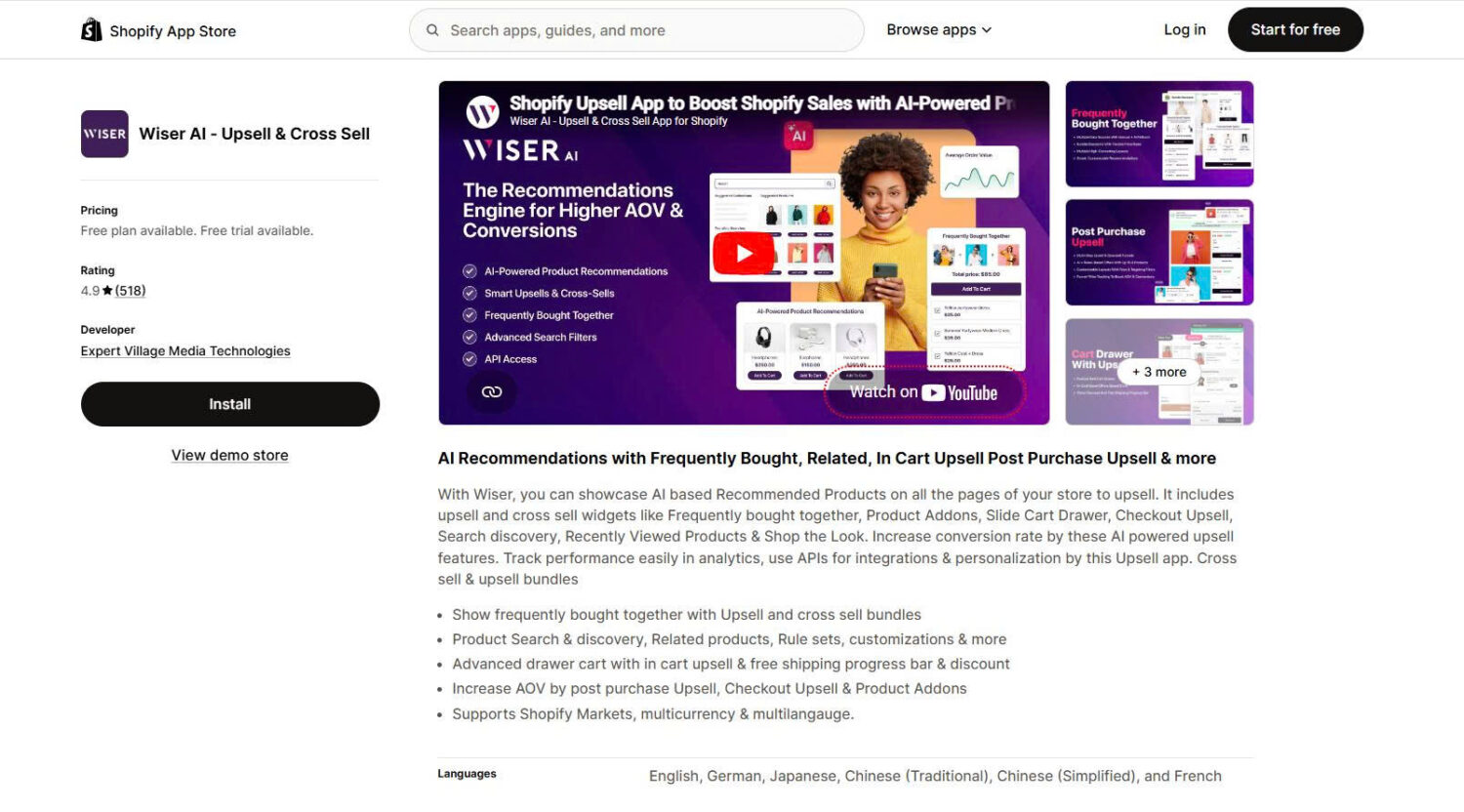
WISER AI is a Shopify upsell app designed to increase average order value using AI-powered product recommendations. It helps you show the right products at the right time. Instead of relying on manual rules, it uses customer behavior and past data to recommend products automatically. Unlike many apps that focus only on one stage, WISER works across your entire store from search to product pages to cart, checkout, and even after purchase.
Upsell capabilities:
AI-powered product recommendations (based on browsing and purchase behavior)
Frequently Bought Together & product bundles
Cart drawer upsells with offers and free shipping bars
Post-purchase and thank-you page upsells
“Shop the Look” and product add-ons
Built-in analytics to track upsell performance
Strengths and limitations: Wiser AI’s biggest strength is its full-funnel coverage. It handles both pre and post-purchase upsells in one app, with AI that improves recommendations as it collects data – reducing the need to juggle multiple upsell tools. The limitation is accessibility for newer merchants. The feature-rich interface can feel overwhelming if you’re just getting started, and the AI needs some sales data before it delivers its best results.
Why it stands out Most stores end up using multiple apps for different upsell placements. WISER combines everything into one platform, which keeps your store faster and easier to manage.
Merchants also highlight that it’s easy to set up and integrates well with Shopify themes. The AI keeps improving recommendations over time, so you don’t have to keep updating rules manually.
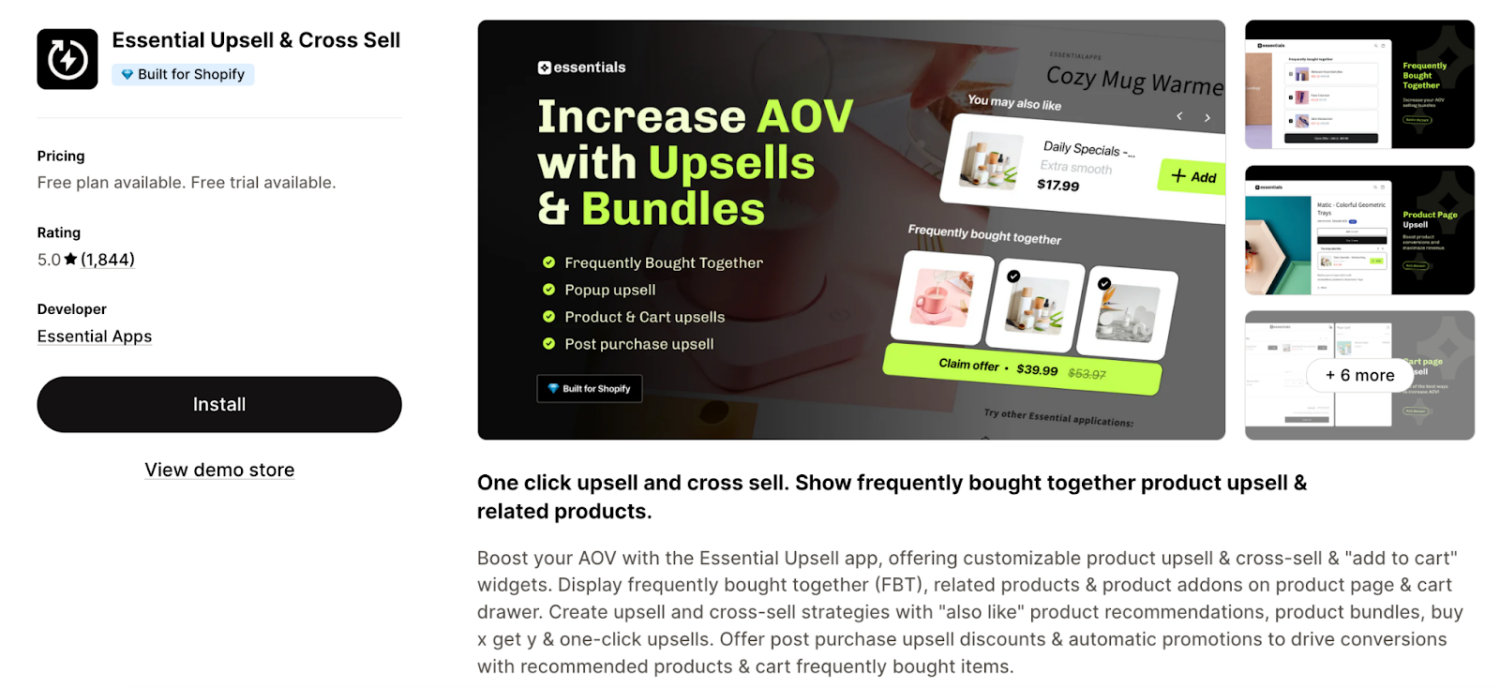
#4 Essential Upsell & Cross Sell
Essential Upsell & Cross Sell is a practical toolkit for merchants who want to cover the core upsell placements without installing multiple apps. We recommend it for growing stores that need quick wins across the product page, cart, and post-purchase, while keeping setup simple.
Upsell capabilities:
Post-purchase upsells shown after checkout, based on your Shopify setup
Frequently bought together offers on product pages
Cart and cart drawer add-ons for accessories or warranties
Volume discounts that apply automatically at set quantities
Strengths and limitations: The biggest strength is coverage. You can launch several common upsell mechanics from one dashboard and keep your storefront consistent. The interface is easy to follow, so you can ship offers quickly and measure AOV lift without a long build cycle. The limitation is testing depth. If you want advanced sequencing, heavy experimentation, or multi-step offer logic, a dedicated funnel-focused tool will give you more control.
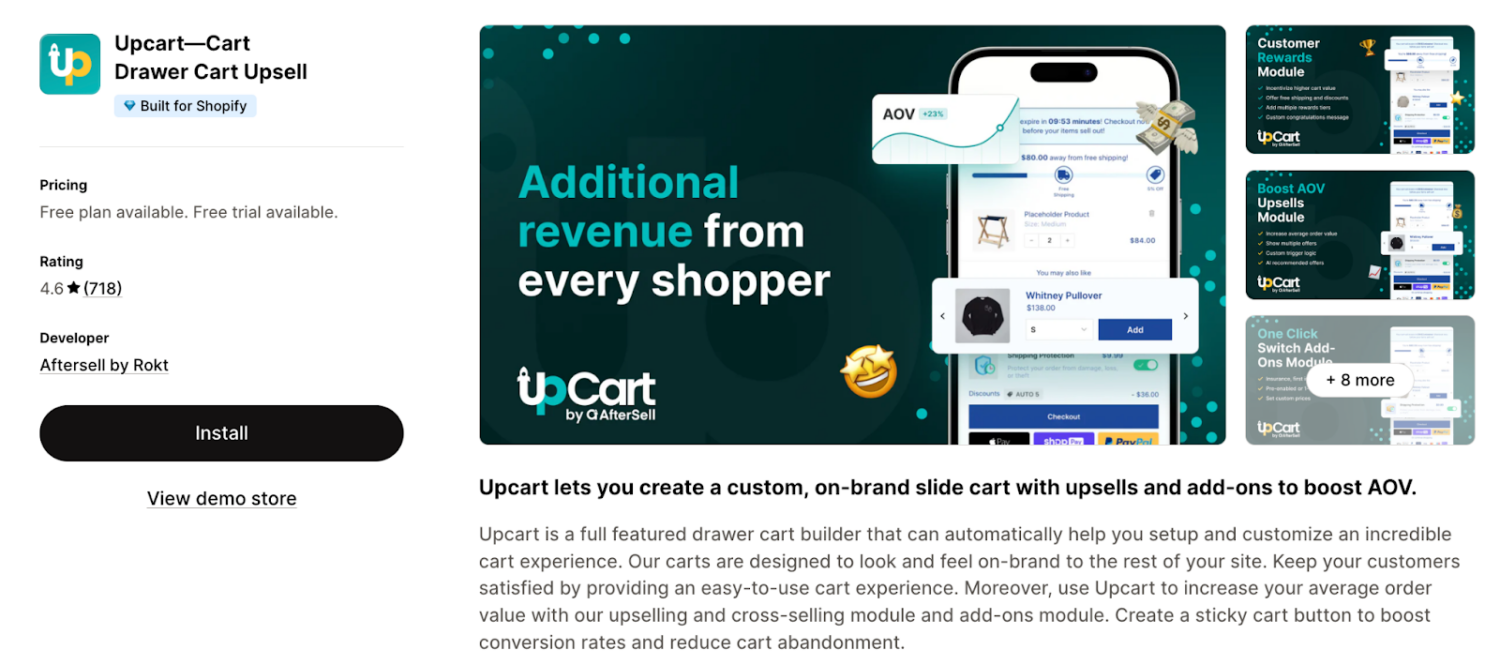
#5 UpCart
UpCart is a slide cart builder that upgrades the cart drawer at the moment shoppers decide to buy. It’s a great fit for brands that already convert well but want a stronger “last step,” like encouraging customers to add one more item, reach a spend goal, and check out without going back to browse. On mobile, this counts even more because every extra tap is another chance to lose the sale.
Upsell capabilities:
In cart rewards bar for free shipping or spend goals
Drag-and-drop upsell blocks for add-ons and accessories
Announcement messages inside the drawer for promos and delivery cutoffs
Add-on toggles for gift wrap, shipping protection, or priority handling
Styling controls to match your theme so the drawer feels native
Strengths and limitations: UpCart feels polished and keeps the checkout flow moving, which can lift AOV without hurting conversion rate. The main limitation is scope: it’s built specifically for the cart drawer, so if you also want product page bundles or post-purchase offers, you’ll likely need another app for that.
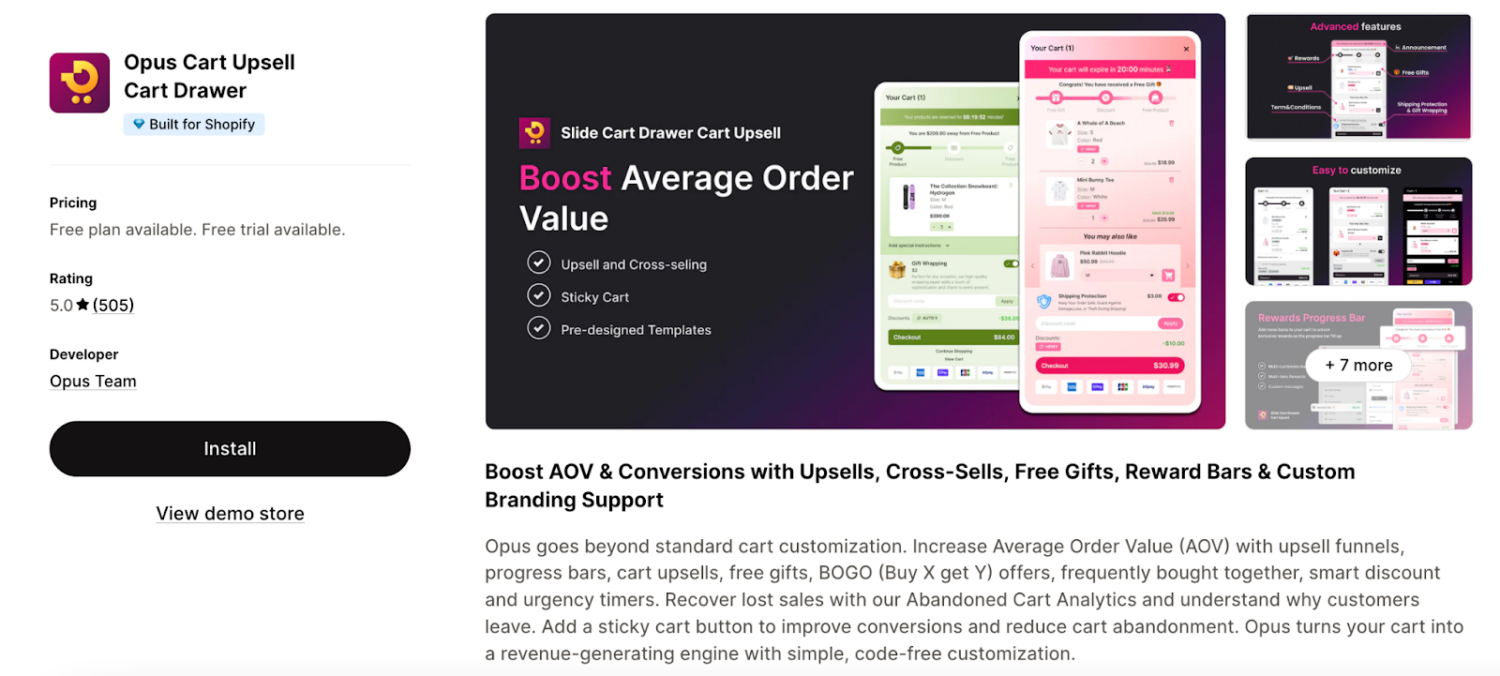
#6 Opus Cart Upsell
Opus is a strong competitor in the cart drawer space, focusing on mobile optimization and speed. We find it a great low-maintenance solution for merchants needing a fast, reliable cart that gently incentivizes spending. It is designed to stay lightweight, which is important for high-traffic stores where any extra load can hurt conversion rate.
Upsell capabilities:
Smart product recommendations that surface relevant add-ons in the cart
Rewards bar tiers that unlock different rewards as cart value increases
Urgency timers to encourage faster checkout decisions
Rule-based targeting that shows specific offers based on what customers add to their cart
Strengths & Limitations: Opus shines in simplicity and performance, with a smooth mobile experience and an intuitive drag-and-drop editor. The reporting is useful for day-to-day tracking, but it can feel more streamlined than enterprise funnel tools, so it is better for quick cart wins than deep, multi-step funnel analysis.
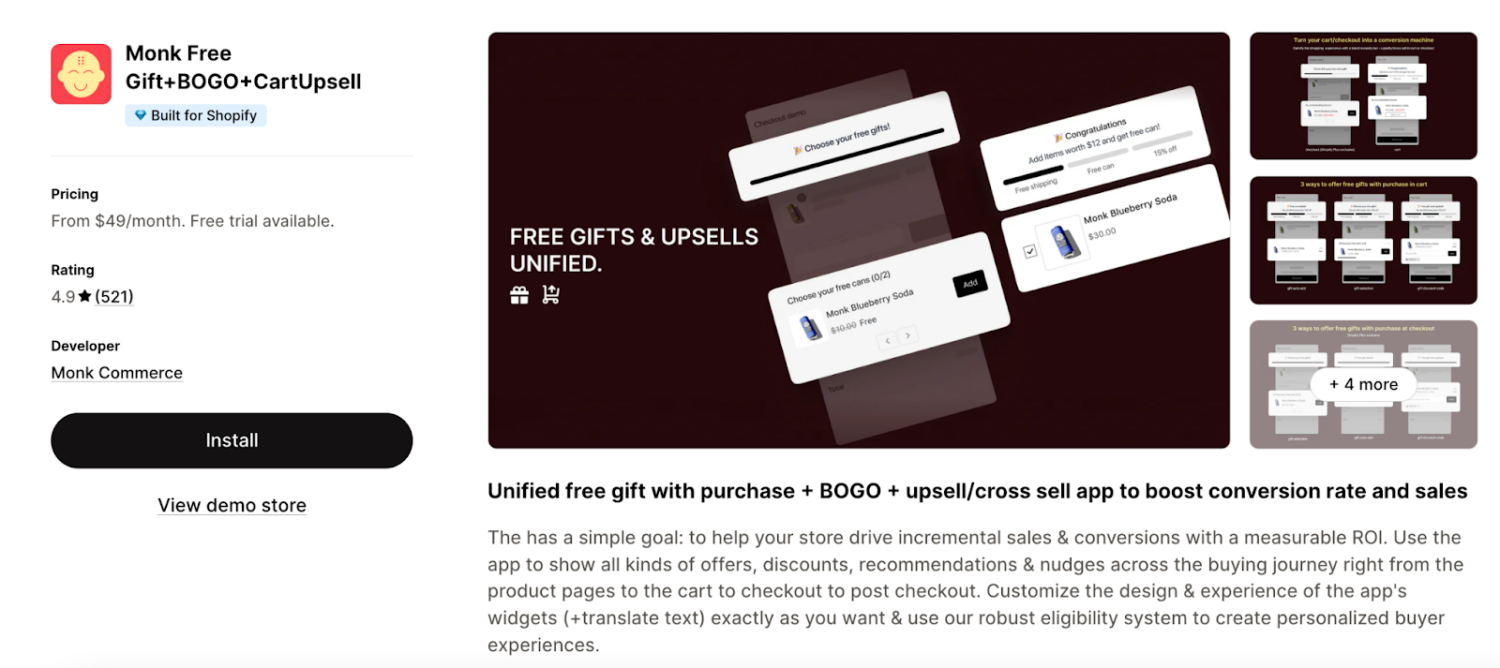
#7 Monk
Monk is a powerful combo app that merges cart upsells with gift-with-purchase logic. We see it as a strong contender for brands that want to create a tiered reward experience, like unlocking a free gift or another perk as cart value increases, inside a smooth, customizable interface.
Upsell capabilities:
Gift with purchase rules that auto-add a gift, or let shoppers choose from a gift set
Tiered cart progress bar with cart value thresholds, including free gift unlocks
Cart upsells that surface add-ons based on products, collections, or cart value conditions
Product page cross-sells that trigger when specific items are viewed or added
Checkout upsells shown inside checkout for Shopify Plus merchants
Strengths & Limitations: Monk’s standout feature is its flexibility in handling complex gift logic without breaking your store design. It can feel very branded, with widgets that look native rather than tacked on. However, the analytics dashboard can feel dense at first. It also takes time to master trigger combinations, so it fits merchants who are comfortable configuring detailed rules rather than wanting a one-click install.
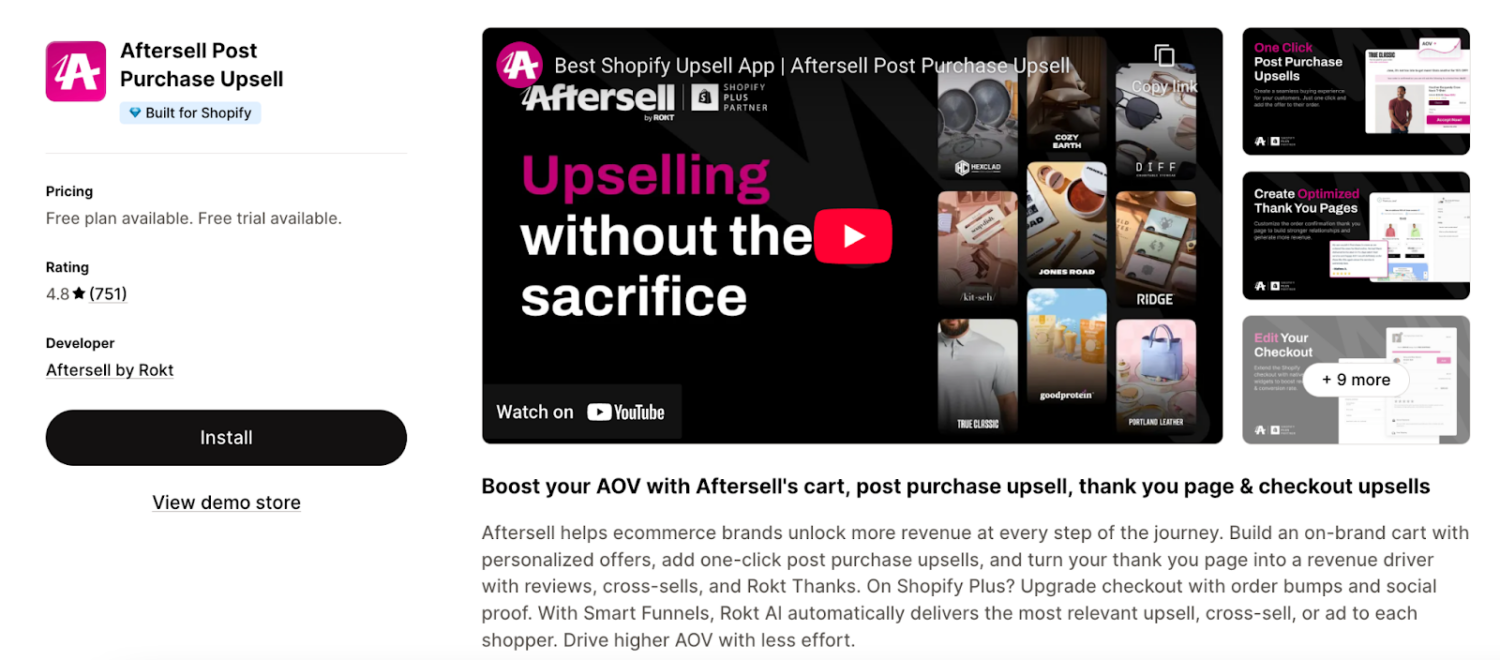
#8 AfterSell
AfterSell is widely considered the gold standard for post purchase upselling. We recommend it for merchants who do not want to interrupt the initial sale, but still want to capture extra revenue right after the customer has committed to buying. It works by showing relevant offers after checkout, when the purchase decision is already locked in.
Upsell capabilities:
One-click post-purchase offers that customers can accept without re-entering payment details
Thank you page customization with cross-sells, reviews, and helpful content blocks
Targeted offers based on cart value, customer tags, or the main product purchased
Built in A/B testing to compare offers, such as percent off versus a bonus item
Strengths and limitations: AfterSell’s biggest advantage is its low-friction approach for post purchase upsells. Because the order is already placed before the offer appears, you are not putting the original checkout at risk. The limitation is placement focus. If your main goal is to drive AOV before checkout through product page bundles or a cart drawer builder, you will likely pair AfterSell with a separate pre-purchase upsell app.
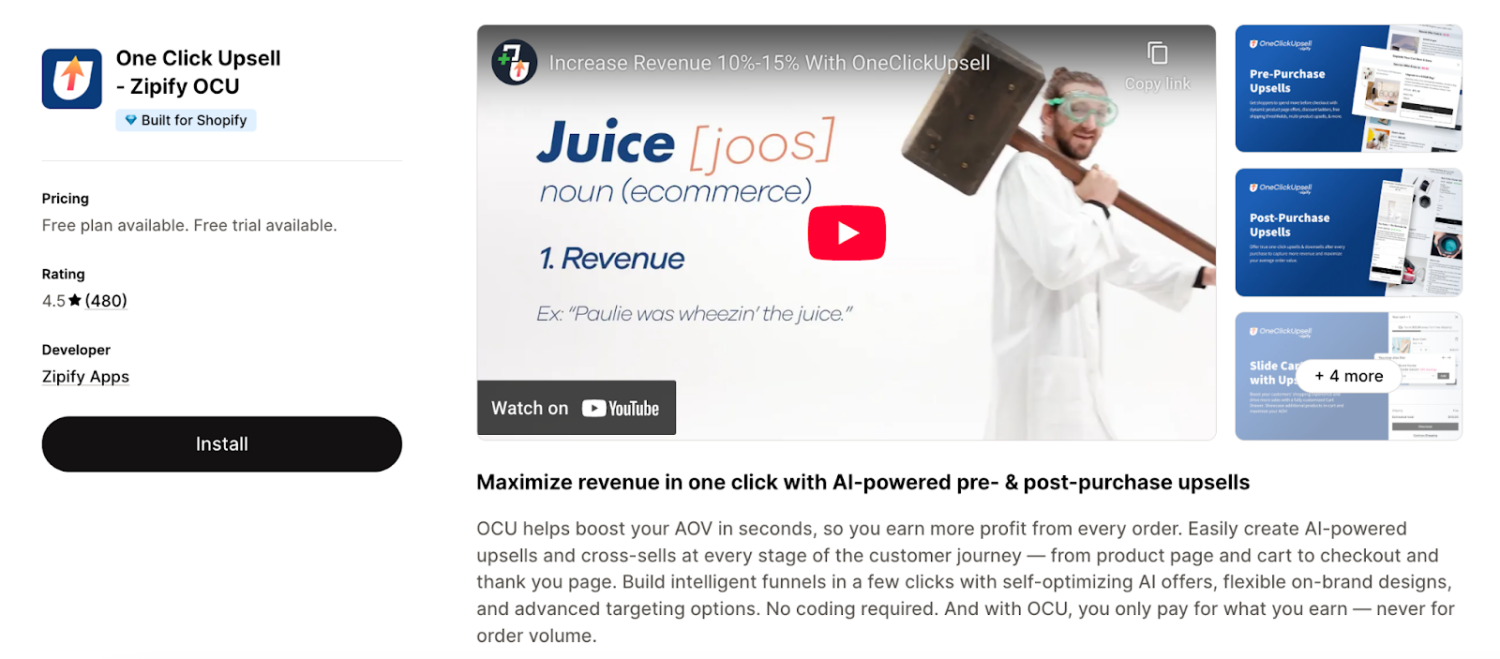
#9 Zipify (OCU)
Zipify OneClickUpsell (OCU) is a veteran funnel builder for brands that treat their store like a sales system, not just a catalog. We like it for DTC teams who want pre-purchase and post-purchase offers tied together in one funnel and improved through testing.
Upsell capabilities:
Funnel sequences where an accept triggers a higher offer and a decline triggers a downsell
Pre-purchase upsells via product page widgets, slide cart drawer offers, and cart pop-ups
Post-purchase one-click offers shown right after checkout
A/B split testing across offers and funnel steps
In checkout offers on the checkout page for Shopify Plus stores
Strengths and limitations: The biggest strength is control, where the app lets you shape the upsell journey step by step, so customers are not shown random add-ons. You can test offer price, discount type, and copy, then keep only what lifts revenue per visitor without hurting the refund rate. Reporting also makes it easy to spot which step leaks, like a weak first upsell or a downsell that never gets accepted. The limitation is workload. Setup takes time, and the interface assumes you will test and iterate.
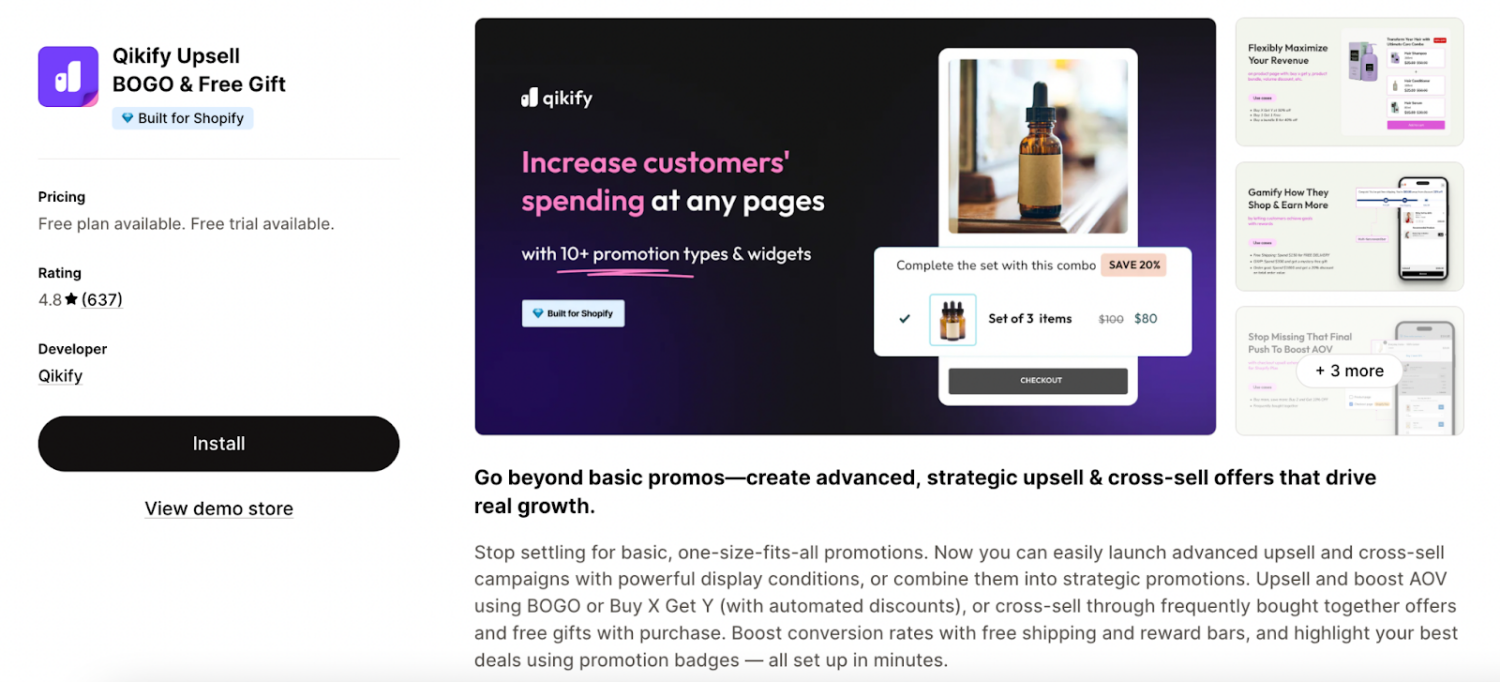
#10 Qikify
Qikify is best for merchants who want value-driven incentives that lift AOV without rebuilding pages quickly. We like it for stores running clear mechanics such as BOGO, Buy X Get Y, bundles, and free gifts, where the offer should feel consistent from the product page to the cart.
Upsell capabilities:
BOGO and Buy X Get Y promos with product and collection targeting
Product bundles and frequently bought together offers
Cart upsells based on cart contents or order value
Gift with purchase, order goals, and free shipping goal bars
Checkout upsell extension for Shopify Plus stores
Strengths and limitations: Qikify covers many core promo types in one app and offers a free plan to test before scaling. The tradeoff is sequencing depth. If you need multi-step accept decline funnels and heavy testing, a dedicated funnel tool gives tighter control.
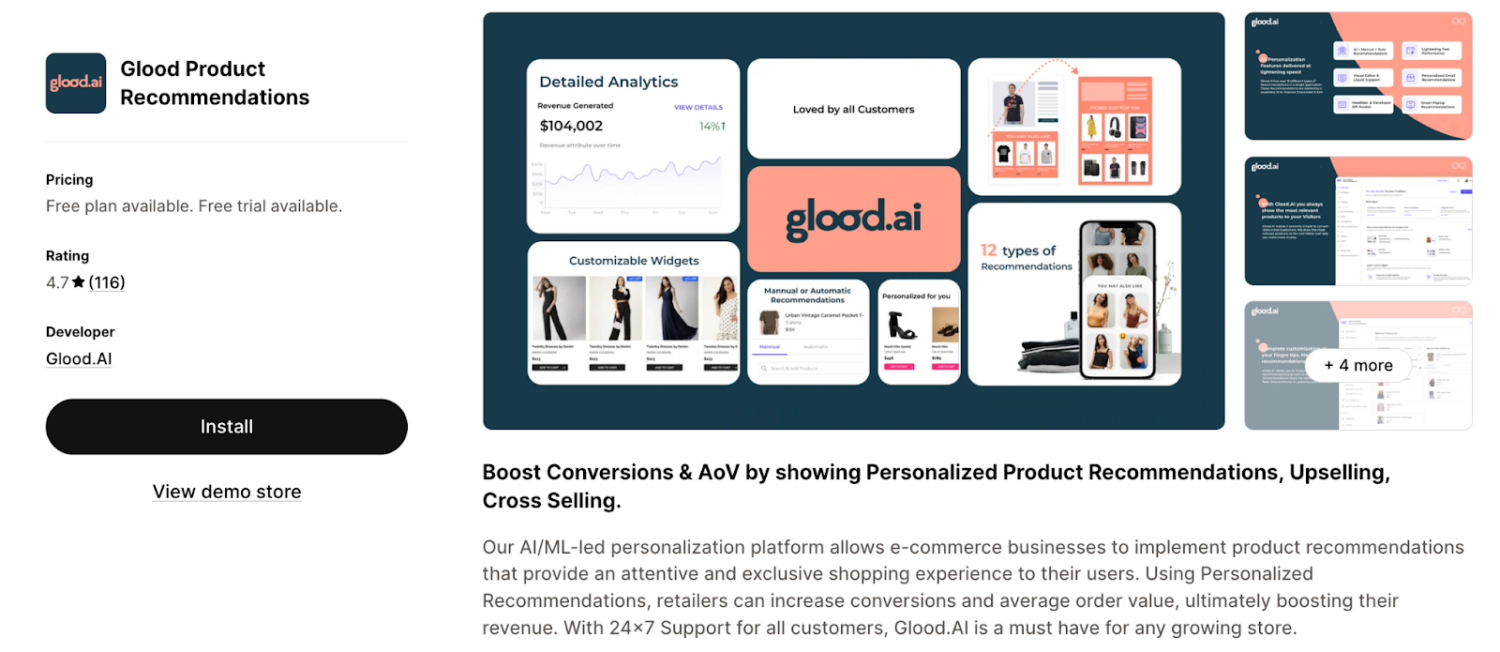
#11 Glood.AI
Glood.ai is an AI-driven product recommendation app for Shopify stores that want smarter merchandising across product pages, cart, and checkout. We like it most for catalogs with enough traffic to learn from real browsing and purchase patterns, so recommendations feel relevant and lift AOV without relying on aggressive popups.
Upsell capabilities:
Personalized recommendation widgets, such as related products and recently viewed
Frequently bought together bundles based on store behavior, with room to fine-tune pairings
Product bundles that can include discounts to encourage multi-item orders
Cart and checkout upsells to surface add-ons right before payment
Visual builder to place and style widgets to match your theme
Strengths and limitations: The big advantage is saved time and better relevance. You set placements once, then review performance to see which widgets lift revenue per visitor. The downside is data dependence. New stores may see more generic suggestions until enough sessions accumulate.
3. Final Word
There’s no single best Shopify upsell app for every store, only the best fit for your products, traffic, and growth stage. We recommend focusing on one upsell mechanic first, proving impact, then expanding across cart, checkout, or post-purchase. That approach keeps upsells effective instead of overwhelming.
4. FAQs
How does an upsell app work?
A Shopify upsell app integrates with your Shopify to offer customers additional items based on their in-cart products or shopping behavior. These offers can be triggered throughout the customer journey and across your web pages (at checkout, product pages, post-purchase, etc.). The app uses collected data to suggest products that entice your buyers.
What types of upsell offers can I create using an app?
The most common types of upsell you can offer your customers include: – Cross-sells: Recommend complementary products that enhance the initial purchase. – Product bundles: Offer a set of related items at a discounted price. – Upgrades: Offer a more advanced, higher-cost version of the product. – Limited-time offers: Create a sense of urgency with soon-to-expire bonuses or discounts.
How do I customize the upsell offers?
Most Shopify upsell apps allow sellers to customize the promotions based on various criteria. These setup conditions often include the trigger product, minimum cart value, other discount requirements, etc. Also, many apps enable you to personalize the content and appearance of these offers to match the brand guidelines.